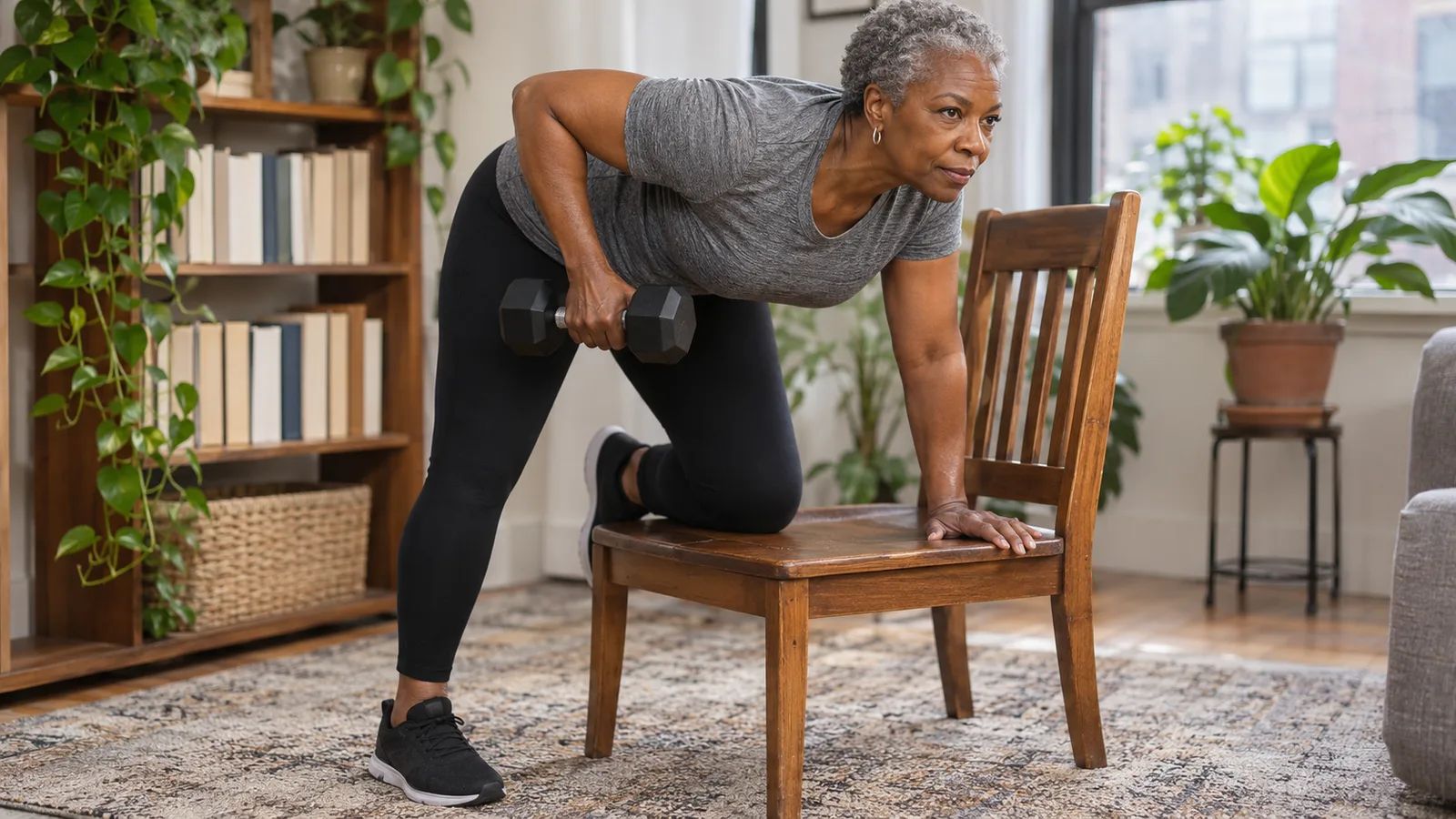
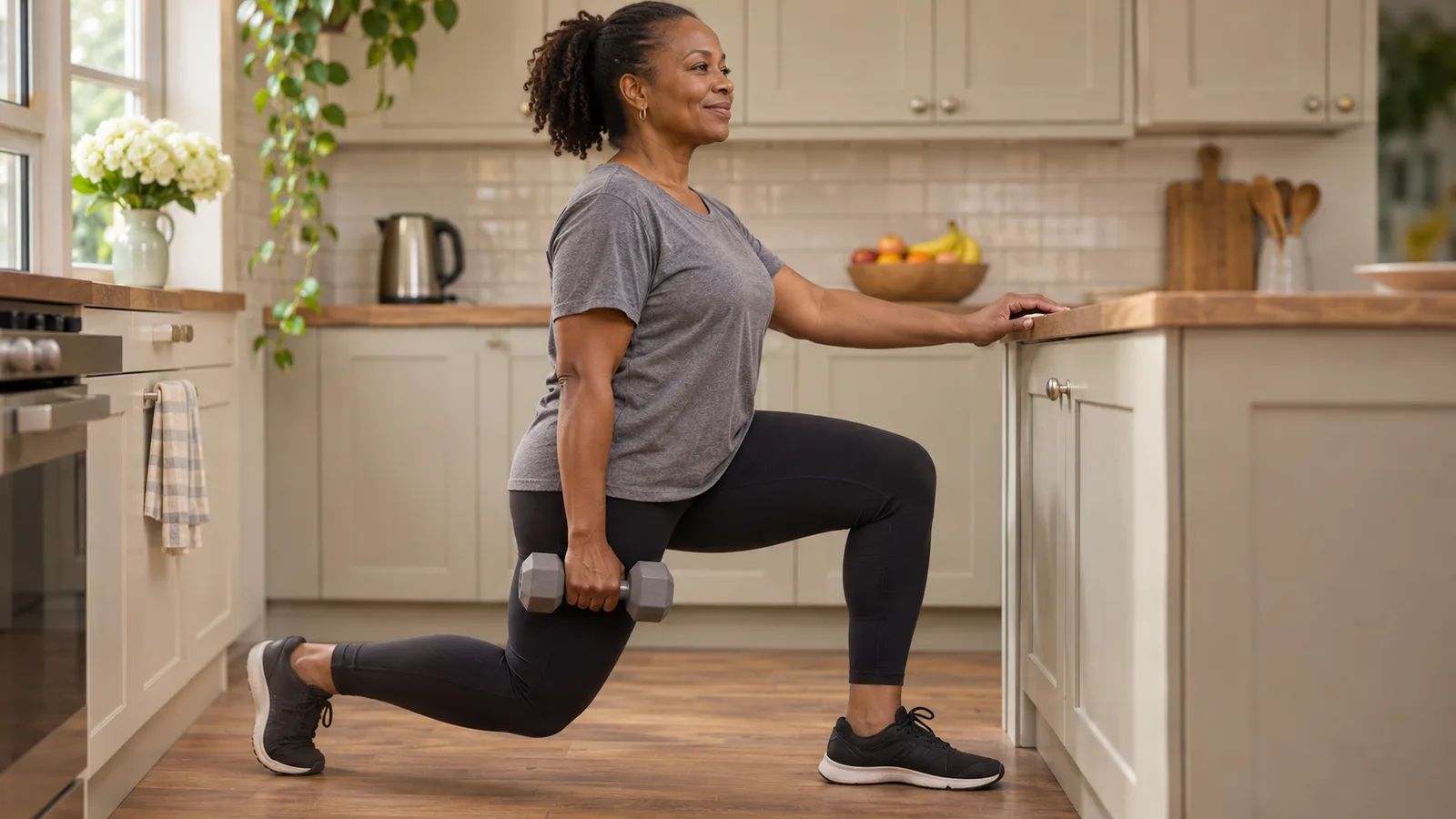
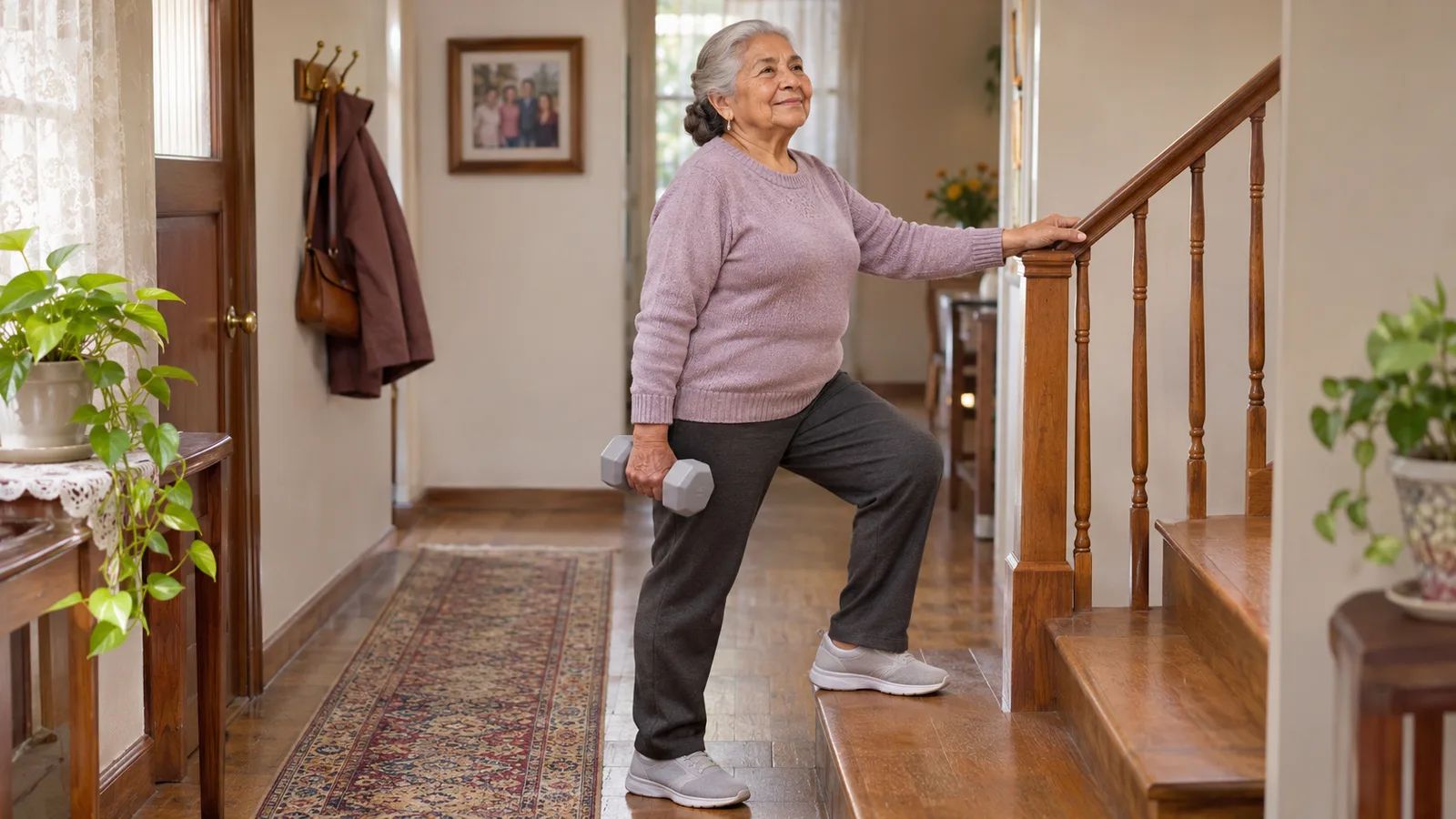
Fitness assessment at home: 6 tests and what to train next
Six simple tests for your legs, pushing, balance, grip, movement and a mile walk. Run them at home in under an hour, then see what to train first.
In this article8
What it is
A fitness assessment is a short set of tests that shows where you're starting: your legs, pushing strength, balance, grip, how you move, and your heart and lungs. It's a baseline you train from and retest.
The version below takes under an hour at home, most of it the mile walk at the end. You need a kitchen chair, a phone, something heavy to carry and a flat mile. Afterwards, one table turns each number into the first thing to train.
Booked one at a gym instead? Here's what a good one looks like.
Before you start
There's no failing this. A low score on every test still tells you exactly where to begin, and needing your hands to get out of a chair is a perfectly good place to start.
If a doctor has told you to limit activity, or you have a heart or lung condition, have had chest pain, fainting or a fall recently, are pregnant, or are recovering from surgery, check with them first. A trainer would hand you the PAR-Q+, a short yes-or-no questionnaire; a yes leads to a few follow-up questions, and sometimes a word with your doctor or a qualified exercise professional before harder exercise.
What you need
- A sturdy chair with no armrests, about 17 inches (43 cm) high, pushed against a wall so it can't slide
- Your phone, for a timer and to film yourself
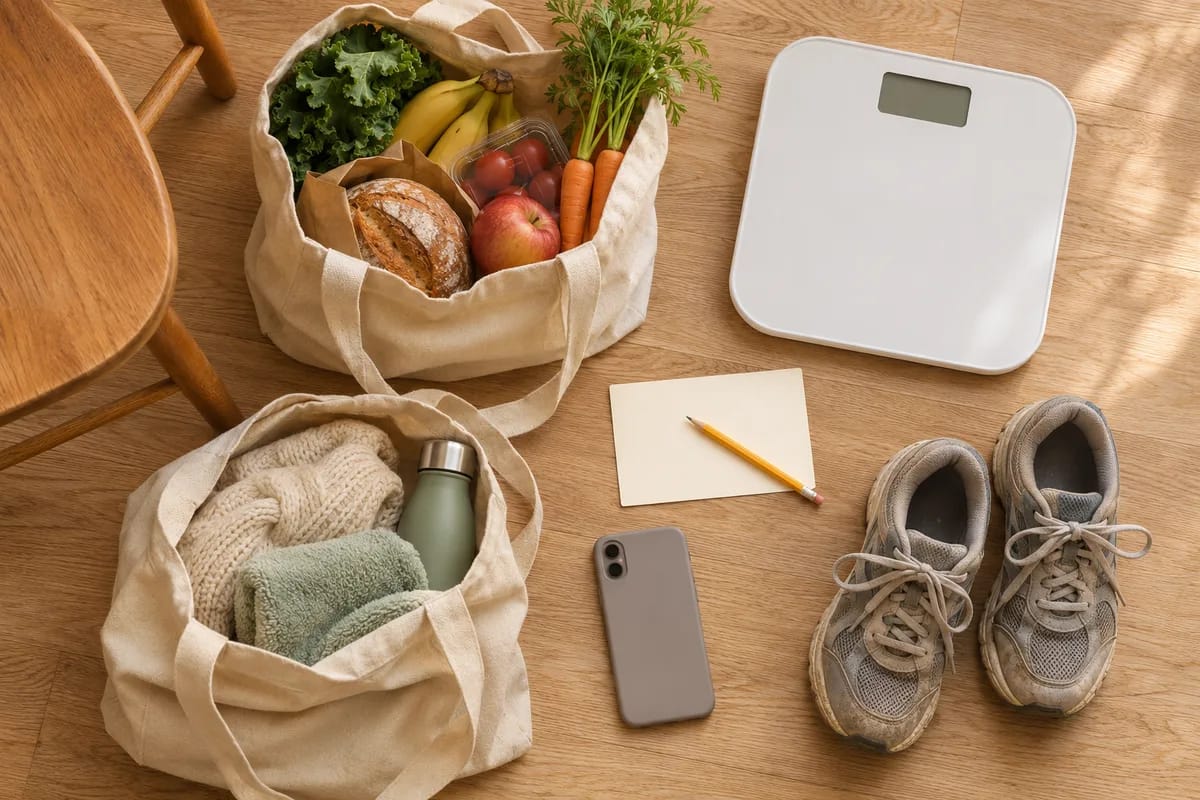
- Two grocery bags or dumbbells you can carry, weighed on a bathroom scale (or two gallon jugs of water, just over 8 lb (3.8 kg) each)
- A clear hallway or a few steps of floor for walking back and forth
- A flat route you know is a mile (1.6 km): four laps of a running track is close enough
The six tests at a glance
| Test | What it checks | About how long |
|---|---|---|
| Movement check | How you squat and bend, on video | 3 minutes |
| 30-second chair stand | Leg strength | 2 minutes |
| Push-up ladder | Upper-body pushing | 5 minutes |
| One-leg stand | Balance | 4 minutes |
| Carry | Grip and the muscles that hold you upright | 4 minutes |
| Mile walk | Heart and lungs | 15 to 25 minutes |
The order matters: the movement check doubles as your warm-up, the strength tests go before you're tired, and the walk comes last. If an hour feels like a lot, do the indoor five one day and walk the mile the next morning.
Run it in this order
Stop any test if something hurts, or if you feel dizzy, faint or unusually short of breath.
Movement check: film five squats and five hinges
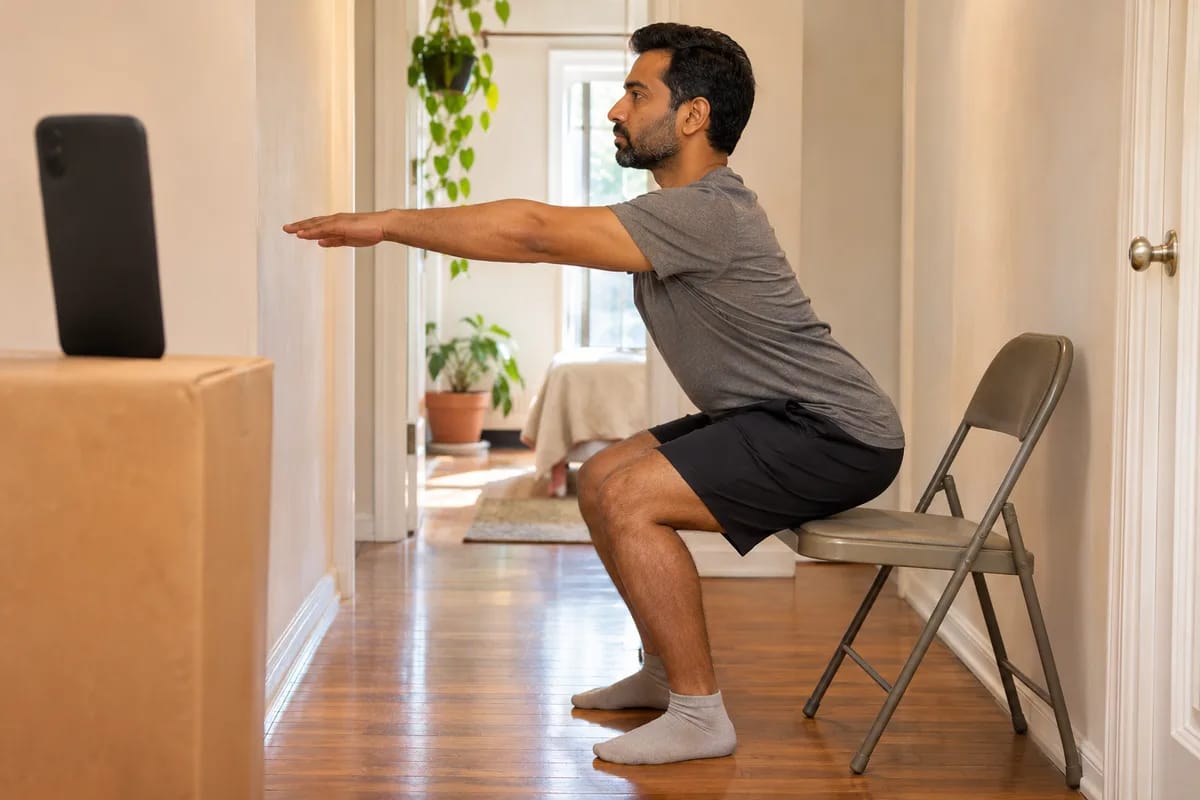
Prop your phone at hip height, side on, about 8 to 10 feet (2.5 to 3 m) away so your whole body is in frame. Do five slow squats down to the chair: sit down lightly, then stand. Then do five hip hinges: stand tall with soft knees, push your hips back and slide your hands down your thighs toward your knees, then stand up. Turn the phone to face you and do five more squats.
Watch the clips and answer four questions with "fine" or "not sure". Do your heels stay flat? Can you lower yourself slowly, or do you drop the last few inches onto the seat? In the hinge, do your hips go back while your back keeps its shape, or does your back round as you reach down? From the front, do your knees point the same way as your toes?
Chair stand: count full stands in 30 seconds
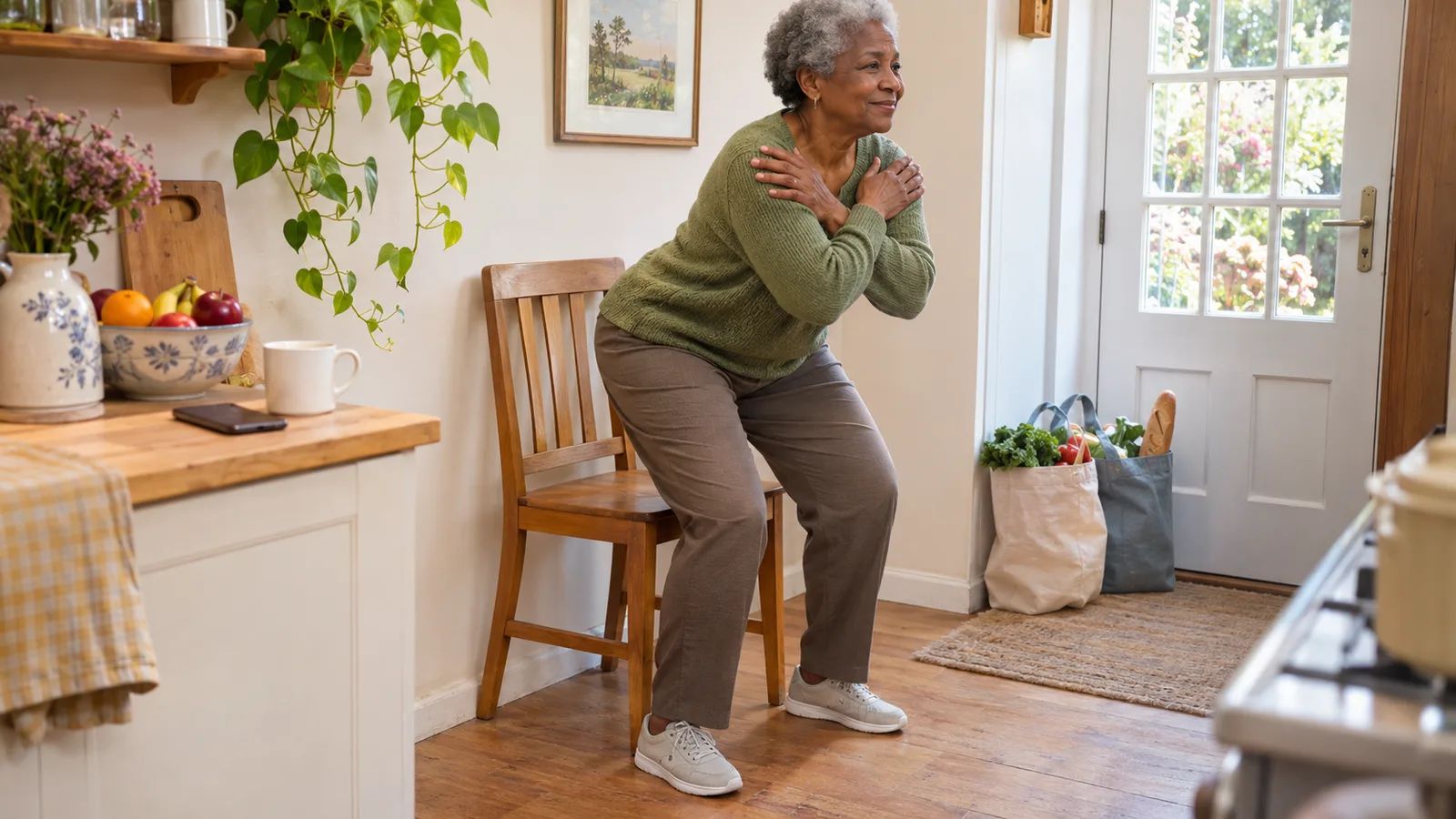
Sit in the middle of the seat, feet flat, arms crossed with your hands on opposite shoulders. On "go", stand all the way up and sit all the way down as many times as you safely can in 30 seconds. If you're more than halfway up when time runs out, that one counts. If you need your hands to get up, use them and write "with hands" next to the number.
Push-up ladder: find your rung, then count your reps
The ladder, drawn just above, is the same push-up at four angles: hands on a wall, on a kitchen counter, on the floor from your knees, and on the floor from your toes. Find the hardest rung where you can do 5 good reps. Good means your body stays in one straight line, your chest comes within a fist of the surface, and your arms straighten at the top. Rest two minutes, then do as many good reps as you can on that rung. Write down the rung and the reps.
One-leg stand: eyes open, best of three, each side
Stand beside the counter with one hand hovering over it. Lift one foot a few inches (about 5 cm) off the floor and start the timer. Stop when the lifted foot touches down, the standing foot shifts, or you grab the counter. Stop at 45 seconds if you get there: that's where the age averages top out, so a longer hold tells you nothing more today. Three tries a side, keep the best.
Made 45 seconds on both sides? Rest, then try it with your eyes closed, hand still hovering over the counter, and write that time down too. Average best times for that version are about 15 seconds at 18 to 39, 13 in your 40s and 8 in your 50s.1
Carry: walk with the weight until your grip or posture goes
Pick up a bag in each hand and walk your hallway back and forth, standing tall. Not sure how heavy? Start with a gallon jug in each hand; if 2 minutes is easy, rest and try a heavier pair. To weigh a bag, step on the scale holding it and subtract your own weight.
Stop when your grip starts to open, your shoulders round or you start leaning, and stop at 2 minutes anyway. Write down the weight in each hand, the time, and which gave out first, grip or posture.
Mile walk: as fast as you can walk, then take your pulse
Walk a flat mile as briskly as you can without jogging, and time it. The moment you stop, find your pulse at your wrist or the side of your neck, count the beats for 15 seconds and multiply by four (or read it off your watch). Not up to a mile today? Walk for 6 minutes on a measured route and write down the distance to beat next time, or do the 13-foot (4-meter) hallway walking test instead.
Read your results: what to train first
Your lowest result picks your starting point. Not every test has a fair age chart, so where none exists, your own first number is the yardstick.
| Test | A rough guide | If yours came out low, start here |
|---|---|---|
| Chair stand | Below your age range in the table underneath | Legs: sit-to-stands from a higher seat, then the chair, 2 or 3 days a week |
| Push-up ladder | No fair chart. Your rung and reps are the baseline | Sets of 8 to 12 good reps on your rung, 2 or 3 days a week. Move up when 12 gets easy |
| One-leg stand | Average best, eyes open: 41 to 45 s under 60, 32 s in your 60s, 22 s in your 70s, 9 s at 80+1 | A few minutes of practice at the counter most days. The balance ladder has the drills |
| Carry | No chart. Your numbers are the baseline | Grip went: carries and holds. Posture went: carries plus planks |
| Movement check | No score. Any "not sure" counts | Practice it unloaded: squats to the chair, hinges with a broomstick along your back |
| Mile walk | 24 minutes or faster is brisk by the CDC's measure: 2.5 mph (4 km/h)2 | Build toward 30 minutes of brisk walking on five days a week3 |
Why no push-up chart: one of the most quoted push-up studies tested only male firefighters around 40.4
Chair stands: the middle half of people your age5
| Age | Women | Men |
|---|---|---|
| 60 to 64 | 12 to 17 | 14 to 19 |
| 65 to 69 | 11 to 16 | 12 to 18 |
| 70 to 74 | 10 to 15 | 12 to 17 |
| 75 to 79 | 10 to 15 | 11 to 17 |
| 80 to 84 | 9 to 14 | 10 to 15 |
| 85 to 89 | 8 to 13 | 8 to 14 |
| 90 to 94 | 4 to 11 | 7 to 12 |
Under 60, this study has no chart, so use the 60 to 64 row as a floor: fewer than 12 stands for a woman or 14 for a man means legs come first. At the top of that row or above, legs probably aren't your starting point. The sit-to-stand guide covers what a low score means and other versions of the test.
Two more readings. If one leg's balance time came out clearly worse than the other, give that side extra turns. And keep your finishing pulse for the retest: the same mile in the same time with a lower pulse means your heart and lungs got fitter, even if the clock barely moved. (Those same numbers, plus your age, sex and weight, are what the Rockport walk test in our VO2 max guide uses to estimate your VO2 max.)
Pick one or two, not six. Here's a made-up card for a 58-year-old woman:
- Chair stand: 11
- Push-up ladder: counter, 9 reps
- One-leg stand: left 20 s, right 38 s
- Carry: 15 lb (7 kg) in each hand, 50 s, grip went first
- Movement check: heels lift in the squat
- Mile walk: 17 minutes, about 3.5 mph (5.7 km/h)
Her mile is comfortably brisk, so walking isn't the problem. Her legs and her balance are furthest behind. So her first eight weeks are two or three full-body sessions a week that lean on squats to the chair with heels down, plus balance practice at the counter while the coffee brews, left leg first. Pushing, carrying and walking stay in the plan without the extra attention. Our beginner plans lay out the full-body sessions.
If your numbers were good across the board, skip the extra attention and run a normal full-body plan from the same page.
Your scorecard
Copy this into your notes app or onto paper.
| Test | What you write down | Today | Week 8 |
|---|---|---|---|
| Movement check | Heels, lowering, back, knees: fine or not sure | ||
| Chair stand | Stands in 30 s (note "with hands" if you used them) | ||
| Push-up ladder | Rung and good reps | ||
| One-leg stand | Best of three, left and right (and eyes closed, if you reached 45 s) | ||
| Carry | Weight in each hand, time, grip or posture | ||
| Mile walk | Time and pulse |
Retest in 6 to 12 weeks. That's our advice, not a rule: long enough for training to show, short enough that you still remember why you started. Make it a fair rematch:
- Same chair, same shoes, same weights, same route.
- Same time of day, and not the day after a hard session, or tired muscles will make your progress look smaller than it is.
- Same counting rules: a stand only counts at the top, a push-up only counts if it was good.
- Same warm-up: re-film the movement check from the same spot. Watching your two clips side by side is the most satisfying part of the whole retest.
When someone else runs the assessment
A gym, a trainer or a clinic might offer you an assessment, often free with a membership tour. They're worth doing when they work like the one above: a starting point that changes your plan. Here's how to tell a useful one from a sales meeting.
Good signs
- They ask about your goals, your history and what hurts before testing anything
- They watch you move, not only count reps
- They test things they'll actually retest
- You leave with a plan and a date to do it again
Red flags
- A body fat percentage is the headline number
- Maximum lifts on the first day
- The "results" talk turns into a package price
- Nobody mentions a retest
When a person watches you move
The movement check is the test a home video does worst. A phone shows you that your heels lift. A person watching you live can tell you why, change your stance, and have you try again on the next rep.
That's how we work at Bespoke Fit. A head coach meets you on a 30-minute call and matches you with your coach. From then on every session is a live 1‑on‑1 video call: your coach watches you move through your camera and writes your program from what they see. If you wear an Apple Watch or a heart rate strap, your coach sees your heart rate live through every set. It's the pulse you counted by hand after the mile, and they use it to decide when to push and when to rest. You can try it 14 days free, then $299/mo.
If you can run these tests, read the table and stick to the plan on your own, the scorecard above may be all the help you need. That's a good outcome too.
Common questions
How many push-ups should I be able to do? It depends on your age, your sex and whose chart you use, and most charts online don't say who was tested. Find your rung on the push-up ladder instead, write down your reps, and beat your own number in eight weeks. If you're curious how your floor number compares, how many push-ups you should be able to do goes through the charts and what they're worth.
What are the five components of fitness? The usual list is heart and lung fitness, muscle strength, muscle endurance, flexibility and body composition. This page swaps flexibility and body composition for balance and a movement check, because those change what you train first, and a body fat number doesn't.
Do I need to know my body fat percentage? No. Most home scales estimate it by sending a tiny current through you, and how much water you're carrying throws that off, so a change of a point or two tells you little. Your chair stands, carry time and mile walk show progress more honestly. If you want a body number, a waist measurement taken the same way each time is simpler.
Sources
-
Springer BA, Marin R, Cyhan T, Roberts H, Gill NW, 2007. Normative values for the unipedal stance test with eyes open and closed. Journal of Geriatric Physical Therapy. Average best-of-three times for 549 adults, men and women together, rounded to whole seconds, from the table reproduced in the Shirley Ryan AbilityLab Rehabilitation Measures Database. Eyes open: 45 s at 18 to 39, 42 s at 40 to 49, 41 s at 50 to 59. Eyes closed: 15 s, 13 s and 8 s for the same groups. Times varied widely within each age group, so treat them as a rough guide. ↩ ↩2
-
Centers for Disease Control and Prevention. How to measure physical activity intensity. Lists "walking briskly (2.5 miles per hour or faster)" as moderate-intensity activity. A 24-minute mile is 2.5 mph (4 km/h) and a 17-minute mile about 3.5 mph (5.7 km/h), our arithmetic. ↩
-
U.S. Department of Health and Human Services, Office of Disease Prevention and Health Promotion. Top 10 things to know about the second edition of the Physical Activity Guidelines for Americans. Adults need 150 to 300 minutes of moderate aerobic activity a week, plus muscle-strengthening activity on at least 2 days. ↩
-
Yang J, Christophi CA, Farioli A, et al., 2019. Association between push-up exercise capacity and future cardiovascular events among active adult men. JAMA Network Open. 1,104 male firefighters, average age 39.6. The authors say the findings may not generalize to women, older or less active people. ↩
-
Rikli and Jones, 1999. Functional fitness normative scores for community-residing older adults, ages 60-94. Journal of Aging and Physical Activity. The ranges are the 25th to 75th percentiles from 7,183 Americans aged 60 to 94; the lower limits match the CDC's 30-second chair stand chart. ↩