Golf exercises: 8 moves and a twice-a-week plan for speed
Eight golf exercises for more clubhead speed, a twice-a-week plan for home or the gym, and what to expect from it: about 2 mph and 10 yards.
In this article8
The short answer
The golf exercises that help most: split squats, Romanian deadlifts, rows, a press, the Pallof press, medicine ball throws, jumps and a suitcase carry, twice a week. In trials, golfers who trained gained about 2 mph of clubhead speed and 10 yards of carry.
Everything here works with a pair of dumbbells, a resistance band and a garage or living room, with gym swaps where they help. You don't have to be young, fit or a low handicapper. You just have to want to swing a bit faster and feel less stiff on the back nine.
The eight golf exercises
A swing starts at the ground. You push into the floor, the hips turn, the chest follows, then the arms, then the club, each part handing speed to the next like the crack of a whip. Each move below trains one of those links.
For the dumbbell moves, most people start somewhere between 10 and 25 lb (4.5 and 11 kg) in each hand. Pick a weight that leaves two good reps in the tank at the end of each set.
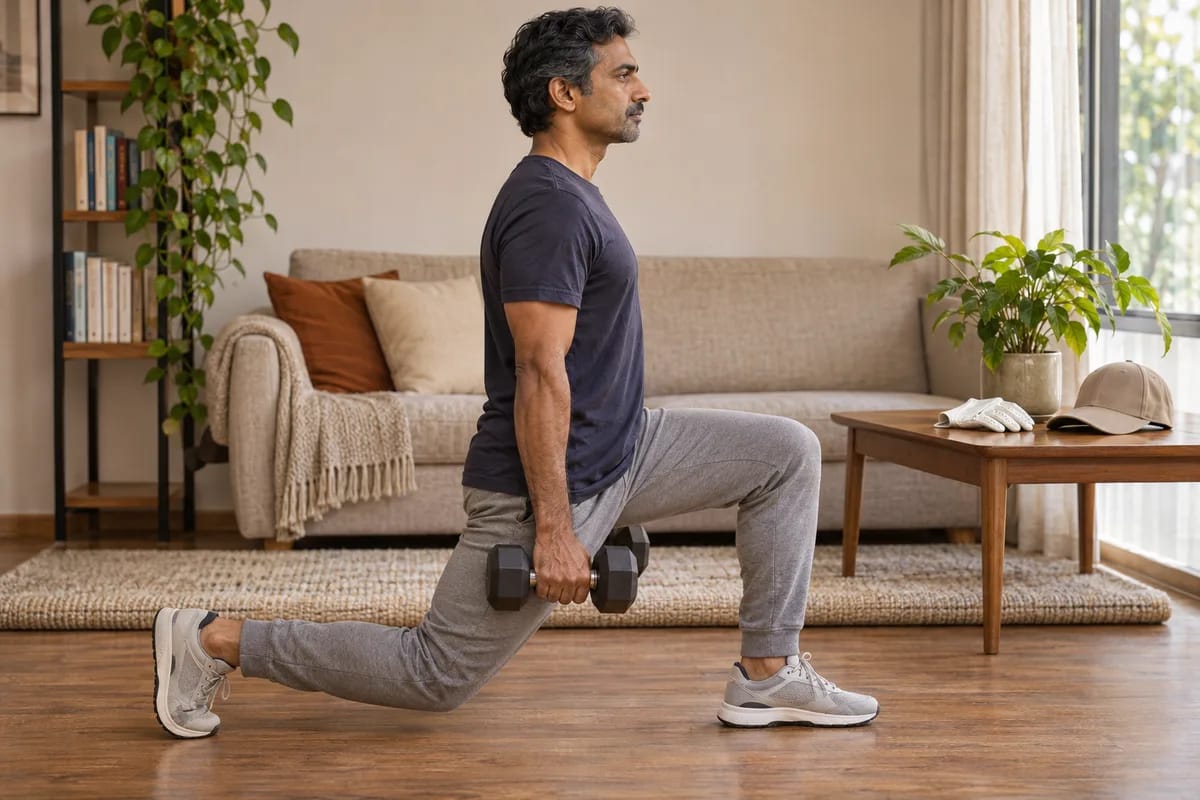
1. Split squat
The downswing starts with a push from the legs, and this trains each leg on its own.
- How: Stand in a long stride, back heel up. Lower straight down until your back knee nearly touches the floor, then push up through the whole front foot.
- Watch for: the front knee caving inward. Keep it in line with your middle toes.
- Gear: Dumbbells at your sides, or a loaded backpack. When it gets easy, rest the back foot on a step or the edge of a couch.
2. Romanian deadlift
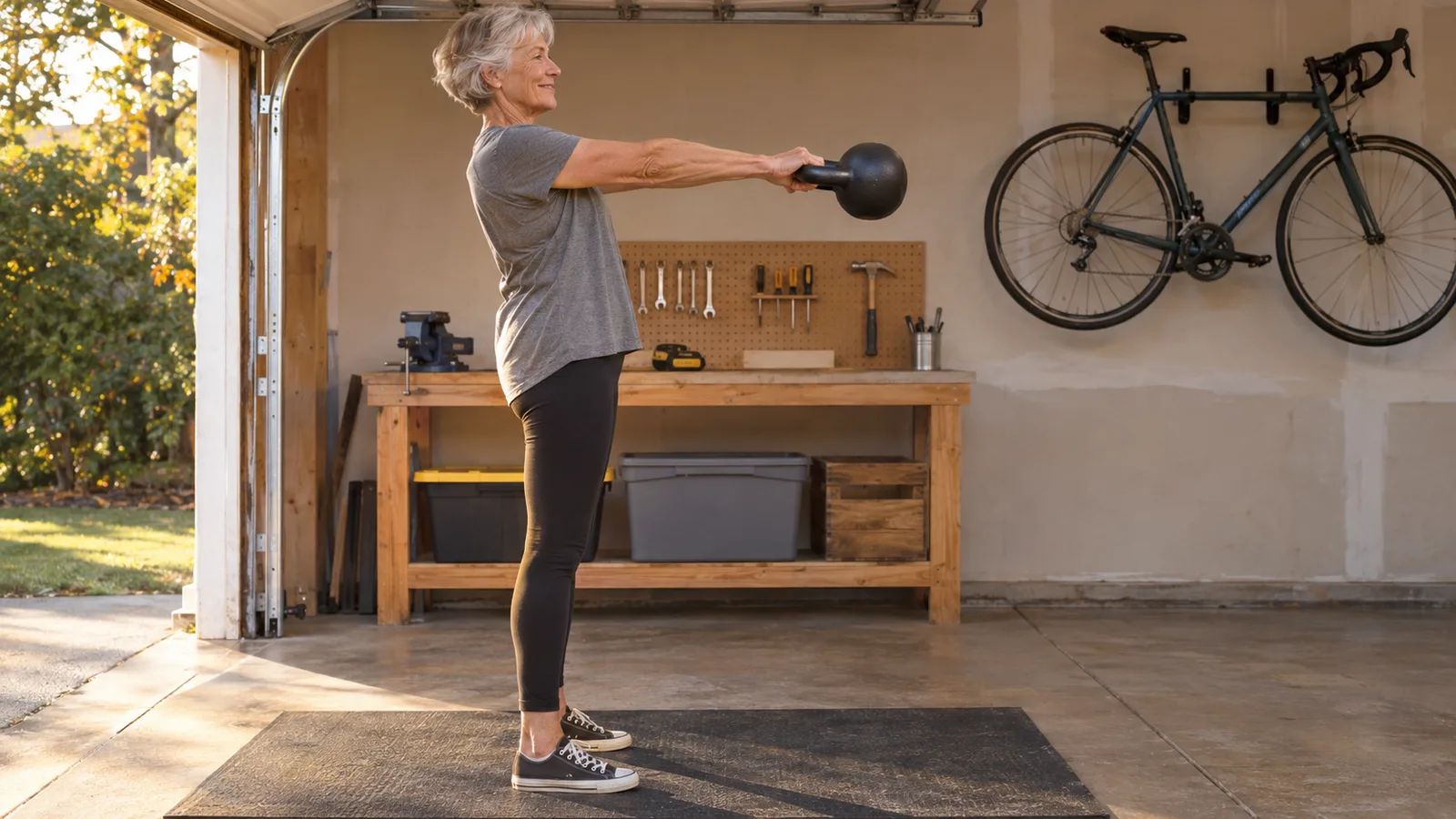
Your golf posture is a hip hinge: hips back, chest over the ball, back long. This makes that position strong.
- How: Soft knees. Push your hips back as if closing a car door with your backside, and let the dumbbells slide down the front of your thighs. Stop when the backs of your legs feel tight, usually around the knees, then stand by squeezing your glutes.
- Watch for: rounding your back to reach lower. Going lower isn't the point.
- Gear: Dumbbells or a kettlebell. Later, try it on one leg with a fingertip on a wall. More on the hinge in our deadlift form guide.
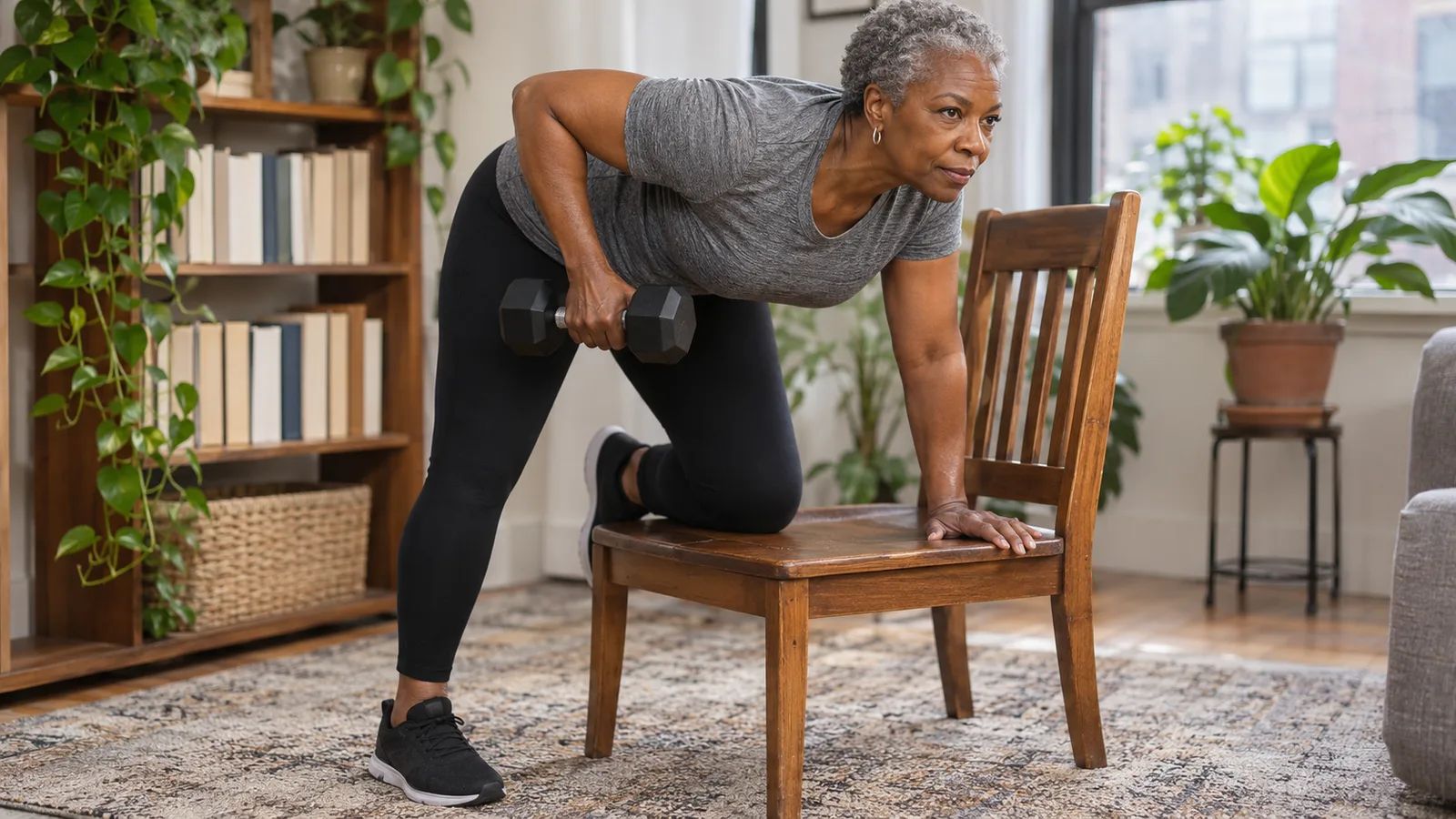
3. One-arm dumbbell row
The pulling half of the swing comes from your back.
- How: One hand and knee on a bench, or one hand on a sturdy chair with a flat back. Pull the dumbbell toward your hip pocket, pause, lower slowly.
- Watch for: twisting your body to heave the weight up. If you twist, it's too heavy.
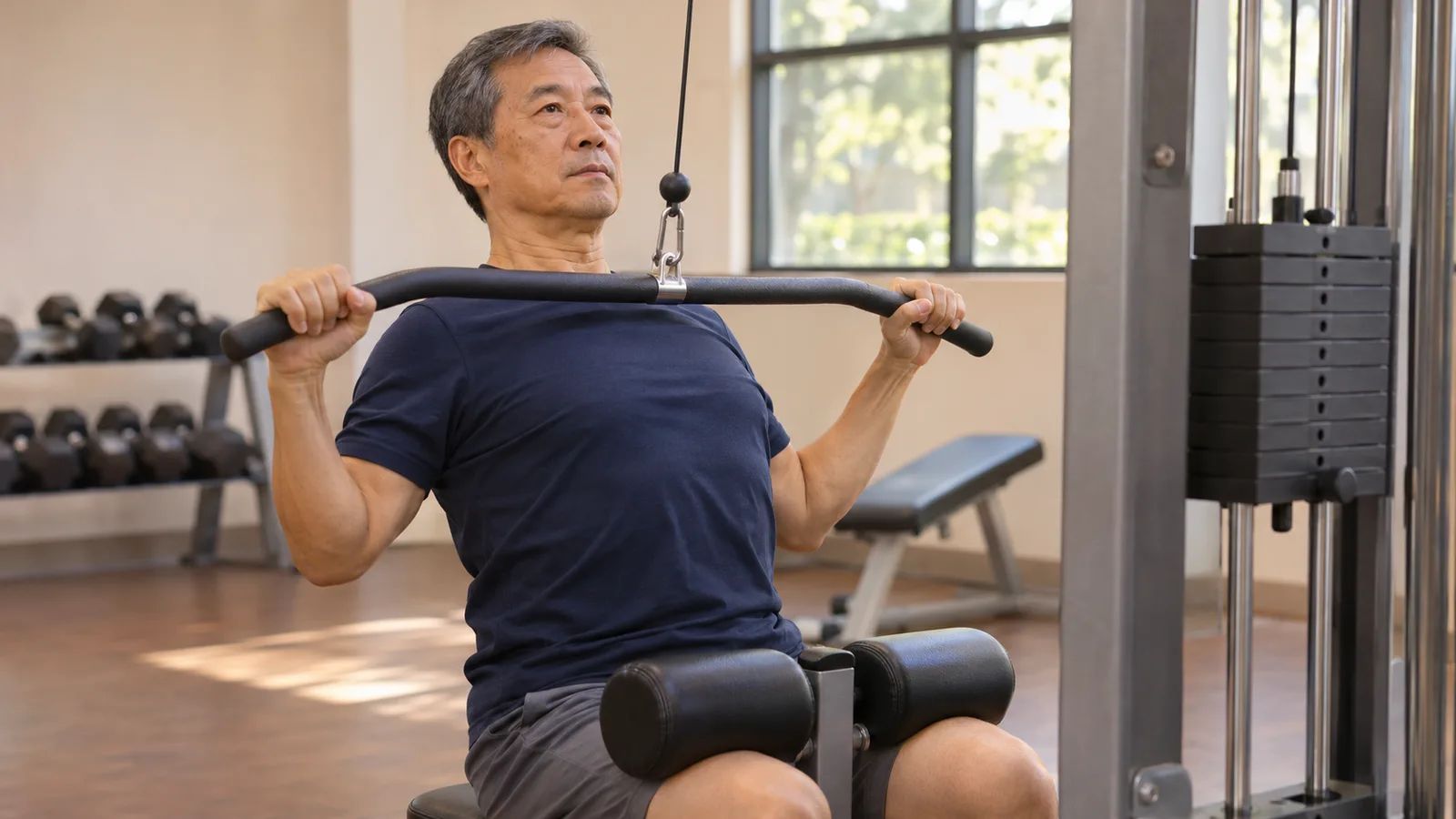
- Gear: One dumbbell. In a gym, a cable row works too.
4. Half-kneeling one-arm press
Upper-body strength goes with a faster swing too. A press balances out the rowing, and kneeling stops you cheating with your lower back.
- How: Kneel on one knee, with the dumbbell on the same side as that knee. Squeeze the glute of the kneeling leg, keep your ribs down, and press up and a little forward.
- Watch for: leaning back or arching as the weight goes up.
- Gear: One dumbbell. No overhead room? Do push-ups, hands on a kitchen counter at first, then a lower surface.
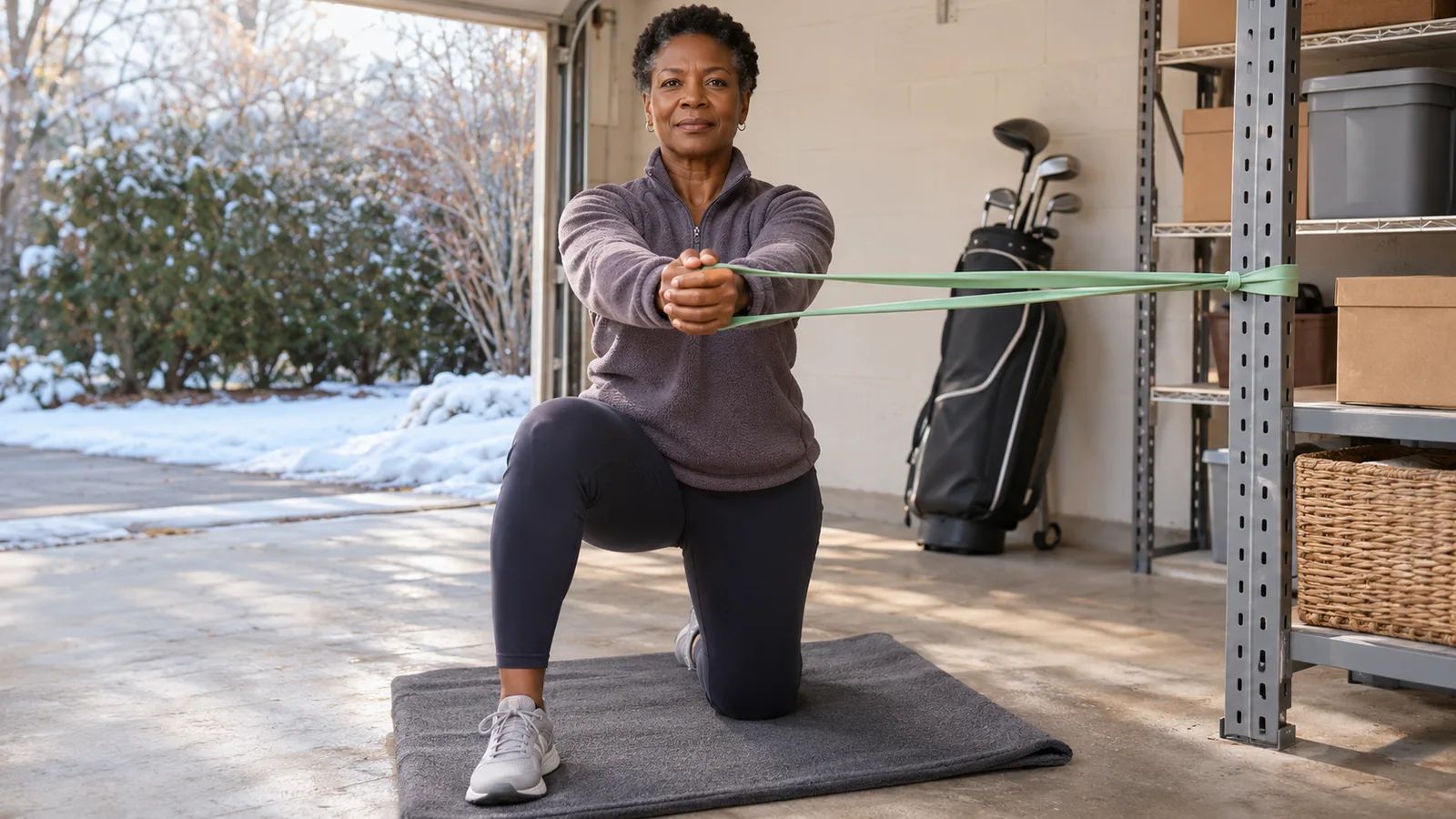
5. Pallof press
The band tries to turn you, and you don't let it. That teaches your trunk to hold steady while the hips and upper back do the turning.
- How: Tie a band at chest height to something solid beside you. Kneel side-on to it, on the knee nearer the band. Hold the band at your chest, press it straight out, hold for 3 seconds, bring it back.
- Watch for: your hands drifting toward the anchor, or your shoulders turning.
- Gear: A resistance band around a post, a stair rail or a door anchor. In a gym, a cable stack.
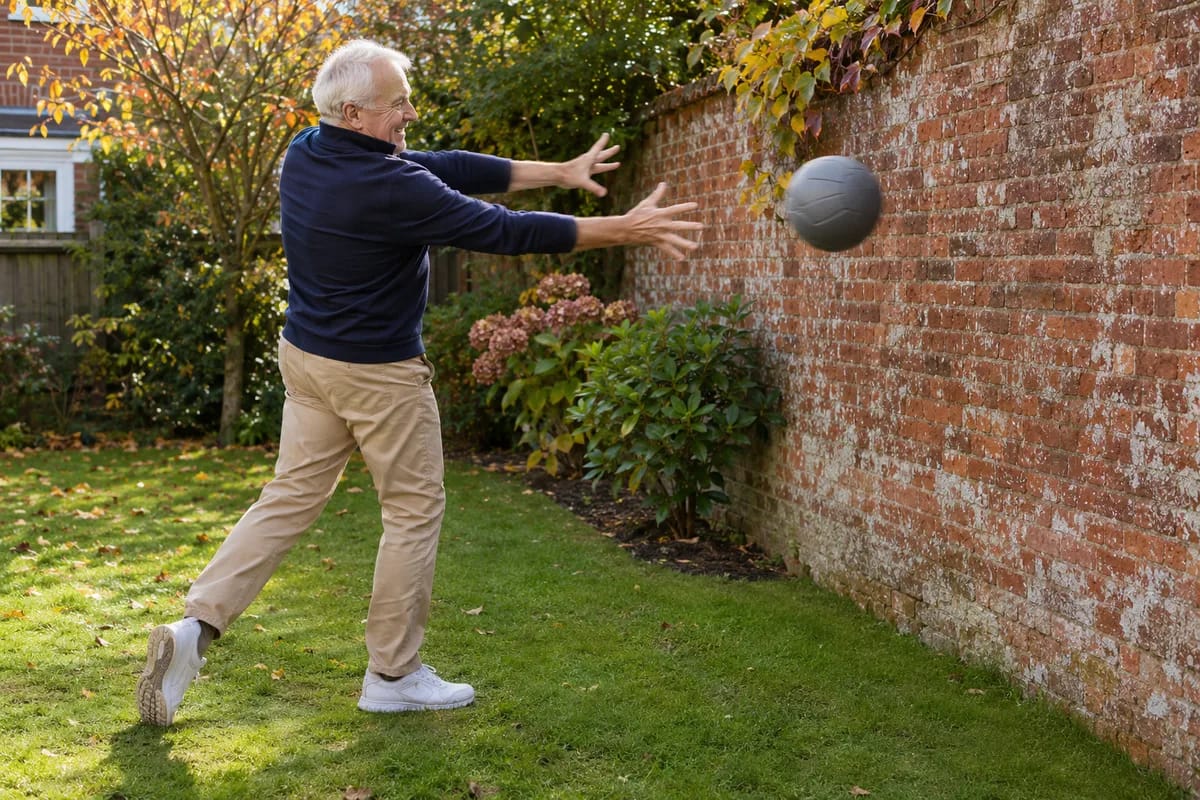
6. Rotational medicine ball throw
This is where the speed gets trained. You throw from your hips, the way you swing.
- How: Stand side-on to a solid wall, 3 to 4 feet (about 1 m) away, in your golf stance. Load into your back hip, then turn the hips first and let the chest and arms follow, and throw hard into the wall. Catch it or let it drop. Do both sides.
- Watch for: throwing with your arms while your hips stay put (see the drawing below).
- Gear: A soft, non-bouncing medicine ball of 6 to 10 lb (3 to 4.5 kg), and a brick or concrete wall with nothing fragile nearby. In an apartment, or no ball? Do a fast band chop instead: band anchored high to one side, pull it down and across your body as you turn your hips.
7. Squat jump, or a fast chair stand
Power, the ability to move force quickly, fades faster than strength as you age. A few fast reps twice a week keep it trained.
- How: Squat a little, jump, and land softly with bent knees, as quietly as you can. Stand up, reset, then do the next one. Each rep is its own effort.
- Watch for: landing stiff-legged, or rushing reps together until they get slow.
- Gentler start: if you haven't jumped in years or your knees grumble, use a fast chair stand. Stand up from a chair as fast as you can, sit down slowly. After a few weeks, try small jumps.
8. Suitcase carry
One heavy dumbbell in one hand, and walk. Your grip and forearms hold the weight, and the side of your trunk works to keep you from tipping. Both matter when you hold a club at speed. Grip strength is also worth having for its own sake.
- How: Pick up the heaviest dumbbell you can carry for about 40 steps. Walk tall and slow, shoulders level.
- Watch for: leaning away from the weight, or toward it.
- Gear: One dumbbell or kettlebell, or a heavy grocery bag in a pinch.
If your back already has opinions
In one large study of Australian club golfers, the lower back was the most common place to get hurt, with the elbow and forearm close behind.1 If that's partly why you're here, two honest points.
These are training moves for people who feel well. Strong legs and hips, and a trunk that holds steady, share out the work of the turn. That's a good reason to train them, but no exercise list can promise to stop back pain or golfer's elbow, and this one doesn't claim to.
If your back or elbow hurts during or after swinging, if pain runs down a leg, or you're coming back from surgery, see a physical therapist or your doctor before you add weight. They can tell you which of these moves to start with.
The twice-a-week plan
Two sessions, two or three days apart (Monday and Thursday, say), about 40 minutes each. The fast moves go first, while you're fresh.
| Day A | Day B | |
|---|---|---|
| Warm-up, 5 min | 90/90 hip switches, 6 each side. Open books, 6 each side. 10 easy squats | Same |
| Fast | Medicine ball throw, 3 × 5 each side | Medicine ball throw, 3 × 5 each side |
| Fast | Squat jump or fast chair stand, 3 × 4 | Squat jump or fast chair stand, 3 × 4 |
| Strength | Split squat, 3 × 8 each leg | Romanian deadlift, 3 × 8 |
| Strength | One-arm row, 3 × 10 each arm | Half-kneeling press, 3 × 8 each arm |
| Trunk and grip | Pallof press, 3 × 8 each side, 3-second hold | Suitcase carry, 3 × 40 steps each hand |
The two warm-up moves: for 90/90 hip switches, sit on the floor with both knees bent and both feet flat, then let both knees drop to one side and back up and over to the other. For open books, lie on your side with your knees bent, arms out in front, and open the top arm across to the floor behind you, following it with your eyes. Both are fine on their own on rest days, whenever your turn feels stiff.
Rest. About a minute between fast sets, so every throw and jump is really fast. A minute or two between strength sets.
When to add weight. When you finish every set with two reps to spare, add about 5 lb (2 kg), or two more reps per set, next time. The throws stay at the same ball. Throw it harder.
When the season starts
Through the winter, two days builds the base. If you have the time and enjoy it, add a third by repeating Day A.
When you're playing again, keep two days but trim them. Drop the strength moves to 2 sets and hold the weights where they are. Keep the throws and jumps as they are; they take ten minutes. And keep the leg-heavy day away from any round you care about: two days before it, or the day after, not the morning of.
What a winter of this will get you
The latest review pooled 26 trials that compared golfers who trained for at least four weeks with golfers who didn't. The ones who trained gained, on average, about 2.3 mph of clubhead speed and 10 yards of carry.2 The researchers rated their confidence as low, because the trials were small and varied. Older golfers gained about the same: roughly 2 mph in eight weeks, in a trial of men aged 55 to 79.3
Ten yards is real. It can often turn a 7-iron approach into an 8-iron, or put you on the same patch of fairway as the friend who's been outdriving you since spring. It won't fix a slice, and no amount of squatting has ever cured a three-putt. That's what lessons are for.
It also means a program promising 10 mph in six weeks is promising about four times what the average trial delivered. Some people will gain more than the average and some less, but plan for a couple of mph and you'll be pleased rather than cheated.
Why the plan starts fast, not with stretches
Most golf fitness pages lead with stretches. When researchers pooled the studies on what goes with a fast swing, flexibility barely showed up.4 On this chart, 1 would mean a perfect match and zero means no link at all.
This shows which golfers are fast, not what training made them fast, and most of the golfers measured were skilled men. Still, it's why the throws and jumps come first in the plan and strength comes next. Mobility keeps its few minutes in the warm-up, because a turn that feels easy is a turn you'll make. It just doesn't show up as what separates fast swings from slow ones.
Before the first tee
What you do in the parking lot matters too.
Do this
- Five minutes of moving: leg swings, trunk turns, arm circles
- Half swings with a short iron, building to full speed
- A few full swings with the driver before you leave the range
Save for after the round
- Long stretches you hold for 30 seconds or more
- Sitting in a deep hamstring stretch on the bench by the first tee
When young competitive golfers did 20 minutes of static stretching before hitting, their clubhead speed dropped about 5% right afterwards and was still about 2% down half an hour later.5 That was a long routine, but it's a good reason to keep the holds for after the round. The fuller story is in warm-ups that work.
When a coach can see your turn
Everything above works on your own, but two things are hard to check alone. An arms-only throw feels like a full turn from the inside, and a back that starts to round at the bottom of a Romanian deadlift is easy to miss when you're looking at the floor.
At Bespoke Fit, every session is a live 1‑on‑1 video call with your own coach, in our app on iPhone, Android or a browser. Prop your phone on its side about 8 feet (2.5 m) back, with your hips and shoulders in frame (camera setup), and three things change:
- The turn gets fixed on the next rep. Your coach sees the hips stall or the hands drift toward the band anchor and tells you while you're still holding the ball, not a day and a half later in reply to a video you sent in.
- Someone watches your hinge. Your coach keeps an eye on your back through the deadlifts and split squats, and changes the weight or the set when your form starts to slip.
- Someone is waiting for you on a dark Tuesday in January. Each session is a set time with your coach already on the call, and skipping means telling a person, which is why it tends to get done. Your coach writes each workout on your training calendar, building through winter and trimming once you're playing, and books sessions with you around your tee times.
"I was skeptical about doing training over video at my age, but it has been much easier than I expected. My trainer is patient and adjusts everything to what my body can handle."
Wanda, 70, a member who trains with JP
Each coach has 12 members at most, and we hold to it when we assign coaches, so yours remembers that your left hip was stiff last week. One flat price covers unlimited sessions of 45 to 90 minutes (most people settle at around an hour), so three a week in winter costs the same as two in summer. Twice a week, that's about $35 for an hour with your coach. It's 14 days free, then $299/mo, cancel anytime, and it starts with a 30-minute call where a head coach matches you to yours.
What we aren't: swing coaches. We don't teach the golf swing, and we have no launch monitor or in-person movement screen. Keep your PGA pro for that. If you already lift twice a week on your own, take the plan above and go. If you want someone to assess you hands-on, an in-person trainer or a physical therapist is the better pick.
Common questions
What's the single best exercise for golfers? If you only do one, make it the rotational medicine ball throw, or the fast band chop if you have no ball or no wall. Fast, explosive work tracks clubhead speed more closely than strength or flexibility, and the throw is the fast move that turns the way your swing does. If you have time for a second, add the split squat.
Can I do golf exercises with no equipment? Mostly, yes. Split squats, single-leg Romanian deadlifts, push-ups and fast chair stands need nothing, and a backpack with a few books in it makes a fine carry. The one thing worth buying is a resistance band for the Pallof press and the chop. A soft medicine ball is the second.
Sources
-
McHardy, A., Pollard, H. & Luo, K., 2007. One-year follow-up study on golf injuries in Australian amateur golfers. American Journal of Sports Medicine. 588 golfers at 8 clubs; lower back 18.3% of injuries, elbow and forearm 17.2%. ↩
-
Johansen, M.J., Bishop, C., Murray, A., Coughlan, D., Gejl, K.D., Aagaard, P. & Bojsen-Møller, J., 2026. Effects of physical training interventions on golf shot performance: a systematic review with meta-analysis. Sports Medicine. 33 studies and 798 golfers, 26 of the studies with a control group. Controlled pooled gains: clubhead speed 1.05 m/s (95% CI 0.39 to 1.71), ball speed 2.20 m/s, carry 9.33 m, total distance 10.55 m; certainty of evidence low. Our conversions to mph and yards. ↩
-
Thompson, C.J. & Osness, W.H., 2004. Effects of an 8-week multimodal exercise program on strength, flexibility, and golf performance in 55- to 79-year-old men. Journal of Aging and Physical Activity. 31 golfers, mean age 65; 19 trained and 12 controls. Mean clubhead speed rose from 85.0 to 87.1 mph, a significant difference between groups. ↩
-
Brennan, A., Murray, A., Mountjoy, M., and colleagues, 2024. Associations between physical characteristics and golf clubhead speed: a systematic review with meta-analysis. Sports Medicine. 20 studies. Pooled correlations: jump impulse 0.68, upper-body explosive strength 0.58, upper-body strength 0.45, lower-body strength 0.44, flexibility -0.04 and balance -0.06 (both not significant). Correlations, not training effects; samples were mostly skilled, mostly male golfers, and very few studies included women. ↩
-
Gergley, J.C., 2010. Latent effect of passive static stretching on driver clubhead speed, distance, accuracy, and consistent ball contact in young male competitive golfers. Journal of Strength and Conditioning Research. A 20-minute static stretching routine plus a dynamic warm-up, against the dynamic warm-up alone: clubhead speed 4.92% lower straight after, 2.19% lower at 30 minutes, no significant difference at 45 and 60 minutes. ↩