Backcasting your training from age 90
Pick the physical tasks you want to still do at 85, then work backward through the decline math to find the strength and power you need to build now.
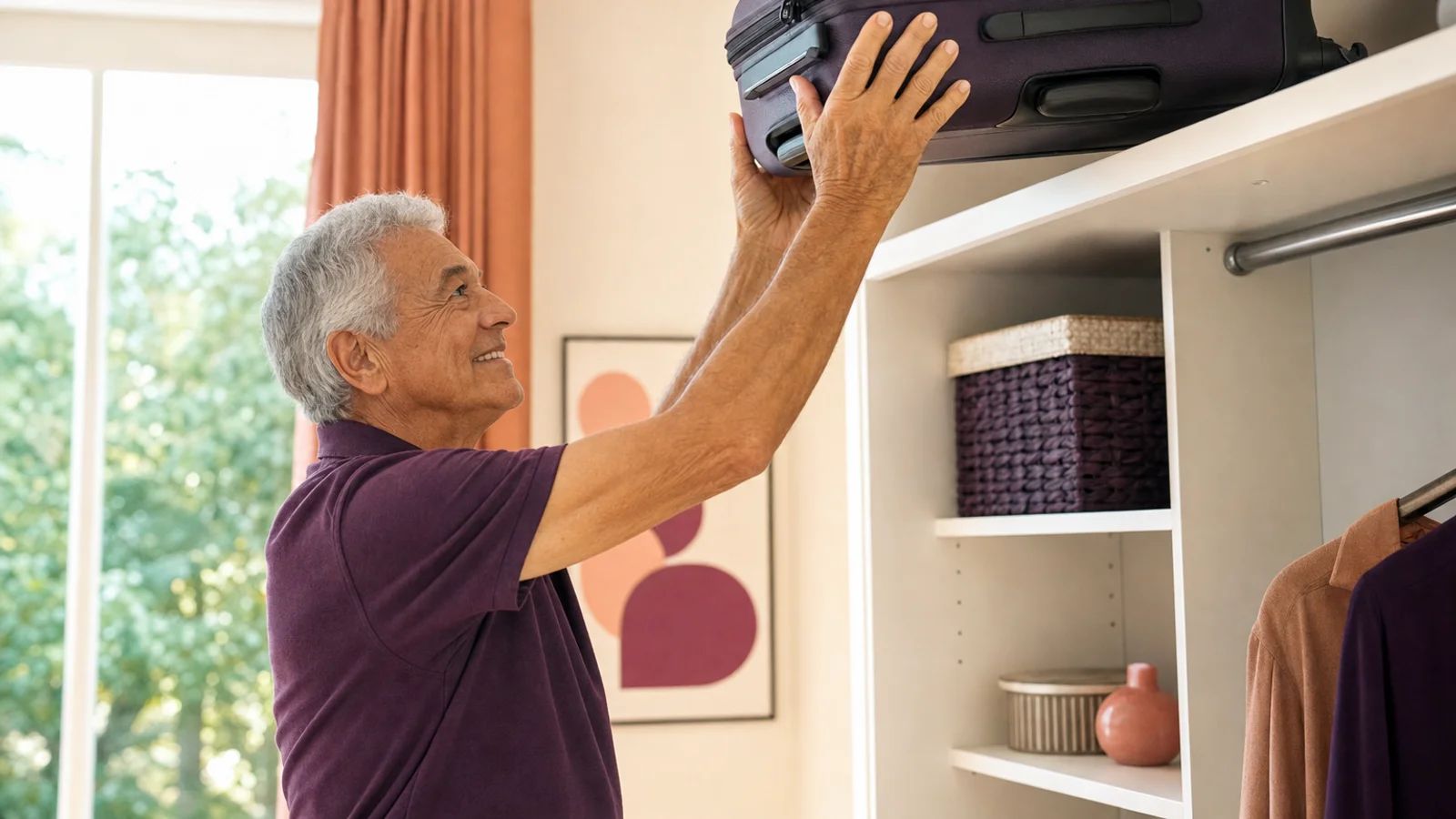
Picture the specific things you want to still do at 85: carry two grocery bags up a flight of stairs, get off the floor without a hand, heave a suitcase into an overhead bin, chase down a grandkid who won't sit still. Set the planning age at 85, not 90, on purpose. It leaves five years of margin, so decline can eat into that number and you're still fine when 90 actually shows up. Now work backward. What does your body need to be capable of today so it can still do those things after decades of decline? That's backcasting, the planning move Peter Attia popularized in Outlive as the "Centenarian Decathlon": pick your events for the last decade of your life, then train now for the version of you who has to compete in them. It's a heuristic, not a lab protocol, but the decline math underneath it is real, and it's steeper than most people expect.
What should be on your list?
Most training plans start from where you are and point forward. Backcasting starts from where you want to end up and works back. Pick a handful of physical tasks for your 80s, real and testable, not vague goals.
"Be strong" doesn't tell you what to train for. "Carry two shopping bags up two flights without setting them down" does. Attia's own version of this list runs eight to ten items long: hauling a suitcase overhead, standing up off the floor with no hands, hiking a loaded pack up a trail. Build your own. It's personal, and it should be.
Once the list is fixed, the rest is arithmetic. Every task on it needs some mix of strength, power, and endurance. You'll have less of all three at 85 than you have right now. So the capacity you need at 85, plus everything you're going to lose between now and then, is roughly what you need to have built by midlife. That subtraction is the whole idea.
Strength, power, and endurance don't fade at the same speed
Muscle mass goes first, and it goes slowest. Strength goes faster than mass does, which is a little counterintuitive: muscle can get weaker per kilo even while there's more of it sitting on the bone. A three-year study of 1,880 older adults' legs, published in the Journals of Gerontology in 2006, found strength falling about three times faster than muscle size, somewhere between 2.6% and 4.1% a year against roughly 1% for mass.1 People who gained muscle over those three years still lost strength. The tissue itself was getting weaker.
Power, the ability to produce force fast, fades faster still. A smaller trial of 100 healthy people aged 65 to 89 put rough numbers on the gap: isometric strength dropped about 1 to 2% a year, while explosive leg power dropped closer to 3.5%, more than double.2 Later reviews of the aging literature back this up: power declines earlier and drops off harder than raw strength does.3
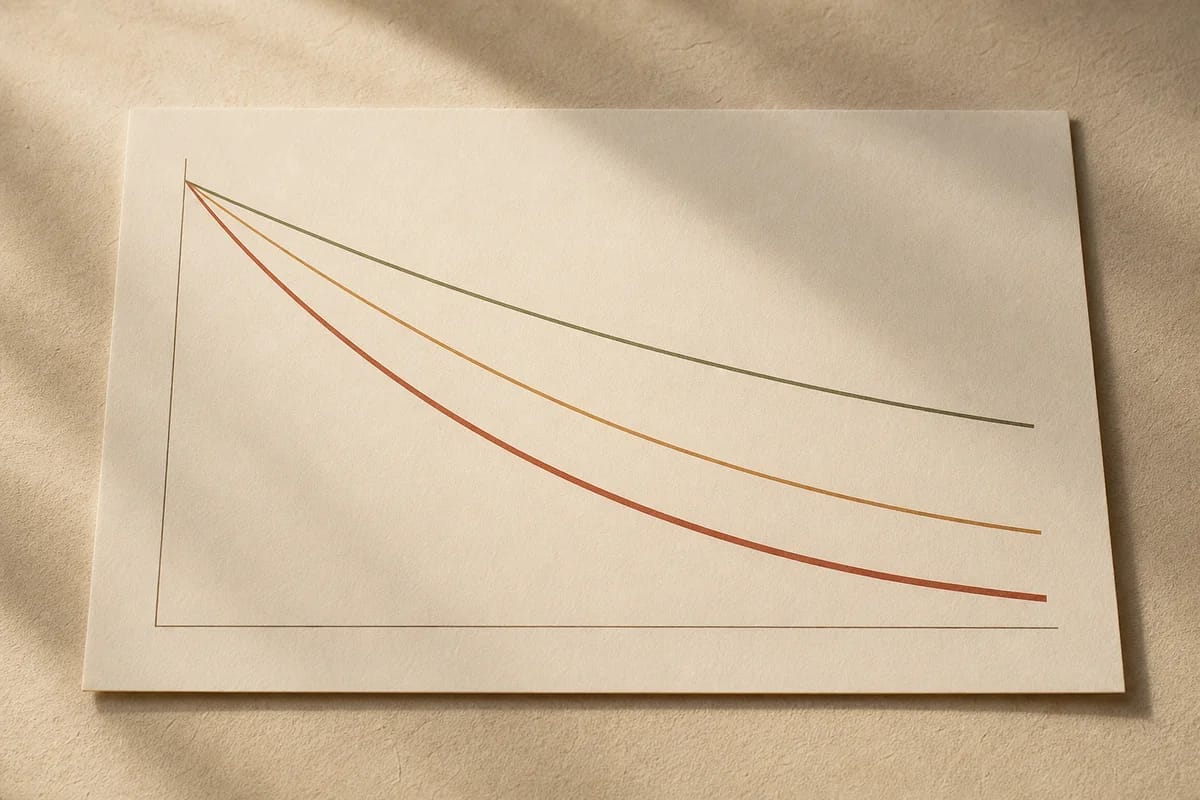
Aerobic capacity plays by a different rule. It barely moves through your 20s and 30s, something like 3 to 6% a decade, then the slope changes hard. A study that followed 810 healthy adults for decades found peak VO2 max losses topping 20% a decade once people hit their 70s, no matter how active they'd stayed.4 We dig into why that number tracks lifespan so closely in why VO2 max predicts how long you will live.
None of these three curves is a straight line down. Power is the steepest, and the whole slope gets steeper the older you get.
You're spending down a reserve you can't refill later
Think of your physical capacity as a reserve account. Attia frames it this way, and the frame holds up: you spend the account down over decades whether you plan for it or not. The only thing you control is how much you put in before the spending speeds up, and how slowly you let it drain after that.
The decline comes from several mechanisms running at once, not one. You lose muscle fibers outright, especially the fast type-2 fibers that generate power. The nerves that fire those fibers drop out too, so what muscle you have left gets slower to switch on. Mitochondria thin out, which drags aerobic capacity down with them. Each of these has its own downward slope, and they stack.
The timing works against you: losses speed up in your 70s and 80s, exactly when you have the least ability to rebuild. A reserve you didn't bank in your 50s is nearly impossible to make up at 80. You cross a real threshold eventually, the point where you can't get out of a chair or up a flight of stairs on your own, and where that point falls depends on how big a reserve you built minus how much you've already spent. Build more early, and you push that crossing years further out.
You can't borrow capacity from your 80-year-old self. You can only lend to him now, while he's still easy to lend to.
How much should you lift today for a task 30 years out?
Take one task and run the numbers. Say it's carrying 20 kg of groceries (about 44 lb) up a flight of stairs at 85. That's not a pure strength task, it's a power task: stairs need force delivered fast, not just force delivered eventually.
Say you're 55 now, 30 years out from the target. If power fades at roughly 3% a year, compounding that over three decades leaves you with about 40% of what you have today, a loss near 60%. Even at a gentler 1.5% a year, you'd only keep about two-thirds.
So the real target for still moving 20 kg up stairs at 85 isn't training with 20 kg now. It's building a base well above that, high enough that losing half of it still clears the bar with room to spare. In practice that's loaded carries, weighted step-ups, and compound lifts in your 40s and 50s that feel like overkill for anything you need to do today. The overkill is the deposit.
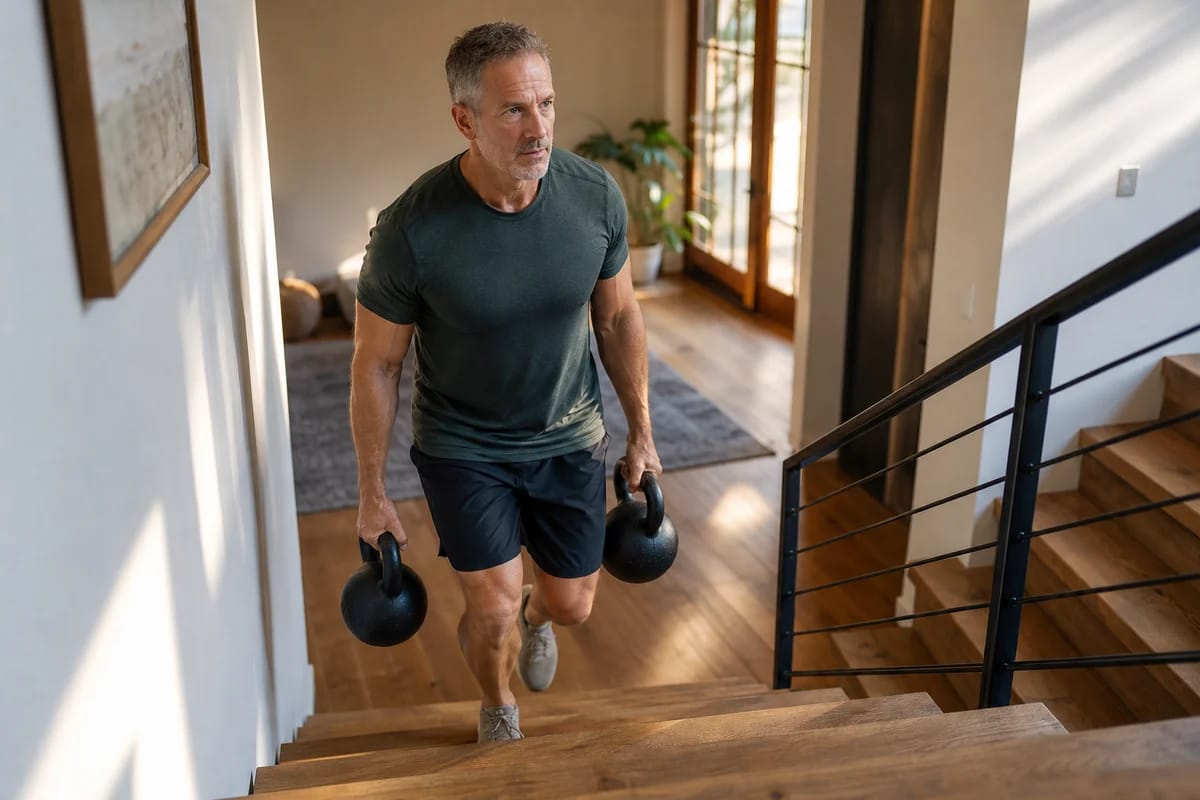
Power needs its own training, not just heavier slow lifting, because it's the quality you lose fastest and the one that fails you on a curb or a stumble. More on that in fall-proofing, why power matters more than strength.
Where the math gets fuzzy
These are population averages, and the spread around them is huge. Plenty of people in their 80s test stronger than sedentary people in their 40s. Genes, training history, illness, and luck all bend your personal curve, so treat the percentages as a rough map, not a fixed sentence.
Training keeps working, too. Older adults still gain strength and even power from resistance training, so the projection isn't a one-way street. Being on a downward slope isn't the same as being stuck on it, and starting late still helps. The math argues for banking early, not for giving up if you didn't.
And the task-list framing itself is a planning tool, not a tested protocol. Nobody has run a trial assigning people a Centenarian Decathlon and measuring whether it beats general fitness for staying independent. It's a sensible way to organize training around what matters to you, and it's built on real decline data, but the exact task-to-target arithmetic hasn't been proven. Use it to think clearly, not as a precise prescription.
Key takeaways
- Write down 5 to 10 specific tasks you want to still manage in your 80s: "carry a 20 kg case up stairs," "get off the floor without a hand," not vague goals.
- Assume you'll lose something like half your power over 30 years. Build your midlife base well above what each task needs today, not just equal to it.
- Train power on purpose, not just heavy lifting: fast reps like jumps, throws, and quick step-ups, since power fades around 3.5% a year, faster than raw strength.
- Keep aerobic work in the plan. VO2 max drops more than 20% a decade after 70, and that's the reserve behind hills and stairs.
- Retest a couple of your target tasks once or twice a year. Watching your own trend beats comparing yourself to an age chart.
Common questions
Is the Centenarian Decathlon an actual training program? No. It's a planning frame Peter Attia popularized for choosing what to train for, not a fixed set of exercises. You pick the tasks that matter to you, then build ordinary strength, power, and endurance work to support them.
Should I train strength or power for old age? Both, though power deserves more attention than most people give it. It's what protects you from falls and gets you up stairs, and it's built on a base of strength, so train the two together rather than picking one.
How do I test my own reserve? Use the tasks themselves, plus a couple of simple field tests: how many times you can rise from a chair in a set time, how much you can carry up a flight, whether you can get off the floor unaided. Repeat them on a schedule and track the direction, not a single number.
Backcasting on your own
You can run this yourself. Write your list. Look up the decline rates for what each task needs. Build in real margin above what the math says, not just enough to scrape by. Program the power work most people skip. Retest twice a year and adjust when the numbers move.
A coach changes the parts that are easy to skip when you're the only one holding yourself to it. Turning "carry the groceries at 85" into this week's actual loaded carries and step-ups, watching the fast lifts closely enough to keep them safe, and adjusting the plan the moment your test numbers say to: that's where most solo plans quietly slip. At Bespoke Fit your coach sets your targets from your own numbers, programs the power work, and watches every rep live over video. Your first month is $49, then $299 a month locked for life as one of 25 founding members, with unlimited live 1-on-1 sessions and a 30-day money-back guarantee. The reserve is yours to build either way.
Sources
-
Goodpaster and colleagues, 2006. The loss of skeletal muscle strength, mass, and quality in older adults: the health, aging and body composition study. Journals of Gerontology Series A. ↩
-
Skelton and colleagues, 1994. Strength, power and related functional ability of healthy people aged 65-89 years. Age and Ageing. ↩
-
Reid and Fielding, 2012. Skeletal muscle power: a critical determinant of physical functioning in older adults. Exercise and Sport Sciences Reviews. ↩
-
Fleg and colleagues, 2005. Accelerated longitudinal decline of aerobic capacity in healthy older adults. Circulation. ↩