Is online personal training good for beginners?
What research says about beginners lifting unsupervised, what live video coaching catches, and when an in-person trainer or cheap app is the better call.
Updated
Yes, if it's the live kind. That's the short version, and the rest of this is the caveats.
The worry that sends most beginners looking is the one about learning everything wrong with nobody in the room. Fair worry, wrong risk. When researchers compare new lifters who train supervised against new lifters who train alone, the gap that shows up isn't injuries. It's that the unsupervised group lifts too light, adds weight too slowly, and stalls out. Left to guess, most beginners undertrain.
So when you're comparing services, the thing to ask about isn't the program. It's whether anyone will actually be watching while you learn.
The injury you're picturing is rarer than you think
Start with the fear, because for most people it's doing all the work, and it doesn't survive the numbers.
A review from 2023 that pooled injury data across resistance-training styles put traditional strength training at the safe end. The strength-training studies it collected counted how many lifters got hurt at all, roughly 10 to 14 percent of them. The styles that do count by the hour, powerlifting and CrossFit-type training, land near 4 injuries per 1,000 training hours. The injuries in question are mostly strains, not disasters. New runners, by comparison, pick up around 17.8 injuries per 1,000 hours.1
Saying that costs us something, because fear is the easiest sales pitch for coaching and we're throwing it away. But the real price of training alone shows up on the calendar. Months spent learning something a coach would have told you in week one.
What supervision actually buys a beginner
Strength, sooner, and the reason is duller than you'd hope. Somebody tells you to put more weight on the bar.
A 2022 meta-analysis of 12 trials and more than 500 participants, published in the International Journal of Strength and Conditioning, found a moderate strength advantage for supervised training, with adherence, heavier loads, and harder effort as the likely reasons.2
Attention level alone moves the needle. Take 124 untrained young men, put them through the same 11-week program, and change only the coach-to-lifter ratio, one coach per 5 lifters against one per 25. The closely watched group gained more strength, upper body and lower.3
Notice what didn't differ: the program. Same exercises, same sets, same weeks. What differed was a person deciding, set by set, that today's weight was too easy. A beginner can't make that call yet, because you have no reference for what "hard enough" feels like. There's nothing to compare today's set against. That judgment takes months to build, and a watching coach lends it to you in the meantime.
Why tomorrow's correction is worth less than today's
Every rep you do as a beginner is a guess. Your brain proposes a movement, runs it, then waits for evidence about whether it was right. Feedback is that evidence, and its value drops fast with time.
Lifters given cues during their sets moved the bar about 8 percent faster within the same session, and the effect was biggest when the feedback came after every rep instead of at the end of the workout.4
Now run the clock the other way. A note that lands tomorrow means every rep between the mistake and the correction was practice, and practice doesn't care whether the version you rehearsed was the good one. Early on, a day's delay turns "fix a guess" into "undo a habit". There's a longer piece on this in why a coach watches every rep.
Live coaching and video review are not the same product
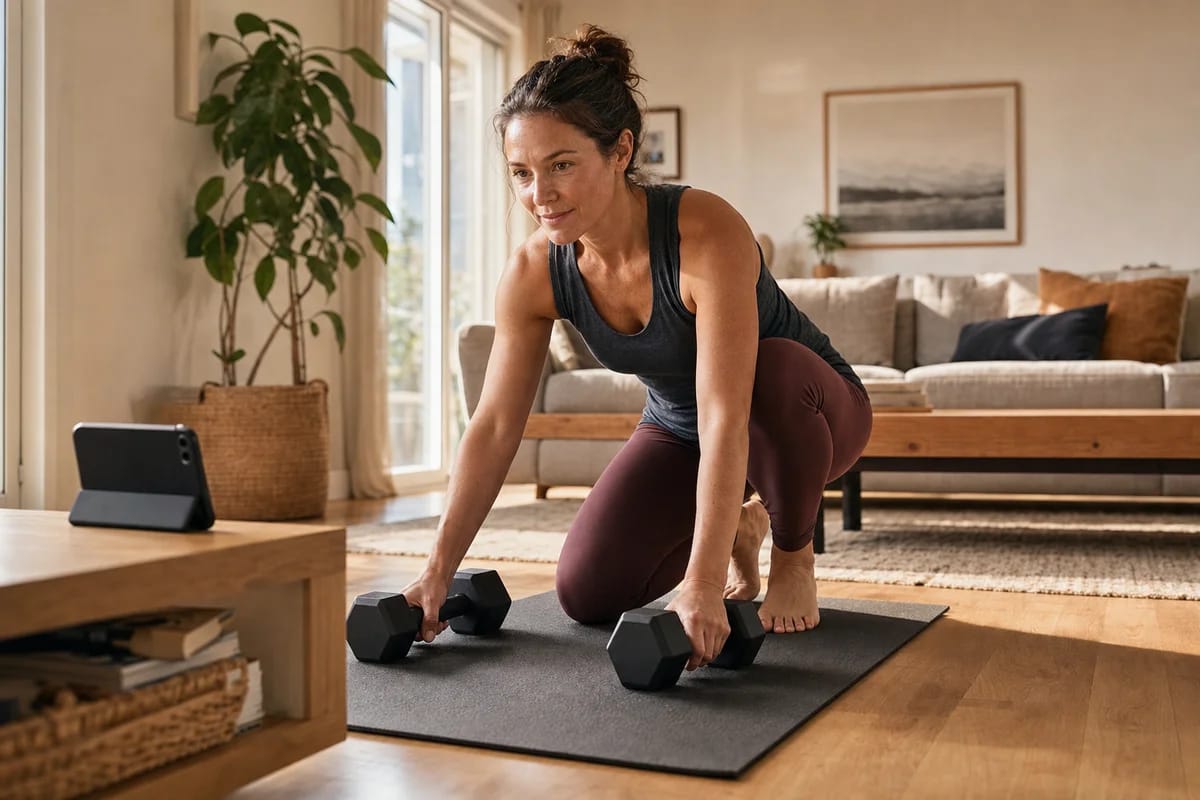
Most online coaching isn't live. The standard model is async: you train alone, film a set when something feels off, upload it, read the notes later. Both get sold as online personal training. For a beginner they're nowhere near the same thing.
A camera handles plenty, once your coach has told you where to put the phone:
- Squat depth and knee tracking. Are you reaching depth, are the knees caving, are the heels lifting. All of it shows up on screen.
- Hinge versus squat. The classic beginner mix-up is turning a deadlift into a squat. Obvious in profile, easy to cue live, and you feel the difference on the next rep.
- Load selection. Bar speed tells a coach when a weight is too light, or when a set should end before your form goes. That's the piece the supervision research points at, and it survives a camera intact.
Two things a camera can't do. It can't spot you, so a good online coach programs around that, keeping a beginner in rep ranges and setups where a missed rep is a non-event. And it can't put hands on you. Some people learn fastest from being physically repositioned, and over video that becomes words plus a demonstration. Works for most, but it's a real difference, not a marketing footnote.
Async has a bigger problem, and it's hiding in the workflow. Filming a set "when something feels off" assumes you can feel when something's off. Beginners mostly can't. Bad positions feel normal when they're all you've ever done, which is exactly why they stick around.
So the loop leans on three skills you haven't built yet: which set to film, which angle, and what a fault even looks like. What happens instead is predictable. New lifters film the wrong lift from the wrong side, or film nothing because it feels like homework, and the coach ends up reviewing a sliver of the week. Async is a fine tool for an intermediate who can self-monitor. It's weakest for the people who need eyes most.
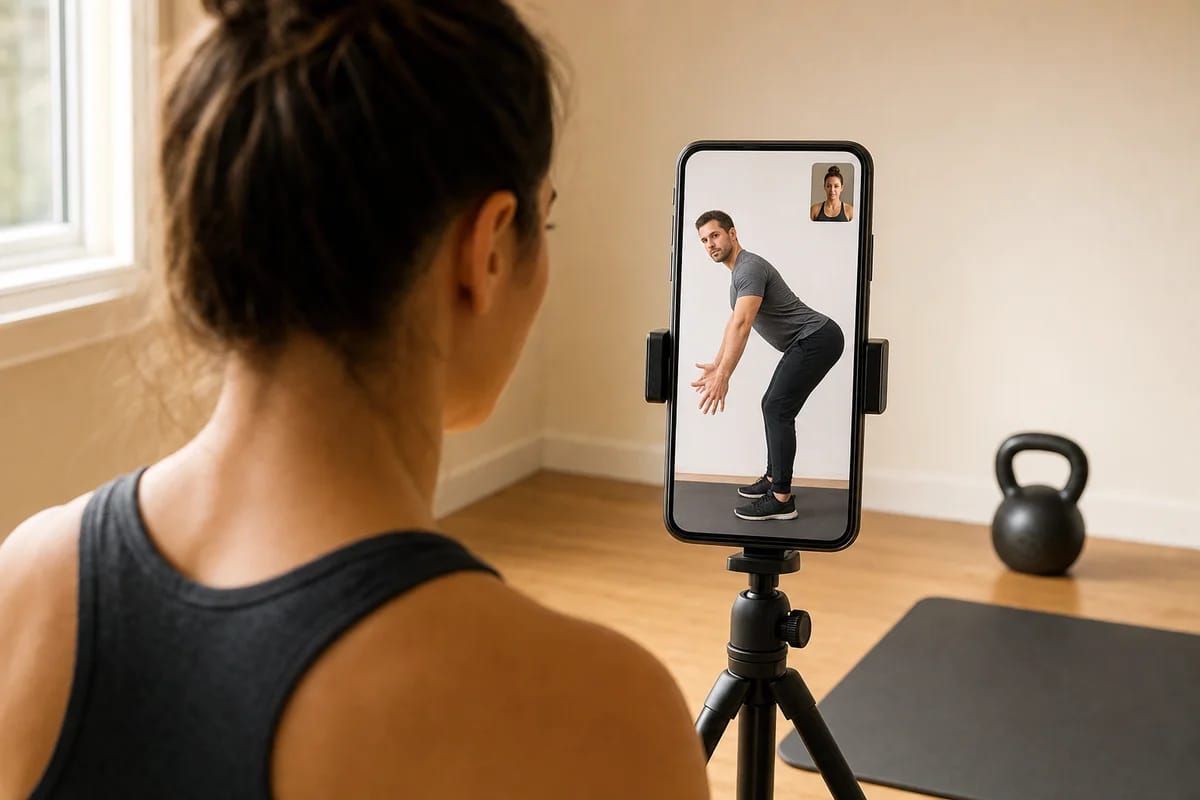
For how a first session runs, movement screen included, see what to expect in your first online personal training session.
Short and often beats long and rare
Technique learning is front-loaded. The first two or three months carry most of the movement learning you'll ever do, and after that supervision shifts from teaching lifts to managing effort.
That collides with how coaching is normally priced. Per session, usually $40 to $90 each. Under that model, a beginner who should be coached three times a week gets a bill that punishes them for being new. So people ration. One session a week, stretching out the exact phase where being watched pays off most.
A flat rate flips it. Three short sessions a week, 30 or 40 minutes each, heavy on feedback, tapering as your technique settles. No meter running in your head. And every one of them is a booked appointment with a person who's expecting you, which for a lot of beginners does as much work as the coaching does.
So if you're choosing between one 60-minute session a week and two 30-minute ones, take the two. While you're learning movements, frequency wins.
When a beginner should start somewhere else
You want to test true barbell maxes soon. Heavy singles on squat or bench need a spotter and safeties in the room. No online service can offer that, ours included. Learn the lifts with an in-person coach in a real gym, then move online once your working weights are ones you can bail on safely.
You've got a specific medical situation. Recent surgery, a heart condition someone is monitoring, pregnancy complications, pain nobody has diagnosed. Get assessed and cleared face to face first. Our FAQ covers what we do and don't take on.
Budget is the whole decision. Apps like Fitbod or Boostcamp cost $15 to $16 a month and will hand you a sensible beginner program. If money is tight, or you're happiest working things out alone, that plus free tutorials and patience is a real path. You'll probably learn slower and lift lighter than you would with eyes on you, but you'll be training, and training beats optimizing. We keep a price survey of the market in how much online personal training costs.
What the studies can't tell us
The supervision research measures strength, not technique quality. So "supervised beginners get stronger" is well supported, while "supervised beginners move better" is a reasonable read of the same data rather than a proven fact. Effect sizes are moderate, not dramatic, and some of the underlying trials used trained lifters instead of true novices.
The bigger gap is that nearly all of it compared in-person supervision against none. Almost nobody has tested live video coaching head to head with anything. Applying these results to a phone on a tripod is an extrapolation, and I'd rather say so plainly. What keeps me confident is the mechanism: effort, load progression, and immediate feedback all come through a camera fine.
Injury rates, meanwhile, are averages drawn from mixed, mostly self-reported groups. Your knees and your history aren't in anybody's meta-analysis.
Common questions
How many sessions a week should a beginner book? Two or three, and 30 to 45 minutes is plenty for each. More feedback moments per week beats more minutes per session.
Do I need a gym membership or equipment first? No. A decent coach programs around whatever you have, from a mat and a pair of dumbbells up to a full gym. Sorting out equipment before you start is usually a way of delaying the start.
How long before I can train on my own? For most beginners, technique on the main patterns settles within 2 to 6 months of steady practice. After that a coach stops teaching you movements and starts managing effort, progression, and the weeks you'd otherwise skip.
So, is it good for beginners?
For most beginners, yes, as long as somebody is actually watching live. Supervision is worth the most exactly when you're new, feedback is worth the most when it's immediate, and the async model that dominates online coaching quietly assumes skills a beginner hasn't built yet.
Going it alone is a real option, so here's the recipe. Pick one beginner program and run it for eight weeks without swapping exercises. Prop your phone at hip height, side on, and film your squat and your hinge every couple of weeks. Compare the clips against a reputable tutorial. Add a little weight any time the last rep still moved fast.
A coach changes two things on that list. Somebody else holds the standard, so you stop grading your own homework. And the correction arrives while the bar is still in your hands, not the next evening.
That's what we built Bespoke Fit around: unlimited live 1-on-1 video sessions with a real coach, starting with a movement screen, at $299 a month as a founding member, locked for life, 25 spots. Your first month is $49, with a 30-day money-back guarantee, no questions asked. For a beginner, that's one month to find out.
Sources
-
Videbæk S, Bueno AM, Nielsen RO, Rasmussen S, 2015. Incidence of running-related injuries per 1000 h of running in different types of runners: a systematic review and meta-analysis. Sports Medicine. ↩
-
Fisher JP, Steele J, Wolf M, Androulakis Korakakis P, Smith D, Giessing J, 2022. The role of supervision in resistance training; an exploratory systematic review and meta-analysis. International Journal of Strength and Conditioning. ↩
-
Gentil P, Bottaro M, 2010. Influence of supervision ratio on muscle adaptations to resistance training in nontrained subjects. Journal of Strength and Conditioning Research. ↩
-
Weakley J, Cowley N, Schoenfeld BJ, Read DB, Timmins RG, García-Ramos A, McGuckian TB, 2023. The effect of feedback on resistance training performance and adaptations: a systematic review and meta-analysis. Sports Medicine. ↩
More on