Is it awkward to work out on camera? What to know
Feeling self-conscious about training on camera is normal. Here's what research says about why it happens, why it fades, and what helps fastest.
Updated
Yes, a bit. For most people it lasts about two sessions.
The odd thing is where the discomfort comes from. It isn't being watched. It's watching yourself. A video call parks a live picture of your own face in the corner of the screen, and that little window does more damage than the person on the other end. You can turn it off.
Which matters, because "I'd feel weird on camera" is one of the most common reasons people give for not trying live coaching. The worry is real. It's also mostly fixable, and mostly on day one.
The problem is the small window with your face in it
Jeremy Bailenson, the Stanford researcher behind the paper everyone cites on why video calls drain you, put mirror anxiety near the top of the causes.1 The self-view window is a mirror that follows you through the whole conversation. Nothing in ordinary life works like that. You don't squat in front of your coach while holding a hand mirror in your spare hand, but a default video call sets up something close to it. Decades of mirror research point the same way: catching your own reflection flips you into self-evaluation, and self-evaluation is rarely generous.
Exercise researchers found this before video calls existed. A 2003 study in Health Psychology put 58 sedentary women through the same 20-minute workout, half of them facing a mirrored wall and half facing a plain one.2 The mirror group finished feeling worse: less energized, less relaxed, less positive. That held whether or not they liked their bodies going in. Same workout, same room, same twenty minutes. The reflection was the only difference.
So the camera isn't what makes you self-conscious. The mirror is. And on a video call, the mirror has an off switch.
Your coach is watching your knees, not your body
Your brain assumes an audience, and it's usually wrong about the size of it. In the experiments that made this famous, students walked into a room wearing an embarrassing Barry Manilow T-shirt and then guessed how many people had noticed. They guessed roughly double the real number.3 Psychologists call it the spotlight effect: you're the main character in your own head, so you assume everyone watches you as closely as you watch yourself. They don't.
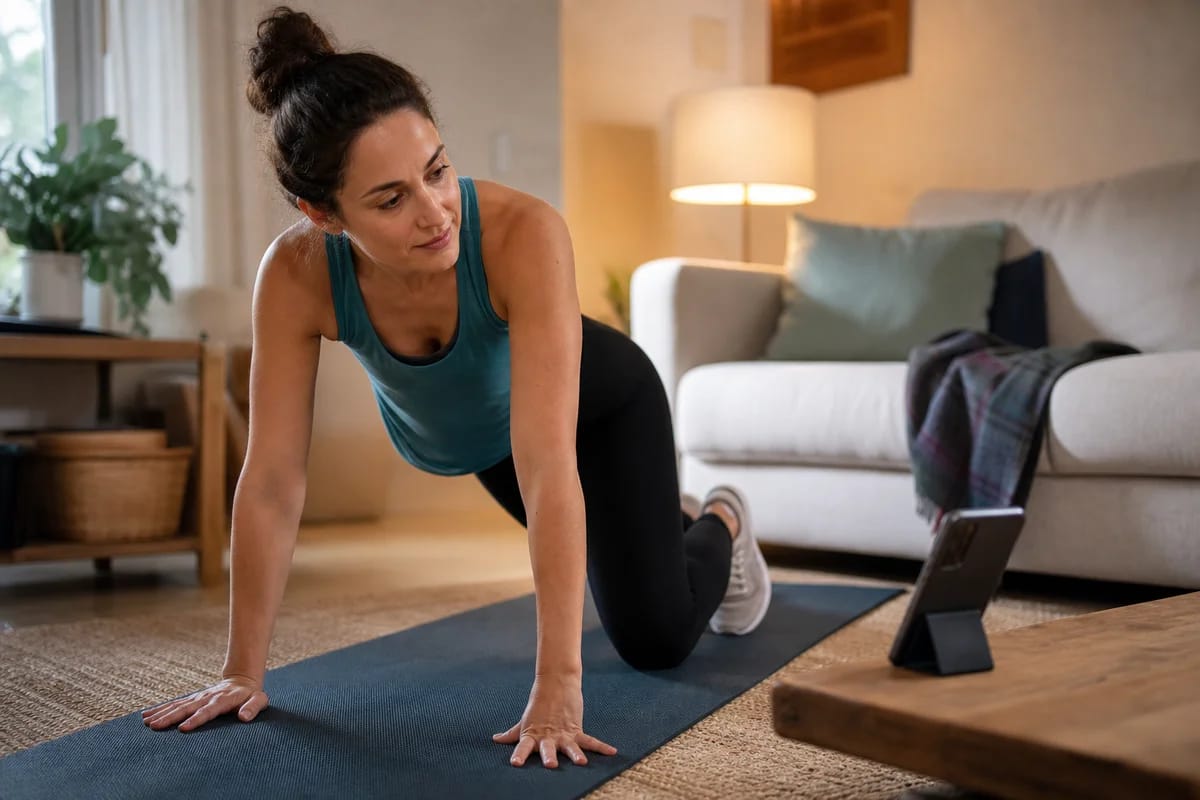
A coach, though, genuinely is watching. That's the product, so I won't pretend otherwise. What changes is what they're looking for. On a video session your coach is tracking whether your knees cave on the way up, whether your lower back rounds at the bottom of a hinge, whether the weight drifts out over your toes. It's the same gaze as a physio watching you walk or a golf pro watching your swing. Mechanics, not looks.
Now compare that with a gym floor. Strangers who might be looking, mirrors down the whole wall, and your own running commentary about your body, all stacked in one room. A 1-on-1 video session removes the first two outright. No strangers, no wall of mirrors, one person whose job is your form, in a room you already live in.
How long until the camera stops mattering?
Faster than most people expect. The mechanism is habituation: when something that makes you anxious keeps happening and nothing bad comes of it, the alarm response fades. Exposure therapy runs on the same principle.
You can watch the curve in miniature in a small study where 19 adults gave repeated speeches to a virtual audience. Distress dropped with each run, and the researchers landed on about three performances in a row as the dose that made the drop stick.4 Small sample, different task. But the shape turns up everywhere exposure gets studied: the first time is the worst time, and the drop starts straight away.
That matches what our coaches see. Session one, people stand a little stiff and apologize for their living room. Session two, less of it. By session three or four the camera is furniture, because the workout is more interesting than the lens. Plan on the first two feeling strange. That's the entry fee, not a verdict.
Five moves that make session one easier
Hide your self-view. This is the big one, and it falls straight out of the mirror research. Bailenson's own advice was to switch off the all-day mirror. Your coach still sees you fine. You just stop co-starring in your own workout. Every video platform has the toggle, ours included.
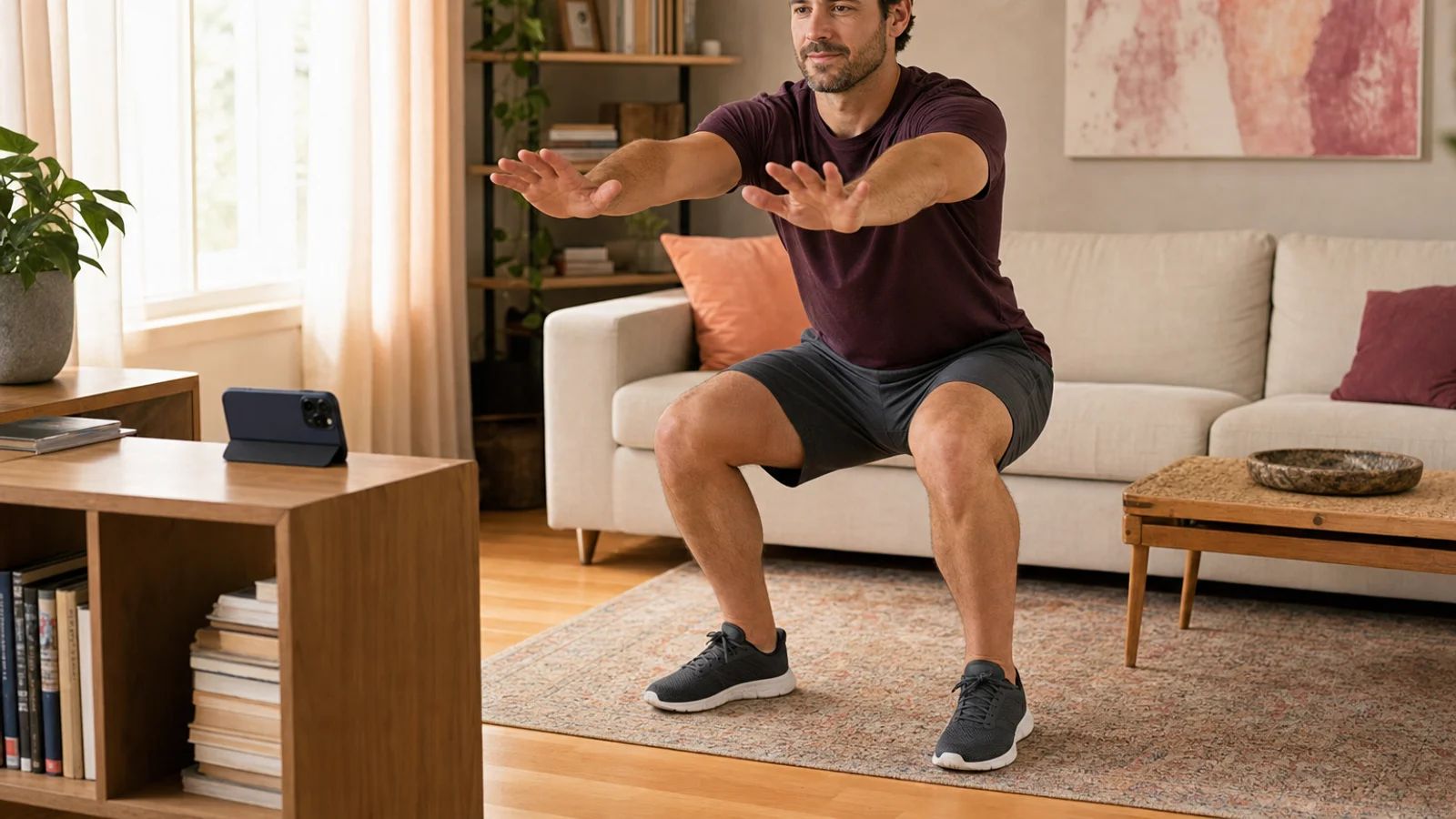
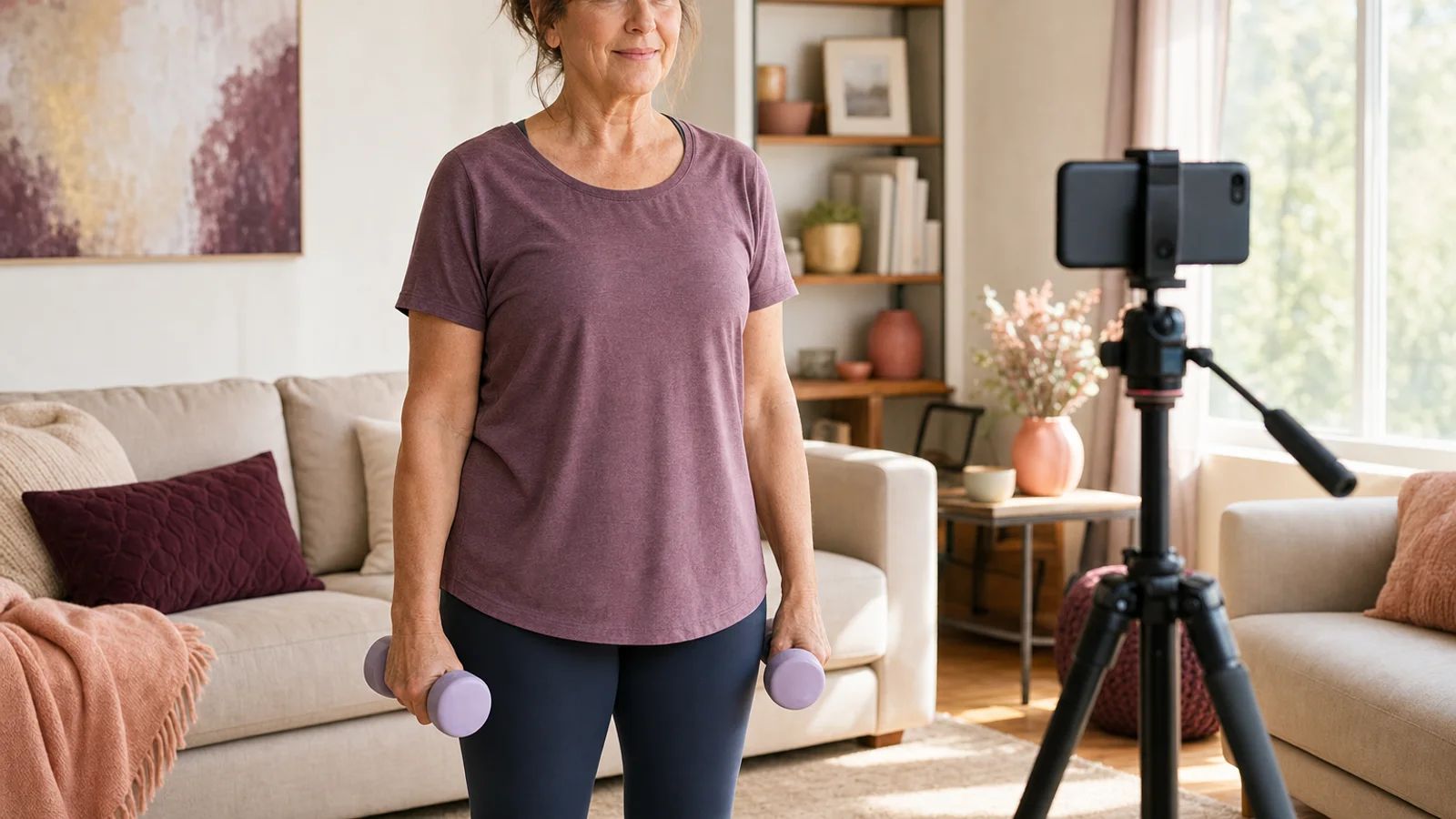
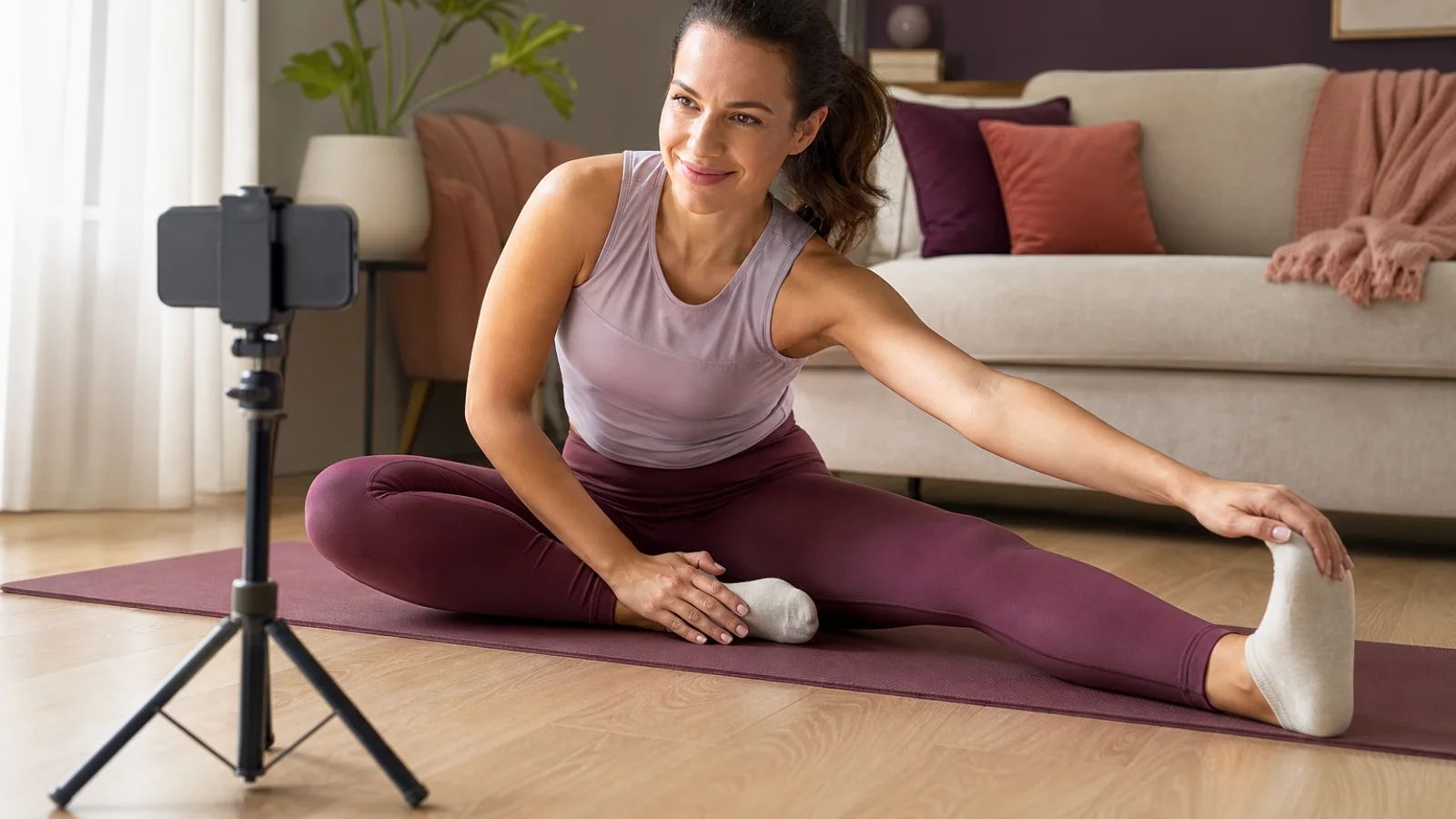
Back the camera up. A form-check frame is a full-body frame, roughly 6 to 10 feet away at knee height. From there you're a figure doing a squat, not a face filling a screen. The close-up talking-head framing that makes meetings uncomfortable is the exact thing a training setup avoids. Placement details are in our setup logistics guide.
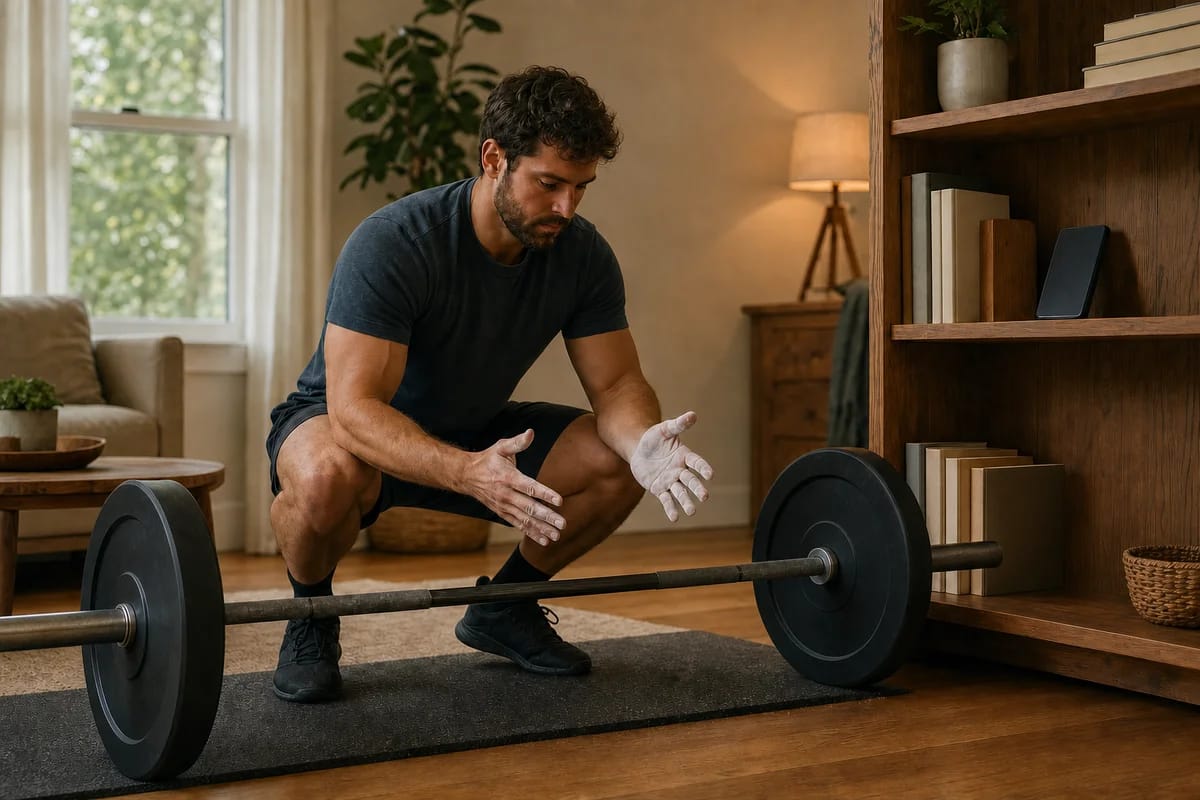
Wear what you'd train in anyway. The only requirement is that your coach can see your knees, hips, and shoulders move. Fitted at the joints, comfortable everywhere else. Nobody needs new clothes to start.
Keep one ear open. One earbud in for the coach, one out for your music and your room. Cues land privately, which helps if part of the awkwardness is other people at home overhearing.
Expect the ramp. Go in knowing sessions one and two carry the tax and that it drops after that. Knowing the curve is there makes it easier to sit through. What the first hour looks like is in what to expect in your first session.
Where the evidence thins out
None of this is airtight. The mirror-workout study ran on 58 young sedentary women in a lab. The habituation work had 19 people giving speeches. Neither measured anyone deadlifting in a living room, so the jump from that research to your workout is an inference. A reasonable one, but an inference.
Individual variation is real too. If you're dealing with social anxiety at a clinical level, two or three sessions may not be your curve, and a blog post is no substitute for proper support.
And some people simply prefer training unobserved. Not just at the start, permanently. If being watched costs you more than the coaching gives back, async form checks or a good training app are the right call and they serve those people well. Live coaching is a trade: some early self-consciousness in exchange for correction while the bar is still in your hands. Worth knowing which side of that trade you're on.
Common questions
Are sessions recorded, and who sees them? Recordings are for internal coaching use only. Your coach reviews your form between sessions and refines your program from what they saw. Nothing is shared, nothing goes to ads or AI training, and every recording is deleted automatically 90 days after the session. The full policy is in our FAQ.
Can I just leave my camera off? No, and you wouldn't want to. The whole value of live coaching is that the coach sees your reps and corrects them in the moment. What you can switch off is your view of yourself. The coach sees you. You see the coach.
Do I need to tidy the room first? No. Coaches look at how you move, not at your decor. A clear patch of floor big enough to train in is the entire requirement.
Will my coach comment on my body or my weight? Cues are about mechanics: knee tracking, back angle, bar path, depth. Weight and body composition are yours to raise, if and when you want to. That framing, mechanics first, is most of why the self-consciousness fades.
How we take the edge off it
Bespoke Fit sessions are 1-on-1 with a real coach, live on video. No group, no audience, nobody else in the room. Your coach sets the camera up with you in the first session, so you're not propping a phone against a water bottle and guessing at angles, and self-view goes off in the first minute.
Sessions are unlimited, your first month is $49, and there's a 30-day money-back guarantee, no questions asked. By the time that window closes the awkwardness has usually died anyway. The whole flow is on how it works. Give it three sessions and the camera stops being something you think about.
Sources
-
Bailenson, J.N., 2021. Nonverbal overload: A theoretical argument for the causes of Zoom fatigue. Technology, Mind, and Behavior. ↩
-
Martin Ginis, K.A., Jung, M.E., Gauvin, L., 2003. To see or not to see: Effects of exercising in mirrored environments on sedentary women's feeling states and self-efficacy. Health Psychology. ↩
-
Gilovich, T., Medvec, V.H., Savitsky, K., 2000. The spotlight effect in social judgment: An egocentric bias in estimates of the salience of one's own actions and appearance. Journal of Personality and Social Psychology. ↩
-
Takac, M., Collett, J., Blom, K.J., Conduit, R., Rehm, I., De Foe, A., 2019. Public speaking anxiety decreases within repeated virtual reality training sessions. PLOS ONE. ↩
More on