Workout app vs personal trainer: what each can do
An app costs $13 to $35 a month and writes the plan. A trainer picks the weight and notices when you stop showing up. Which one you need, honestly.

A workout app costs $13 to $35 a month and will hand you a genuinely good plan. A personal trainer costs $50 to $90 a session in person, or roughly $90 to $300 a month online for the mainstream services, and sells you something else: a person who picks the weight, watches the rep, and notices when you go quiet for two weeks.
If you already train 3 times a week and your technique holds when the weight gets heavy, buy the app. You'd be paying a trainer to fix problems you don't have.
If you're new, coming back after years away, or you've been lifting the same dumbbells since spring, the app is the wrong tool. Not because the plan is bad. The plan was never the part going wrong.
What an app actually does well
The apps got good. We sell coaching, so that's an awkward thing to write, and it's true.
The better ones write a structured program, swap exercises for the equipment you own, show a demo clip for anything unfamiliar, log every set, and add weight on a schedule. When we priced 25 online training services from their own pages in July 2026, that tier ran $13 to $35 a month. Nothing else gives you that much structure for that little money.
Apps also bend around your week. No booked time, no coach waiting, no rescheduling message. Train at 5:40am Tuesday and 9pm Thursday and nothing objects.
For someone who trains anyway, that's the whole purchase. Where apps get oversold is the coaching half, and we went through those limits from the point of view of people who use AI all day in the case against AI coaching.
The weight you pick is usually too light
Ask a trained lifter what they bench for 10 reps, load exactly that, and tell them to go until they can't. Across 160 trained men, the average was 16 reps, give or take 5. Only 22% stopped somewhere between 10 and 12.1
These weren't beginners. Every one of them named a weight from their own routine, and still had about 6 reps left when the set was supposed to be over.
An app can't see any of it. It reads the number you typed, marks the set complete, and adds a little next week. What you get is a tidy log of easy sets. Someone watching the bar slow down on rep 8 knows what you had left, and says so before you rack it.
That gap is the most expensive part of training alone, and you can't feel it from the inside. A set that's hard and a set that's hard enough feel the same while you're in it. If lifters with an established routine misjudge it, someone in their first month has nothing to compare against yet.
What changes when someone is watching?
Supervised training has been compared with training alone many times over. People with a coach watching turn up more often and lift heavier.
In a 2004 trial in the Journal of Strength and Conditioning Research, 42 young rugby league players ran the same 12-week periodized program, half supervised by a strength coach and half left to it. Both groups got stronger. The supervised half completed significantly more sessions, and gained significantly more on their 3-rep-max squat and bench press.2
Teenagers on a rugby program are not a 45-year-old with two dumbbells and a spare bedroom, and 42 people is a small study. It's one result among several, and we walked the wider literature in does online personal training actually work.
What's doing the work here isn't complicated. Supervision changes how often you train and how heavy you go, and those two decide most of your result. An app can ask you about both, but it can't check either.
A gym membership is not the middle step
People treat a gym as the compromise between an app and a trainer. It isn't one. A gym sells access to a room. Nobody in it owns your program or notices when you stop coming.
The attendance numbers are grim. One fitness center in Rio de Janeiro pulled the records of 5,240 members across nine years: 63% stopped before the third month, and under 4% were still training continuously at 12 months.3 That's one club in one city, not a national rate. What it shows is how quietly a membership stops getting used, and how long it keeps billing after that.
A gym membership is cheap until you divide it by the workouts you finished.
Personal trainer now means three different things
The word covers three products now, at three prices. What separates them is who's with you while you train.
| Format | Realistic price | Who's there during the workout |
|---|---|---|
| In person | $50 to $90 a session | A coach, in the room |
| Async coaching in an app | $90 to $300 a month for the mainstream services, up to $600 at the specialist end | Nobody. A human writes the plan and replies between sessions |
| Live 1-on-1 video | $40 to $88 a session, or a flat monthly rate | A coach, on camera |
In person is still the most complete version. Your coach can spot a heavy set and put a hand where your position is going wrong, and you're in a room that has every piece of equipment. Marketplace data puts most of the US at $50 to $90 a session, with big cities higher and New York averaging around $100.4 The costs are time and money: door to door, an hour session eats closer to two, and 12 sessions a month runs $600 to $1,080. We put the formats side by side in online personal training vs in-person.
Async coaching is what most "online personal trainer" products are. Future, trainwell, Caliber and Kickoff all work this way. A real human writes your program, answers your messages, and reviews the clips you remember to film. It solves what to do today. You still train alone, so load and effort stay yours to judge.
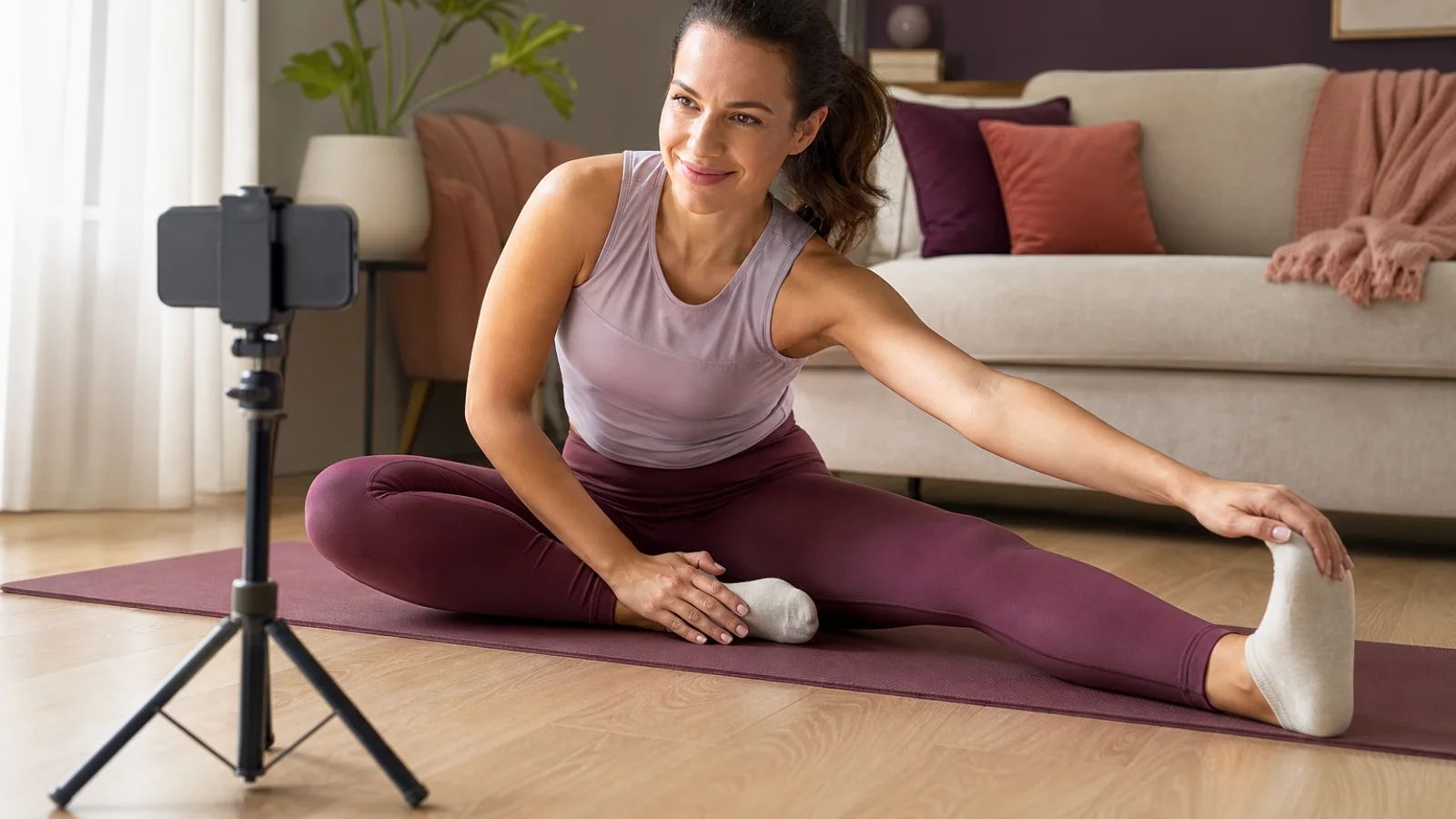
Live video is the smallest group, because a coach can't be on two calls at once. Someone is on camera for the whole session, correcting the rep while it's happening. Most services meter it per session, which adds up fast at 4 workouts a week. A few charge a flat monthly rate instead. Those monthly and per-session ranges come from the same July 2026 survey.
Pick by what's actually stopping you
- Consistent for a year, technique holds under heavy weight? App. You already own the expensive part.
- Never trained, or back after 10 years off? Get eyes on it for 8 to 12 weeks, then decide. Technique, load and honest effort are the three things you can't grade yourself on yet, and an app can only work from what you tell it.
- Same weights for 2 months? That's usually load selection, not programming. A new program feels like the fix. What you probably need is someone telling you the weight is too light.
- Started and abandoned 3 programs? Buy the booked hour, not the spreadsheet. Nothing inside an app makes 6am harder to skip.
- Under $50 a month to spend? App plus a fixed slot in your calendar, treated like a meeting you'd be embarrassed to miss. That beats a gym membership you don't use.
- Training around a replaced joint, a bad back, or a recent injury? A human, at least to start. An app can't tell discomfort from damage.
Common questions
Can a workout app replace a personal trainer? For programming, largely yes. A good app picks sensible exercises, orders them properly, and progresses them week to week. What it can't do is see that the weight you chose was too light, catch a technique fault mid-set, or care whether you turn up. If none of those are your problem, the app is the better buy.
Is a workout app enough for a complete beginner? It can be, if you're patient, film yourself, and compare honestly against the demo videos. The awkward part is that the two things supervision fixes fastest, technique and load, are the two a beginner has no reference point for yet. Most people learn them faster with a human watching for the first couple of months.
How long do you need a trainer before going solo? Nobody has tested a number. A fair target is that you can name the weight you lifted last week, explain why today's is different, and get within a rep or two of real failure on purpose. For most people that takes a few months, not years.
Is a gym membership plus an app the cheapest way to train? Per month, yes. Per workout completed, often not, because a lot of memberships stop getting used within a few months. If you buy that combination, put the sessions in your calendar first and the membership second.
What we do, and who it's wrong for
Bespoke Fit is the live video row in that table. A real coach on HD video for the whole session, watching every rep, choosing the weight with you, and rewriting next week from what they saw today. Nobody else is on the call. Unlimited sessions on a flat rate: $49 your first month, then $299 a month locked for life as one of 25 founding members, $499 a month once those spots go, with a 30-day money-back guarantee. How live sessions run covers the mechanics.
It's the wrong buy for plenty of people. If your calendar moves hour to hour, a booked appointment is a downgrade and an async coach suits you better. If you're testing true one-rep maxes, you want hands in the room. And if you've trained on your own for years without missing much, you're already doing the part we charge for.
Sources
-
Barbosa-Netto S, d'Acelino-e-Porto OS, Almeida MB, 2021. Self-selected resistance exercise load: implications for research and prescription. Journal of Strength and Conditioning Research. ↩
-
Coutts AJ, Murphy AJ, Dascombe BJ, 2004. Effect of direct supervision of a strength coach on measures of muscular strength and power in young rugby league players. Journal of Strength and Conditioning Research. ↩
-
Sperandei S, Vieira MC, Reis AC, 2016. Adherence to physical activity in an unsupervised setting: explanatory variables for high attrition rates among fitness center members. Journal of Science and Medicine in Sport. ↩
-
Bark, updated January 16, 2026. How much does a personal trainer cost?. Bark marketplace data, read September 8, 2026. ↩
More on