Online personal training vs in-person, honestly compared
In-person coaching wins on spotting, equipment, and feel. Online wins on price and consistency. Here's what the trials say, and where video lands.
Updated

A personal trainer in most US cities charges about $90 an hour, and plenty of people pay it happily. In-person training is a genuinely good product. A coach standing next to you in a well-stocked gym has been the gold standard for a century, and it earned that.
What matters is how much of that standard survives the trip through a camera, and what the price difference buys. Short version: you give up hands, heavy spotting, and a room full of equipment. You keep the part the research keeps rewarding, which is a person watching you work at a time you both agreed to.
I build Bespoke Fit, a live online coaching service, so I have a side here. I'll show my math and the trials, and you can judge.
What you give up when the coach isn't in the room
The losses are real, so start there.
A coach in the room can put a hand on your lower back and say "brace here". That lands faster than any sentence, and video has no version of it. Touch is a teaching channel, and it doesn't go down a wire.
Then there's the gear. A commercial gym has racks, platforms, cable stacks, dumbbells up to 150 pounds, and machines for the awkward angles. Your trainer can build a session around any of it. At home you work with what you own, which for most people is a couple of dumbbells and a bench.
Some people also train harder with other people around. If a busy gym floor raises your effort, that's worth paying for, and no camera reproduces it. In-person has no tech friction either. No camera angle to fix, no wifi to blame, no phone propped against a water bottle.
If you live five minutes from a gym you like and the $90 doesn't sting, stay put. Nothing below is an argument against that.
Two things a camera will never do
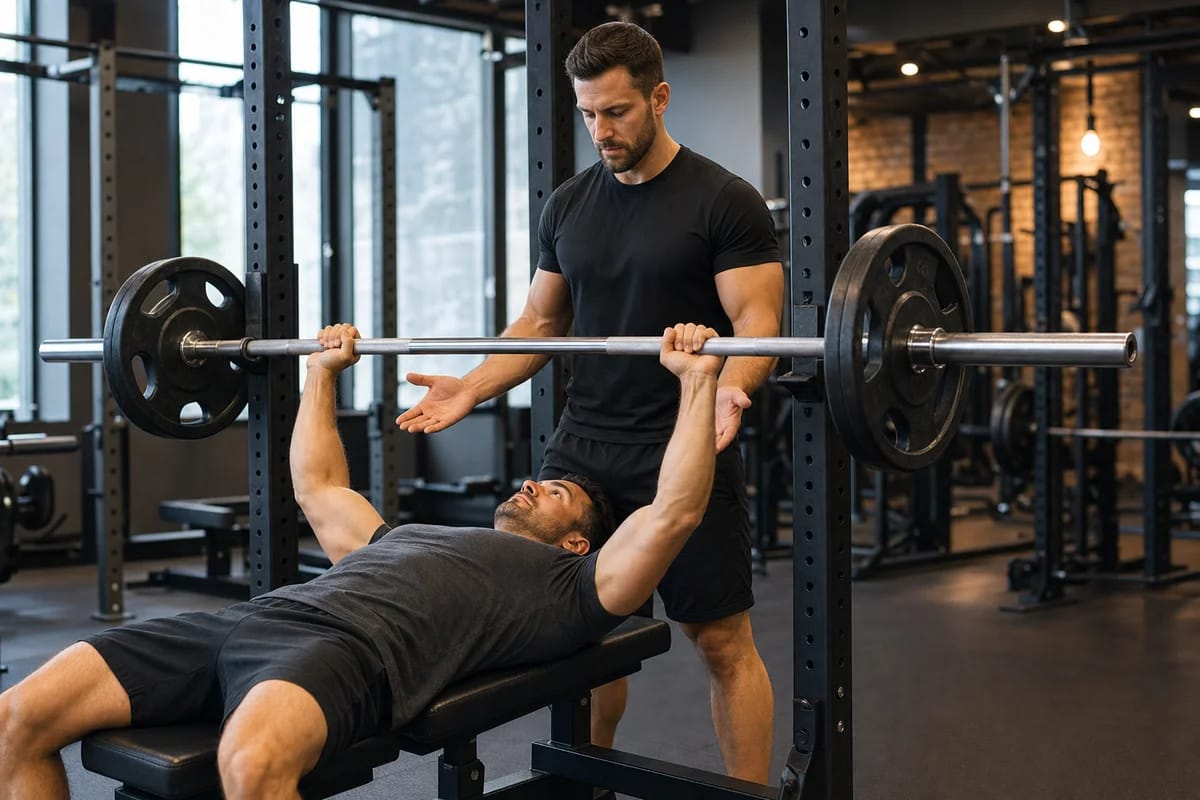
Catch a bar. If you're testing a one-rep max on the bench, you want hands that can save you. A remote coach can program around that with safety pins, dumbbell variations, and rep ranges that don't need a catch, and for most people training for health that covers the whole year. Programming around something isn't the same as replacing it. Powerlifters working near their limit should have a spotter in the room, full stop.
Put hands on you. Joint mobilization, soft-tissue work, a physio assessing your shoulder capsule by feel. None of that travels over video. If part of what you're buying from your trainer is treatment, online coaching doesn't sell it.
The math that makes people switch
An hour with a trainer isn't an hour. Door to door it's 90 minutes to two hours. Go three times a week and you're spending 3 to 5 hours a week on logistics. Online, the session starts when you step in front of the camera.
Then the money. At about $90 a session, 12 sessions a month is roughly $1,080. A flat-rate live service at $299 a month, trained four times a week, works out to $18.69 a session. Same coaching frequency, about a fifth of the price. I went through the market service by service in how much online personal training costs.
The bigger effect is on how often you get coached at all. When each session costs $90, most people buy one or two a week and train alone the rest of the time. When the next session costs nothing extra, three to five coached sessions a week becomes normal. Frequency of supervision is one of the strongest levers in training, and price is usually what caps it.
Two smaller things come with the switch. Your coach programs for the equipment you own rather than the gym's, which is what you'll be using on the days nobody's watching. And your options stop being whoever works within driving distance, so you get matched on goal and personality instead of zip code.
Does coaching survive the trip through a camera?
Most of what makes in-person coaching work is the supervision rather than the room, and supervision travels better than people expect. Three pieces of it come through more or less intact. (I put live coaching next to the more common async model in live vs async online coaching.)
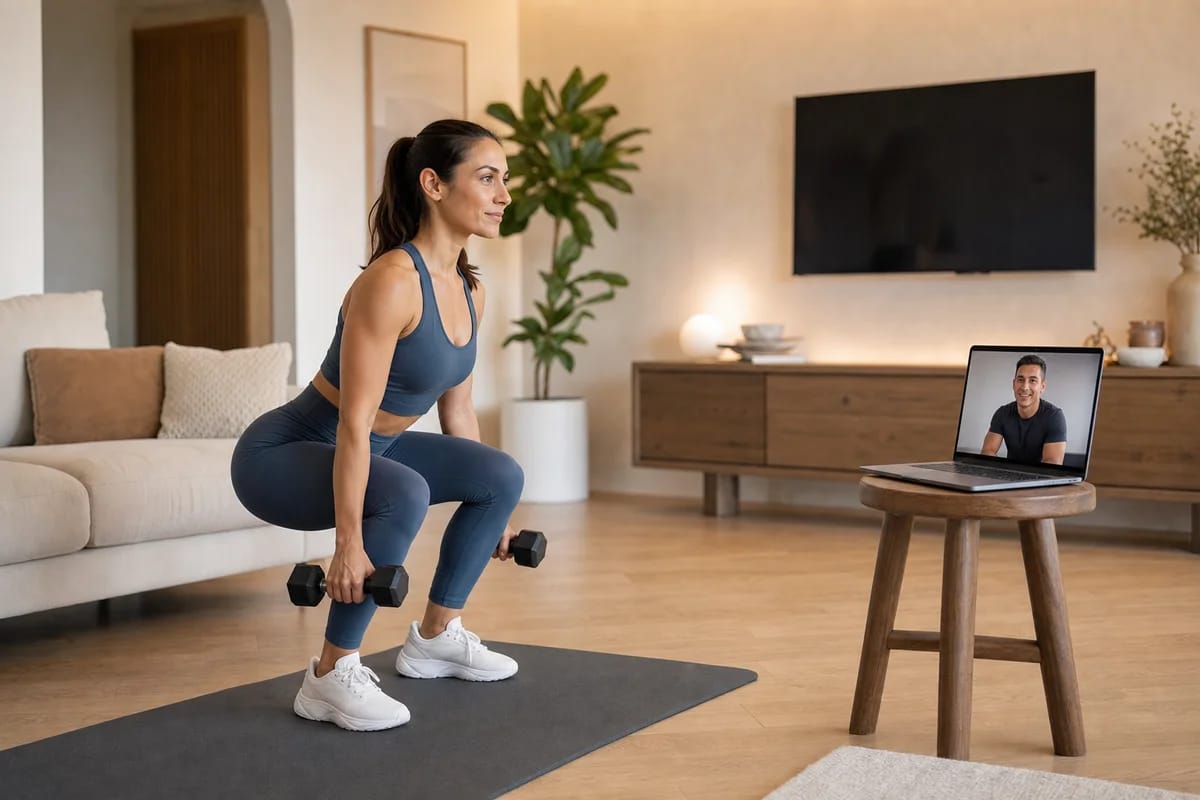
Form correction still happens in the moment. A coach watching your set on HD video sees your squat drift forward and says so before the next rep, same as they would from six feet away. The fix lands while the pattern is still forming, not in a video review tomorrow afternoon.
Load decisions still work, because bar speed shows up on camera. Experienced coaches judge how heavy a weight really is for you by how fast it moves, and that isn't folklore. Measured across 120 strength-trained men, bar velocity tracked the percentage of their max so tightly (an R² of 0.98) that you can read one off the other.1 A coach watching your third rep slow down can add weight, cut the set short, or ask for two more while it still counts.
The appointment survives completely. Accountability at a gym was never about the room. It was a specific person expecting you at a specific time. Canceling on someone already waiting on the call feels nothing like swiping away an app notification.
The third option is no coach at all
This whole comparison has assumed you're buying coaching. Most people aren't. They're paying for a gym membership, or for a set of dumbbells at home, and running their own training. Nobody owns the program. That's the real default, and it deserves a straight answer.
Self-led training works, under one condition: you already show up, and you already know what you're supposed to add this week. If you can name the weight you lifted last Tuesday and the reason today's number is different, coaching isn't what's holding you back. A decent program and a notes app will take you a long way for almost nothing.
It falls apart on a smaller question than people expect. Not "what's the best split" but "what am I doing today". Every session you run yourself starts with that decision, and decisions made while tired get made badly or skipped. That's how a plan that felt solid in week one turns into the same three easy exercises by week six, then a missed Monday, then a gap. Nothing dramatic breaks. The programming just stops moving, and progress goes with it.
Coaching, in either format, is mostly buying that decision off yourself. An in-person trainer makes it standing next to you at a set time. An async coach makes it in advance and sends you the plan, which fixes the what-am-I-doing-today problem and leaves the showing up to you. A live video coach makes it in advance and is also on the call, which is why frequency of supervision, rather than the address, is the thing that keeps coming up in the results.
Sorting yourself is quick. Consistent and self-directed, stay self-led. Stuck on what to do, buy programming. Stuck on starting at all, buy the appointment.
Where the research lands
Two separate questions have been tested. Does supervision beat training alone, and does supervision work through a screen.
The first has a clean answer. A 2025 randomized trial in the Journal of Strength and Conditioning Research ran 79 trained lifters through the same 10-week program, either supervised in person, guided by an app, or left alone with a PDF. They stuck to the plan 88%, 81%, and 52% of the time, and the supervised group gained the most squat strength, +26.6 kg against about +19 kg for the other two.2
Notice what the online arm was there: an app, not a person. That trial brackets the second question rather than answering it. For an answer, look at rehab, where the trials are bigger. The largest head-to-head test, the PEAK trial, randomized 394 adults with chronic knee pain to five physiotherapist consultations, half delivered in person and half by video. At three months the video group's pain and function scores were statistically no worse, and adverse events were similar.3 In older adults, the 2023 review of live video group exercise found no significant difference in outcomes across the four studies that had an in-person comparison group, and the video groups turned up more often.4
The pattern holds across this literature. Put a real human on a live screen and the in-person advantage shrinks toward nothing, while attendance tends to go up.
What the trials can't tell you
The strong head-to-head evidence comes from rehab and older adults, because that's where the research money goes. Nobody has run a large randomized trial of live video personal training against in-person training in healthy 40-year-olds chasing a bigger squat, so going from knee-pain patients to your goblet squats takes some faith. The 2025 supervision trial measured an app against a person in the room, not a live coach on video, so the exact question stays open. And trials report averages. If the gym floor is what makes you work hard, your own experience beats any average. Consistent and encouraging, not settled.
So which one do you buy?
- Within 15 minutes of a gym you like, happy at about $90 a session, training as often as you want? Stay. Don't fix what works.
- If cost is what caps your frequency, run the per-session math: $1,080 a month for 12 in-person sessions against $18.69 a session at four a week on a $299 flat rate.
- Training at home or traveling a lot? Pick a coach who programs for the equipment you own, not a gym you rarely see.
- Going after true one-rep maxes in the big barbell lifts? Keep in-person spotters for those days, whatever else you do.
- Either way, book sessions with a human at fixed times. The appointment is what the adherence data keeps rewarding, not the address.
Common questions
Is online personal training as effective as in-person? The trial evidence so far says real-time video coaching gets comparable results, with the caveat that most head-to-head trials ran in rehab and older-adult populations. What moves the needle more is whether a human supervises your sessions at all, not which side of a screen they're on.
Can an online trainer really check my form? On live video, yes, and in the moment. A coach watching in real time sees the same bar path, depth, and speed they'd see standing next to you, and cues you between reps. What they can't do is put hands on you, so the correction is verbal and visual only.
Do I need a gym to train online? No. Most people do fine with a pair of adjustable dumbbells and a bench, and a good coach programs for exactly what you own. That's arguably better: you get coached in the room where you'll still be training in two years.
How much cheaper is online personal training? In-person averages about $90 a session, so 12 sessions a month is around $1,080. Live 1-on-1 video on a flat rate lands near $18.69 a session at four sessions a week. Roughly 80% cheaper per coached hour, at higher frequency.
Is coached training better than training on your own? Only when what's stopping you is something a coach fixes. If you already train consistently and know what to progress each week, a good program and a notebook do the job for almost nothing. Coaching earns its money when the decision about what to do today, or whether you start at all, is the part that keeps failing.
When is in-person clearly the right call? Maximal barbell testing that needs a spotter, hands-on rehab or manual therapy, sports that need specialized facilities, or knowing yourself well enough to admit you won't work hard alone in your living room. All legitimate. Pay for the room if the room is what makes you train.
If you're in the middle
Most people reading this sit between the two extremes. They want someone watching, and they can't spend $1,080 a month or four hours a week getting to a gym and back.
If you're already consistent and your technique holds up when the weight gets heavy, a well-written program and a phone timer costs almost nothing, and for you that's the right call.
Bespoke Fit is built for everyone else. Every session is live 1-on-1 HD video with a real coach, never AI, correcting your form as it happens and rewriting the plan from what they saw that day. It's $49 for your first month, then $299 a month locked for life for the 25 founding members, with unlimited sessions, which is where that $18.69 comes from. How it works walks through a session, and the full numbers are on pricing.
Sources
-
González-Badillo JJ, Sánchez-Medina L, 2010. Movement velocity as a measure of loading intensity in resistance training. International Journal of Sports Medicine. ↩
-
Gavanda and colleagues, 2025. Optimizing resistance training outcomes: comparing in-person supervision, online coaching, and self-guided approaches: a randomized controlled trial. Journal of Strength and Conditioning Research. ↩
-
Hinman and colleagues, 2024. Telerehabilitation consultations with a physiotherapist for chronic knee pain versus in-person consultations in Australia: the PEAK non-inferiority randomised controlled trial. The Lancet. ↩
-
Fernandez and colleagues, 2023. Physical function effects of live video group exercise interventions for older adults: a systematic review and Veteran's Gerofit group case study. Telemedicine and e-Health. ↩
More on