Does online personal training actually work?
The research says supervised training beats going it alone, but not every online model counts as supervised. Here's what the studies actually show.
Updated
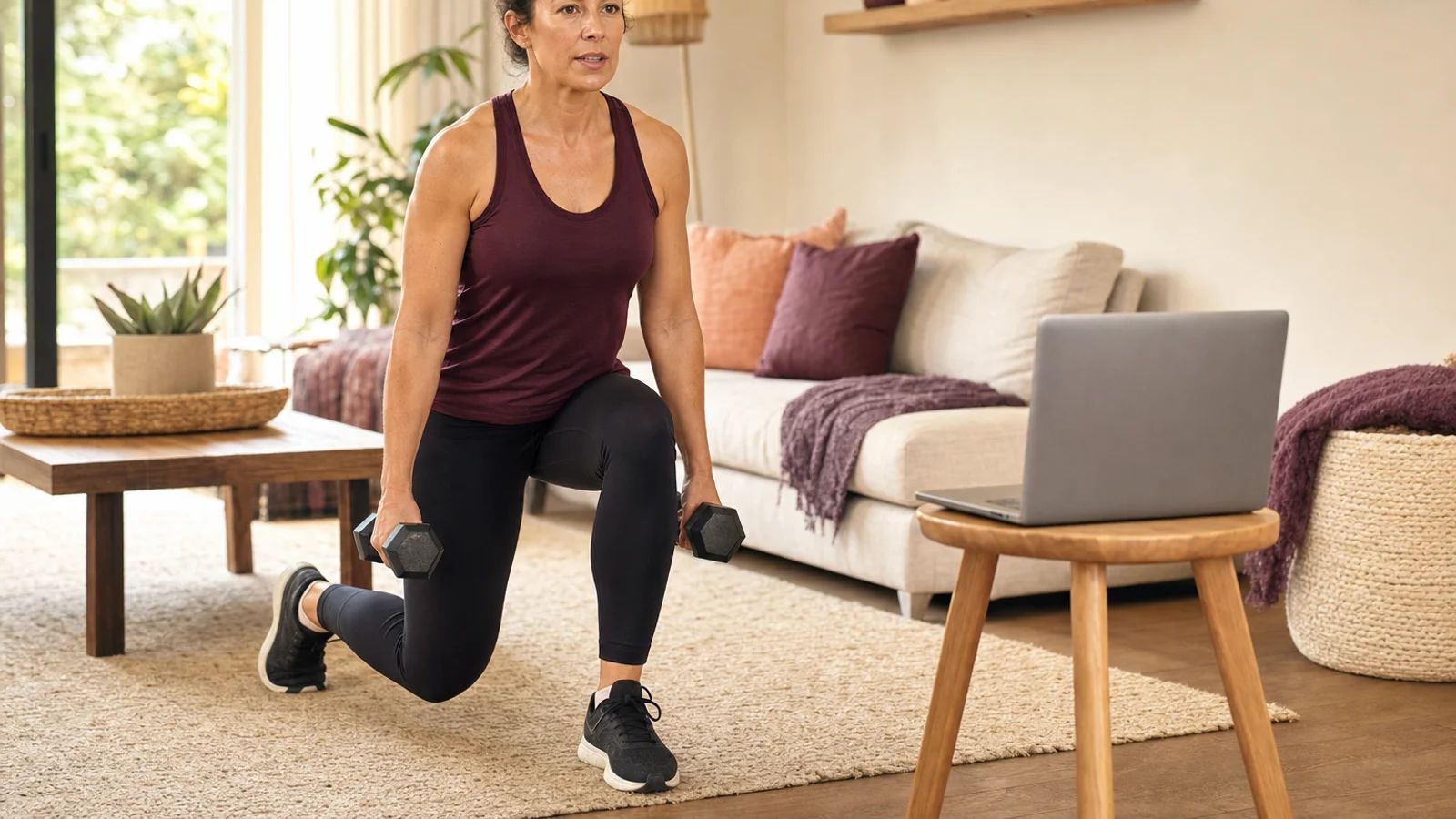
Yes, as long as somebody is actually watching you train. That's the short answer, and the research is unusually tidy about it.
In the cleanest head-to-head test we have, lifters were handed the exact same ten-week program. The ones training under a coach's eye finished 88% of their sessions. The ones with an app finished 81%. The ones left to get on with it finished 52%.1 Same exercises, same sets, wildly different amounts of training that actually happened.
So the screen was never the variable. Being watched was. And being watched holds up over video better than most people expect.
I build Bespoke Fit, a live online coaching service, so I have a stake in the answer. That's why the numbers below come from published research and not from me, and why I'll point out where the evidence is thin.
Three products, one name
Three quite different things get sold as online personal training, and they don't perform the same. Worth separating them before we look at any numbers.
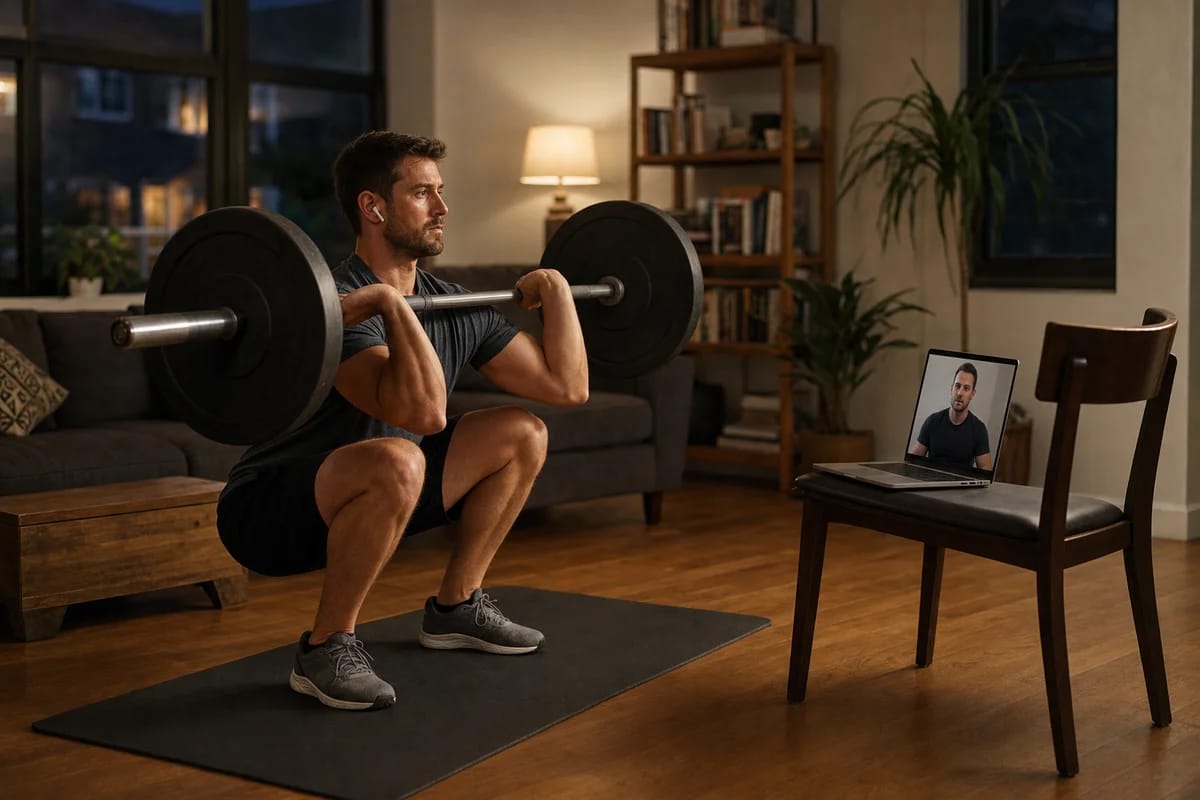
Live coaching puts a coach on video with you during the workout, watching your sets as they happen. Fewer companies sell it, because it doesn't scale the way the others do.
Async coaching means a real human writes your program and messages you, but you train alone. You film a set and they comment on it tomorrow. Future, Caliber and trainwell work this way.
Under both sit apps and PDFs, where nobody knows whether you trained today. I've written a longer breakdown of the top two in live vs async online coaching. Keep the three tiers in your head, because the research lines up with them almost too neatly.
Does the screen cost you anything?
Start with the bit people actually doubt: whether coaching survives being delivered through a laptop.
The biggest pooled answer covers 28 studies of 2,086 adults over 65 doing exercise programs run live over video. In the methodologically strong studies, video-delivered training worked as well as training in the same room. Attendance averaged 79.7%, completion 92.8%, and injuries and other adverse events were no more common than in person.2
Over-65s are the hardest possible group to prove this on. Least comfortable with the technology, most likely to want a hand on the shoulder. It still held up.
What you genuinely lose over video is touch. No spotting, no hands-on cueing, no shared gym equipment. What you keep is the part the evidence says drives results: a coach who sees the rep, says something about it, and changes the next set.
Same program, three ways to deliver it
A 2025 trial in the Journal of Strength and Conditioning Research took 79 trained men and women, gave them all the same three-day full-body program for ten weeks, and changed one thing. Some were supervised by a coach. Some were guided by an app. Some got the plan as a PDF and nothing else.
Everyone who trained got stronger, and the squat and bench numbers of the people who did the work weren't far apart. The programs were fine.
What split was how much of the program happened at all: 88% of sessions with supervision, 81% with the app, 52% alone. The supervised group was also the only one to put on meaningful fat-free mass, about 1.4 kg (roughly 3 lb) in ten weeks.1
Ten weeks isn't long. The gap it opened was mostly a gap in showing up.
Why being watched makes you lift heavier
None of this is new, and none of it is about video. Supervision was beating self-direction offline long before anyone tried it over a webcam.
The oldest clean test ran in 2000: 20 moderately trained men, 12 weeks, one identical periodized program, half of them supervised and half not. The supervised half added around 1.4 kg of fat-free mass. The other half added about 0.3 kg, well under a pound.3 Same program on paper, different program in practice.
Repeat it in a commercial gym and the answer holds. Thirty-four members, twelve weeks, and the ones training with a personal trainer gained about 1.3 kg (just under 3 lb) of lean mass while the self-directed group gained essentially none, with clearly bigger strength gains too.4 Pool twelve of these trials, 577 people between them, and you get a small but consistent strength edge for supervision.5 The authors called their own review exploratory, which is fair. The same pattern turns up in older adults, where supervised strength and balance programs beat unsupervised ones on both.6
So why would someone watching change anything? The mechanism is right there in the data. Supervised lifters use heavier loads and add weight sooner. Train alone and most people stop sets well short of real effort and sit on the same dumbbells for a month, because you can't tell from inside a set that you had three more reps in you. Someone outside it can, from your bar speed and your face, and they say so before you rack the weight. I go further into that in why a coach watches every rep.
A coach doesn't make squats work better. A coach gets you to do more squats, at the weight where squats do something.
Why apps lose people even when the plan is good
That 52% came from a trial, where people are recruited, measured and paid attention to. Out in the world it's worse.
Pooled across 17 studies of app-based health programs, dropout runs about 43%. It's roughly 49% in real-world settings against 40% inside trials, which tells you how much of the good behavior in any study is the study itself.7 Fitness apps are notorious in industry data for losing most of their users within weeks, and plenty of them make their money on people who subscribe and stop turning up.
The reason is boring and human. An app's accountability is a notification, and a notification costs nothing to ignore. Async coaching does better, because ignoring a person who typed your name is harder than swiping away a badge. Live coaching does better again, because the session is an appointment and the coach is already on the call at six, waiting for you specifically.
Each step up makes bailing more awkward, and the adherence numbers climb with it. Results follow the dose, and the dose is just the sessions you didn't skip.
Where the evidence gets thin
I'd rather you knew the weak spots.
The supervision literature is small. That pooled review covered twelve studies and its authors labeled it exploratory for good reason. Most of these trials run 10 to 12 weeks, so nobody has measured a year of live online coaching against a year of an app.
The video evidence is strongest in people over 65. There's no obvious reason a 35-year-old would respond worse to a coach on a screen, but that's an assumption, not a result.
Everyone in a trial also gets measured and monitored, which props up adherence in every group. Real-world gaps between the three models are probably wider than the trial gaps, not narrower. And selection never fully washes out: people who pay for coaching tend to be people who were readier to train in the first place.
If you're choosing right now
- Quit two or more programs before week eight? Buy accountability first and programming second. Adherence is the variable supervision reliably fixes.
- Ask any service one question: what happens when I skip? A text the next day is worth something. A human already on the call is worth more.
- Consistent self-starter? Take the cheaper option and don't feel bad about it. The self-guided lifters who showed up still got stronger.
- Give whatever you pick 10 to 12 weeks at 2 to 4 sessions a week before you judge it. That's the window and the dose the trials used.
- Push the load up every week. The supervised groups mostly won on progression, so if you train alone, add reps or weight on a schedule instead of waiting until you feel ready.
Common questions
Does online personal training work for beginners?
Beginners probably get the most out of it. The things supervision improves, technique, load progression, honest effort, are exactly the things you can't judge for yourself yet. The condition is that a beginner needs the live version, or feedback often enough to feel live. Handing a novice a PDF is the setup that produced 52% adherence.
How much does online personal training cost?
Async coaching from a real human usually runs low hundreds a month, and live 1-on-1 costs more than that. Our comparison pages keep current prices for the big services. Bespoke Fit is $49 for your first month, then $299 a month at the founding member rate with unlimited live sessions. At four sessions a week that works out to about $18.69 a session.
Do I need a gym for this to work?
No. Most of the video studies used home programs with modest equipment and still produced real strength and function gains. What you can't skip is progression, so you need some way to keep making the work harder: a barbell, adjustable dumbbells, bands, or a coach who knows how to progress whatever you own.
How long before I see anything?
The trials measured real change in 10 to 12 weeks. Strength went up in every group that trained, and 1.3 to 1.4 kg of lean mass showed up in the supervised groups. Strength moves first and visible body composition trails it. If a service promises dramatic change in a month, the research isn't behind them.
What we built, and when to ignore it
Bespoke Fit exists because of the split in that ten-week trial. The model where a coach is present during the workout is the one that keeps adherence near 90% instead of near 50%. So every session is a live 1-on-1 HD video call with a real coach, never an AI, who writes your programming session by session and adjusts it in real time from what they see. The accountability is the old-fashioned kind: a booked appointment with a human already on the call. How a session runs covers the mechanics, and the numbers, including the $49 first month and the 30-day money-back guarantee, are on pricing.
The self-guided lifters who showed up got stronger too. If that was you all last year, you already own the thing we're selling, and your money is better spent elsewhere. Buy supervision if showing up is your bottleneck. For most people, honestly, it is.
Sources
-
Gavanda and colleagues, 2025. Optimizing resistance training outcomes: comparing in-person supervision, online coaching, and self-guided approaches: a randomized controlled trial. Journal of Strength and Conditioning Research. ↩ ↩2
-
Toledano-Shubi and colleagues, 2025. Feasibility and effectiveness of physical exercise for older adults delivered remotely via videoconferencing-systematic review and meta analysis. Age and Ageing. ↩
-
Mazzetti and colleagues, 2000. The influence of direct supervision of resistance training on strength performance. Medicine and Science in Sports and Exercise. ↩
-
Storer and colleagues, 2014. Effect of supervised, periodized exercise training vs. self-directed training on lean body mass and other fitness variables in health club members. Journal of Strength and Conditioning Research. ↩
-
Fisher and colleagues, 2022. The role of supervision in resistance training: an exploratory systematic review and meta-analysis. International Journal of Strength and Conditioning. ↩
-
Lacroix and colleagues, 2017. Effects of supervised vs. unsupervised training programs on balance and muscle strength in older adults: a systematic review and meta-analysis. Sports Medicine. ↩
-
Meyerowitz-Katz and colleagues, 2020. Rates of attrition and dropout in app-based interventions for chronic disease: systematic review and meta-analysis. Journal of Medical Internet Research. ↩
More on