Personal trainer for seniors: how to choose and what to pay
How to choose a trainer for an older parent or yourself: what to check, what in-home and online sessions cost, and when a physical therapist comes first.
In this article8
The short version
Look for a certification you can check, real experience with older adults, and a first session of health questions and movement checks. In person, expect about $50 to $90 a session at a gym and $60 to $120 at home. After a fall or with unsteady walking, a physical therapist comes first. If they're steady and will train at home twice a week or more, a coach live on video costs less: ours is $299 a month for as many sessions as they like.
Maybe your mom's doctor said she needs to get stronger. Maybe physical therapy for your dad's knee ended a month ago and nothing took its place, or a sibling call ended with "someone should do something". You're about to spend real money on someone whose work you'll rarely see, often from another city. If you're in your 70s and reading this for yourself, read every "your parent" as "you". All of it applies.
A note on where we stand: we run a coaching service where older adults train with a coach live on video, so we're not neutral. We'll say where that fits, where it doesn't, and who does better.
Is it safe, and do they need a doctor's OK first?
For most people, starting is safer than not starting. The World Health Organization's guidance is that someone with no medical reason to avoid it generally doesn't need a doctor's clearance for light or moderate activity, the kind that's no harder than a brisk walk.1 To find out whether your parent is an exception, use the PAR-Q+, a short questionnaire that trainers and clinicians use, free to download. A "yes" sends you on to follow-up questions, and maybe to the doctor.
A visit to the doctor or a physical therapist comes first if your parent:
- has fallen in the past year, or walks unsteadily
- has had recent surgery or a joint replacement
- has a heart condition or blood pressure that isn't under control
- gets chest pain, dizziness, blackouts or unusual breathlessness when they exert themselves
- has osteoporosis and has broken a bone in a minor fall
That's not a reason to skip training. It's a reason to start it with the right person. Falls are the leading cause of injury for adults 65 and older, and about 1 in 4 report a fall every year,2 which is exactly why the training is worth doing. Training in your 70s walks through the PAR-Q+ questions and how to start once the answers are clear.
Which kind of help fits
There are six kinds of help, and the right one depends less on age than on how steady your parent is and how much they'll actually do.
| Kind of help | Rough cost | Who watches the workout | Best when |
|---|---|---|---|
| Physical therapist | You pay 20% after the Part B deductible3 | A clinician, in the room | After a fall or surgery, or unsteady |
| Community falls or exercise class | Varies; free in some Medicare Advantage plans4 | An instructor, with a group | They like company and are steady |
| Trainer at a gym or studio | About $50 to $90 a session5 | A trainer, in the room | They drive and don't mind a gym |
| Trainer who comes to the home | About $60 to $120 a session67 | A trainer, in the room | They need hands-on help or setting up |
| Coach live on video | About $60 to $320 a month8 | A coach, on camera, every session | They're steady and happy to train at home |
| App-based coach | About $95 to $150 a month910 | Usually nobody; the coach checks in after | They're confident alone and mostly need a plan |
On that last row: with app-based services such as trainwell and Kickoff, the coach writes the plan and checks in, but usually nobody watches the workout itself. trainwell's workouts aren't coached live (its own site points people who need "real-time correction on every rep" to an in-person trainer), and live video workouts are optional at Kickoff. That matters more when balance is the worry.
Don't skip the community classes. The National Council on Aging lists 20 evidence-based falls programs, including A Matter of Balance, Stepping On, Tai Ji Quan and EnhanceFitness, with a map to find one nearby.11 If your parent is sociable and steady, start there and add a trainer later if they want more.
What to look for in the trainer
A certification you can check. Ask which one, and the number, then look it up in a couple of minutes. This table of official lookups covers the main US ones (NASM, ACE, ISSA, ACSM, NSCA and NCSF) and the mark to look for: an exam accredited by the NCCA. Senior badges mean less than they sound. ACE's Senior Fitness Specialist Program, for example, is an online continuing-education course (a digital textbook, recorded video and a quiz), and you need an ACE credential to earn its credits.12 It's a good sign of interest, not proof of skill. Real hours with people like your parent matter more.
Real strength work, not only stretching. A lot of senior fitness is chair stretches and light bands forever. The CDC asks adults 65 and older for muscle-strengthening work at least two days a week, plus balance training.13 In the best evidence we have, programs that mix balance and strength probably cut the rate of falls by about a third.14 A good trainer makes things gradually harder and can tell you how they decide when. Training in your 60s and why power matters for falls show what a program should include, even at 80.
Someone who talks to your parent, not about them. Patience, plain words and treating them as the adult in charge. If the trainer addresses you instead of your dad on the first call, that tells you how the sessions will go.
Where to find two or three to call
- Their physical therapist or doctor. Ask who they hand patients on to when therapy ends. They know who is careful.
- The certifier's own directory. Find an ACE Pro searches by location and specialty.15
- The Eldercare Locator. A public service of the federal Administration for Community Living, at eldercare.acl.gov or 1-800-677-1116, that connects families to their local Area Agency on Aging and services nearby.16
- In-home marketplaces such as RightFit and ElderFIT list trainers who come to the home, with their rates.67

Then put these to each one, whether you're asking for a parent or for yourself. Good trainers are glad you asked.
Questions for the first call
- "How many clients over 65 do you train now, and on what?" A good answer is a number and an example.
- "What happens in the first session?" Listen for health questions and watching your parent stand, walk and balance before any workout.
- "How do you decide to make it harder?" Good: a rule, like adding reps once two sets feel easy. Worrying: "we'll see".
- "What do you do if they feel dizzy mid-session?" Listen for stop, sit, watch them recover, and when to call for help.
- "Do you carry liability insurance and current CPR, AED and first aid?" For someone coming to the home, also ask about a background check.
- "Is it the same trainer every time, and who covers when you're sick?"
- "What does cancelling cost, and how much notice do you need?"
- "When would you send them to a doctor or physical therapist instead?"
- "How will you keep me posted?" Agree the answer with your parent first.
If something in the answers feels off, our red flags guide covers the warning signs in detail.
How you'll know it's working
You'll rarely see a session, so pick one or two numbers at the start and check them again later. The 30-second chair stand needs a dining chair and a timer, and every 8 to 12 weeks is a sensible gap between tests. Walking speed and grip strength are the other two worth knowing. The everyday signs count as much: the stairs without the rail, getting up off the floor, carrying the shopping in one trip.
What it costs
Trainers quote by the session. Families pay by the month, so here's the month. Twice a week comes to about 8.7 sessions:
Bark (US average $50 to $90 a session), RightFit (Los Angeles in-home median, $100 an hour), ElderFIT (Riverside, CA, up to $120 a session) and HipTrain's 60-minute plan, read November 2026. 8.7 sessions a month is our arithmetic
Our $299 works out to about $34.50 a session at twice a week, and about $23 at three times, because the price doesn't change with how often your parent trains.
HipTrain is the closest like-for-like: live 1‑on‑1 video every session, the same coach each time, and cheaper at one or two hour-long sessions a week ($109.99 or $219.99 a month).8 If once a week is the plan, it's the better buy. At twice a week the gap is about $79 a month, and here's what it buys:
- Room to add sessions. A third hour a week takes HipTrain to $319.99 a month, more than our $299, and its plans stop there. Here a third or fourth session, say one just for balance, costs nothing, so the coach can add it without a price conversation.
- A coach with a small roster. No coach here has more than 12 members, and we enforce that. We couldn't find a published number for HipTrain as of November 11, 2026.
Can Medicare or an HSA pay for it?
Mostly not for a trainer. Original Medicare doesn't cover gym memberships or fitness programs.17 Some Medicare Advantage plans include SilverSneakers, which gives members gym access, live online classes and on-demand videos at no extra cost. Personal training isn't part of what it lists.4 Call the plan and ask what's in it.
Physical therapy is different. Part B helps pay for outpatient therapy that a doctor or other provider certifies your parent needs, including to keep their current abilities or slow a decline, not only to recover from something.3
An HSA or FSA usually won't cover general fitness. The IRS only counts it as a medical expense when it's for a particular medical condition.18 Ask the plan administrator before you count on it.
Why a coach on live video suits a lot of older adults
Say your dad is doing sit-to-stands from a dining chair, two sets of eight, from the plan his coach wrote. By rep six he's pushing off his thighs with his hands. His coach sees it, stops the set there, and has him put a firm cushion on the seat for the next one so he doesn't have to rise from as low. Nobody waits a week to find out the plan was too hard. If he wears an Apple Watch or a Bluetooth heart rate strap, his coach also sees his heart rate live and uses it to decide how hard to push and when to rest.
That's the whole case in one example: someone is watching while it happens. The rest follows from it.
A coach who knows them. A head coach matches your parent to a coach on a 30-minute strategy call, and with a roster that small, that coach remembers last week and why. Every coach goes through a 90-day vetting process with our founder before they see a member, then is onboarded on our systems, camera setup, cueing and session pacing.
Nothing to drive to. Your parent trains at home, in normal clothes, in our own app on an iPhone, an Android phone, or a browser on a laptop or tablet. If eyesight isn't what it was, they can pinch to zoom in on the coach. Every session arrives as a calendar invite, with reminders the day before and shortly before, so nobody has to remember the time.
Sessions and the app. Sessions run 45 to 90 minutes at the same price, and most people settle at around an hour. The program, progress and a recap of each session sit in the app, and your parent can message their coach, photos included.
Here's how we answer the checklist:
| Your question | Our answer |
|---|---|
| Experience with older adults? | Coach JP lists training for older adults as a specialty, and our head coach, Tris, is also a registered nurse. All the bios are on our coaches page. |
| How do you make it harder? | The coach who writes the plan watches every set, and changes it from what they see, as with the cushion. |
| What if they feel dizzy? | They stop and sit straight away. The coach is watching for it too, and stops the set. |
| Same coach every time? | Yes. If the match isn't right, ask and we'll move them. |
| What does cancelling cost? | Nothing at 12 or more hours' notice. Later than that, three a month are free, then $20 each.19 |
| How will you keep me posted? | The recaps, progress and messages are in your parent's app, so the simplest update is them showing you. |
Does training over video actually work for older adults? The research so far is on live video group classes rather than 1‑on‑1, but in a review of those studies, the four that compared video with in-person classes found no significant differences in results.20 Here's how one member put it:
"I was skeptical about doing training over video at my age, but it has been much easier than I expected. My trainer is patient and adjusts everything to what my body can handle. I have exercised more in the past two months than in the last ten years. My friends can see the difference."
Wanda, 70, a member who trains with JP
Making a video session safe at home
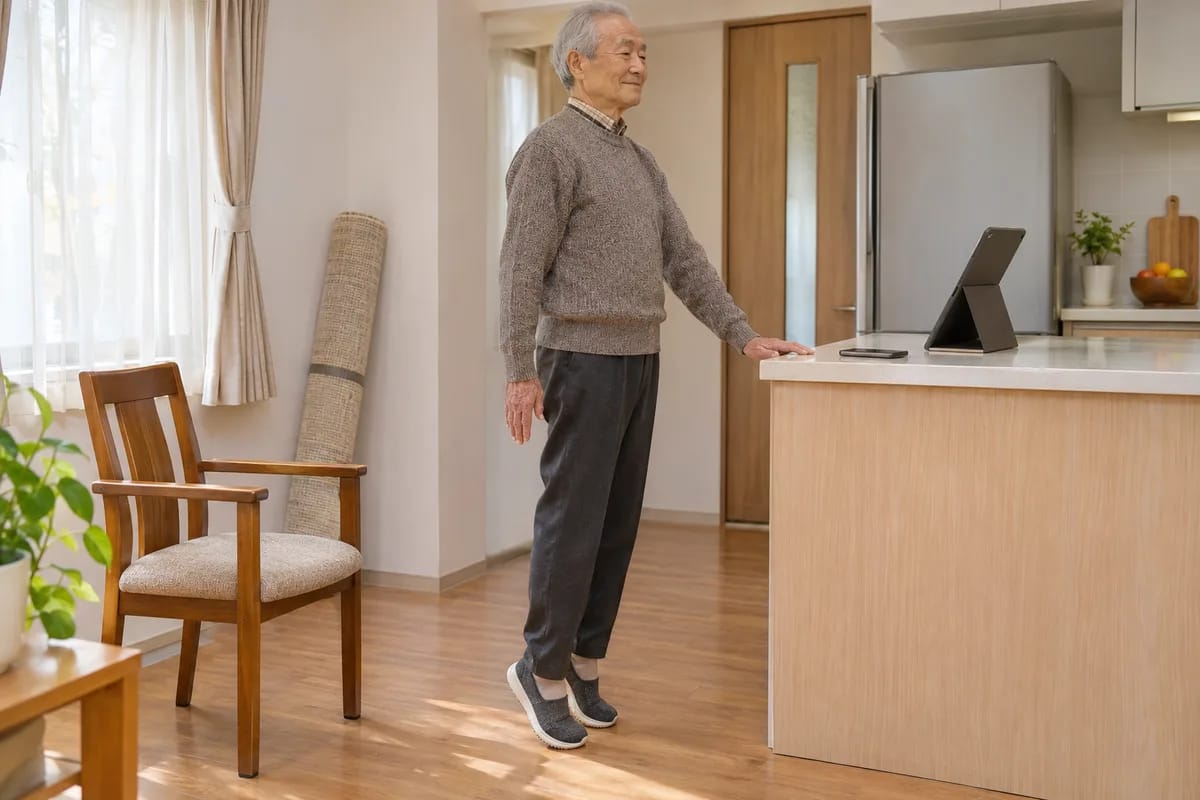
Nobody on a video call can catch someone, us included. So set the room up so nobody needs to. Keep a sturdy chair or the kitchen counter within reach for anything that tests balance. Roll up any loose rug and wear shoes with grip. Keep a phone within reach too, and know who your parent would call: a coach on a screen can see trouble but can't open the front door. If balance work, like standing on one leg, is new to them, have someone else at home for the first few sessions. Our camera setup guide covers where the tablet or laptop goes. How live 1‑on‑1 video training works has more on what happens during a session.
When we're the wrong pick
- Your parent has fallen in the past year or is unsteady on their feet. Start with the safety list at the top.
- They need someone in the room each time, to set up, follow along or remember the plan. An in-home trainer is the right call. With Parkinson's or dementia, ask their clinician whether an in-person specialist would suit them better.
- They want hands-on help, like a guiding hand on a balance exercise or someone to spot them.
- $299 a month is too much, or they'll train once a week. HipTrain or a community class, both above.
- They want meal plans. Our coaches don't do nutrition.
- They want to train whenever the mood strikes. Our sessions are booked with the coach.
Getting a parent to say yes
The quickest way to lose this argument is to make it about age. Make it about what they want to keep doing: the stairs to the bedroom, carrying a grandchild, the trip next spring, getting down to the garden bed and back up.
Let them choose. The coach, the time of day, whether to try it at all. If you offer to pay, offer it as a gift, not a prescription. If it's you, the same goes: choose the coach and the time yourself.
Then make the first step small. Set up the tablet or laptop together, propped at chest height with enough floor to stand and step. Ask if they'd like you there for the first call, and take no for an answer. The first session is usually the strangest one, and being on camera stops feeling odd faster than most people expect.
With us, it starts with the strategy call. The 14 days free begin at the first session, not at signup, then it's $299/mo. That's enough time for your parent to decide for themselves.
Sources
-
Bull FC and colleagues, 2020. World Health Organization 2020 guidelines on physical activity and sedentary behaviour. British Journal of Sports Medicine. ↩
-
Centers for Disease Control and Prevention, updated September 4, 2026. Older adult falls data. "Over 14 million, or 1 in 4 older adults report falling every year", and falls are "the leading cause of injury for adults ages 65 years and older". Read November 12, 2026. ↩
-
Centers for Medicare and Medicaid Services. Physical therapy services. Medicare.gov. Part B covers outpatient physical therapy a provider certifies as medically necessary, including to maintain function or slow decline; after the Part B deductible, you pay 20% of the approved amount. ↩ ↩2
-
Anthem, 2026. SilverSneakers: "live online fitness classes, on-demand videos, and access to thousands of gyms", at "no cost to you if SilverSneakers is included in your Medicare Advantage plan". Anthem is a Medicare Advantage insurer. Read November 12, 2026. ↩ ↩2
-
Bark, updated January 16, 2026. How much does a personal trainer cost?. An average of $50 to $90 a session for US trainers, higher in some big cities, with in-home or private-studio sessions "typically higher". Read November 12, 2026. ↩
-
ElderFIT, 2026. In-home personal trainers for seniors in Riverside, CA. A marketplace for in-home senior trainers. Its FAQ says "Prices typically range from $60-$120 per session"; the trainer listings on the same page run $56 to $90. Read November 12, 2026. ↩ ↩2
-
RightFit Personal Training, updated November 11, 2026. Personal trainers in Los Angeles, CA: in-home median "$100 an hour", and 22 trainers serving Los Angeles who list geriatric fitness training as a specialty. Read November 12, 2026. ↩ ↩2
-
HipTrain, 2026. Pricing: live 1‑on‑1 video every session, from $59.49 a month for one 30-minute session a week to $319.99 for three 60-minute sessions, with 60-minute plans at $109.99 and $219.99 for one or two a week; plans stop at three a week. Read November 11, 2026. HipTrain is a competing service. ↩ ↩2
-
Kickoff, 2026. Personal training for $3 a day: "$95 Billed Monthly", with texts from a coach and "Optional 1‑on‑1 Live Video Workouts". Read November 11, 2026. Kickoff is a competing service. ↩
-
trainwell, 2026. FAQ: $149 a month, billed $447 every three months. Its how it works page: "Sessions aren't supervised in person, so if you need hands-on spotting or real-time correction on every rep, an in-person trainer may suit you better", and "Book a live video call to work through technique together in real time". Read November 11, 2026. trainwell is a competing service. ↩
-
National Council on Aging, June 22, 2026. Evidence-based falls prevention programs. 20 programs and a locator map. Read November 12, 2026. ↩
-
American Council on Exercise, 2026. Personal Trainer and Active Aging Coach bundle: "Senior Fitness Specialist Program | 2.5 CECs", a digital textbook, recorded video and online quiz, and "You must first hold an ACE Credential before completing this online course". Read November 12, 2026. ↩
-
Centers for Disease Control and Prevention, December 4, 2025. Physical activity guidelines for older adults: at least 150 minutes of moderate activity a week, muscle strengthening on at least 2 days, and activities to improve balance. ↩
-
Sherrington C, Fairhall NJ, Wallbank GK and colleagues, 2019. Exercise for preventing falls in older people living in the community. Cochrane Database of Systematic Reviews. Programs combining several types of exercise, usually balance plus strength, probably cut the rate of falls by 34% (moderate-certainty evidence); balance and functional exercise alone, by 24%. ↩
-
American Council on Exercise, 2026. Find an ACE Pro: "Filter your search by location, specialty, or type of credential". Read November 12, 2026. ↩
-
Administration for Community Living, 2026. Eldercare Locator: "a public service of the Administration for Community Living connecting you to services for older adults and their families", including Area Agencies on Aging; call or text 1-800-677-1116. Read November 12, 2026. ↩
-
Centers for Medicare and Medicaid Services. Gym memberships and fitness programs. Medicare.gov: "Medicare doesn't cover gym memberships or fitness programs", which "may be part of the extra coverage offered by Medicare Advantage Plans". Read November 12, 2026. ↩
-
Internal Revenue Service, 2025. Publication 502, Medical and dental expenses: costs that only improve general health aren't medical expenses unless they're for a particular medical condition. ↩
-
Bespoke Fit. Terms of service: cancel at least 12 hours before a session at no charge; three free late cancellations per calendar month, then $20 each. ↩
-
Fernandez D, Wilkins SS, Melrose RJ, and colleagues, 2023. Physical function effects of live video group exercise interventions for older adults: a systematic review and Veteran's Gerofit group case study. Telemedicine and e-Health. Nine studies; the four with an in-person comparison found no significant differences. ↩
More on