Red flags when hiring an online personal trainer
Ten warning signs to check before you pay an online trainer, why each one predicts a bad outcome, and how to verify certifications and refund terms.
Updated

Search for an online personal trainer and you get a wall of confident faces making the same claims, with nothing on the page to tell them apart. Personal training is an unlicensed trade in the US. No state board checks who uses the title, and online the last few filters fall away too: no gym vetting the staff, no front desk to complain to, sometimes no legal name on the site. Screening is your job.
Bad online trainers do signal early though, usually before your card comes out. Ten signals below, grouped by what they cost you rather than by how often you'll run into them, because a resetting countdown timer is tacky and a coach programming around an injury they've never seen is dangerous.
I run Bespoke Fit, an online coaching service, so I'm selling something here. Every flag comes with its reasoning, which means you can point the list back at us. There's a section near the end where I do that.

Promises nobody can keep
A results guarantee
What happens to your body depends on adherence, sleep, stress, food, injury history, and where you're starting from. A trainer controls none of it. So a guarantee isn't confidence. It's a claim about things the seller can't see, made to close a sale.
The FTC puts it in writing. Its Gut Check guide for media buyers lists a product that "guarantees" results for everyone among the claims that are simply false, and the agency has brought more than 250 cases over deceptive weight-loss claims.
Don't confuse that with a money-back guarantee. "You'll lose 20 lbs" is a promise about your body. "Full refund if you're not happy" is a promise about their invoice. The second one is normal and fine. The first is the tell.
Certainty about an injury nobody has looked at
There's a line between working around a limitation and treating a condition, and scope-of-practice guidance from bodies like ACSM and NSCA puts diagnosis, treatment, and rehab on the far side of it. A trainer who confidently programs "around" your disc issue off a single intake form skipped the assessment that in-person professionals still need, and skipped the referral a good coach makes.
The flag isn't a coach acknowledging your injury. It's certainty without looking. What you want back is questions. When does it hurt, what makes it worse, can you get clearance from your physio, and then conservative work until somebody qualified has seen it. "No problem, I've got a template for bad backs" is a guess meeting your spine.
The same meal plan for everyone
Selling every client the same macros, or the same paywalled meal plan, fails twice. It ignores your medications, your history, and what you'll realistically eat, so it's a template wearing a lab coat. It may also be illegal: individualized meal plans sit inside the scope of dietetics, and the American Nutrition Association's state map shows most US states license who can provide individualized nutrition counseling.
General nutrition education, portion guidance, and habit coaching are fair game for a trainer. A prescriptive plan sold to all comers as an upsell is a different thing.
What you can check in two minutes
"Certified" with no organization attached
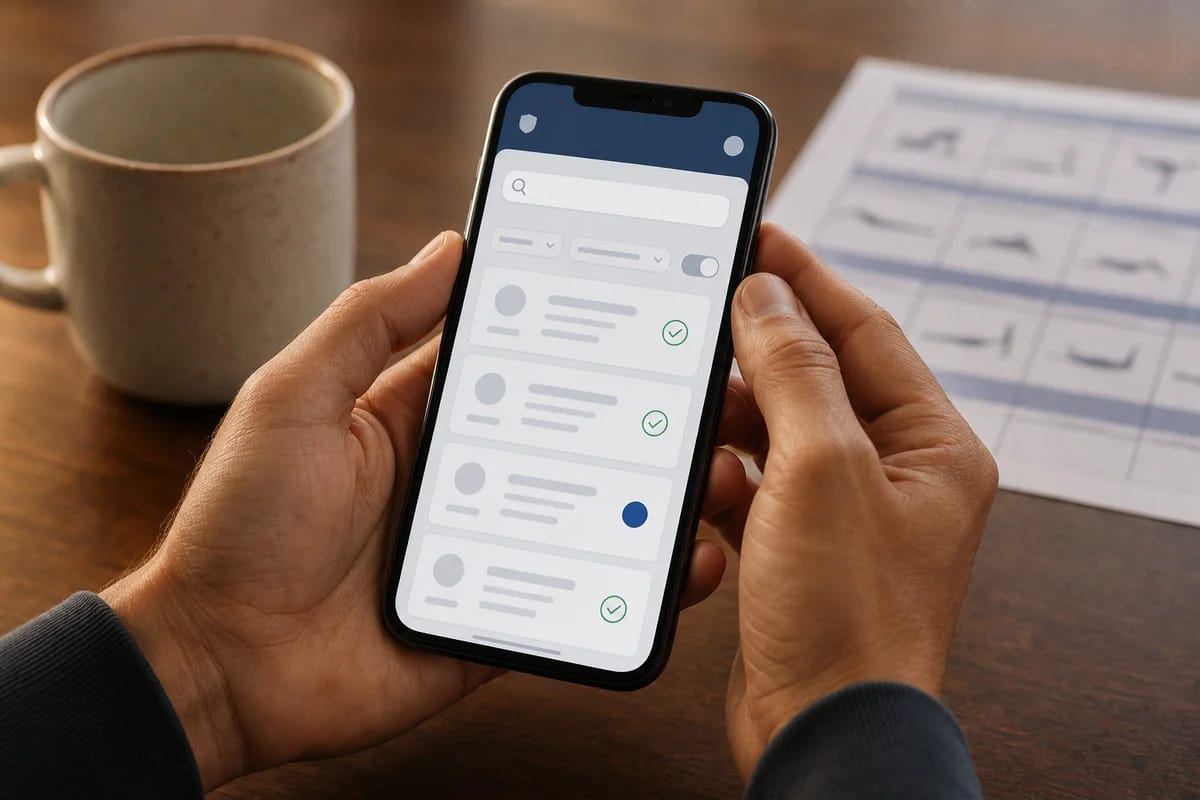
Credential vagueness looks like "certified trainer" with no organization, no credential name, no number. Real certifications are verifiable online in minutes, so vagueness is a choice. Go and look:
- NASM: the credential validation page confirms an active NASM-CPT.
- ACE: use ACE's certification verification or the Find an ACE Pro directory.
- NSCA: submit the certification verification form, answered within a couple of business days.
- USREPS: the United States Registry of Exercise Professionals covers 130,000+ currently certified professionals in one search.
Ask for the certifying body and the trainer's full name, then check. Someone who stalls, or names a credential from an outfit that appears nowhere, has answered your question. One caution runs the other way: a cert is a floor, not a ceiling. Use it to rule people out, not to rule them in.
A template with your name typed on it
"Fully customized programming" is the most copied phrase in online fitness, and it's cheap to fake. A template with your name on it costs the seller nothing and costs you a custom price.
Finding out takes one message: "What changes in my program if I report knee pain in week two?"
A real coach gets specific, because that's the job. Swap the loading pattern, cut the range of motion, ask when it hurts, refer out if it looks beyond them. A template seller says "the program adapts to your feedback" and stops there, with no mechanism behind it. Vague answers to specific questions mean nobody is making decisions about you.
No live contact at any price
Some services are honestly async, coaching you between workouts rather than during them, and that suits self-driven people fine. Live and async are different products at different prices, and neither is a scam. The flag is a service where a live conversation isn't available at all, at any price. Then nobody has watched you move, and the form feedback is guesswork stacked on a questionnaire.
Supervision is one of the few things here with real evidence behind it. Pooled trials comparing supervised with unsupervised lifting find a moderate edge for supervision on strength, largely because people load the bar properly when someone is watching.1 The sharper number is about showing up at all: a 2025 trial in the Journal of Strength and Conditioning Research followed 79 trained adults for 10 weeks and logged 88.2% adherence with supervised training against 52.2% self-guided, with app-guided coaching in between at 81.2%.2 People skip fewer sessions when a human is there.
A wall of before and after photos
Those photos are survivorship on display. You see the twenty clients who finished, not the two hundred who quit in week six. A context-free wall proves the best case exists, which nobody doubted.
The law leans the same way. Under the FTC's Endorsement Guides, revised in 2023, an advertiser using a testimonial that isn't typical of what customers get must clearly disclose the results generally expected, and a buried "results not typical" line doesn't count. Photos with dates, methods, and real base rates are good evidence. The context-free wall predicts a service that can't talk about its outcomes straight.
The money and the exit
A price that only appears on a call
If the number shows up only after a "free strategy call", the number isn't fixed. It gets set on the call, often after a scripted conversation about how much your goal is worth to you. That structure exists to charge each person the most they'll accept, and to make you decide inside a sales conversation.
Published pricing kills the whole dynamic. You compare, you sleep on it, you decide alone. What this market charges is public enough that nobody needs a discovery call to quote you. When a service hides its number, ask why the number needs a salesperson attached.
A countdown timer
Urgency is a tool for stopping you from thinking. The FTC's 2022 report Bringing Dark Patterns to Light names the mechanics: baseless countdown timers that reset when they hit zero, and false low-stock messages built to force a decision before you can compare.
So the test isn't whether a limit exists. It's whether the limit survives you poking at it. Refresh the page and see if the timer starts over. Come back in a week and see if it's still "3 spots left". An offer that only works when you don't think it over is telling you what thinking it over would turn up.
Nothing in writing about cancelling
"Just message us to cancel" is not a policy. It's a promise from someone with a reason to forget it. This matters more than it used to: the FTC finalized a click-to-cancel rule for subscriptions, and the Eighth Circuit threw the whole rule out in July 2025 on procedural grounds. No federal rule currently guarantees you an easy exit, so your written terms are the protection you have.
Get four things in writing before you pay: the exact price, what triggers renewal, the steps to cancel, and any refund conditions. If the answer lives only in a DM, assume the worst version of it.
When a flag isn't a verdict
One flag doesn't make somebody a scammer. A good solo coach might have no published pricing because they've never bothered with a website, and a mediocre one can hold three respectable certs, because a certification verifies a knowledge floor and nothing about coaching quality.
The supervision evidence has its own limits. Most of it is in-person and short-term, so how much of that adherence gap carries over to live video coaching specifically is still open, even if the mechanism (somebody is expecting you at 6pm) travels fine.
Treat the flags as evidence that compounds. One means ask a question. Three or four means walk. And weight them, because getting the money and injury ones wrong costs you far more than a tacky sales page does.
Before you pay
- Send the knee-pain question to everyone on your shortlist. Specifics pass, vagueness fails.
- Spend two minutes in USREPS or the certifier's own registry. No verifiable credential, no payment.
- Don't buy inside a sales call. Get the price and terms in writing, then decide at least a day later.
- Screenshot the refund policy, cancellation steps, and renewal terms before your card is charged.
- Walk away from any results guarantee, any timer that resets, and any meal plan sold to every client alike.
Common questions
Is it safe to hire a personal trainer online? It can be, with screening you do yourself, since no license governs the title. Verify the certification in a registry, get terms in writing, and confirm a real human will actually see you move. The flags above catch most bad actors early.
What certifications should an online personal trainer have? Look for an NCCA-accredited certification such as NASM-CPT, ACE-CPT, ACSM-CPT, or NSCA-CPT, and verify it with the certifying body or USREPS. Degrees and specialty credentials add depth, but the accredited cert is the baseline.
Can an online trainer give me a meal plan? General nutrition guidance, yes. Individualized meal plans belong to dietetics in most US states that license nutrition practice, so prescriptive plans should come from a registered dietitian. A trainer selling the same meal plan to every client is a flag on both legal and quality grounds.
Run the list at us
Two flags could plausibly point our way, so I'll say them first. We're young and we're small. No decade of testimonials, no big-brand safety net. If that gives you pause, that's a fair read of the evidence.
Here's what we can put on the other side. Our pricing is published rather than consult-gated: $49 your first month, then $299 a month locked for life as a founding member, $499 standard once the 25 spots fill. The 30-day money-back guarantee sits in writing on the pricing page, not in a DM. Email us inside 30 days and your first month is refunded, no questions asked. Our comparison pages cite their sources and show when each competitor's facts were last checked, so you can audit what we say about other people. Every session is live 1-on-1 HD video with a coach I vetted myself. And yes, "25 spots" is a scarcity claim, so hold it to the test I just gave you: it's a fixed cap tied to how many people one coach can genuinely know, published next to the price that follows it, and it doesn't reset.
Being new is a flag you offset with claims somebody can check, so check ours skeptically. If you've trained for years and can audit a program yourself, a $15 template and some discipline will do the job. This list is for when you're paying for judgment. The companion piece on how to choose an online personal training service runs the same decision from the other side, by fit instead of by elimination, and our FAQ covers what people ask us before joining. Whoever ends up with your card, make them show you the judgment you're buying.
Sources
-
Fisher, Steele, Wolf, Androulakis Korakakis, Smith, Giessing, 2022. The role of supervision in resistance training: an exploratory systematic review and meta-analysis. International Journal of Strength and Conditioning. ↩
-
Gavanda and colleagues, 2025. Optimizing resistance training outcomes: comparing in-person supervision, online coaching, and self-guided approaches: a randomized controlled trial. Journal of Strength and Conditioning Research. ↩
More on