Workouts for men over 50: a 3-day plan for gym or home
Three full-body workouts a week for men over 50: what to lift, how heavy, when to add weight, swaps for a cranky knee or shoulder, and what week 12 looks like.
In this article11
The plan in one line
Three full-body sessions a week, two hard and one lighter, about 40 to 50 minutes each. Every session opens with one fast move and a few main lifts, and most end with a carry or a short cardio finisher. Add weight when every set reaches the top of its rep range.
This is for the man who used to train and stopped somewhere between the second kid and the second mortgage, or who trains now but feels stuck, sore or bored. It runs in a gym or a garage with a pair of adjustable dumbbells, and every move has both versions side by side. Never lifted at all? Run the same plan and lean on the two-week on-ramp below; starting to lift at 50 walks you through your very first session. Most healthy men can start without a doctor's OK; the exceptions are in the questions at the end.
We run a live coaching service, and near the end we show what a coach on the call changes about this plan. Everything before that works on your own.
The week
| Day | What you do | About how long |
|---|---|---|
| Mon | Day A, hard | 50 min |
| Tue | Brisk walk, still able to chat | 30 to 45 min |
| Wed | Day B, lighter: speed and a cardio finisher | 40 min |
| Thu | Brisk walk, or off | 30 to 45 min |
| Fri | Day C, hard | 50 min |
| Sat | Something you enjoy: golf, a hike, a bike ride, the yard | As long as you like |
| Sun | Off |
Move the days to fit your life. The one rule: keep at least two full days between the two hard days. That shape, two hard days and an easier one between, is what tends to hold up after 50, and training in your 50s goes through why. Hard cardio counts as a hard day, so a spin class or a hard run takes the place of a hard lifting day rather than adding to it.
Make both walks 45 minutes, spend an hour on Saturday doing something that gets you breathing a little harder, and the week covers the CDC's 150 minutes of moderate activity as well as its two days of strength work.1
Before every session: a 10-minute warm-up
Three minutes of easy cardio
A brisk walk, a bike, or the stairs. Warm, not tired.
Ten hip hinges with a broomstick
Hold the stick along your spine so it touches your head, upper back and tailbone. Push your hips back until you feel the backs of your thighs, keeping all three points on the stick. It's the shape of the swing and the Romanian deadlift.
Fifteen band pull-aparts
Arms straight at shoulder height, pull a light band apart to your chest. No band? Slide your arms up and down with your back against a wall.
Ten slow squats to a bench or chair
Two ramp-up sets of your first main lift
The fast move needs none, and neither does Day B, where everything is already light. For the squat (the split squat on Day C), do one set at about half your working weight for 6 to 8 reps, then one at about three-quarters for 3 or 4. Now you start.
The three workouts
Each table has a gym version and a home version. The home version needs adjustable dumbbells, a resistance band and something sturdy to sit on. "3 × 6 to 10" means three sets, each of 6 to 10 reps. In your first two weeks, do two sets instead of three and stop every set with three or four reps left.
Day A: hard
| Move | Gym | Home | Sets × reps | Rest |
|---|---|---|---|---|
| Fast move | Kettlebell swing | Dumbbell swing, holding one dumbbell by its end | 3 × 5 | 1 to 2 min |
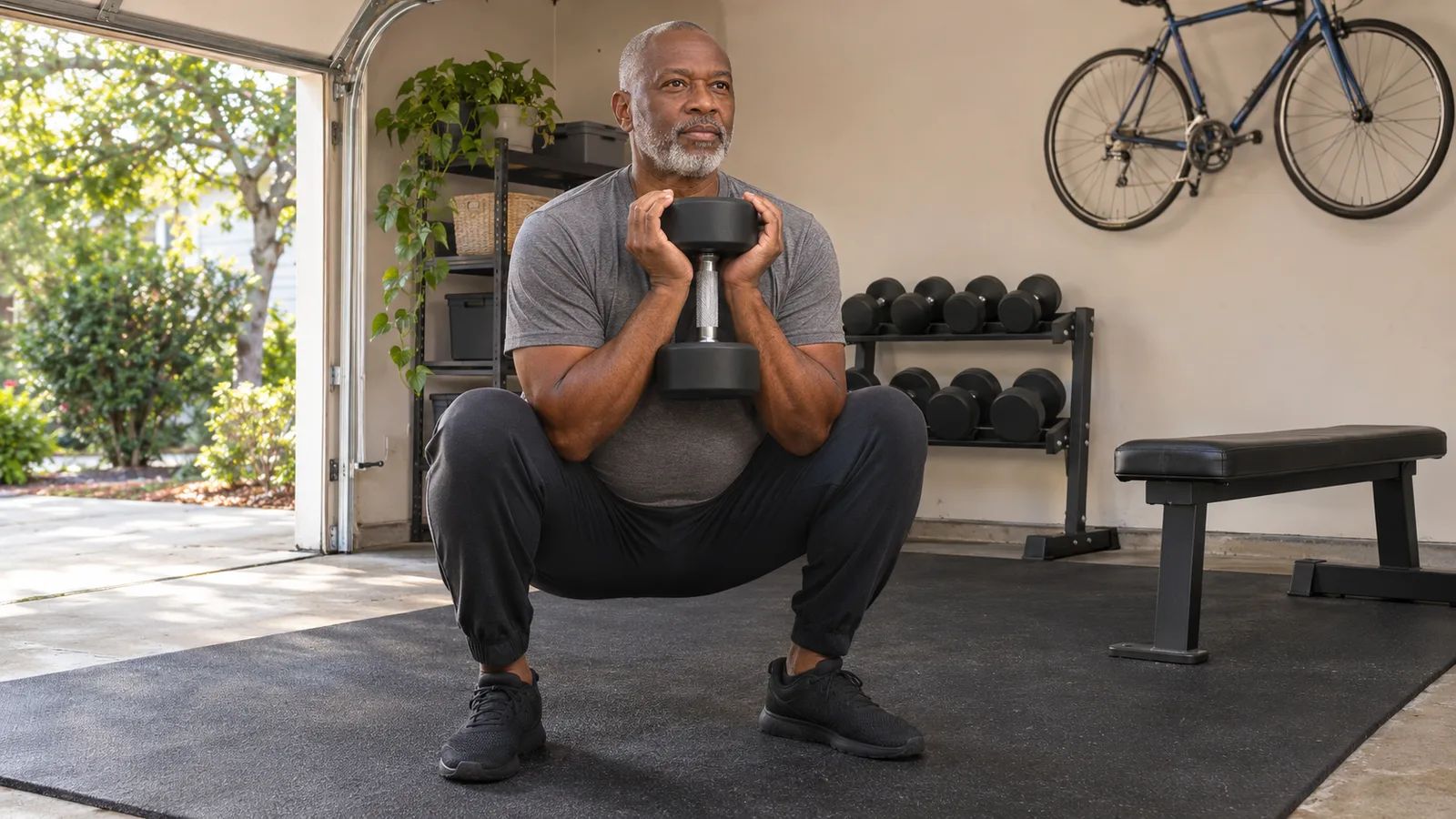
| Squat | Goblet squat or leg press | Goblet squat, one dumbbell at your chest | 3 × 6 to 10 | 2 min |
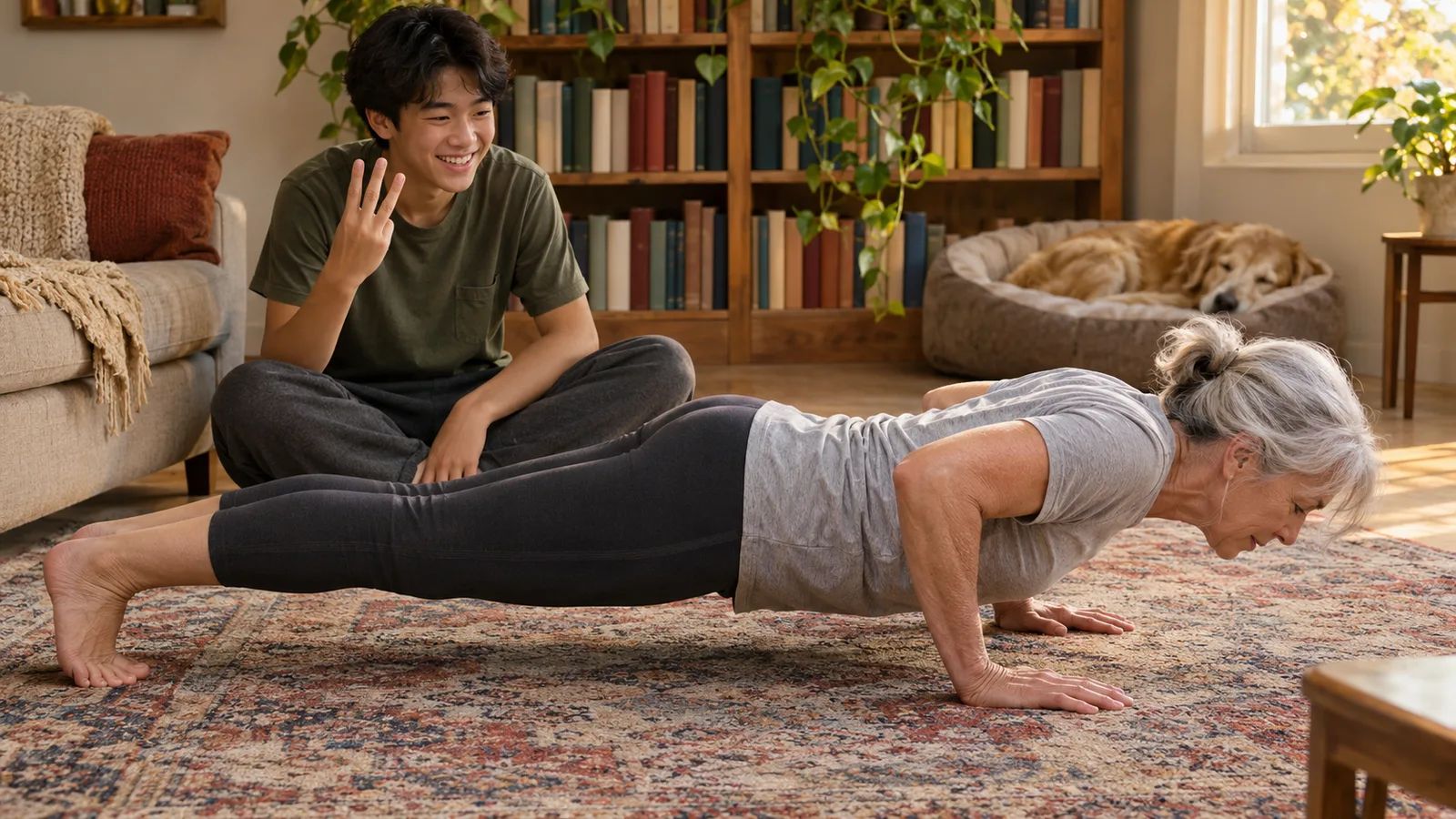
| Push | Dumbbell bench press | Dumbbell floor press, or push-ups | 3 × 6 to 10 | 2 min |
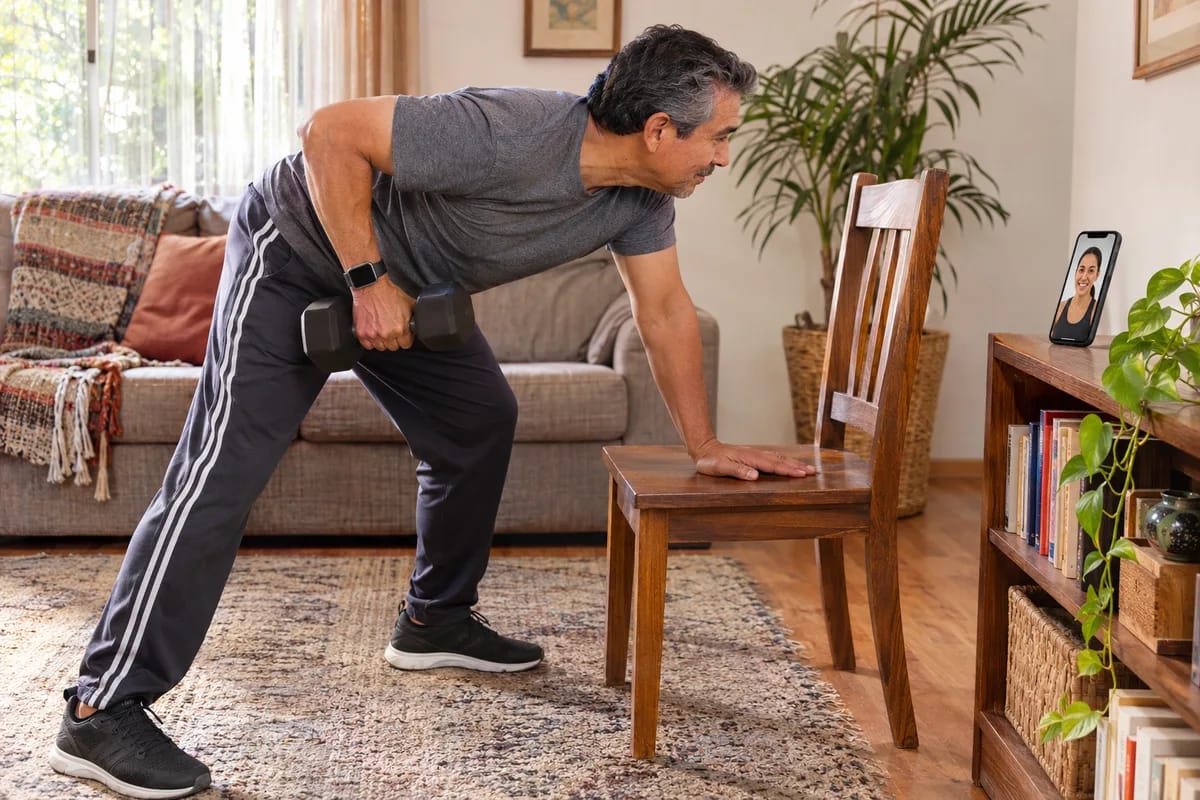
| Pull | Chest-supported dumbbell row | One-arm row, free hand on a chair, each arm | 3 × 6 to 10 | 2 min |
| Hinge | Romanian deadlift, dumbbells or trap bar | Dumbbell Romanian deadlift | 3 × 6 to 10 | 2 min |
| Carry | Farmer carry, heavy dumbbells | Farmer carry, your heaviest pair | 3 × 40 steps | 1 min |
The swing is a hip snap, not a squat and not a front raise. Push your hips back like the broomstick drill, then stand up hard and let the bell float to about chest height. Your arms are just ropes. Five crisp reps, then rest until you'd happily do five more. Speed is the point, so stop the set the moment the reps slow down. The kettlebell swing breaks it down step by step.
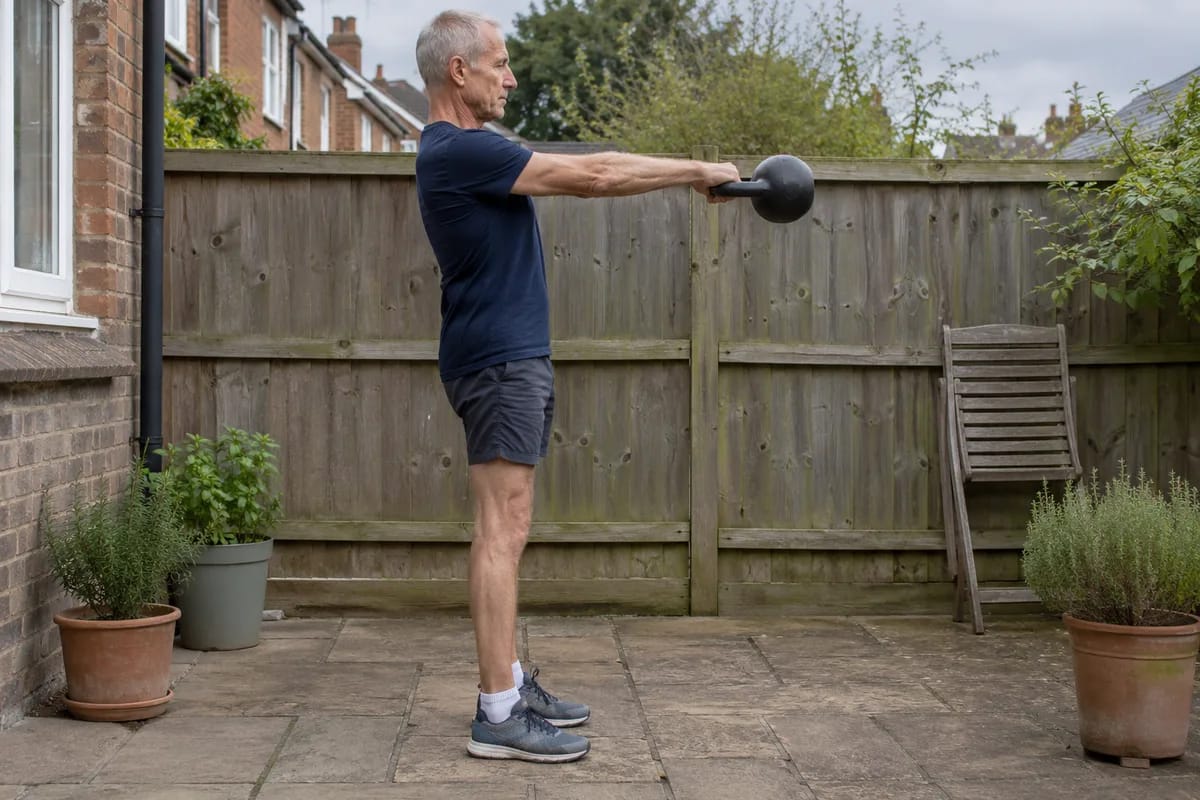
The Romanian deadlift stops when your hips can't go back any further, usually somewhere around the knees or just below. Keep the weights brushing your legs. If your back starts to round, you've gone past your range. Deadlift form covers the Romanian version and its common faults.
The farmer carry: dumbbells at your sides, stand tall, walk slowly, don't shrug. It trains grip, trunk and the job of getting all the groceries in from the car in one trip.
Day B: lighter, faster, with a finisher
| Move | Gym | Home | Sets × reps | Rest |
|---|---|---|---|---|
| Fast move | Fast sit-to-stand from a bench | Fast sit-to-stand from a chair | 4 × 5 | 1 min |
| Squat | Goblet squat, light | Goblet squat, light | 2 × 10 | 1 min |
| Push | Dumbbell bench press, light | Push-ups, hands on a bench or counter | 2 × 10 | 1 min |
| Pull | Cable row, light | One-arm row, light | 2 × 10 | 1 min |
| Carry | Suitcase carry: one dumbbell, one hand, don't lean | Same | 2 × 40 steps each hand | 1 min |
| Finisher | Bike, rower or incline treadmill | Bike, a hill, or stairs | 6 rounds: 45 s harder, 75 s easy |
Light means about 60% of your hard-day weight, finishing every set with plenty left. You should walk out of Day B feeling better than when you walked in.
The sit-to-stand sounds too easy until you do it right: stand up as fast as you possibly can, then sit down slowly over two or three seconds. Once that feels easy, hold a dumbbell at your chest.
The finisher is about effort, not heart rate math. "Harder" means you could say a few words but wouldn't want to chat. "Easy" means you could. If you love running and your knees agree, run the hard bits.
Day C: hard
| Move | Gym | Home | Sets × reps | Rest |
|---|---|---|---|---|
| Fast move | Medicine ball chest throw against a wall | Fast push-up, hands on a bench or counter | 3 × 5 | 1 to 2 min |
| One leg | Split squat or step-up | Split squat or step-up | 3 × 8 to 12 each leg | 90 s |
| Overhead push | Seated dumbbell press or landmine press | Half-kneeling one-arm dumbbell press | 3 × 6 to 10 | 2 min |
| Pull-down | Lat pulldown | Band pull-down, band anchored over a door | 3 × 8 to 12 | 2 min |
| Hinge | Trap-bar deadlift | Hip thrust, dumbbell on your hips, shoulders on the sofa | 3 × 6 to 10 | 2 min |
| Arms, if you want them | Curls, then triceps pushdowns | Curls, then band pushdowns | 2 × 12 each | 1 min |
The split squat is a lunge where your feet stay put. Drop the back knee straight down toward the floor and keep the front heel planted. Hold on to something for balance at first. That's not cheating. For the step-up, step-ups has the right box height.
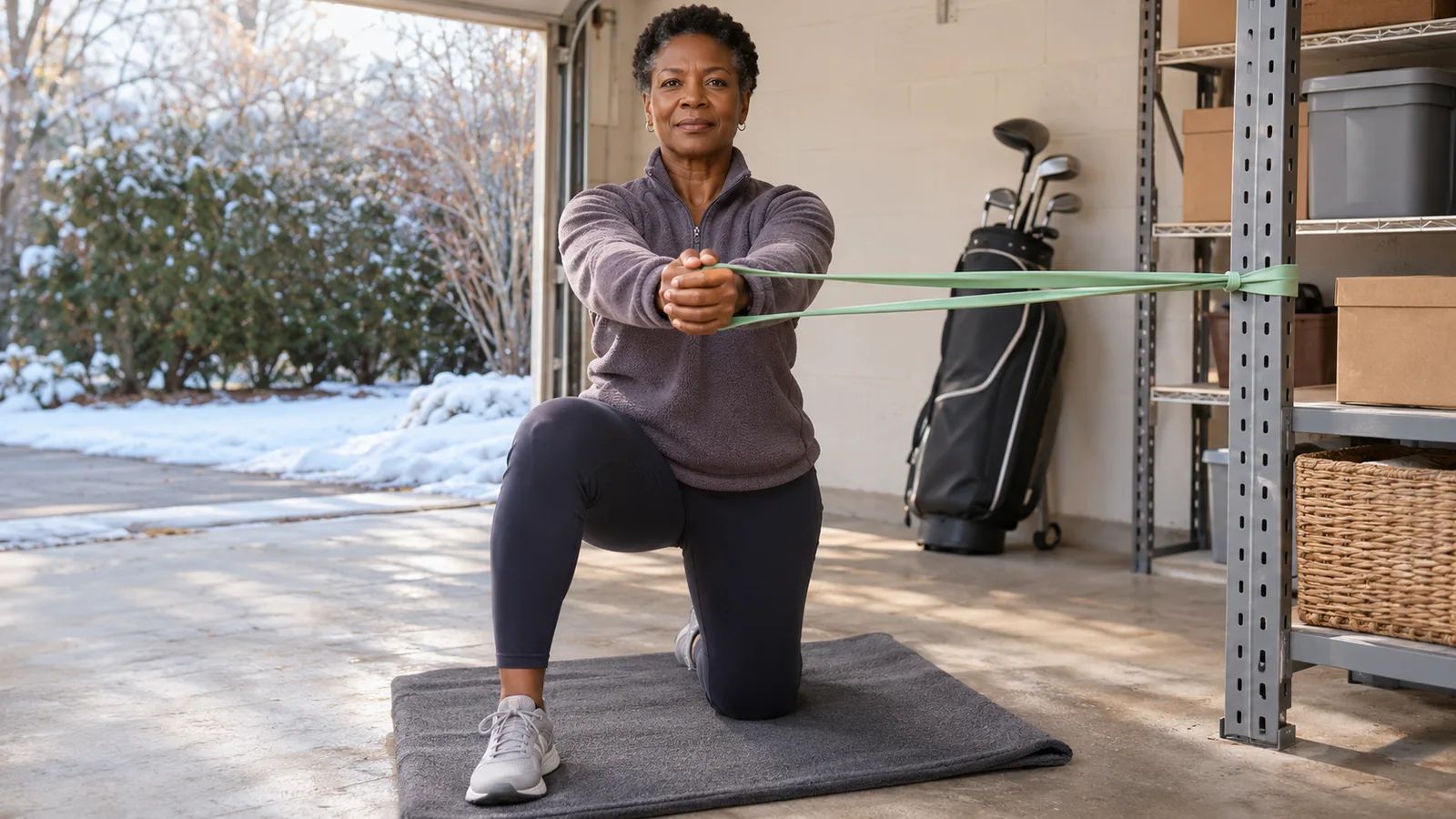
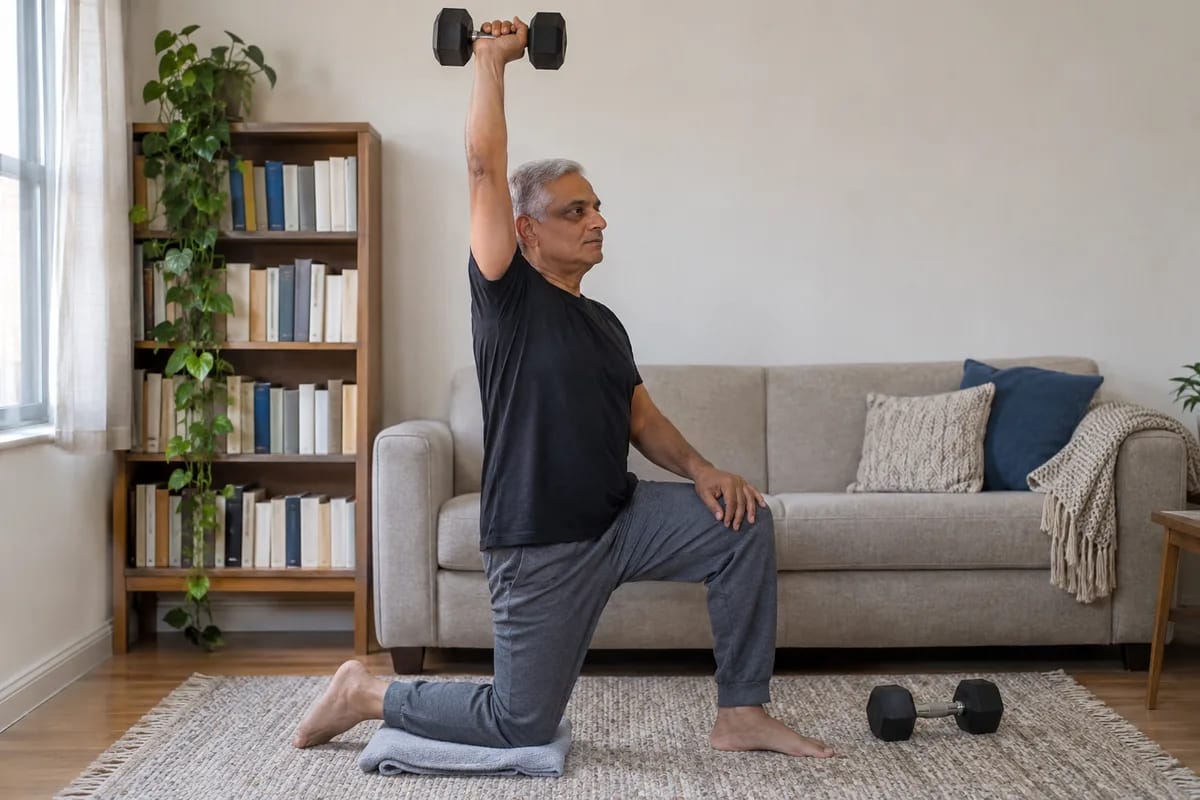
The half-kneeling press has one knee down, the other foot forward. Press with the arm on the side of the down knee. Kneeling stops you from leaning back to cheat the weight up, which is usually what makes overhead pressing hurt.
If a knee, shoulder or back complains
When something grumbles, change one thing and try again, in this order: lighten the weight, shorten the range, slow the lowering, then swap the exercise. Plenty of people keep training around a mild ache at a lighter weight; if you're not sure yours is that kind, ask a physical therapist. When the move itself is the problem, swap:
| Complains on | Instead of | Try |
|---|---|---|
| Knee | Goblet squat | Squat to a bench set a little higher, or the leg press with a shorter range |
| Knee | Split squat | Step-up onto a low step, or a reverse lunge |
| Shoulder | Overhead press | Landmine press, or the half-kneeling press with your arm angled slightly forward |
| Shoulder | Bench press or push-up | Floor press with palms facing each other, or push-ups with hands on a counter |
| Lower back | Romanian or trap-bar deadlift | Hip thrust or glute bridge |
| Lower back | One-arm row | Chest-supported row, lying face down on an incline bench |
| Lower back | Swing | Medicine ball chest throw, or the fast sit-to-stand |
These are different exercises, not treatment. If the pain is sharp, makes you change how you move, is worse the next day or keeps building over a week, or comes with swelling, numbness or tingling, stop training through it and see a doctor or physical therapist. The same goes for a recent injury or operation.
How heavy, and when to go up
Pick the weight by how the set ends. On Days A and C, stop each set with one or two good reps still in you. On Day B, stop with three or four left. Good reps means the same speed and shape as the first one. If you have no idea what to start with, how much weight should a beginner lift has starting numbers by exercise and a three-set test.
Add weight with the double progression. Each lift has a rep range, like 6 to 10. Stay at the same weight and add reps until you hit the top of the range on every set. Next session, go up a step and drop back to the bottom of the range. Here's what that looks like on the dumbbell bench press:
| Week (Day A) | Weight per hand | Reps over 3 sets |
|---|---|---|
| Week 1 | 30 lb (14 kg) | 8, 7, 6 |
| Week 2 | 30 lb (14 kg) | 9, 8, 8 |
| Week 3 | 30 lb (14 kg) | 10, 10, 9 |
| Week 4 | 30 lb (14 kg) | 10, 10, 10. Time to go up |
| Week 5 | 35 lb (16 kg) | 7, 6, 6 |
The steps: 5 lb (about 2 kg) per dumbbell, or 5 to 10 lb (2 to 5 kg) on a machine or a trap bar. Lower-body lifts usually move up faster than presses. Some weeks you won't add anything, and that's normal.
Going from 30 to 35 lb adds about a sixth, which is why week 5 drops back to 7 reps. If the next pair up feels like too much, bridge it with a fourth set or a three-second lowering first. Progressive overload at home has more ways to bridge the gap.
Why a fast move, and why the finisher
Power is strength done quickly: getting up off a low sofa, catching yourself on a stair, swinging a club. In one study of people aged 65 to 89 it fell faster than strength, most clearly in men,2 and in trials of adults around 70, lifting fast did a little more for everyday function than lifting at normal speed, though the evidence is thin.3 Why power fades faster than strength has the longer story.
The finisher gives your heart and lungs a few minutes of harder work once a week. The walks do the rest of the cardio.
What 12 weeks looks like
Weeks 1 to 2
Learning the moves
The weights will feel random. Some days the right one feels heavy, some days light. Mild soreness for a day or two is normal and fades.
Weeks 3 to 6
Numbers go up most sessions
You're adding reps or weight almost every time. Much of this early jump is your body getting better at using the muscle you already have, before much new muscle arrives.
Weeks 7 to 12
Slower numbers, visible changes
Weight goes up every week or two instead of every session. Some men notice shirts fitting differently across the shoulders.
After week 12
Keep it, or add a day
Keep running the plan and keep adding weight. If you want a fourth day, the best workout split shows how to add one without losing the recovery between hard days.
How much can you expect? In pooled studies of beginners, strength rose by about a fifth on average, with huge variation, and age didn't predict who did well.4 Programs for adults over 50 added about 2.4 lb (1.1 kg) of lean muscle on average.5
So you can't predict your own speed, and being slower than your brother-in-law tells you nothing about where you'll be in a year. Eating enough protein helps the muscle part; how much protein you need after 40 has the numbers.
Two things you can skip
Testosterone boosters. In one review of 50 products, nine in ten promised more testosterone and only about a quarter had any data behind the claim, and 13 went over the FDA's safe upper limits for zinc, niacin or magnesium.6 In men over 60, lifting barely moves resting testosterone either, and it builds muscle anyway.7 If you think your levels are low, that's a blood test and a conversation with your doctor.
The 50-a-day challenges. Fifty push-ups, fifty squats, every day. Fine as a habit to get you moving, but once fifty is easy, doing fifty again stops making you much stronger. The plan above keeps adding weight. A daily challenge can't.
The whole week on one screen
Screenshot this for the garage. Rest about 2 minutes between hard sets, 1 minute on Day B.
- Mon, Day A (3 sets): swing × 5, goblet squat, dumbbell press, one-arm row, Romanian deadlift (6 to 10 reps each), farmer carry 40 steps.
- Wed, Day B (2 sets, light): fast sit-to-stand 4 × 5, goblet squat, push-up, row (10 each), suitcase carry, then 6 rounds of 45 seconds harder and 75 easy.
- Fri, Day C (3 sets): chest throw or fast push-up × 5, split squat (8 to 12 each leg), overhead press (6 to 10), pull-down (8 to 12), deadlift or hip thrust (6 to 10), arms if you want them.
- Tue and Thu a brisk walk, Sat something you enjoy, Sun off.
- Go up when every set reaches the top of its range. First two weeks: two sets, stopping three or four reps short.
Doing this plan with a coach on the call
Count the calls this page leaves to you: whether a set had two good reps left, when to go up, which swap to make when the shoulder pinches, and getting yourself to Monday's session after a long weekend. On your own you make every one of them, and the ones you get wrong show up as a lift that stalls or a shoulder that flares.
At Bespoke Fit, every session is a live 1‑on‑1 video call with your own coach, in our app on iPhone, Android or a browser. You prop the phone up in the garage or the living room, and your coach watches through the camera. Your coach also writes your program, a plan like this one built around your joints, your equipment and your week, and rewrites it from what they see.
Here's a Day C with a coach. On the fourth rep of your overhead press, your elbow drifts out and you wince. Your coach sees it, has you switch to the landmine press for the next set, and notes it on your program so next week's Day C starts there. On the trap-bar deadlift you stop at eight thinking you're done. Your coach saw the last rep move as fast as the first and asks for two more, and those two tell you next week's weight. On Wednesday's finisher, if you wear an Apple Watch or a Bluetooth heart rate strap, your coach sees your heart rate live and tells you when to ease off and when to go again.
If video coaching at your age sounds like a stretch, one member had the same doubt:
"I was skeptical about doing training over video at my age, but it has been much easier than I expected. My trainer is patient and adjusts everything to what my body can handle. I have exercised more in the past two months than in the last ten years. My friends can see the difference."
Wanda, 70, a member who trains with JP
You log each set in the app, and after every session a recap shows what you lifted and any records, so the week 5 jump lives on your phone, not on scrap paper. When the knee is sore on a Thursday, message your coach a photo.
Your coach books each session with you as a calendar invite, so Monday has a person waiting in it, and skipping means telling them. Each coach has 12 members at most, a cap we hold to when we assign coaches. Twelve people training three times a week is already about 36 hours of live calls, so yours has room to remember which shoulder grumbled in week three.
You start with a 30-minute call with a head coach. That's the place to mention the knee, the shoulder and the back that once went out lifting a cooler. Then they match you to one of our coaches, each of whom went through 90 days of hands-on vetting with our founder before taking on a member. After that it's 14 days free, then $299 a month, for as many sessions as you and your coach schedule. Sessions run 45 to 90 minutes at the same price, and most people settle at around an hour. At three a week that's about $23 a session; personal trainers in the US average $50 to $90.8
It isn't for everyone. If you already train three times a week and keep making progress, this page is all you need. If you want a gym floor and someone beside you spotting a heavy bar, we train you on video, not in person. And we don't coach nutrition. If $299 a month would strain your budget, run the plan above on your own. It works.
Common questions
How many days a week should a man over 50 work out? Two or three lifting days, with at least two full days between the hard ones. Two meets the CDC's minimum for strength work, so it's a real plan for a busy stretch.1 Three, as laid out above, gives you more work each week, and in studies of adults over 50, more weekly work went with more muscle.5
Do I need a doctor's OK before I start? Most healthy men don't need one to start moderate lifting. In 2015 the American College of Sports Medicine stopped screening people on risk factors alone, because it sent too many people to the doctor and may have kept some from exercising.9 Get checked first if you have known heart, kidney or blood sugar disease, or symptoms like chest pain or pressure, dizziness or unusual breathlessness when you exert yourself. The same symptoms during a session mean stop and get checked.
Is 30 minutes of strength training enough? For health, it goes a long way. In long-term studies, the lower risks linked with strength training peaked at around 30 to 60 minutes a week, and the picture beyond that is unclear.10 Building visible muscle takes more, which is why this plan has three sessions. On a short day, do the warm-up, the fast move and the first three lifts of Day A or C.
Should I take creatine? It's one of the few supplements with decent evidence in older lifters. In pooled trials of adults averaging about 64, creatine plus lifting added more lean mass and more chest and leg press strength than lifting alone, though the studies were few.11 The plan works without it. If you have kidney disease, ask your doctor first.
Sources
-
Centers for Disease Control and Prevention, 2023. Adult activity: an overview. CDC. At least 150 minutes a week of moderate-intensity activity, and muscle-strengthening activity on at least 2 days a week that works the legs, hips, back, abdomen, chest, shoulders and arms. The weekly total in the article (two 45-minute walks, the 12-minute finisher and an hour on Saturday) is our arithmetic. ↩ ↩2
-
Skelton DA, Greig CA, Davies JM, Young A, 1994. Strength, power and related functional ability of healthy people aged 65-89 years. Age and Ageing. A cross-sectional study of 50 men and 50 women aged 65 to 89. Across the age range, strength was lower by the equivalent of 1 to 2% a year and leg power by about 3.5% a year; power fell faster than strength in men, but not significantly so in women. ↩
-
Balachandran AT, Steele J, Angielczyk D and colleagues, 2022. Comparison of power training vs traditional strength training on physical function in older adults: a systematic review and meta-analysis. JAMA Network Open. 20 trials, 566 healthy adults averaging 70; power training was associated with a modest improvement in physical function (SMD 0.30), on evidence the authors rate as low certainty. ↩
-
Ahtiainen JP, Walker S, Peltonen H and colleagues, 2016. Heterogeneity in resistance training-induced muscle strength and mass responses in men and women of different ages. Age. Pooled data from earlier studies of untrained, healthy men and women aged 19 to 78 (n = 287, with 72 non-training controls). Strength rose 21% on average, ranging from a loss of 8% to a gain of 60%; age and sex did not affect the response. ↩
-
Peterson MD, Sen A, Gordon PM, 2011. Influence of resistance exercise on lean body mass in aging adults: a meta-analysis. Medicine and Science in Sports and Exercise. 49 studies, 1,328 adults aged 50 and over; an average lean mass gain of 1.1 kg, larger with higher-volume programs and slightly smaller in older participants. ↩ ↩2
-
Clemesha CG, Thaker H, Samplaski MK, 2020. 'Testosterone boosting' supplements composition and claims are not supported by the academic literature. World Journal of Men's Health. Of 50 products found through Google search, 90% claimed to raise testosterone and 24.8% had data supporting that; about 1 in 10 contained ingredients with data showing a decrease, and 13 of the 50 exceeded FDA upper limits for zinc, niacin or magnesium. ↩
-
Hayes LD, Elliott BT, 2018. Short-term exercise training inconsistently influences basal testosterone in older men: a systematic review and meta-analysis. Frontiers in Physiology. 22 studies of men aged 60 and over; resistance training did not significantly change basal testosterone. ↩
-
Bark, updated January 16, 2026. How much does a personal trainer cost?: "The average personal trainer cost is $50-90 per session" in the US, for in-person and online trainers alike; the page gives no session length for the range. Read November 12, 2026. Our $23 is $299 divided by 13 sessions a month (three a week, 156 a year, divided by 12), our arithmetic. ↩
-
Riebe D, Franklin BA, Thompson PD and colleagues, 2015. Updating ACSM's recommendations for exercise preparticipation health screening. Medicine and Science in Sports and Exercise. Screening now rests on current activity, signs or symptoms, known cardiovascular, metabolic or kidney disease, and the intensity planned; risk-factor profiling was dropped because it could cause excessive physician referrals, possibly creating a barrier to exercise. ↩
-
Momma H, Kawakami R, Honda T, Sawada SS, 2022. Muscle-strengthening activities are associated with lower risk and mortality in major non-communicable diseases. British Journal of Sports Medicine. 16 cohort studies; the largest risk reductions were at about 30 to 60 minutes a week. Observational, so it shows association, not cause. ↩
-
Devries MC, Phillips SM, 2014. Creatine supplementation during resistance training in older adults: a meta-analysis. Medicine and Science in Sports and Exercise. 357 adults averaging about 64, in trials of about 12 weeks; the authors note the limited number of studies. ↩