Step-ups: form, the right box height and how to progress
How to do a step-up so the front leg does the work, how high your step should be for your body, the faults to look for, and a six-week plan to progress.
In this article8
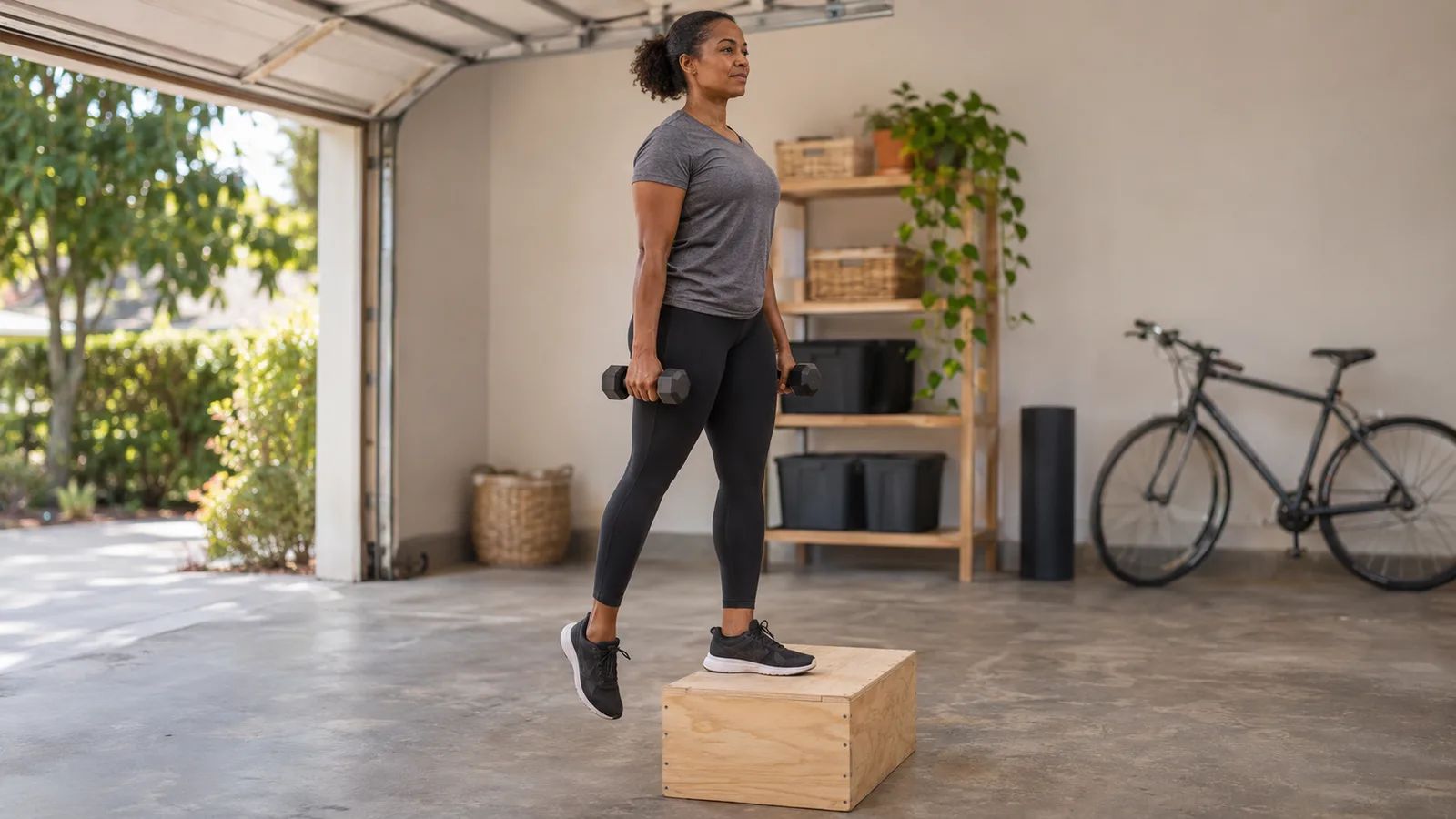
A step-up is standing up onto a step with one leg. Put your whole foot on the step, push through that foot until you're standing tall, and let the back leg come along as a passenger. Then lower yourself down the same way, slowly, on the same leg.
The one thing that matters most: the front leg does the lifting. If your back foot is bouncing you off the floor, you're walking upstairs, not training the leg. Most step-up problems start there, and most of those start with a step that's too high.
All you need is the bottom stair of your staircase, a banister to hold if you like, and ten minutes. No jumping, and nothing for the neighbors to hear.
Why bother? One leg works at a time, so your stronger leg can't quietly cover for the weaker one. And it's the movement behind every stair, hill and curb: in a small trial, older adults with limited mobility who climbed stairs in a weighted vest for 12 weeks gained more leg power than a group who walked instead.1
How high should the step be?
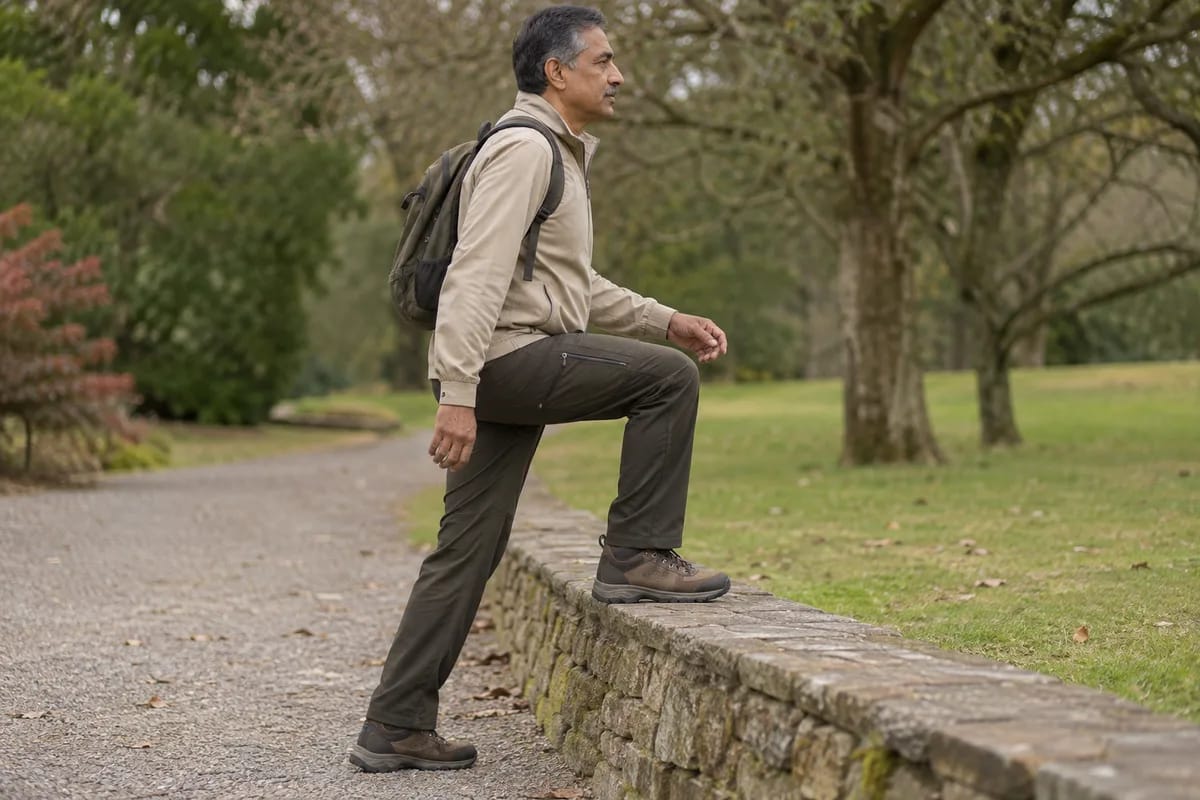
Lower than you'd think. For most people starting out, that's the bottom stair or a step of 6 to 8 inches (15 to 20 cm). Knee height is where you might end up, not where you start.
Inches only get you so far, because legs differ. A better guide is what your front thigh does when your foot is on the step:
Then test it. You've found your height when all three of these are true:
- You can stand up without a shove from the back foot. A small push on the first rep or two is fine when you're new, which is why some instructions tell you to push off the back leg. Making that push smaller each week is the progression. A bounce on every rep means the step is too high.
- Your front knee stays in line with your toes, pointing roughly at your second toe, all the way up and all the way down.
- You can lower yourself slowly and smoothly, without dropping onto the back foot at the end.
Fail any one of them and go a step lower. Pass all three easily for 12 reps and you're ready to go higher.
What to step onto: the bottom stair is the steadiest thing in most homes, and it comes with a handrail. An adjustable aerobic step, a weight bench or a solid wooden box work too. Whatever it is, it shouldn't slide, fold or wobble. A dining chair is a last resort, and this checklist covers what makes one safe enough.
If you're after the glutes in particular, a higher step bends the hip further, and a slight forward lean tends to shift more of the work to the glutes.
How to do a step-up
Get close and put your whole foot on the step
Heel included, not just the ball of the foot. Hold the banister or a wall lightly if you want; it still counts.
Shift your weight onto the top foot
Lean your chest slightly forward over that knee before you move. A small lean is normal and helps you stand.
Push the step away through the whole foot
Stand all the way up until your hip and knee are straight. To keep the back foot honest, lift its toes so it can't push you up.
Stand tall at the top for a beat
Bring the other foot up beside the first, or let it hang next to the step for a harder version where you balance on one leg.
Lower yourself the way you came up
Slowly, on the same leg, over about two seconds, because this half builds a lot of the strength. Let the back foot touch the floor softly, like a kickstand, then step down fully and reset.
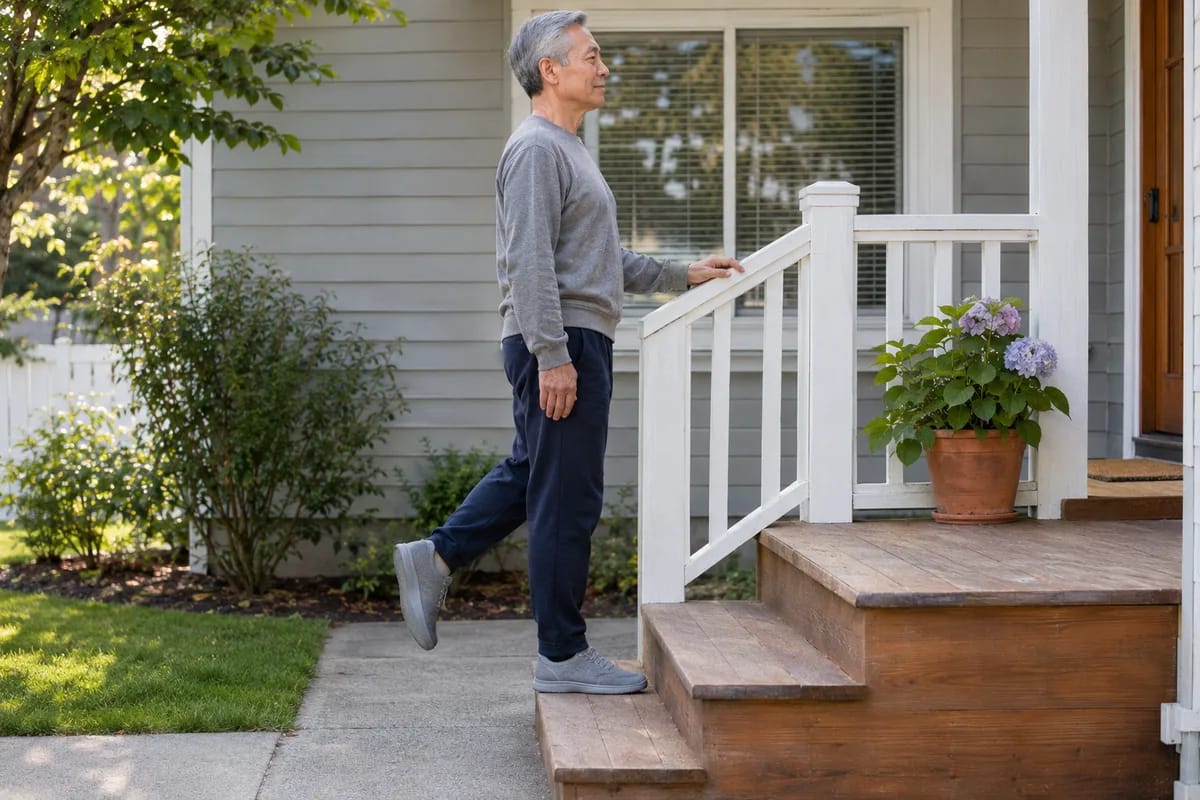
For strength, do all your reps on one leg, then switch. Alternating lets each leg rest while the other one works, so the set is easier than it looks and each leg gets less out of it. Start with your weaker leg, and do the same number of reps on the stronger one. For cardio, alternate; see the last variation below.
Where you should feel it, and what about your knees
Mostly in your quads (the front of the thigh) and glutes (your seat), on the leg that's on the step.
If you felt nothing, one of three things is usually going on: the step is too low for you now, the back foot is lifting you (a tired back leg gives it away), or the set is too easy. A set should get hard by the last two or three reps.
Step-ups are a standard way to strengthen the legs around the knee, and you control how much the knee bends: a lower step bends it less. Effort in the front of the thigh is the point. Pain at the knee itself, during or after, is a signal to go lower, lower more slowly, or swap the move for something else for now. Our low-impact workouts guide has a simple rule for telling ordinary ache from too much, too soon.
If your knee swells, gives way, locks or catches, if the pain is sharp or getting worse, or if you're recovering from surgery or an injury, see a doctor or physical therapist before you train it, and follow their plan.
What goes wrong, and the fix
Most of these are easiest to spot on a phone clip. Prop the phone about 45 degrees off to the front of the leg that's working, as in our camera setup guide, and film one set.
| What you'd see | Why it happens | The fix |
|---|---|---|
| The front knee drifts in toward the other foot, or the hip hikes and twists | Tired hip muscles, or a step that's too high | Keep the knee over your second toe; go a step lower |
| The front heel hangs off the edge, or you're up on your toes | Standing too far away | Step closer so the whole foot fits, heel included |
| Your chest folds down over the knee to get up | The leg can't lift you from this height yet | A slight lean only, chest up; if you can't, go lower |
| You stop just short of standing tall | Rushing into the next rep | Straighten hip and knee fully and pause a beat |
| You speed up and drop the last few inches down | Control usually goes late in the lowering | Slow down most where it gets hard, near the floor |
A clip shows you the drifting knee after the set is over. A coach watching from that same angle sees it start to drift on rep six and tells you before rep seven. That's what live coaching over video at Bespoke Fit is for: a real coach watches every session through your camera, and since they write your program too, they're the one who tells you when it's time for a higher step.
A six-week progression
Do step-ups two or three times a week, with a day off between. The order of progress matters: more reps first, then slower lowering, then a higher step, and only then a weight.
| Weeks | Step | Sets × reps, each leg | What changes |
|---|---|---|---|
| 1 and 2 | Bottom stair, 6 to 8 in (15 to 20 cm), rail if you like | 2 × 8 | Smooth reps, back foot quiet |
| 3 | Same step | 3 × 10 to 12 | More reps and a third set |
| 4 | Same step | 3 × 10 to 12 | Lower over three seconds every rep |
| 5 | One height up, about 12 in (30 cm) | 3 × 8 to 10 | A new height, so reps drop back |
| 6 | Same as week 5 | 3 × 8 | 5 to 10 lb (2 to 4.5 kg) in each hand |
No dumbbells? A backpack with a few books in it does the job in week 6. The reps follow the US guideline for strength work: sets of 8 to 12 that get hard by the end, at least one set and ideally two or three, on at least 2 days a week.2
If the higher step fails the three-part test in week 5, stay on the stair for another week or two with the slow lowering, or find something in between. Early on, a few more inches of step adds more challenge than a few more pounds in your hands.
If you already lift, start where this plan ends. Use a bench or box around knee height, 16 to 20 in (40 to 50 cm), and hold a dumbbell in each hand. Do 3 sets of 8 to 12 per leg with a weight that makes the last two or three reps hard while the back foot stays quiet. When you get 12 clean reps on both legs, add about 5 lb (2 kg) to each hand. Out of heavier weights? These ways to progress without adding load all work on a step-up, and our dumbbell leg workout puts step-ups inside a full plan.
Variations worth knowing
| Variation | What changes | Good for |
|---|---|---|
| Dumbbell step-up | A dumbbell in each hand at your sides | Adding weight while staying easy to balance |
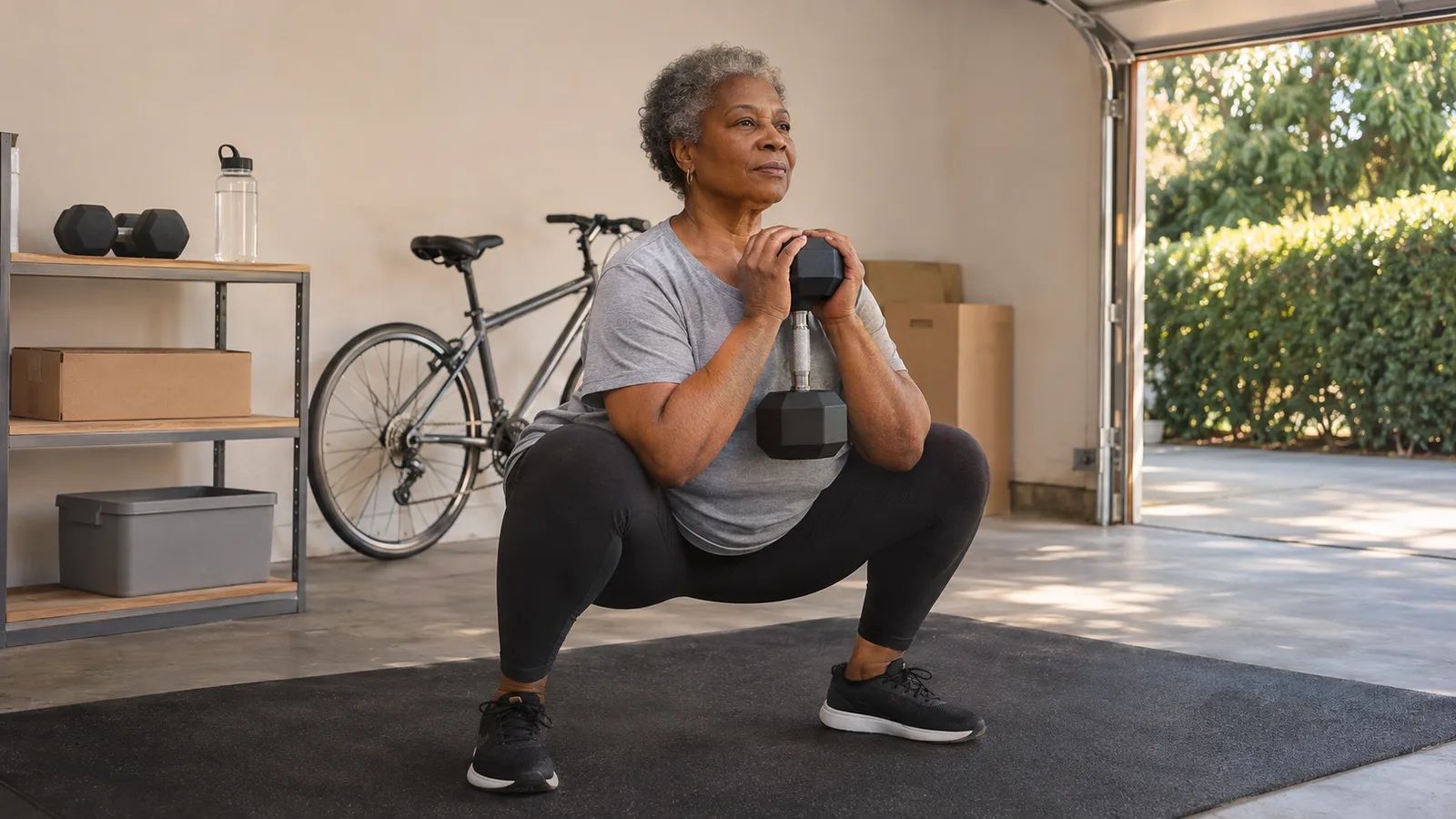
| Goblet step-up | One dumbbell or kettlebell held at your chest | Owning only one weight; it keeps you upright |
| Lateral step-up | Stand side-on to the step and step up sideways | More work for the knee and ankle; the forward version works the hip more3 |
| Crossover step-up | Stand side-on and cross the far leg over to step up | Leans harder on the muscle at the side of the hip (glute medius) on the way up4 |
| Fast up, slow down | Stand up quickly, lower over three seconds | Leg power: the quick push you use on stairs |
| Steady stepping | Low step, alternate legs, at a brisk walking pace for 5 to 10 minutes | Cardio rather than strength, so here alternating is the point |
The fast-up version is the one to add if you're over 60 or thinking about falls. Quick leg power fades faster than strength as you age, and a quick push from the legs is what catches a trip.
A barbell across your back is the other option you'll see. It's harder to balance and harder to bail out of, so at home, dumbbells come first.
Step-ups and step-downs
A step-down is the lowering half on its own. Stand on the step, slowly bend that leg to lower the other heel until it touches the floor, then stand back up. The front thigh has to brake your body weight all the way down, which is exactly what going down stairs or a hill asks of your legs.
If you hike, train both, because the long descents tend to be what leaves your legs sore; our Kilimanjaro training plan puts both inside a full hiking program.
Common questions
Can you do step-ups every day? Easy ones, yes. Bodyweight step-ups on a low step ask about as much of you as a few trips up the stairs. Hard sets, with a weight or close to the last rep you can do well, go better two or three days a week with a rest day in between.
Are step-ups or lunges better? Neither wins outright. Both train one leg at a time. The step-up is easier to control, you can hold a rail, and there's no step backward, so it's the friendlier one to start with. Lunges ask more of your balance. Plenty of good plans use both.
What are the best exercises for your legs? A short list covers almost everything: a squat, a hip hinge such as a deadlift or a hip thrust, a one-leg move such as the step-up or a split squat, and calf raises. Two or three sets of each, twice a week, is a solid leg plan for most people.
Sources
-
Bean J, Herman S, Kiely DK, and colleagues, 2002. Weighted stair climbing in mobility-limited older people: a pilot study. Journal of the American Geriatrics Society. 45 people aged 65 and over, 12 weeks: leg press peak power improved 17% compared with the walking group. ↩
-
Centers for Disease Control and Prevention, 2023. What counts as physical activity for adults. CDC. ↩
-
Wang MY, Flanagan S, Song JE, Greendale GA, Salem GJ, 2003. Lower-extremity biomechanics during forward and lateral stepping activities in older adults. Clinical Biomechanics. ↩
-
Simenz CJ, Garceau LR, Lutsch BN, Suchomel TJ, Ebben WP, 2012. Electromyographical analysis of lower extremity muscle activation during variations of the loaded step-up exercise. Journal of Strength and Conditioning Research. ↩