Kilimanjaro training plan: 12 weeks, no mountain needed
A free 12-week Kilimanjaro training plan in hours, feet and pack pounds, with stair and treadmill swaps for flat towns, and the part fitness can't fix.
In this article9
The plan at a glance
Twelve weeks, four days a week, if you can already walk briskly for an hour. If not, add a four-week on-ramp first. Each week has a long hike, a climbing session, strength and an easy day, building to a 3,000 ft (900 m) hike with a 20 lb (9 kg) pack and a shorter hike the next day.
The deposit's paid, the flights are booked, and the welcome email from your trekking company says you'll need to train. Maybe you live somewhere flat. Maybe the last hill you climbed on purpose was years ago. Neither one is a problem. Kilimanjaro is a long, slow walk, not a climb with ropes, and most people who try it reach the top: nearly 9 in 10 hikers in one large study did.1 The fitness it asks for can be built on a staircase and a treadmill. Two questions below tell you whether that takes twelve weeks or longer.
What the mountain asks of your legs
| On the mountain | The numbers |
|---|---|
| The summit | 19,341 ft (5,895 m) |
| A normal trekking day | 4 to 8 hours of slow walking, many around 5 or 6 |
| Summit day | 12 hours or more on your feet, starting around midnight: roughly 8 up, 6 to 7 down |
| The summit climb on one route | 4,265 ft (1,300 m) of climbing over 3 miles (5 km), in 8 to 10 hours |
| The last day | About 5 hours of walking downhill to the gate |
| What you carry | A daypack of about 15 lb (7 kg): water, layers, rain gear, snacks |
Sources: the CDC, the guide company Alpine Ascents, and Thomson Treks.234
Read that as your training brief. The plan trains three things: climbing steadily for hours with a pack, doing it again the next day, and coming down on tired legs.
Speed hardly comes into it. Guides keep the pace slow on purpose ("pole pole", Swahili for "slowly, slowly", is the phrase you'll hear most). Alpine Ascents' benchmark is gaining about 1,000 ft (300 m) an hour with your pack,3 an unhurried walk up a steep path.
Where you're starting from
Two questions decide your first week. Can you walk briskly for an hour without stopping? Can you walk up 10 floors of stairs at a steady pace without a rest?
- Yes to both. Start week 1 twelve weeks before you fly.
- Not yet. Do a four-week on-ramp first. Walk 30 minutes four days a week, adding 5 minutes each week. Once a week, walk up and down 3 floors of stairs, adding 2 floors a week. Do the strength moves below with 2 sets and no weight. That makes it 16 weeks.
- You hike hills most weekends already. Start at week 5, eight weeks before you fly. With twelve weeks to go, run weeks 7 to 10 twice before weeks 11 and 12.
- You've had a knee or hip replaced. Read strength training after a knee or hip replacement before you start the strength day.
Alpine Ascents, whose benchmarks this plan borrows, says most people need at least 4 to 6 months.3 We think twelve weeks is enough for this gentler plan if you answered yes to both questions. Starting from very little, or with months to spare, take the longer runway.
The plan, week by week
Four sessions a week. The numbers are our coaching judgment, built on the benchmarks guide companies publish and kept gentle for a first-timer.
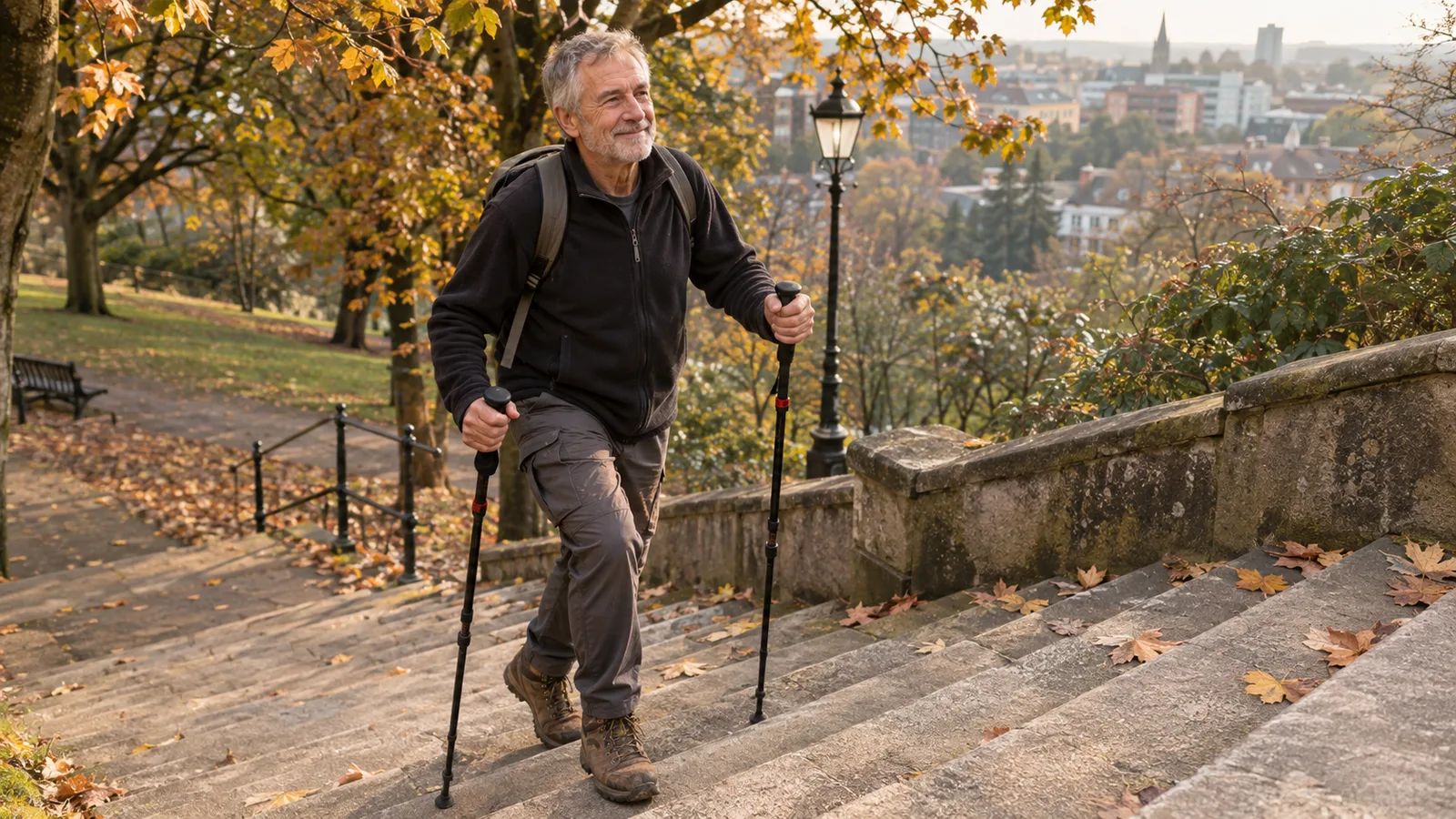
- Long hike. Your weekend session, outdoors if you can. Count hours and feet of climbing, not miles. Wear the boots and the pack you'll take, building to 20 lb (9 kg), a little over what you'll carry on the mountain (how to load and fit a pack is in our rucking guide). If you'll use trekking poles on the mountain, bring them from about week 5, so planting them on a descent is a habit by summit day.
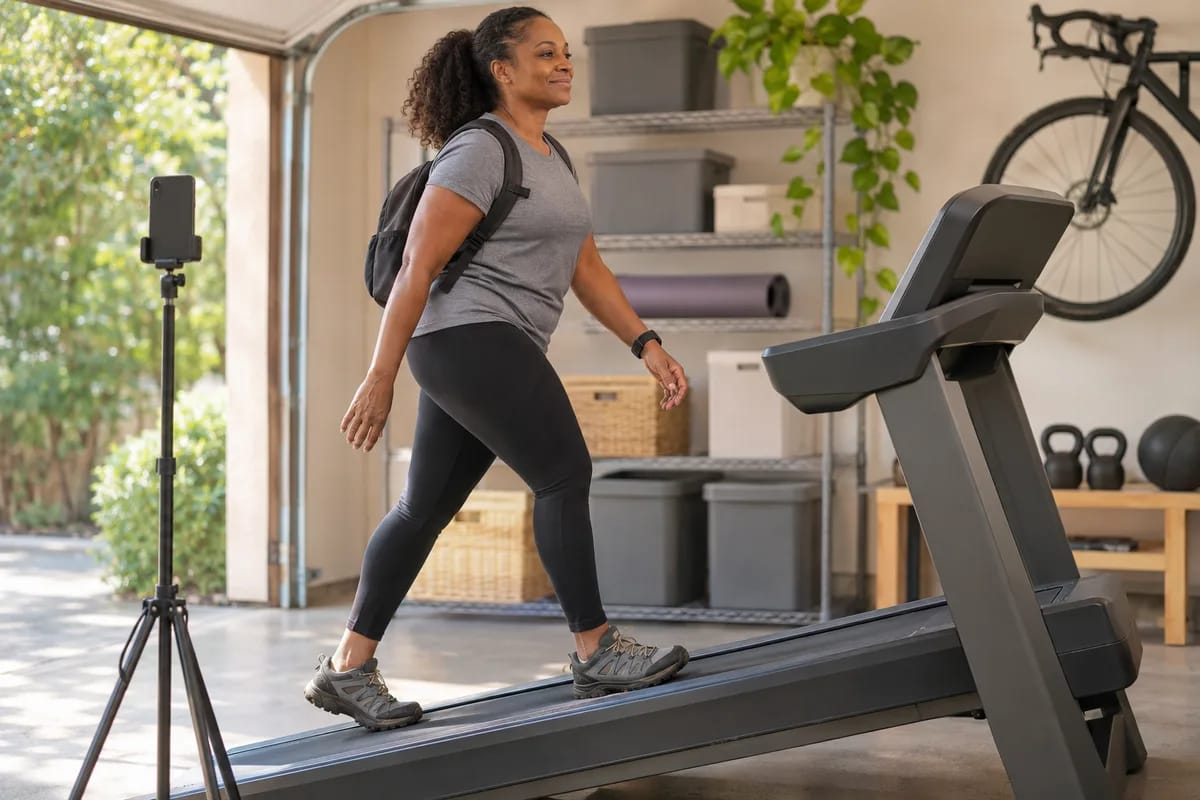
- Climbing session. Midweek, on an incline treadmill, a stepmill or a stairwell, at a pace where you can talk in full sentences, roughly zone 2. From week 3, wear the pack with about half the weekend's weight.
- Strength. About 40 minutes, five moves, described further down.
- Fourth day. An easy walk in weeks 1 to 6. From week 7 it becomes a second hike on the day after the long one, because the mountain doesn't give you a rest day between big days.
| Week | Long hike | Pack | Climb | Fourth day |
|---|---|---|---|---|
| 1 | 1½ hr, 500 ft (150 m) | 10 lb (5 kg) | 30 min | Walk, 30 min |
| 2 | 2 hr, 800 ft (250 m) | 10 lb (5 kg) | 35 min | Walk, 35 min |
| 3 | 2½ hr, 1,200 ft (370 m) | 12 lb (5.5 kg) | 40 min | Walk, 40 min |
| 4, easy | 1½ hr, 600 ft (180 m) | 10 lb (5 kg) | 30 min | Walk, 30 min |
| 5 | 3 hr, 1,500 ft (450 m) | 15 lb (7 kg) | 45 min | Walk, 45 min |
| 6 | 3½ hr, 2,000 ft (600 m) | 15 lb (7 kg) | 50 min | Walk, 45 min |
| 7 | 4 hr, 2,500 ft (750 m) | 18 lb (8 kg) | 50 min | Hike, 2 hr, 1,000 ft (300 m) |
| 8, easy | 2½ hr, 1,200 ft (370 m) | 15 lb (7 kg) | 35 min | Walk, 40 min |
| 9 | 4½ hr, 3,000 ft (900 m) | 20 lb (9 kg) | 60 min | Hike, 2½ hr, 1,500 ft (450 m) |
| 10 | 5 hr, 3,000 ft (900 m) | 20 lb (9 kg) | 60 min | Hike, 3 hr, 2,000 ft (600 m) |
| 11 | 5 to 6 hr, 3,500 ft (1,070 m) | 20 lb (9 kg) | 45 min | Hike, 3 hr, 2,000 ft (600 m) |
| 12 | 2 hr, 1,000 ft (300 m), early in the week | 15 lb (7 kg) | 30 min, easy | Rest |
On the next-day hikes, carry 15 lb (7 kg) in weeks 7 and 9 and the full 20 lb (9 kg) in weeks 10 and 11.
On the strength day, do 3 sets. Do 2 in weeks 1 and 2, in the easy weeks 4 and 8, and in week 11, when the hikes are biggest.
Weeks 4 and 8 are lighter on purpose, as Alpine Ascents advises about every fourth week.3 They feel like slacking, but they're when your body catches up with the hard weeks before (why backing off works).
Week 12 is for arriving fresh. One short hike, one easy climb and a single set of the strength moves early in the week, then mostly rest before you fly. You can't gain fitness that week, but you can arrive tired.
Screenshot the table or print the page; it's the part you'll keep coming back to.
Week 9, day by day
- Tuesday, climbing session. Sixty minutes on a treadmill at 10% incline and about 2 mph (3 km/h), with 10 lb (5 kg) in the pack. That's roughly 1,050 ft (320 m) of climbing, about the pace you'll keep on the mountain.
- Thursday, strength. The five moves, 3 sets each.
- Saturday, long hike. 4½ hours, 3,000 ft (900 m) of climbing, 20 lb (9 kg) on your back.
- Sunday, the next-day hike. 2½ hours and 1,500 ft (450 m) on legs that still remember Saturday. That tired feeling is the training.
- Monday, Wednesday, Friday. Rest, or an ordinary walk.
If you can only train three days
Drop the fourth day in weeks 1 to 6. From week 7 keep the next-day hike, because back-to-back days are the part of this plan the mountain checks hardest. Fold strength into the end of the climbing session instead: 2 sets of step-ups, step-downs and split squats, about 15 minutes.
When a week goes missing
Pick up from the last week you finished, not the one the calendar says. If the calendar then runs out, arrive having done week 9 or 10 twice rather than having rushed through week 11. Being a little less fit on a slow, long itinerary is fine. Being run down when you land isn't.
No mountain? Getting the climbing in a flat town
The climbing is what a flat town lacks, so count it. On a treadmill, the height you climb is the distance the belt moves times the slope. Our arithmetic:
| Treadmill incline | Climbing per mile walked | Time to climb 1,000 ft (300 m) |
|---|---|---|
| 10% | About 525 ft (160 m) | About 38 min at 3 mph (5 km/h) |
| 12% | About 630 ft (190 m) | About 32 min at 3 mph (5 km/h) |
| 15% | About 790 ft (240 m) | About 30 min at 2.5 mph (4 km/h) |
The popular 12-3-30 workout (12% incline, 3 mph, 30 minutes) climbs about 950 ft (290 m), close to an hour's uphill walking on the mountain (how to start on a steep incline). One rule: don't hold the handrails. Hanging on takes weight off your legs, and there are no handrails on Kilimanjaro.
Stairs and stepmills. With a standard 7 in (18 cm) step, 1,000 ft (300 m) is about 1,700 steps. A building floor is usually 10 to 12 ft (3 to 3.5 m), so that's roughly 80 to 100 floors. In practice: a 10-story stairwell climbed about 10 times. Walk down each time, with the pack on from week 5: that's your practice for the 6 to 7 hours of downhill on summit day, and the stepmill can't give it to you. On a stepmill, use its floors or feet display rather than counting. Tusker Trail suggests stadium steps and parking garage ramps too, for anyone without hills.5
The long hike in a flat town. Five hours on a stepmill is grim, and you don't need it. Do the climbing in blocks of about 1,000 ft (300 m) on a stepmill or in a stairwell, with flat walking outside in between, pack on the whole time. If a real hill is within a drive, go once or twice in weeks 9 to 11: rocky ground and long downhills are worth the trip.
The strength day
Five moves, 3 sets of 8 to 12 on each leg (fewer where the plan says so). Stop each set with two or three good reps left. Once your body weight feels easy, hold dumbbells or wear your pack.
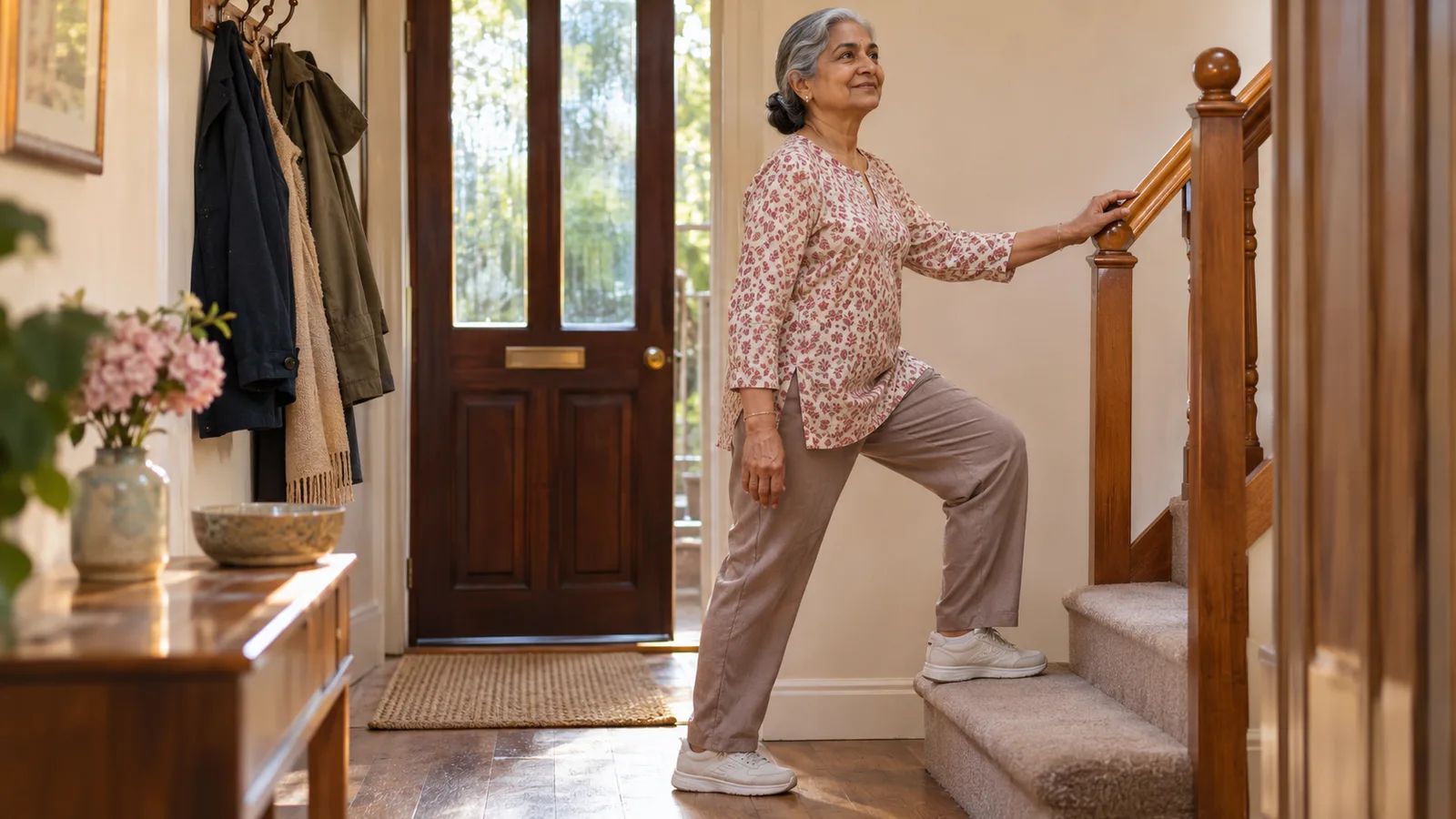
- Step-up. Onto a sturdy step or box. Start with one stair, about 7 in (18 cm), and work up to 12 to 16 in (30 to 40 cm). Push through the whole foot of the top leg and stand fully tall.
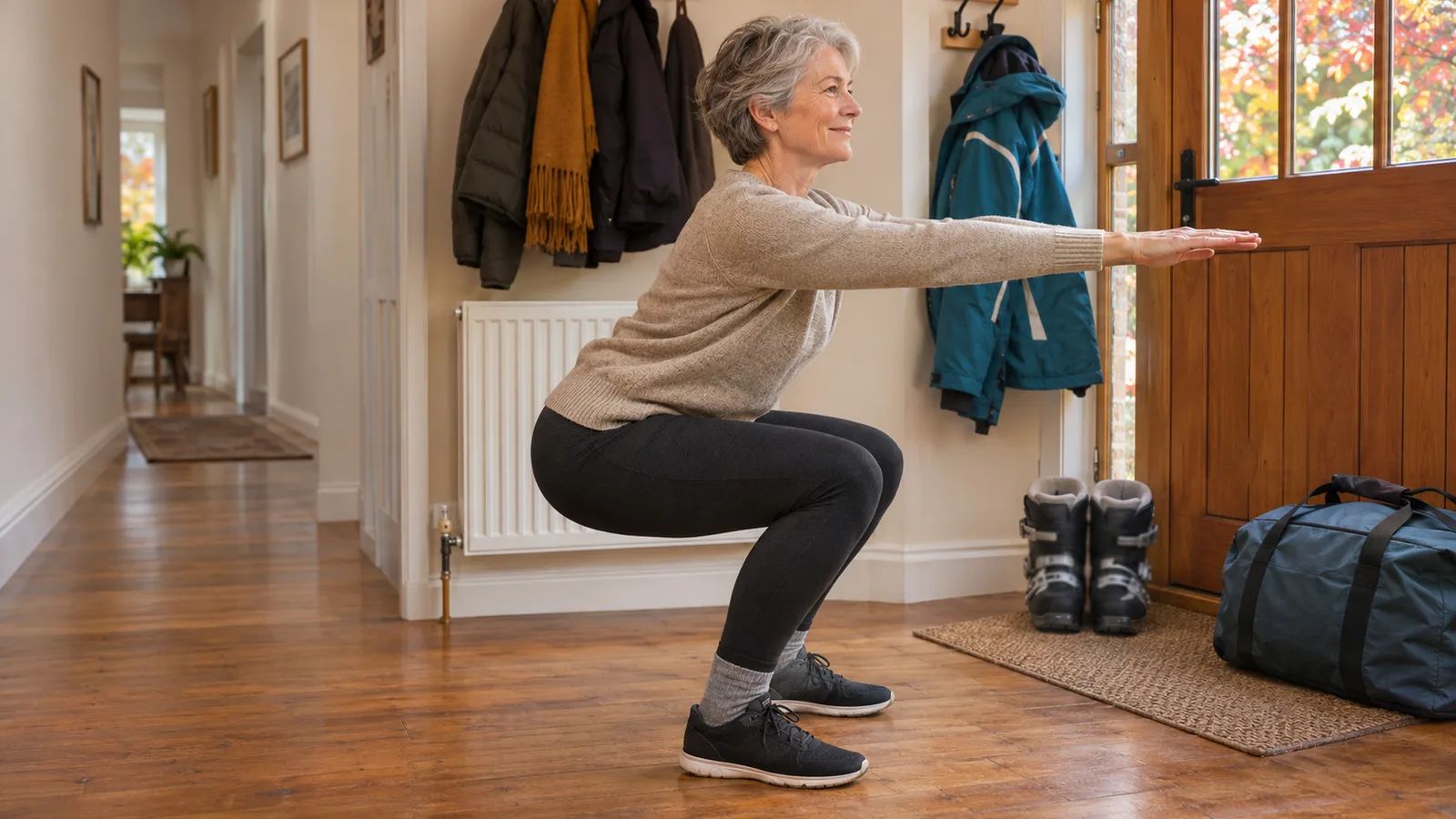
- Slow step-down. Stand on the step on one leg. Take three seconds to lower the other heel to the floor, tap it, and stand back up. Keep the standing knee pointing over your middle toes, not drifting inward. This is the downhill move: legs that haven't practiced lowering you step after step are the ones that ache for days after the descent.
- Split squat. One foot forward, one back, both on the floor. Lower straight down until the back knee is just above the floor, then stand.
- Romanian deadlift. Dumbbells or a loaded backpack held in front. Push your hips back with a flat back until the weight passes your knees, then stand. It trains the hips and back that carry the pack for hours.
- Calf raise. On the edge of a step, rise up on both feet, then take three seconds to lower your heels below the step.
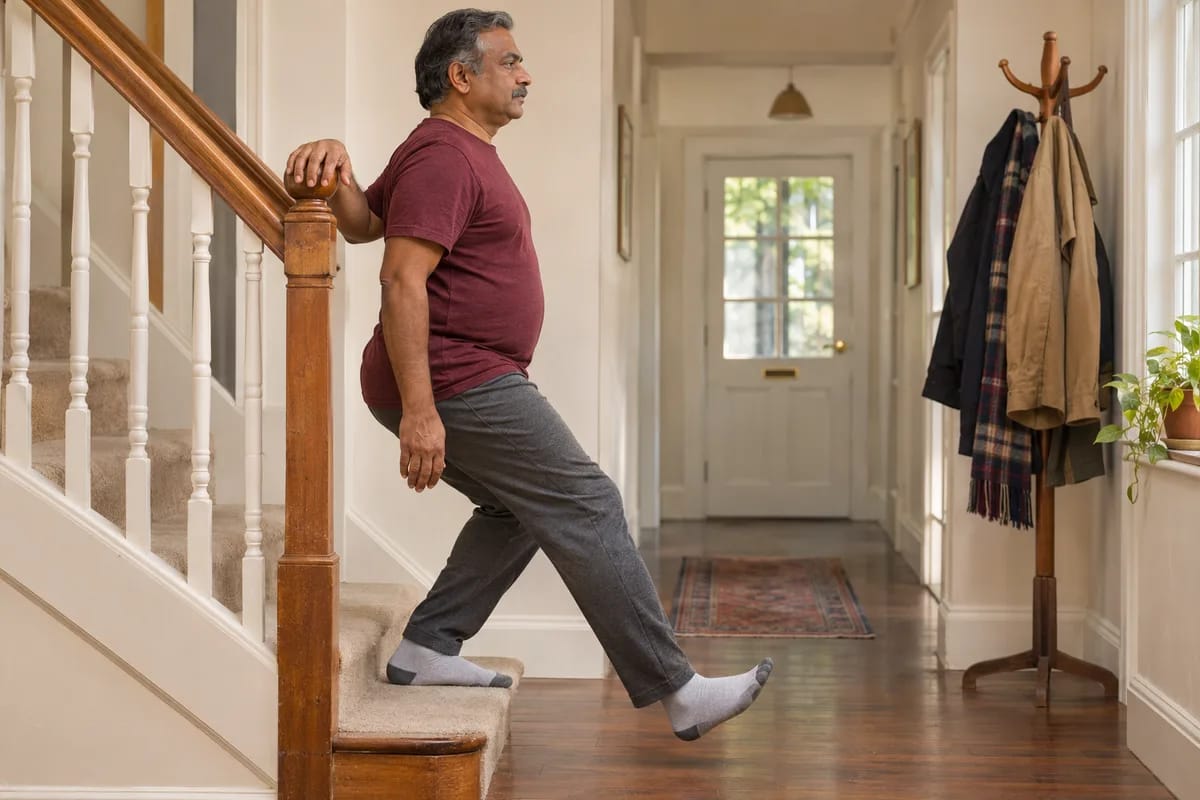
Most of these are one leg at a time for a reason: walking uphill is one leg at a time lifting you and your pack, thousands of times a day.
The check two weeks before you fly
Do these in week 10 or 11
- Hike 5 to 6 hours with your daypack, in the boots you'll wear on the mountain
- Climb 3,000 ft (900 m) in about 3 hours of uphill walking with 20 lb (9 kg), timed on your week 10 long hike
- Hike again the next morning, for 2 to 3 hours
- Walk down 1,000 ft (300 m) of stairs, about 10 trips down a 10-story building, without your thighs shaking
- Do one evening walk in the headlamp, gloves and layers you'll wear on summit night
Alpine Ascents wants the second item about a month before you go;3 this plan aims for it a couple of weeks later. If you can do all five, you're ready. If you can't yet, don't make the last weeks harder. Repeat week 10 instead of moving on, walk slower on the mountain, and take every chance your guides give you to rest.
What fitness won't fix: the altitude
Being fit doesn't protect you from altitude sickness. The CDC says it in so many words: "Training and physical fitness do not affect risk."2 The Merck Manual agrees. It reports altitude sickness rates of about 80% in some groups, Kilimanjaro climbers among them, and names going up too fast as a primary risk factor.6
The study from the top of this page points the same way. Training for the climb didn't predict reaching the top. More days on the itinerary did, with about 16% higher odds for each extra day. Hikers under 50 also summited more often. You can't change your age, but you can add days.1 It's an observational study with self-reported training, so it doesn't prove training is pointless. What training buys is pleasant days, a summit night you can keep going through, and legs that get you down safely.
What that means in practice:
- Choose the longer itinerary if you still can. It's the one risk factor you choose when you book.
- Walk slowly, even when you feel strong. Feeling strong is exactly when going fast is tempting.
- Tell your guides how you feel, every day, honestly.
- See a doctor or a travel clinic well before you go. Ask about altitude and whether a preventive medicine makes sense for you. If you have a heart or lung condition, or any other ongoing health problem, the CDC's advice is to talk to a doctor who knows high-altitude medicine.2
Your Tuesday climb, with a coach on the call
Training won't buy you the summit on its own, but it decides how the trip feels. It also takes twelve weeks of turning up through work, weather and dark evenings. Plenty of people manage it with a printout on the fridge. Others find the Tuesday climb has quietly become a Tuesday on the couch.
Bespoke Fit is built for that part. Every session is a live 1‑on‑1 video call with your own coach at a set time, in our app on iPhone, Android or a browser, so someone is waiting for you. Your coach writes your 12 weeks on your training calendar. If you're starting with the on-ramp, they run those weeks with you and decide when week 1 begins.
Week 9, Tuesday: your phone is on a stand by the treadmill, and your coach sees your heart rate live from your Apple Watch or a Bluetooth heart rate strap. Twenty minutes in, at the same speed, it creeps out of the easy zone, which is normal on long efforts (here's why). Alone, it's tempting to hold the pace. Your coach takes the speed down a notch before an easy session turns hard.
Thursday, step-downs. On the fourth rep your left knee drifts in, and your coach says so before the next one. That's the move that carries you down the mountain, and on a replaced knee it's the rep you most want someone watching.
Your coach doesn't see the weekend hikes; you message afterwards, with a photo if you like. Say Saturday's descent left your thighs sore for two days: next Sunday's hike gets shorter, and Thursday gets an extra set of step-downs.
Each coach has 12 members at most, and we hold to that when we assign coaches. A head coach matches you on a 30-minute call; tell them your trip date. Your coach doesn't need to have climbed Kilimanjaro. This plan is the brief, their job is getting you through it on schedule, and on the mountain your guides make the calls.
The price, and who's better off training alone
14 days free, then $299 a month, cancel anytime, with unlimited sessions of 45 to 90 minutes (most people settle at around an hour). The 14 days start at your first session, not at signup. Two calls a week, the climb and the strength day, comes to about $35 a session, and a third costs nothing more. Twelve weeks is three payments ($897), and you can cancel when you fly.
Use the 14 days as a test. Put both sessions on calls each week, then ask: did your coach catch something you'd have gotten wrong alone, like a pace that was too hard or a knee drifting in? If not, keep this plan and spend the money on the trip.
Train on your own instead if:
- You have a hiking club or a class you love, with people who'll notice when you don't show.
- You want to train whenever suits you. Your coach books set times with you.
- You want meal plans or macros. We don't do nutrition coaching.
- $299 a month is a stretch next to the trip. The plan above is free and will get you ready. If it's a choice between us and an extra day on the mountain, take the extra day.
Sources
-
Croughs, M., Nyakunga, G.B., Sakita, F.M., Kilonzo, K., Mmbaga, B.T. & Soentjens, P., 2022. Incidence and predictors of severe altitude illness symptoms in Mt. Kilimanjaro hikers: a prospective cohort study. Journal of Travel Medicine. 1,237 recreational hikers over one season; 87.9% reached Uhuru Peak. Summit success went with no severe symptoms, preventive medicine, climbing higher in daytime, age under 50 and more days (odds ratio about 1.16 per extra day). Specific training, reported by a third of hikers, was not related to summit success. Observational, with training self-reported. ↩ ↩2
-
Centers for Disease Control and Prevention, High elevation travel and altitude illness, CDC Yellow Book, read November 12, 2026: Kilimanjaro "approximately 5,900 m; 19,341 ft"; "Training and physical fitness do not affect risk"; travelers with conditions such as heart or lung disease "should consult a physician familiar with high-altitude medical issues before undertaking such travel". ↩ ↩2 ↩3
-
Alpine Ascents International, Kilimanjaro training, read November 12, 2026: most days 4 to 8 hours of hiking, many around 5 or 6; summit day 12 hours or more from around midnight, roughly 8 hours up and 6 to 7 down; about 5 hours downhill on the last day; a daypack of about 15 lb; packs built up to 20 to 25 lb; about 1,000 vertical feet an hour with a pack; "About a month out, you should be able to gain 3,000 feet in around three hours with that pack"; "Approximately every 4th week should be a very easy consolidation week"; "Most people will need to train for at least 4-6 months". A guide company's guidance, not research. ↩ ↩2 ↩3 ↩4 ↩5
-
Thomson Treks, How to train for Kilimanjaro, January 4, 2025, read November 12, 2026: Barafu Camp to Uhuru Peak about 3 miles, 8 to 10 hours, 4,265 ft of gain, on its Western Approach route. ↩
-
Tusker Trail, Training for Kilimanjaro if you're over 50, read November 12, 2026: "If there are no hills where you live, stairwells, stadium steps and parking ramps can simulate hiking conditions." ↩
-
Luks, A.M., Acute altitude illness, Merck Manual Professional Version, read November 12, 2026: "Physical fitness is not protective"; acute mountain sickness rates of approximately 80% reported among pilgrims in Nepal and climbers on Kilimanjaro, settings known for "overly rapid rates of ascent, which is a primary risk factor". ↩