Rucking for zone 2: load, pace, and progression
Carrying a loaded pack pushes an easy walk into zone 2 without a jog's impact. Here's the energy-cost science, the bone claim, and how to start safely.
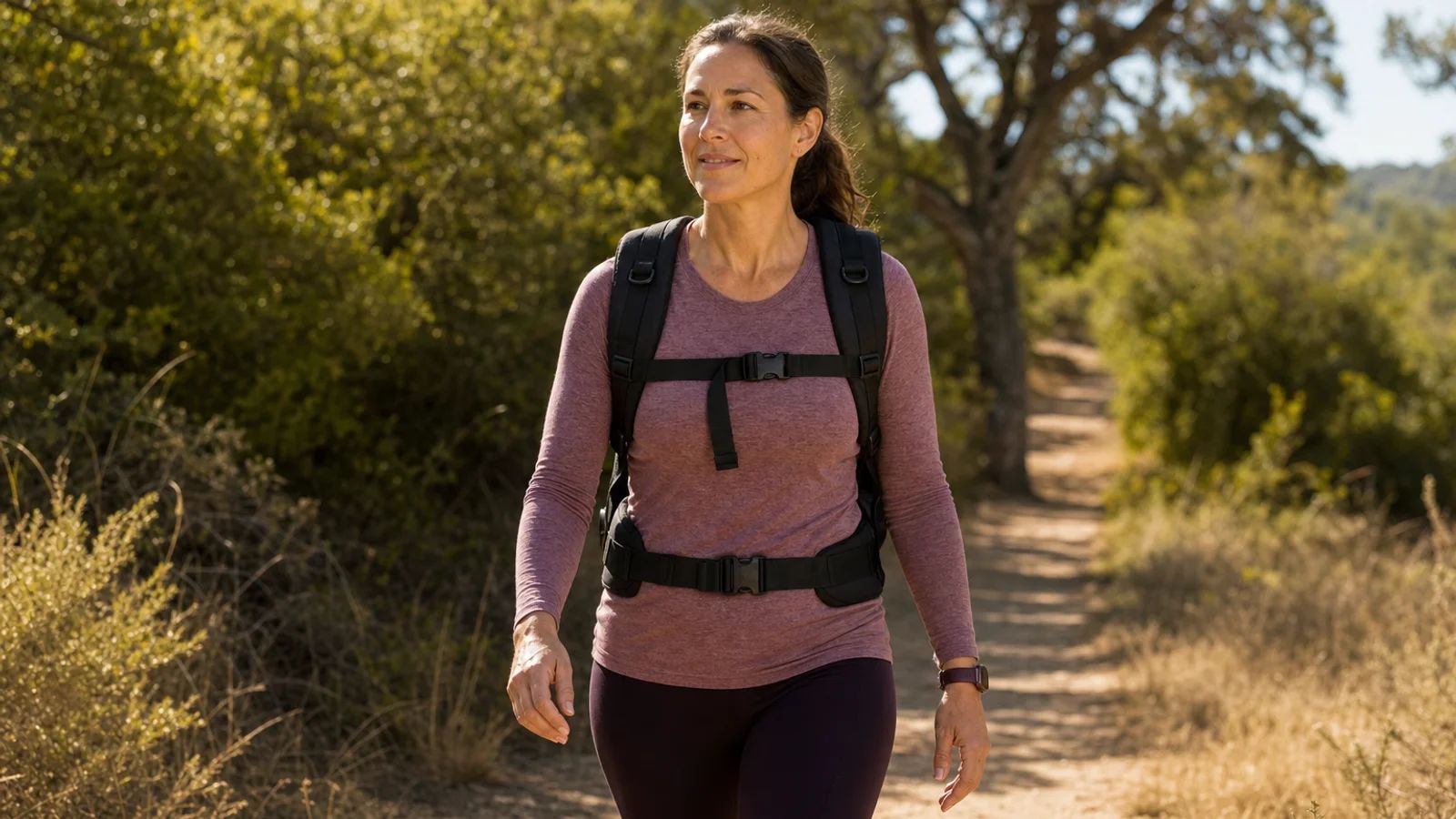
Strap weight to your back and go for a walk, and your heart rate climbs like you're jogging, except your knees never leave the ground. That's the whole trick behind rucking, which is really just walking with a loaded pack.
Zone 2 is the effort level where your body can still clear lactate about as fast as it makes it, roughly the pace where you could hold a conversation but wouldn't choose to. (We cover how to find that pace in the zone 2 primer.) A flat, easy walk usually sits below that zone, too gentle to count as real training. The usual fix is jogging, but jogging brings impact a lot of stiff knees or heavier beginners would rather skip.
Load solves the same problem without the impact. Add weight and every step costs more energy, so your heart rate rises at the same walking speed you'd use anyway. This piece covers three things: how much weight it takes to feel it, how to build up a pack without hurting yourself, and whether the bone-density claim attached to rucking holds up.
How much weight it takes
Enough to matter, and in a way you can predict ahead of time. The energy cost of walking rises with the total mass you're moving, and a loaded pack counts as mass just as much as your own body does.
The cleanest test of this is a 2003 study in the Journal of Applied Physiology, where people walked carrying loads of 0, 10, 20, and 30 percent of their body weight. Metabolic cost rose in close to direct proportion to the load: double the weight on your back and you roughly double the extra energy it costs to carry it.1 There's no trick that lets you carry weight for free.
The military turned that relationship into a formula decades ago, useful for predicting how far a soldier carrying gear can march in a day. It factors in body weight, load, walking speed, hill grade, and the ground underfoot.2 The lesson for a regular walker: load, hills, and soft footing all stack on each other, and heavy loads carried as a large share of your body weight cost a bit more than a straight line would predict.
In practice, a pack at 10 to 20 percent of your body weight is usually enough to push an easy walk into zone 2 heart rates. If it isn't, a small hill will finish the job without you having to speed up at all.
Building your pack: start, add, repeat
Start lighter than you think you need to. The mistake that hurts people is treating the load as the goal instead of the dose.
A pack around 10 percent of your body weight is a sensible place to begin. For most people that's enough to feel real effort without straining anything, and it leaves plenty of room to grow. I'd rather see someone start too light and add a notch every couple weeks than show up to week one with a pack that wrecks their shoulders. Add weight in small steps, not every session, and only once your current load feels genuinely easy for the whole walk.
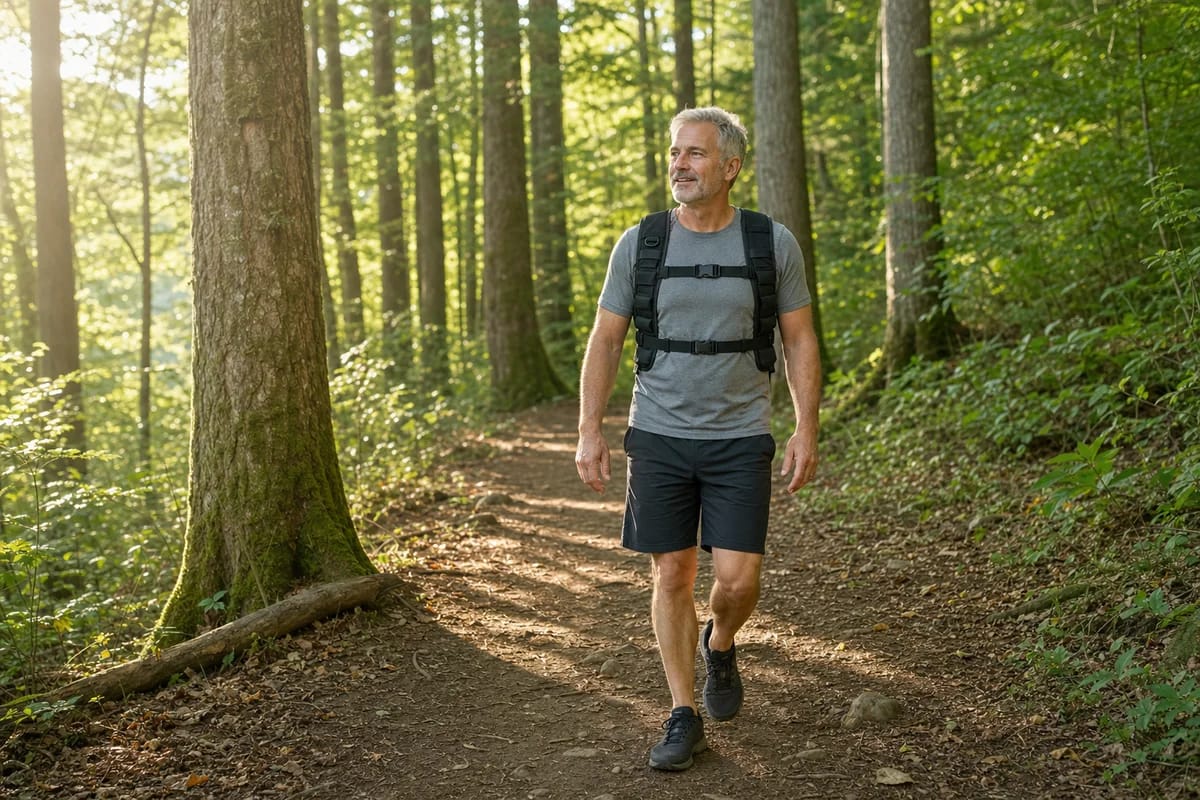
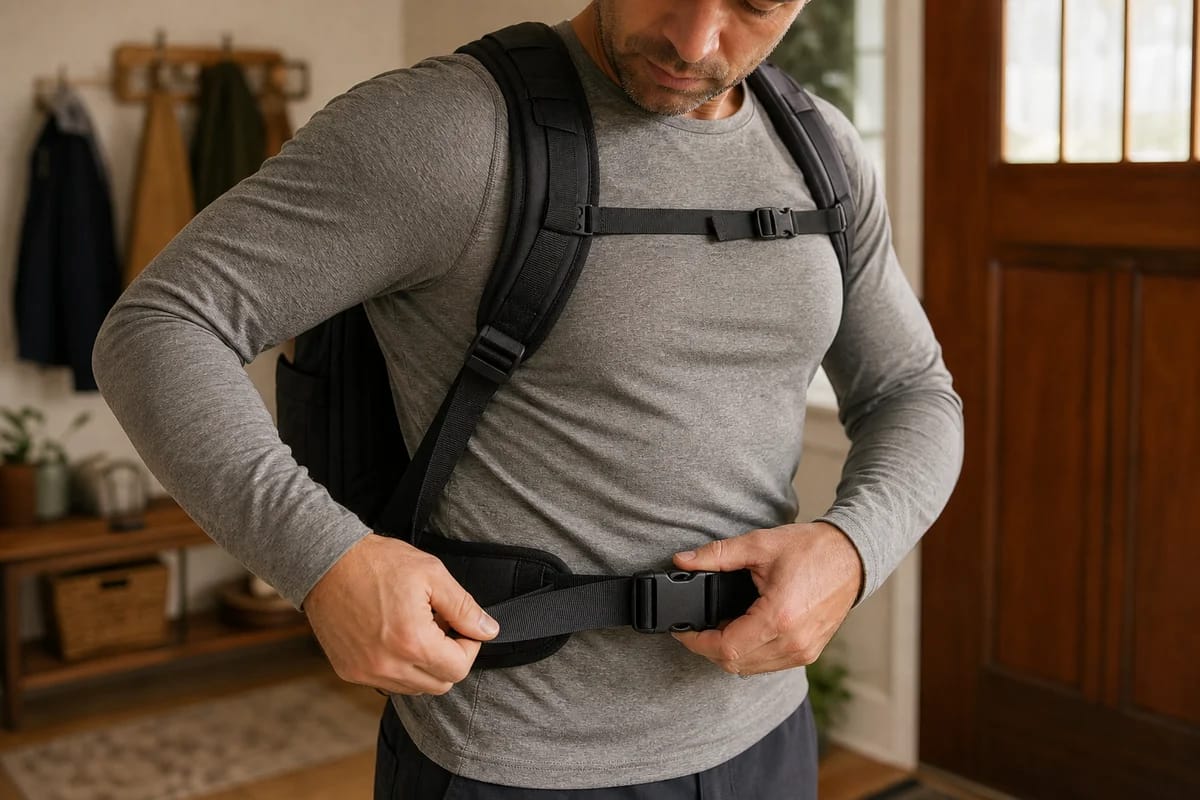
How the pack fits matters as much as what's in it. Keep the weight high and close to your upper back instead of letting it sag at your waist. Use both shoulder straps. Tighten a hip belt if the pack has one, so your hips carry some of the load instead of leaving it all on your shoulders. Plates or sand packed snug beat loose gear that shifts with every step.
Pace and terrain are your other two dials. Flatten the route or slow down to make a walk easier, add a hill or pick up the pace to make it harder. Start flat and save hills for later, since grade multiplies both the cardio cost and the strain on your back at the same time.
Does it build bone, or just protect what you have?
This is the claim most likely to be oversold, so it's worth being careful with.
The logic holds up as far as it goes. Bone only gets stronger when the strain on it crosses a real threshold, which is why heavy lifting builds bone while gentle movement mostly just maintains what's already there. (We go through that mechanism in how lifting builds bone.) Rucking is weight-bearing and pushes load straight down through your spine, hips, and legs, so in principle it should move the needle further than an unloaded walk does.
But walking-level strain, even loaded, is probably still under the threshold that reliably builds new bone. The best direct evidence isn't even about rucking. It's a small trial, 18 postmenopausal women followed for five years: the group wearing weighted vests and doing jumping drills held onto their hip bone density, while the group that did neither lost about 4 percent at the femoral neck.3 Encouraging, but that combined a weighted vest with real jumping, so the loaded walking alone can't take full credit, and the group was tiny.
Rucking almost certainly beats an unloaded walk for your skeleton. But the specific evidence for rucking itself is thin, most of the bone case is borrowed from impact and lifting research, and it belongs in your week as a bonus, not the main event. If bone density is your actual goal, heavy lifting is still the better-proven tool.
The posture side holds up better day to day. Carrying weight in front of and behind your center of mass makes the muscles along your spine and around your shoulders work to keep you upright for the whole walk. That's low-grade postural endurance training, and it's real, though it won't fix a desk-bound back on its own.
The injury data is about soldiers, not you
Almost everything we know about load-carriage injuries comes from military research, and that gap matters more than the raw numbers suggest.
Reviews of load-carriage injury put the lower body at the top of the list: blisters, stress fractures, knee and foot pain, plus shoulder and back nerve irritation from straps digging in over hours.4 The loads behind those numbers routinely top 45 kilograms, about 100 pounds, more than four times what we're suggesting you start with.5 That context doesn't erase the risk. It resizes it: the injury sites are worth respecting even at a fraction of military load, but the scary totals aren't your situation.
Individual response still varies. If you already deal with back trouble, low bone density, or knee arthritis, added load can make things worse, and that's worth a conversation with a clinician before you start, not after something starts hurting.
Common questions
How heavy should my ruck be to start? About 10 percent of your body weight. That's usually enough to push your heart rate into an easy aerobic zone at a normal walking pace, and it leaves room to add weight over the following weeks.
Is rucking better than running for cardio? They're different tools, not a ranking. Rucking gets you to zone 2 with far less impact than running, which suits cranky knees or extra body weight to move. Running raises your heart rate faster and needs no gear. If impact is what's keeping you from cardio, rucking is a real answer.
Does rucking really build bone? Probably more than an unloaded walk does, since you're weight-bearing under extra load. But the direct evidence for rucking specifically is thin, and most of the bone case is borrowed from impact and heavy-lifting research. If bone density is the priority, heavy resistance training has the stronger track record.
Will a weighted pack wreck my back? Not at sensible loads, carried well. The injury numbers that worry people come from soldiers under packs several times heavier than yours will be. Keep the weight modest and high on your back, use a hip belt, and add weight slowly. Back ache that lingers after a walk is your signal to lighten up.
Pairing rucking with the rest of your training
Fill a pack to about a tenth of your body weight, walk at a pace where you can still talk, and add weight every week or two. Do that consistently and you'll get most of what rucking has to offer, and that part is arithmetic and patience. If you're the kind of person who keeps doing both without being reminded, this particular piece of your training doesn't need extra hands on it.
Where a coach earns their spot is everything around it: fitting rucking into a week that already has lifting and a life in it, and pairing it with the heavy strength work that does the real bone-building as you age. At Bespoke Fit your coach watches your lifting sessions live over video, sets the load based on how you respond, and adjusts week to week as your fitness changes. Your first month is $49, and founding members lock in $299 a month for life, with unlimited live 1-on-1 sessions, 25 spots, and a 30-day money-back guarantee. See how it works if you want a coach building the plan around you.
Sources
-
Griffin and colleagues, 2003. Metabolic cost of generating muscular force in human walking: insights from load-carrying and speed experiments. Journal of Applied Physiology. ↩
-
Pandolf, Givoni, and Goldman, 1977. Predicting energy expenditure with loads while standing or walking very slowly. Journal of Applied Physiology. ↩
-
Snow and colleagues, 2000. Long-term exercise using weighted vests prevents hip bone loss in postmenopausal women. The Journals of Gerontology, Series A. ↩
-
Orr and colleagues, 2014. Soldier occupational load carriage: a narrative review of associated injuries. International Journal of Injury Control and Safety Promotion. ↩
-
Orr and colleagues, 2021. Soldier load carriage, injuries, rehabilitation and physical conditioning: an international approach. International Journal of Environmental Research and Public Health. ↩