Fun ways to exercise when you hate working out
Fun ways to exercise, sorted by the kind of fun you like: games, music, people, outdoors or progress. How hard each one is, and how to fit strength in.
In this article7
The fun way to exercise is the one built out of something you already enjoy: games, music, other people, being outdoors, or watching a number go up. Nobody has to like the gym. You just need one or two things you'd happily do again next Thursday.
Below: about 30 ideas sorted by kind of fun, how hard each one really is, and the strength work nearly every fun list forgets.
Find your kind of fun first
Start with the row that sounds least bad.
| If this sounds like you | Start with |
|---|---|
| You liked recess more than gym class | Pickleball, a frisbee in the park, shooting hoops |
| You'll move to music, just not to someone shouting | A kitchen dance playlist, a salsa or line-dancing night |
| You show up for other people more than for yourself | A rec league, a walking group, a water aerobics class |
| You'd rather be outside and somewhere new | Geocaching, disc golf, a bike ride with somewhere to go |
| You like seeing yourself get better | Bouldering, a martial art, lifting with a notebook |
| You get bored after five minutes of anything | A show or audiobook you only get while moving |
The ideas, sorted by kind of fun
Play and games
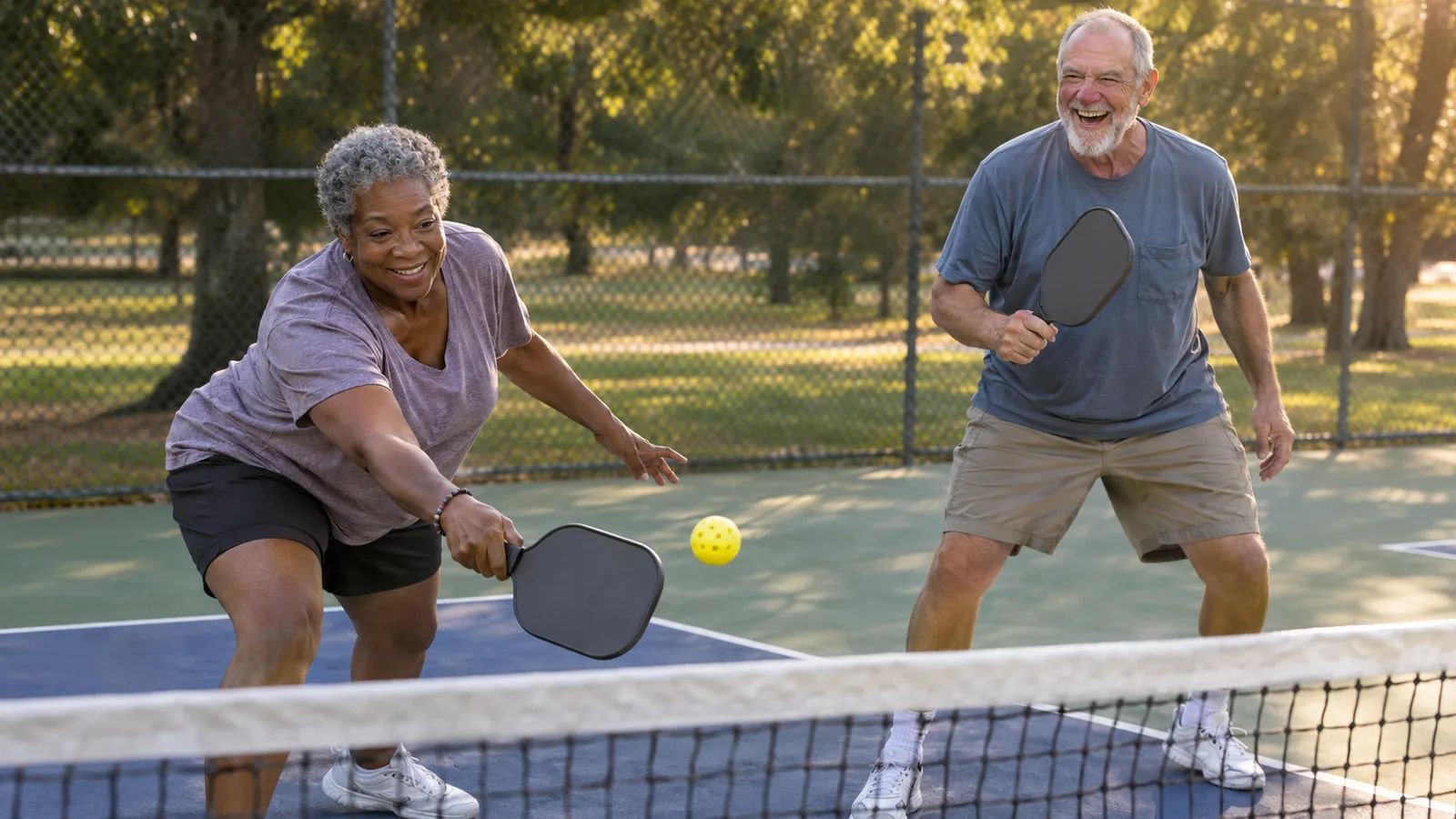
- Pickleball. Doubles is the friendly way in, and many parks departments and Ys run beginner or open-play times. The snag: it's easy to play for three hours on day one. Stop at an hour while your knees and shoulders adjust.
- Frisbee, from a toss to a team game. A lazy toss in the park is gentle. A full pickup game is one of the hardest things on this page, so it grows with you.
- Shooting hoops, or a game of H-O-R-S-E. Shooting around is moderate; a real game is vigorous.
- Active video games and VR fitness. Rhythm and boxing games in a VR headset can leave you properly out of breath. Clear some space so you don't punch a lamp.
- A trampoline park. Adult sessions exist, and ten minutes of bouncing is harder than it looks.
- The playground. Monkey bars, a curb as a balance beam, skipping for a block. Go when it's quiet, or bring the kids.
Music and rhythm
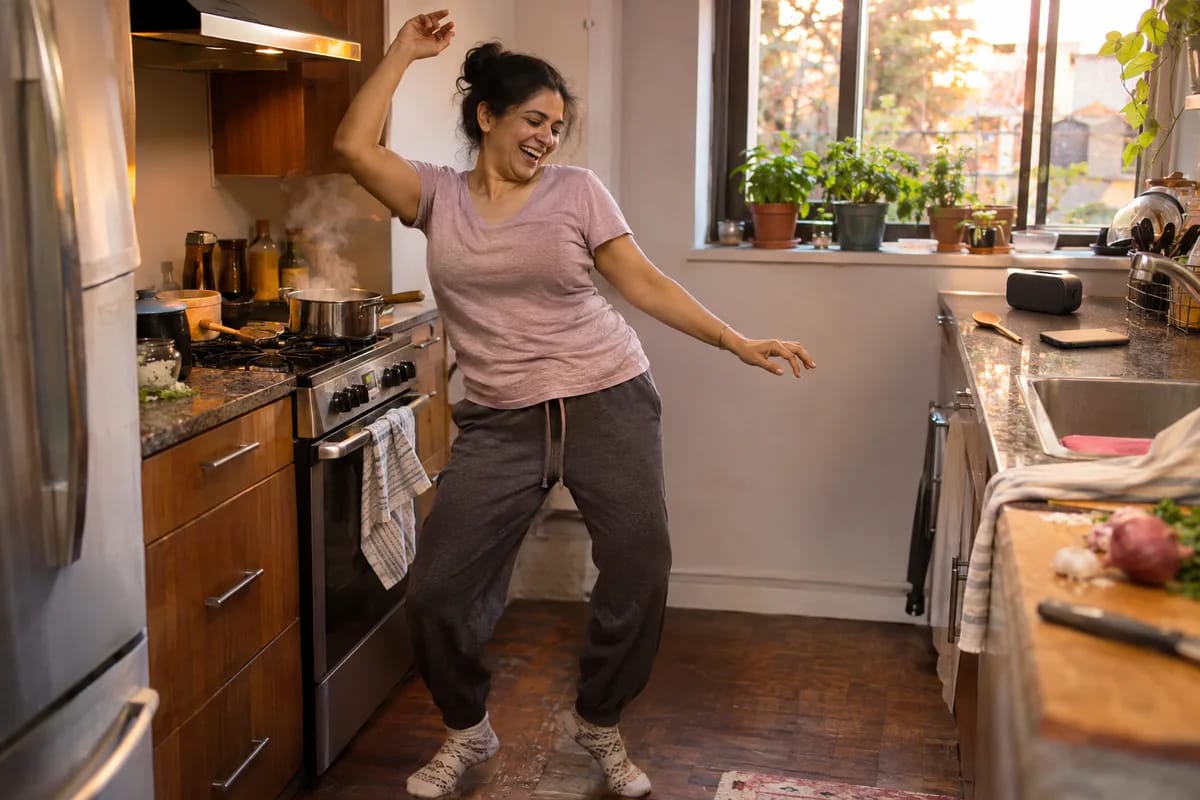
- A kitchen dance playlist. Three songs while the pasta water boils. Free, private, and nobody's watching.
- A line-dancing or salsa night. Studios and community centers run beginner nights. You go for the music and realize you've moved for two hours.
- A dance workout video. Zumba and its cousins. Pick the instructor whose music you'd listen to anyway.
- Hula hooping. An adult-sized hoop is much easier to keep going than a kid's hoop. Hoop through one song, rest through the next.
People and teams
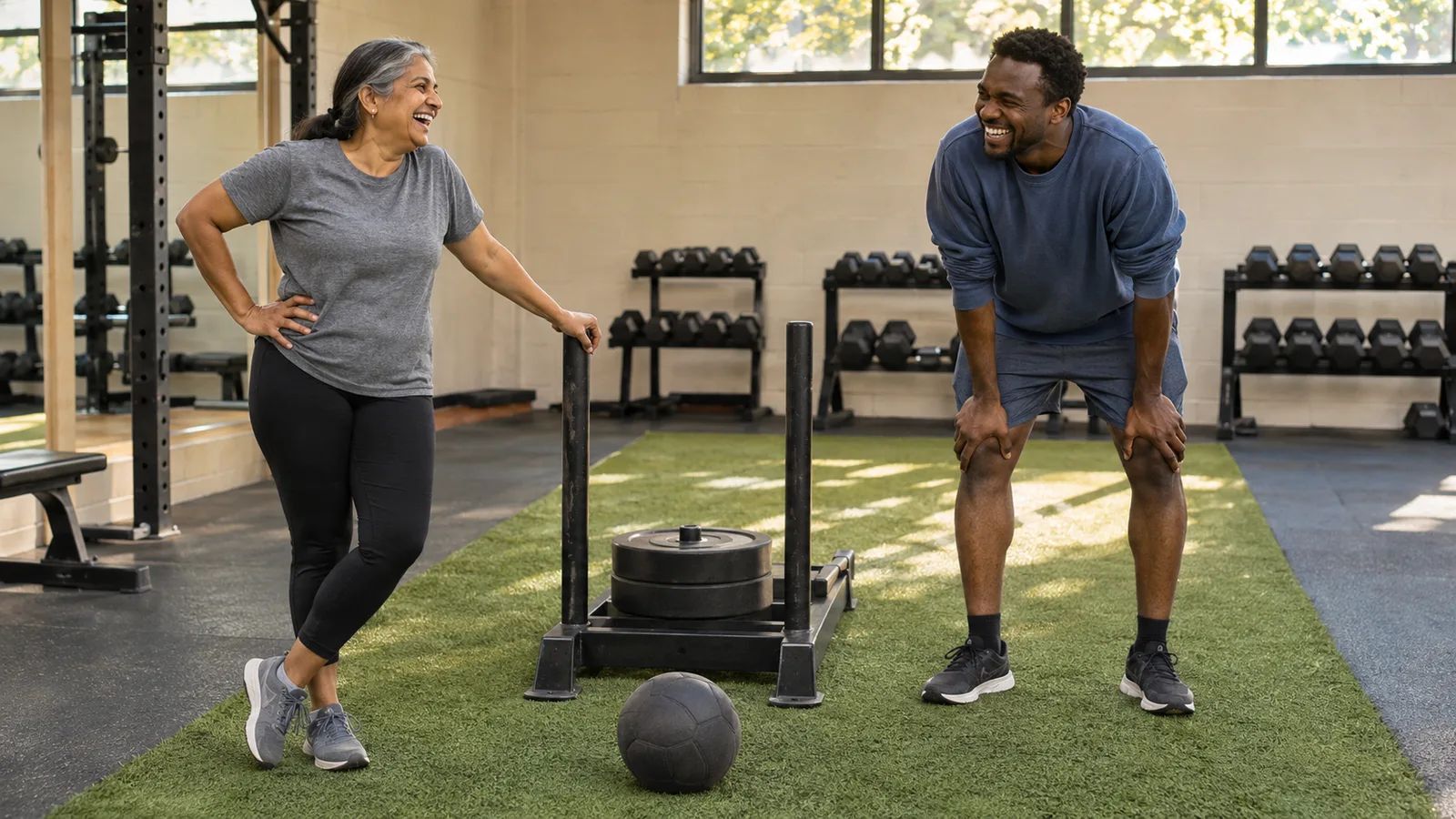
- A rec league. Kickball, softball or volleyball through your city's parks and rec. Teammates need you there, which is the point.
- Doubles tennis or badminton. Half the running, twice the conversation.
- Water aerobics, or a lap swim. The water carries part of your weight, which is kind to sore knees and hips, and classes tend to be chatty. Laps are the solo version.
- A walking group, or a walk-and-talk. Same day, same time, every week. A phone call with a faraway friend counts if you walk while you talk.
- A class with a friend in the same slot. On the nights you wouldn't go for yourself, you'll go for them.
- Moving for a cause. Park cleanups, a charity walk, a shift at the community garden. The good deed hides the exercise.
Outdoors and exploring
- Geocaching. A free app shows hidden containers near you and turns a walk into a treasure hunt.
- The dog walk, the long way. Add a loop the dog hasn't sniffed yet.
- A bike ride with somewhere to go. The coffee shop, the library, a friend's porch. An e-bike flattens the hills and still counts.
- Gardening. Digging, hauling mulch, weeding on your knees. The digging even counts as strength work, which almost nothing else here does.
- Disc golf. Lots of courses sit in public parks. One disc is enough to start.
- Golf on foot. Walk nine holes and pull your clubs instead of riding in the cart.
- A new trail each weekend. Start with loops of about 2 miles (3 km) and add a little when it feels easy.
- Roller skating. Rinks run adult nights; outdoors, find a smooth path. Wrist guards are cheap and worth it.
Getting better at something
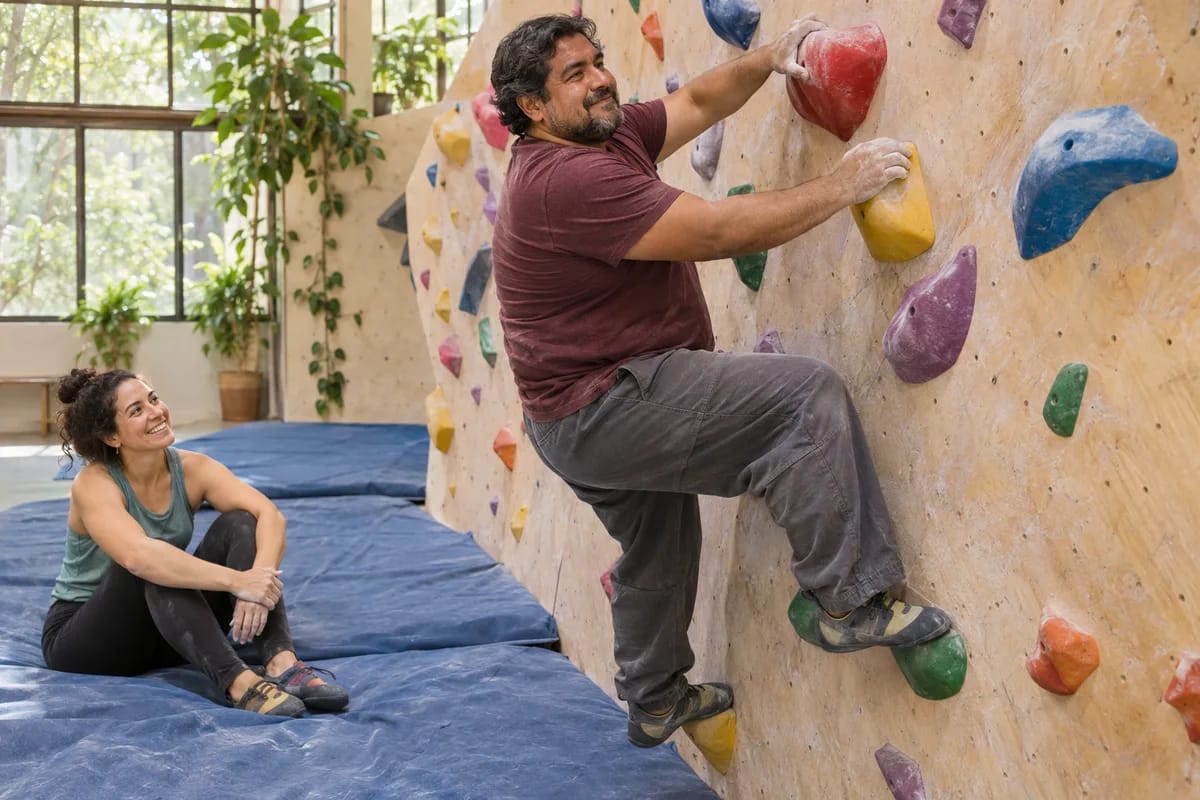
- Bouldering. Short climbs over thick mats, no ropes. Routes are graded by color or number, so you can see yourself move up.
- A martial art. Tai chi at the gentle end, jiu-jitsu or kickboxing at the other. Belts and stripes are progress you can see.
- A skill at home. Your first pull-up, a handstand against the wall, a minute-long plank. Practice for five minutes most days.
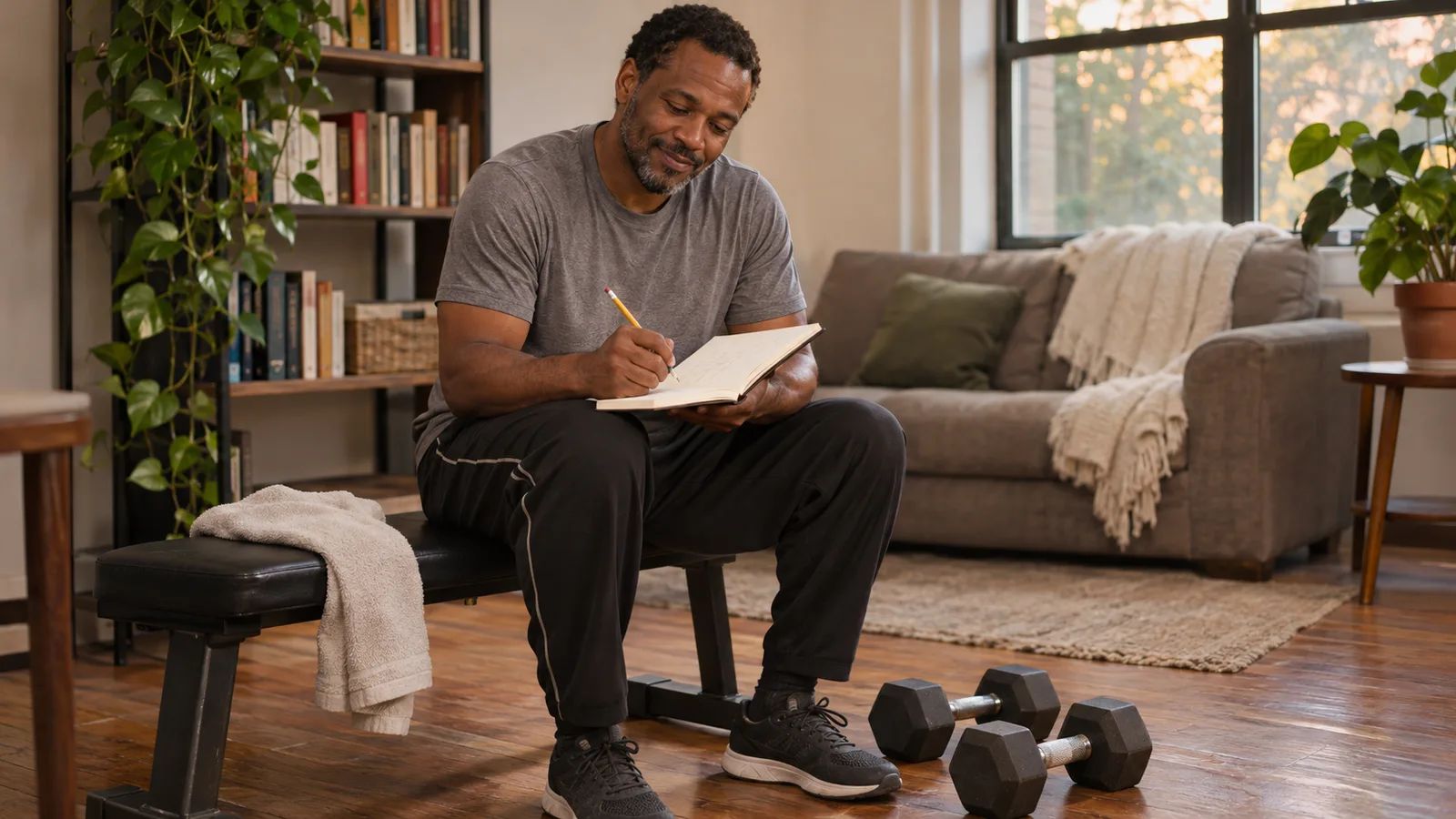
- Lifting with a notebook. It sounds like the least fun idea here. Give it a month before you decide, for reasons below.
Something to watch or listen to
- A show you only watch while moving. On a walking pad, an exercise bike, or the treadmill that's been holding laundry. The next episode waits for the bike.
- A podcast or audiobook you save for walks. Keeping the good stuff for workouts got people to the gym more often at first, then the effect faded. The story is in our post on motivation and systems.
If jumping or running is off the table for you, these no-jump routines cover the same ground gently.
How hard is each one, really?
Effort is measured in METs, roughly how many times harder than sitting still: 3 to 5.9 is moderate, 6 or more is vigorous.1 The calorie column is our rough arithmetic for a 160 lb (73 kg) person, and your own burn will differ.2
| Activity | Effort (METs) | Counts as strength? | Calories in an hour, roughly |
|---|---|---|---|
| Lifting weights, 8 to 15 reps | Moderate (3.5) | Yes | 250 |
| Disc golf | Moderate (3.8) | No | 280 |
| Golf, walking and pulling clubs | Moderate (4.5) | No | 330 |
| Salsa with a partner | Moderate (4.8) | No | 350 |
| Shooting hoops | Moderate (5.0) | No | 360 |
| Martial arts, beginner class | Moderate (5.3) | Partly | 380 |
| Zumba to a video at home | Moderate (5.5) | No | 400 |
| Badminton, social | Moderate (5.5) | No | 400 |
| Hula hooping | Moderate (5.8) | No | 420 |
| Trampoline, for fun | Vigorous (6.3) | No | 460 |
| Roller skating | Vigorous (7.0) | No | 510 |
| VR fitness game, hard | Vigorous (7.9) | No | 570 |
| Basketball game | Vigorous (8.0) | No | 580 |
| Frisbee, full team game | Vigorous (8.0) | No | 580 |
| Bouldering | Vigorous (8.8) | Partly | 640 |
| Dancing flat out (disco, line dancing) | Vigorous (9.8) | No | 710 |
"Partly" is our call for activities that work your arms, back or legs hard without covering the whole body.
You don't need a heart rate monitor to know where you are. If you can talk but not sing, it's moderate. If you can only get a few words out before you need a breath, it's vigorous.1 Spend most of your time on the talking side. Push past the point where your breathing races ahead of you and almost everyone starts to dislike it.3 That matters, because how a session feels while you're in it is linked to whether people come back. How they feel afterward isn't.4
Moderate is plenty. The US guideline is 150 minutes of moderate activity a week, or 75 vigorous, and any amount has some benefit.5
What about burning 700 calories in an hour? At 160 lb you'd need to hold about 9.6 METs for the full hour, which means dancing flat out, nonstop. At 200 lb (91 kg) it's about 7.7 METs, a full hour of team frisbee. Fine for a big day out, a poor reason to pick an activity you'll quit.
If you have a heart condition or another health condition, or you get chest pain, dizziness or unusual breathlessness when you exert yourself, talk to your doctor before you start vigorous sport.
The part fun lists leave out: strength
Look at the strength column again. Almost nothing fun ticks it. The guideline asks for muscle-strengthening work at least two days a week, covering legs, hips, back, chest, belly, shoulders and arms, done until another rep would be hard without help. Weights, bands, bodyweight moves and some yoga postures count, and so does digging in the garden.6
It's the part that makes carrying groceries, climbing stairs and getting up off the floor easier, so it's worth finding a version you don't dread:
- Make it a game of beating last week. Pick four moves, write down the reps and the weight, and next week try for one more rep or 5 lb (2 kg) more. Beginners improve quickly, so the number moves often. Our guide to tracking your workouts keeps the log simple.
- One song, one move. Squats for the verse, rest for the chorus. A playlist is a timer that doesn't nag.
- Climb and hang. Bouldering and monkey bars work your grip, arms and back hard. Pair them with one day of squats and lunges and you've covered most of the list.
Three rules that keep it fun
1. Choose the fun one over the useful one. People told to pick the exercise they'd enjoy most, instead of the one they thought was best for them, kept going longer.7
2. Change something every few weeks. A bit of variety helps people stick with a new routine, and a new trail or a new class costs almost nothing to try.8
3. Bring a person. Among people who'd just joined a gym, enjoying it was the strongest sign they'd still be going a year later, and support from friends and family was linked to it too.9 If you're weighing a friend against a paid coach, here's what each one actually gives you.
Quit three times already? Run a two-week taste test
The problem might not be you. You may have kept picking things you hated. Treat the next two weeks as a test.
Pick two ideas from different groups
One at home, one out the door. A dance playlist and pickleball open play, say.
Put each one in your calendar twice
Real days, real times, over the next 14 days. Four sessions in total.
Stay on the talking side
You're testing whether you like it, not whether you can survive it.
Score each one straight after
Would I do that again next Thursday? Yes, maybe or no. Write it down.
Keep the winner and add one strength day
Twenty to thirty minutes, using the beat-last-week game above.
Swap one thing in every four to six weeks
A new trail, class or playlist keeps the winner from going stale.
Coming back after a long break? Start with our guide to getting back in shape, which covers how hard to go in the first few weeks.
If strength is the part you keep skipping
The list above takes care of the fun. Strength is the half that's easiest to drop, because nothing about it is a game and nobody notices when you stop. That's what we built Bespoke Fit around: live 1‑on‑1 video personal training in your living room, in normal clothes, with your coach watching through your phone or laptop camera for every session. The pickleball gets to stay pure fun.
- Someone waiting for you. Your coach books each session with you at a set time and is waiting on the call. Each coach has 12 members at most, and we hold to that when assigning coaches, so yours remembers last week.
- It's built around what you like. Your coach writes your program on your training calendar. Message them that lunges bore you, and next week's plan can change. On the day, you open the workout and start.
- The effort stays where you can handle it. Your coach sees your heart rate live from an Apple Watch or a Bluetooth strap, watches every set, and changes the weight or the rest from what they see.
- The number goes up. After each session a recap shows what you lifted and any records, and your strength trend builds over the months. A lighter week shows up as a session done, not a verdict.
"I've always wanted to be consistent with training, but I'd get demotivated and just stop showing up. Knowing Tris is waiting for me at every session means I actually go."
Henrik, 36, trains with Tris
You start with a 30-minute call with a head coach, who matches you to your coach. Sessions run 45 to 90 minutes, and most people settle at around an hour. One flat price covers as many as you want: twice a week works out to about $35 a session, three times about $23. It's 14 days free, then $299 a month, and the 14 days start at your first session, not when you sign up. Cancel anytime.
It isn't for everyone. If you love your sport and already do strength work twice a week on your own, keep going. If $299 a month would strain your budget, a rec league or a friend in the same class costs little or nothing. And we're not group classes, a video library, in-person training or nutrition coaching.
Sources
-
Centers for Disease Control and Prevention, 2025. How to measure physical activity intensity. Moderate is 3 to 5.9 METs, vigorous 6 or more; includes the talk test. ↩ ↩2
-
Herrmann, S.D. and colleagues, 2024. 2024 Adult Compendium of Physical Activities, the standard research list of activity costs. Journal of Sport and Health Science. Values from its sports, dancing and conditioning exercise lists; some are estimates rather than measurements. Pickleball has no entry, so it is not in the table. Calories are our arithmetic: METs × body weight in kilograms × hours. ↩
-
Ekkekakis, P., Parfitt, G. & Petruzzello, S.J., 2011. The pleasure and displeasure people feel when they exercise at different intensities. Sports Medicine. A review of 33 studies; it also found people cope with harder work better when they choose their own pace. ↩
-
Rhodes, R.E. & Kates, A., 2015. Can the affective response to exercise predict future motives and physical activity behavior? A systematic review of published evidence. Annals of Behavioral Medicine. ↩
-
Centers for Disease Control and Prevention. Adult activity: an overview. 150 minutes of moderate activity a week, or 75 minutes of vigorous, and any amount brings some health benefit. ↩
-
Centers for Disease Control and Prevention, 2023. What counts as physical activity for adults. ↩
-
Woolley, K. & Fishbach, A., 2016. For the fun of it: harnessing immediate rewards to increase persistence in long-term goals. Journal of Consumer Research. ↩
-
Sylvester, B.D. and colleagues, 2016. Variety support and exercise adherence behavior: experimental and mediating effects. Journal of Behavioral Medicine. 121 inactive university students over six weeks; the effect was small. ↩
-
Gjestvang, C. and colleagues, 2021. What makes individuals stick to their exercise regime? A one-year follow-up study among novice exercisers in a fitness club setting. Frontiers in Psychology. 250 previously inactive new members of 25 Norwegian gyms; regular attendance meant twice a week or more. ↩