Accountability partner or paid coach? What the money buys
A friend who asks if you trained helps, for free. What a paid coach adds on top, what it costs per coached hour, and when free is enough.
Updated

In this article8
"An accountability coach checks in once a week to ask whether I did the work. My roommate could do that for free." If that's roughly what you were thinking when you searched, you're more right than most coaching websites will admit.
The short answer
If a coach only asks whether you trained, keep the money: a friend who asks does that job for free. Paying earns its keep when someone watches you train, writes and changes your plan, and waits for you at a set time. That's live coaching.
We sell live coaching, so we're not neutral. Here's where we land. If a friend will reliably train with you, that's the best deal on this page, and there's a setup below to make it last. If nobody will, or you don't know what to do once you're there, a coach on a live video call is the paid option worth having, and for anyone training twice a week or more we think ours is the best of them. It isn't cheap, so you'll also find what it costs per coached hour, and who should buy something else.
We coach exercise, so that's the lens here. If your "work" is writing or study, the first two sections are the ones for you.
Three kinds of accountability, side by side
People use one word for three quite different things.
| Friend or roommate | Check-in coach | Live coach | |
|---|---|---|---|
| Typical cost | Free | $60 to $500 a month | $60 to $110 a month for one session a week, or $299 for unlimited with us |
| Asks if you trained | Yes | Yes, daily or weekly | No need, they were there |
| Keeps asking when you slip | Often not, if they're slipping too | Usually, it's what you pay for | Yes, they notice a no-show |
| With you at a set time | If your schedules line up | No | Yes, booked |
| Sees your form | If they know what to look for | Not live; at most a video you send | Live, as you train |
| Writes and changes your plan | No | Sometimes, from your reports | Yes, from what they saw |
The check-in prices come from GoalsWon, a general accountability-coaching service. It charges $60 to $90 a month for daily chat check-ins and a monthly video call, and puts other coaching services at $200 to $500 a month, usually for one call a week or month.1 Live video coaching at HipTrain is $59.49 a month for one 30-minute session a week, or $109.99 for an hour a week;2 how much online personal training costs has the service-by-service breakdown.
The whole table comes down to three questions for anyone who wants your money.
Ask before you pay anyone
- Will someone see me train?
- Who changes my plan, and based on what?
- Is there a set time when someone is waiting for me?
If every answer is no, you're buying the middle column: asking that doesn't run out. That's worth paying for if the asking is what you're missing and nobody in your life will keep it up. If someone will, it's a roommate with an invoice.
What a check-in coach adds over a friend
A friend who asks how it went, or trains alongside you, genuinely helps, and the numbers are below. Keeping it going is the hard part, and it usually fades for reasons that aren't anyone's fault.
"No worries." When your partner texts that they can't make it, the kind reply is "no worries." Next week you're tired, and they say it back. You each hold the same guilt-free way out, and over enough Tuesdays you both use it. Nobody decides to quit. The sessions just stop.
Their life becomes your life. A new job, a new baby, a move across town. When their week falls apart, your session goes with it.
A good check-in coach is built around exactly those weak spots:
- It's one-way. They never need a night off from asking, so there's no "no worries" to trade.
- They message first when you go quiet. A friend who's slipping too lets the silence sit, and can't say "that's three missed weeks" without it getting awkward at dinner.
- They shrink a plan you keep missing. Four sessions a week that never happen become two that do.
Where it stops: a check-in coach hears about your workouts, but doesn't see them. They can't tell that your knees cave in on the way up, or that the weight has quietly become too easy. GoalsWon says outright that its coaches aren't personal trainers.1 For writing or study, that's no loss. For exercise, it leaves out most of what a coach can do.
Two big app-based services, trainwell and Future, sit in this column too, with a plan added: a coach writes your program and messages you, and you train on your own to their recorded voice cues.34 trainwell also includes video calls you book, but nobody is on the workout itself; its own site says sessions "aren't supervised in person".3 Coaching this way lets one coach look after a lot of people. trainwell's CEO has recalled early pitch decks that said "the economics will work when trainers train 300 clients at once."5 That was the number the business was pitched on, not an average, and trainwell doesn't publish one.
The fee itself doesn't make you go. In a study of three US gyms, members who chose a monthly fee of over $70 went about 4.3 times a month, when a 10-visit pass at $10 a visit would have been cheaper.6 A charge you stop noticing isn't a reason to turn up. A person waiting for you is.
What a coach who trains you adds
Someone who sees the work
Two small groups of young men followed the same 12-week lifting program, one with a trainer supervising. The supervised group lifted heavier, added weight faster and finished stronger.7 Same plan on paper. The likely difference is someone who can tell when you have more in you, and when you don't. It holds up after 65 too, where supervised strength and balance programs beat ones done alone on strength and on most measures of balance.8 A coach can do that watching over video, too.
Someone who changes the work
Over months, we'd argue this is the job that matters most, though it's the hardest to study. Your knee grumbles in May, you travel for two weeks in June, you've stopped progressing on the squat. A good coach rewrites the plan around all of that. A friend, bless them, will say "maybe rest it?"
Someone counting on you to show up
A booked session with a person waiting on the other end is harder to skip than one you planned alone. That's the appointment effect, and it's the one job a check-in coach can't copy. It gets you through the door, though, not further. In one long weight-loss program, trainers who walked with people and phoned reminders got them to more sessions, but not to more weight lost.9 Once you're there, it still has to be the right work.
What that looks like with us
Here's one session. It's Tuesday at 7, in your calendar as an invite, with a reminder at the lead time you picked. Can't make it? Decline the invite 12 or more hours ahead and your coach is told, at no charge. Later than that, you get three free late cancellations a month, then $20 each. Skip without a word and your coach is on the call, waiting for you.
You join the video call in our app, on an iPhone, an Android phone or a browser, and your coach is there. This week's workouts are already on your training calendar, because your coach wrote them.

You're on sit-to-stands from a chair, a light dumbbell at your chest, three sets of 10. On rep 6 your knees start drifting in, and your coach says "knees out" while you're still in the rep, not a day and a half later from a video you filmed and sent in. You're wearing an Apple Watch or a Bluetooth heart rate strap, so your heart rate is on their screen. After set one it's slow to come down, so you get an extra 30 seconds. Set two moves cleanly, so set three goes up 5 lb.
Afterwards a recap shows what you lifted and any records, and the app keeps your progress over months next to your messages with your coach, so a photo of a hotel gym or a question about a sore knee goes to the person who wrote the plan. Sessions run 45 to 90 minutes at the same price, and most people settle at around an hour.
"I was skeptical about doing training over video at my age, but it has been much easier than I expected. My trainer is patient and adjusts everything to what my body can handle. I have exercised more in the past two months than in the last ten years. My friends can see the difference."
Wanda, 70, a Bespoke Fit member
Each of our coaches has 12 members at most, against the 300 in trainwell's early pitch decks, and we enforce the cap when we assign coaches. If all twelve trained three times a week for an hour, that would be 36 hours on camera, nearly a full working week before any programming or messages. A head coach meets you on a 30-minute strategy call and matches you to a coach. Every coach goes through 90 days of onboarding before taking a member, and a head coach reviews recorded sessions. If the match isn't right, ask and you'll be moved.
"I've always wanted to be consistent with training, but I'd get demotivated and just stop showing up. Knowing Tris is waiting for me at every session means I actually go. Zero planning on my end, he's got it all figured out. Simplest and best thing I've ever done for my health."
Henrik, 36, a Bespoke Fit member
What it costs per coached hour
$299 a month looks steep next to a $60 check-in, but it buys something else: hours with a person watching you train. Here's that per hour, for one-hour sessions.
| Sessions a week | Bespoke Fit | Per hour with us | HipTrain, 60-minute plans | Trainer in person at $50 |
|---|---|---|---|---|
| 1 | $299 | $69 | $109.99 | $217 |
| 2 | $299 | $34.50 | $219.99 | $433 |
| 3 | $299 | $23 | $319.99 | $650 |
| 4 | $299 | $17.25 | Not sold | $867 |
| 5 | $299 | $13.80 | Not sold | $1,083 |
| 6 | $299 | $11.50 | Not sold | $1,300 |
A month is about 4.33 weeks; the per-hour and in-person figures are our arithmetic. HipTrain's prices are its own,2 and Bark puts the US average for an in-person trainer at $50 to $90 a session,10 so the last column is the low end.
At one session a week we're the expensive way to do this. HipTrain is the closest service to ours: live 1‑on‑1 on video, the same coach every time, a free first session with no card, and an hour a week for $109.99. Its coaches are well reviewed, too.
At two hours a week HipTrain is $219.99 and we're $299. Here's what the extra $79 buys. Your coach watches your heart rate and changes the session on it. A third or fourth session in a good week costs nothing extra. Your program and progress live in our app; we couldn't find heart-rate sharing or progress tracking on HipTrain's site or app listings as of November 11, 2026. And there's room to run to 90 minutes when you need it (HipTrain's sessions are 30 or 60). At three a week we cost less than HipTrain, whose plans stop there.
That's the point of a flat price. When every session adds to the bill, each extra one is a decision about money, and the third session of a busy week is the first to go. With us your coach plans what you need, not what you can afford. It's 14 days free, then $299/mo. You add a card when you sign up, the 14 days start at your first session, we remind you 3 days before the first charge, and you can cancel anytime.
If you'd rather keep the money
Fair enough, and the research is on your side, especially when your friend trains with you rather than just asking. In one lab study, young women rode exercise bikes on six separate days, either alone, alongside another rider, or as a team where the score was set by whoever quit first.11
Irwin and colleagues, Annals of Behavioral Medicine
Simply having someone there, doing their own thing, almost doubled how long people kept going, and the other rider only took part virtually. Outside the lab, people who joined a fitness program with their spouse were far less likely to drop out within a year: 6% against 43%.12 These are small studies, so they show the direction rather than promise a result.
So the partner isn't the problem. The setup is. Here's one built to last.
Pick one fixed day and time, and put it in both calendars
"Sometime this week" is how sessions disappear. Tuesday at 7 is a plan.
Agree that cancelling means a call, the day before
Not a text 20 minutes before. Making it slightly awkward to cancel is the whole point.
Report a number, not “yeah I went”
“Two rounds, 3 × 10 squats to a chair, 20 minutes walking.” Across many experiments, people who tracked their progress got closer to their goals, and more so when they wrote it down or reported it to someone else.13
Decide now who restarts things after a miss
A missed week is the easiest place for a partnership to fizzle without anyone saying so. A simple rule helps: whoever missed books the next one.
Train side by side, even if your workouts differ
Same time, same room or same video call. You don't have to match exercises or pace.
Check on the partnership itself after a month
Is it still happening? If not, change the time or the format, or let it go without guilt and try something else.
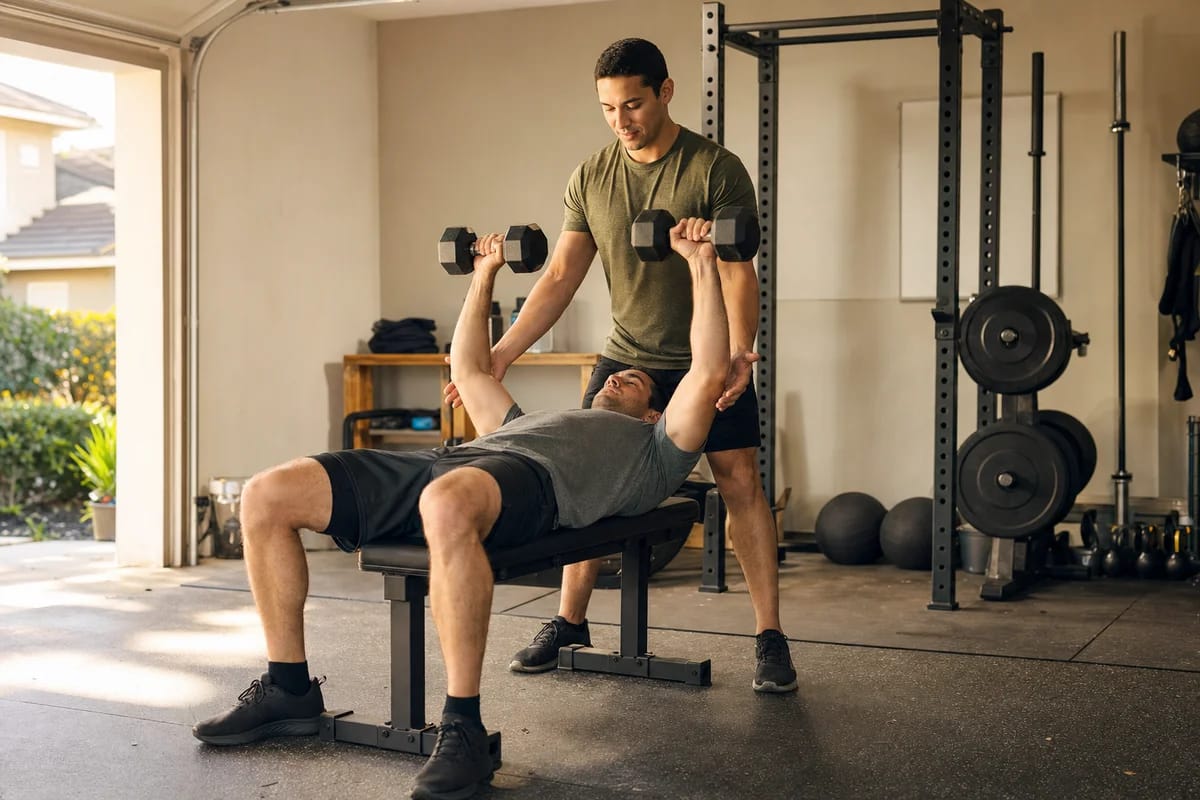
A partner sorts out showing up. They don't tell you what to do once you're there, so pair them with a simple written plan. If the plan keeps falling apart, it's usually the system, not your willpower.
No one to train with? Look for company with a fixed time already built in: a class at a gym or community center, a walking or running group, a neighbor with the same free hour. A class comes with an instructor at the front, which covers a little of the watching too.
Two cheaper ways to pay sit in between. One is a stake: money you set aside and lose each time you skip, through an app or a deal with a friend. Unlike the gym fee, that's a loss you'd notice this week. The other is a trainer once or twice a month to check your form and set the plan, with a friend for the weeks in between.
When paying is worth it, and when ours isn't
Paying makes sense when one of these is true:
- You've given the free version a fair go. A month of the setup above, and you made fewer than half your planned sessions.
- You've looked for company and come up empty. Nobody you know is free at the same time each week, and no class fits your hours.
- You don't know what to do, or whether you're doing it safely. Especially if you're starting to lift later in life or coming back after years away.
- Your plan has to keep bending. Around travel, shift work, a cranky joint, or progress that's stalled.
If something hurts in a way that worries you, or you have a health condition that affects exercise, check with your doctor or a physical therapist first. That's their job, not a coach's or a friend's.
And buy something other than us if:
- You'll train once a week. HipTrain, or a trainer once or twice a month, costs less for that.
- $299 a month would strain things. A friend and the setup above is a real plan, not a consolation prize.
- You want to train whenever the day allows. Our sessions are booked with your coach at a set time; our fair-use rules cover cancelling one.
- You want meal plans, or someone to spot a heavy barbell. Our coaches don't do nutrition, and nobody on a video call can spot you.
Weighing several services? Put the three questions from the top of this page to each one. Our guide to online training for accountability does that by name.
You don't have to pay forever
A coach isn't a lifetime subscription. Plenty of people hire one for a few months to learn the movements, find the right weights and build the habit, then carry on with a friend or on their own. In that review of older adults, home programs that included a few supervised sessions came closer to fully supervised ones,8 which fits that plan.
So a perfectly sensible plan is: a friend for company, a coach for as long as you need someone watching and planning, and an honest look every few months at which of those you still need. If you have nobody to train with and would go twice a week or more, try 14 days free.
Sources
-
GoalsWon, 2026. Accountability partner vs accountability coach: when free is enough and when it stops working. Prices and the note that its coaches are not personal trainers as listed on the page, checked November 2026. GoalsWon is a paid accountability-coaching service. ↩ ↩2
-
HipTrain, 2026. Pricing and HipTrain vs Bespoke Fit: live 1‑on‑1 video, $59.49 a month for one 30-minute session a week, 60-minute plans at $109.99, $219.99 and $319.99 a month for one, two or three a week, sessions of "30 or 60 minutes", a free first session with no card, and "Our plans top out at three sessions a week". The second page describes our old prices and terms. Its reviews page shows 5.0 on Google from 81 reviews. hiptrain.com, read November 11, 2026. HipTrain is a competing service. ↩ ↩2
-
trainwell, 2026. How it works: "Book a live video call to work through technique together in real time" and "Sessions aren't supervised in person, so if you need hands-on spotting or real-time correction on every rep, an in-person trainer may suit you better." trainwell.net, read November 11, 2026. trainwell is a competing service. ↩ ↩2
-
Future help centre, 2026. What should I expect from a Future Pro workout? and What should I expect from my Future Pro coach?: your coach's recorded voice guides the workout, and you share feedback afterwards. faq.future.co, read November 11, 2026. Future is a competing service. ↩
-
Matt Spettel, September 2025. CONNECTS: Early-Stage User Acquisition and Marketing. Carnegie Mellon Swartz Center for Entrepreneurship, at 58:50, told as a story from the company's early days. trainwell publishes no average number of clients per trainer. ↩
-
DellaVigna and Malmendier, 2006. Paying not to go to the gym. American Economic Review. ↩
-
Mazzetti, Kraemer, Volek and colleagues, 2000. The influence of direct supervision of resistance training on strength performance. Medicine and Science in Sports and Exercise. ↩
-
Lacroix, Hortobágyi, Beurskens and Granacher, 2017. Effects of supervised vs. unsupervised training programs on balance and muscle strength in older adults: a systematic review and meta-analysis. Sports Medicine. ↩ ↩2
-
Jeffery, Wing, Thorson and Burton, 1998. Use of personal trainers and financial incentives to increase exercise in a behavioral weight-loss program. Journal of Consulting and Clinical Psychology. ↩
-
Bark, updated January 16, 2026. How much does a personal trainer cost?. An average of $50 to $90 a session depending on where you live. Bark marketplace data, read November 11, 2026. ↩
-
Irwin, Scorniaenchi, Kerr, Eisenmann and Feltz, 2012. Aerobic exercise is promoted when individual performance affects the group: a test of the Kohler motivation gain effect. Annals of Behavioral Medicine. ↩
-
Wallace, Raglin and Jastremski, 1995. Twelve month adherence of adults who joined a fitness program with a spouse vs without a spouse. Journal of Sports Medicine and Physical Fitness. A small study of married people at one university fitness program; the two groups were equally self-motivated. ↩
-
Harkin, Webb, Chang, Prestwich, Conner, Kellar and colleagues, 2016. Does monitoring goal progress promote goal attainment? A meta-analysis of the experimental evidence. Psychological Bulletin. ↩
More on