How many push-ups should I be able to do? By age and sex
Typical push-up numbers for men and women by age, from the knees or toes, how to test yourself fairly, and a 6-week plan to add reps from any start.
In this article7
The short version
Typical for a man: 24 or more push-ups in his 20s, 20 in his 30s, 16 in his 40s, 13 in his 50s, 11 after 60. For a woman from her knees: 12, 10, 8, 7 and 5. Below that? Our plan works from zero.
Is your number good?
The men's numbers come from the chart most sites reprint, which Topend Sports credits to research by the American College of Sports Medicine.1 That chart doesn't say which push-up its women did, so the women's numbers come from Topend's home-test page, which gives knees and toes separately.2 "Typical" is each chart's average band; "strong" is its good and excellent bands together.
Men, push-ups from the toes
| Age | Typical | Above typical | Strong |
|---|---|---|---|
| 20s | 24 to 29 | 30 to 38 | 39 or more |
| 30s | 20 to 24 | 25 to 33 | 34 or more |
| 40s | 16 to 20 | 21 to 27 | 28 or more |
| 50s | 13 to 17 | 18 to 24 | 25 or more |
| 60+ | 11 to 16 | 17 to 23 | 24 or more |
Women, push-ups from the knees
| Age | Typical | Above typical | Strong |
|---|---|---|---|
| 20s | 12 to 22 | 23 to 29 | 30 or more |
| 30s | 10 to 21 | 22 to 29 | 30 or more |
| 40s | 8 to 17 | 18 to 24 | 25 or more |
| 50s | 7 to 14 | 15 to 20 | 21 or more |
| 60 to 65 | 5 to 12 | 13 to 18 | 19 or more |
Women, push-ups from the toes
| Age | Typical | Above typical | Strong |
|---|---|---|---|
| 20s | 9 to 13 | 14 to 23 | 24 or more |
| 30s | 7 to 12 | 13 to 20 | 21 or more |
| 40s | 5 to 9 | 10 to 14 | 15 or more |
| 50s | 4 to 8 | 9 to 12 | 13 or more |
| 60 to 65 | 3 to 5 | 6 to 9 | 10 or more |
Neither page says who its numbers were first measured on, so treat them as a rough guide, not a grade. They also stop at 60-something; at 70 or 80, your own number, and whether it's rising, is the better measure.
- Is 20 in a row good? Yes for a man over 30, and for a woman of any age, from her knees or her toes. A man in his 20s is a few reps short of typical.
- How rare is 20? We couldn't find a count of the general public. Among people who log their training on Strength Level, 20 beats a little over 1 in 5 men and just over half of women, and that's a crowd that trains.3
- Only 3, or none at all? Common, and very fixable. Put your hands on a kitchen counter or a wall instead, and build down to the floor one rung at a time. The plan below works on any rung.
Why every chart gives a different number
Search this and the same man in his 20s gets several "averages". Topend Sports alone gives 24 to 29 on one page and 17 to 29 on the other, and Strength Level's middle man that age does 37 to 39. They aren't all wrong. They're counting different people doing different push-ups.
- The men's chart above. Reprinted everywhere, origin unclear. Each rep goes down to a set point, the floor or a 90-degree bend at the elbow, with no rests.
- Strength Level's standards, one of the top results for this question, built from results its users log. These are people who track their training, so of course their middle is high. The site doesn't define a rep, or say whether women counted from their toes or knees.
- A study of firefighters, the source of the "40 push-ups" headline: men only, pushing up in time to a metronome.
Then there's body weight. At the hardest point of a floor push-up, your hands hold up about two thirds of it.4 At 250 lb (113 kg), every rep is a press of about 160 lb (73 kg). Strength Level shows the effect:
| Body weight | Middle user's reps |
|---|---|
| Man, 150 lb (68 kg) | 40 |
| Man, 250 lb (113 kg) | 33 |
| Woman, 120 lb (54 kg) | 19 |
| Woman, 250 lb (113 kg) | 12 |
If you're bigger than average, a count below the chart still means you're moving a lot of weight.
The biggest difference of all is what counts as a rep. Stop a few inches short of the floor and almost anyone's count goes up a lot. The charts assume you went all the way down.
How to test yourself fairly
You need a towel, a bit of floor and a notebook. The point is a number you can compare with next month's, so the setup matters more than the effort.
Warm up first
A minute of arm circles, then 8 to 10 easy push-ups with your hands on a counter or from your knees. Rest two minutes.
Pick your version and stick with it
Floor from your toes, floor from your knees, or hands on a counter. Write it down. A knee result and a toes result are two different tests.
Put a fist-high towel under your chest
Roll up a bath towel until it's about as tall as your fist and lay it under your breastbone. That's your depth for every rep, today and at every retest.
Count only full reps, straight through
Chest touches the towel, arms straight at the top, body in one line from head to heels (or knees). Don't stop to rest, at the top or on the floor. The charts were counted without rests, so a breather would flatter your number.
Stop when the form goes
Your hips sag or rise before your chest, your chin reaches for the towel instead of your chest, or you can't do the next rep without a rest. That's your number. A max test is the one time going right to the end is the point, and push-ups are a low-risk move to take to failure.
Write down the date, the version and the count
Same time of day, same towel, same version next time. Retest in 4 to 6 weeks.
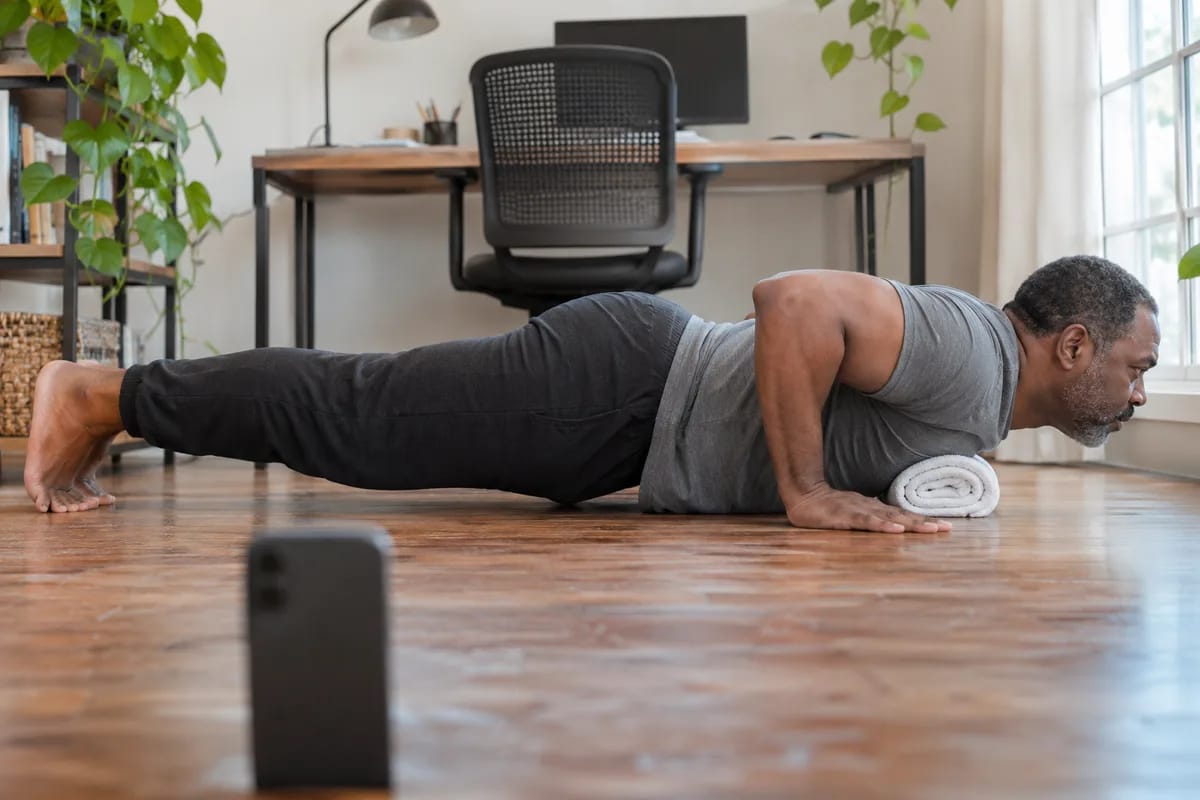
If you can, prop your phone on the floor side-on and film it. A side view is the easiest way to check your own depth; filming has its limits, but for counting it's honest.
Ask your doctor before an all-out test if you have a heart condition or blood pressure that isn't under control, and stop and get checked if a set brings on chest pain, unusual breathlessness or dizziness. A wrist or shoulder that hurts, as opposed to muscles working hard, is one for a physical therapist, not something to test through.
Training for a police, fire or military test? Practise that test's own rules. The Army, for example, now uses a hand-release push-up: chest, hips and thighs down on every rep, hands out to the sides, as many as you can in two minutes.5
A 6-week plan to add reps
This is our coaching method, not a formula from a study. It gives you lots of clean practice reps without grinding, and a little more each week.
- Three days a week, with a day off between. It takes about ten minutes, on its own or at the end of another workout.
- Three sets each time, resting one to two minutes between them.
- Start each set at half your test, rounded down. Week 1 should feel easy, with plenty left in you. You'll have fewer reps left in you as the weeks go on; rating that effort gets easier with practice.
- Add one rep to each set every week, as long as every set last week ended with at least one clean rep left. If the last set got ugly, repeat the week. If week 4 or 5 takes two goes, that's fine.
- Retest at the start of week 6, after a warm-up, then carry on from your new number.
Say you tested at 12. Half of 12 is 6.
| Week | Each session |
|---|---|
| 1 | 3 × 6 |
| 2 | 3 × 7 |
| 3 | 3 × 8 |
| 4 | 3 × 9 |
| 5 | 3 × 10 |
| 6 | Retest, then 3 sets at half the new number |
Fewer than 8 on the floor, or none? Run the same plan on the hardest version where you can do 8 clean reps: hands on a counter, a sturdy table or a stair, or from your knees. The push-up ladder has every rung from the wall down.
Already doing 25 or more? Longer sets get tedious and hard to judge. Make each rep harder instead: feet up on a step, or three slow seconds down to the towel. Then run the plan again from a lower number.
One more thing. Push-ups train the front of your upper body, so give the back the same attention: a set of rows for every set of push-ups. The ladder post has a backpack row and a table row that need nothing you don't already own.
About that 40 push-ups headline
You may have seen the headline: men who can do 40 push-ups have a 96% lower risk of heart disease. It comes from a study led by Harvard researchers, of male firefighters in Indiana, average age about 40, followed for ten years.6 Men who did more than 40 did have far fewer heart problems than men who did 10 or fewer; that's the 96%. But heart problems were rare in the whole group, and the top group was also younger, leaner and smoked less.
Once the researchers allowed for age and body size, that gap was no longer statistically clear. The authors wrote that their results "do not support push-up capacity as an independent predictor" of heart disease, and may not apply to women, older or inactive people. So a push-up test is a fair check of upper-body strength and stamina. It isn't a heart test, and a low number isn't a diagnosis.
Six weeks with someone counting on you
The plan above is easy to start. Keeping it going is the hard part: a busy Tuesday, a set that felt ugly, a decision about repeating the week that nobody makes.
At Bespoke Fit, every session is a live 1‑on‑1 video call with your own coach, from home, at a set time. Your coach is on the call waiting for you. Skipping means telling a person, which is harder than closing a notebook. One of our members, Henrik, 36, puts it this way:
"I've always wanted to be consistent with training, but I'd get demotivated and just stop showing up. Knowing Tris is waiting for me at every session means I actually go."
Your coach also makes the calls that are hard to make alone: which rung to start on, whether that last set was clean, when to move from the counter to the floor. Prop the phone side-on and they count only the reps that reach the towel. Say your hips start to sag on rep 9. Your coach says "stop there, that's 8" while you're still on the floor. On your own, it's easy to count the sagging ones too and write down 14. With an app where you send a video for a trainer to review, you might find out a day and a half later.
Each coach has 12 members at most, so yours remembers last month's number and why it dipped. They write your whole program, and push-ups end up a small part of it.
If a push-up number is all you're after, this page, a towel and your phone will get you there. If you want a trainer in the room with you, a gym floor or meal plans, we're not that. If you want to get stronger all over, two or three times a week, with a coach waiting for you on the call, that's what we do. It's 14 days free, and the 14 days start at your first session. Then $299 a month. Cancel anytime. Sessions are unlimited; at three a week that's about $23 each.
Common questions
Is 100 push-ups a day too much?
It's more than most people need, and daily quotas tend to turn into sloppy reps squeezed in whenever. We'd take two or three planned sessions a week, with every rep reaching the towel, over 100 scattered ones. Your wrists and shoulders get days off too.
Do knee push-ups count?
Yes, as their own test. A knee push-up puts about half your body weight on your hands, against about two thirds from your toes. So compare a knee result with the knee table and a toes result with the toes table, never one with the other.
Sources
-
Topend Sports, Push-up test, checked 12 Nov 2026. The norms are described as "based on ACSM research", citing ACSM's Guidelines for Exercise Testing and Prescription, 11th edition (2022). The test is done "without rest" to a set depth. Our columns are its average band, its above-average band, and its good and excellent bands together; its below-average band and its 17 to 19 rows are left out. We use it for men only, because its women's table doesn't say which push-up was done. ↩
-
Topend Sports, Home push-up test, checked 12 Nov 2026. Separate tables for men, women on their toes and women on their knees; the page says "the original source for this data is unknown." Our women's tables use the same three groupings from its two women's tables; where its 30s knee bands share the number 30, we count 30 as strong. Its oldest row is 60 to 65. Its knee table's upper bands sit within a rep of the ACSM-credited women's table, but its average band starts lower (12 against 17 in the 20s). Its men's table gives an average of 17 to 29 for the 20s. ↩
-
Strength Level, Push-up standards, checked 12 Nov 2026. 875,653 qualifying results from 2,928,475 submissions, May 2017 to March 2026. Its averages are 39 for men and 18 for women. "Novice" means stronger than 20% of its users (19 reps for men) and "intermediate" stronger than 50% (39 for men, 18 for women). Its intermediate man does 37 at 20 and 39 from 25 to 40. The body-weight figures are its intermediate rows. ↩
-
Ebben WP, Wurm B, VanderZanden TL, Spadavecchia ML, Durocher JJ, Bickham CT, Petushek EJ, 2011. Kinetic analysis of several variations of push-ups. Journal of Strength and Conditioning Research. Peak force on the hands was about 64% of body weight for a regular push-up and 49% from the knees, from Table 1 of the conference version (ISBS proceedings); the pounds are our arithmetic. ↩
-
U.S. Army, Army Fitness Test, checked 12 Nov 2026. The hand-release push-up, test of record since 1 June 2025. ↩
-
Yang J, Christophi CA, Farioli A and colleagues, 2019. Association between push-up exercise capacity and future cardiovascular events among active adult men. JAMA Network Open. 1,104 men, average age 39.6, doing push-ups to a metronome at 80 beats a minute; 37 cardiovascular events over ten years, one of them among the 155 men who did more than 40. The 96% is the paper's crude figure (incidence rate ratio 0.04) for men who did 41 or more against those who did 0 to 10, before any adjustment; adjusted for age and body mass index, that comparison was not significant. The first and senior authors list the Harvard T.H. Chan School of Public Health and Harvard Medical School. ↩