Resistance band exercises for seniors: a 20-minute session
Seven moves for older adults in one 20-minute band session, seated or standing. How to pick the right band and make it harder without buying another.
In this article6
You need one band, a sturdy chair and about 20 minutes, twice a week. Seven moves do the job: a row, a chest press, a pull-apart, a leg press and an anti-turn press with the band, plus standing up from the chair and heel raises without it. All of it works seated or standing. The right band is the one you can move 10 to 12 times smoothly, with the last two reps slowing down. The color on the box doesn't decide it.
The 20-minute session
The moves come in pairs. Do the first move of a pair, go straight into the second, rest about 20 seconds, then do both again. Then on to the next pair, and finish with heel raises.
| Pair | Move | Reps to start | The one thing to get right |
|---|---|---|---|
| Warm-up | March in place, then easy rows | 2 minutes | No effort yet |
| 1 | Seated row | 10 to 12 | Elbows back past your ribs |
| 1 | Chest press | 10 to 12 | Elbows soft, not locked |
| 2 | Sit-to-stand (no band) | 8 to 12 | Nose over toes, then stand |
| 2 | Pull-apart | 10 to 12 | Squeeze your shoulder blades |
| 3 | Leg press | 10 each leg | Push through your heel |
| 3 | Anti-turn press (door anchor) | 8 each side | Don't let it turn you |
| Finish | Heel raises (no band) | 12 to 15 | Lower slowly, all the way |
Need to stay seated? Every move except the sit-to-stand works from the chair. Keep practicing the sit-to-stand anyway, with your hands on your thighs if you need them.
No curls or floor moves, on purpose. The row already works the front of your arms, and nothing here asks you to get down on the floor and back up. If you like curls, add a set at the end: stand on the middle of the band and bend your elbows.
In your first two weeks, go through each pair once. That's about 12 minutes, and it's plenty while the moves feel new. From week three, do each pair twice.
How hard? Work to the point where another rep would be hard to do without help, which is how the CDC puts it.1 In practice: the last two reps slow down, and you could manage one or two more in good form, not five. Take about two seconds on the way out and three on the way back. Breathe out as you pull or push, and in as you return.
How often: two days a week, with a day between, such as Monday and Thursday. That's the strength target for adults over 65.1 Walking and balance practice go on the other days, and they matter too. In the main review of falls in older people, balance practice cut falls by about a quarter, and programs mixing balance with strength probably by about a third. Strength work on its own hasn't been shown to cut falls, which is why this plan has both.2
If you've had recent surgery or a hip or knee replaced, have a heart condition, have fallen in the past year, or you're unsure about a move, check with your doctor or physical therapist first. During any session, stop if you feel dizzy, short of breath or pain, and call your healthcare provider.3
Before your first session
- Stretch the band gently and look along it for nicks or tears, including where it meets a handle or anchor. Throw out a damaged band
- A sturdy armless chair, its back against a wall so it can't slide
- Clear floor about 6 feet (2 m) around the chair
- Shoes on, so the band can't slip off a bare foot
- Count how many times you can stand up from the chair in 30 seconds, using your hands the same way each time, and write it down. You'll retest at week 8 and week 12
- For the anti-turn press, a door anchor in a door that opens away from you. Your pull then presses the door into its frame instead of opening it. Shut it fully before you start
How to do each move
Each move has three cues, then an easier and a harder version. If a move hurts a joint (not the tired-muscle feeling, a joint), use the easier version or skip it today.
Seated row (pair 1). Works your upper back and the backs of your shoulders, the muscles that keep you from rounding forward.
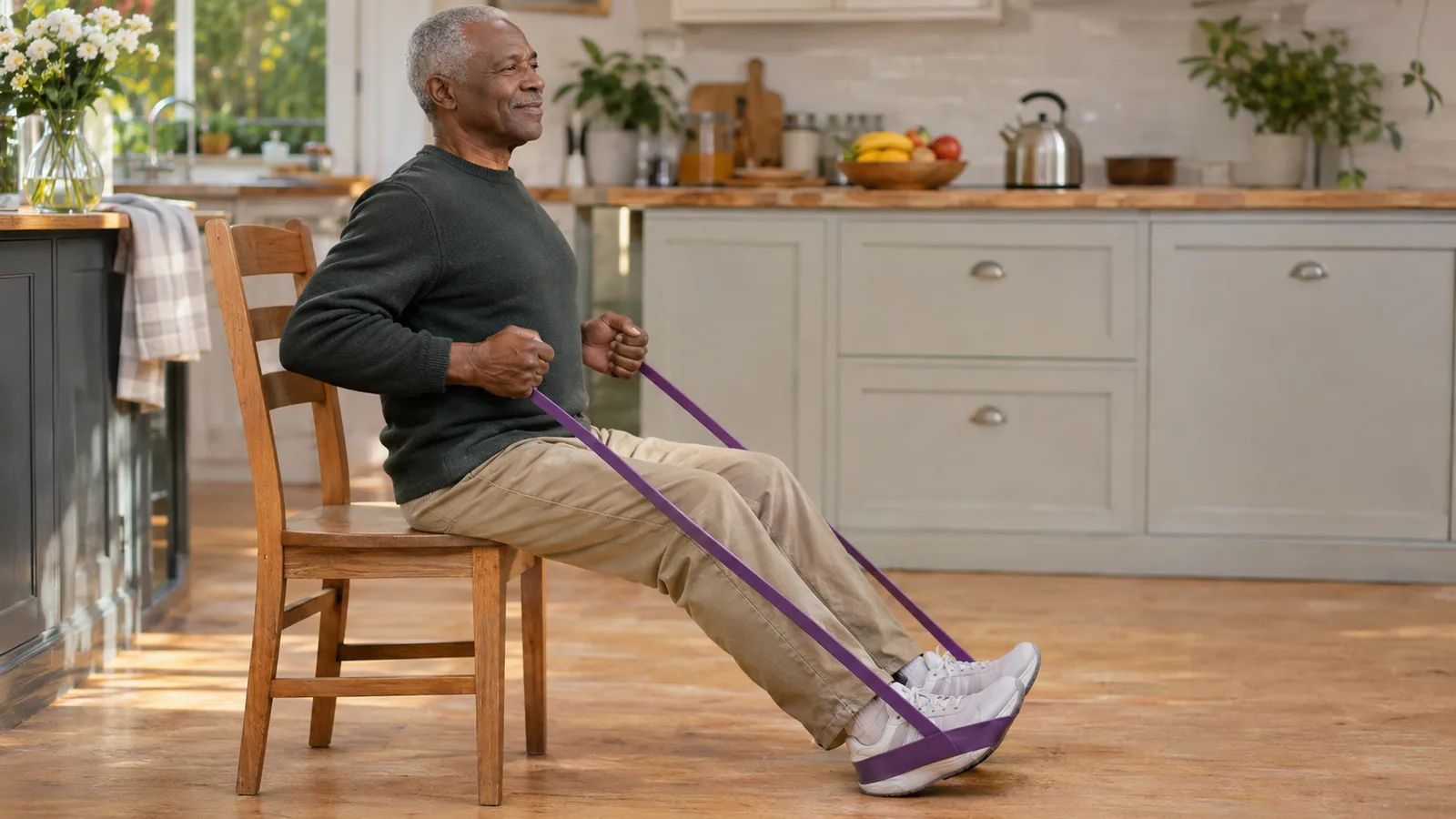
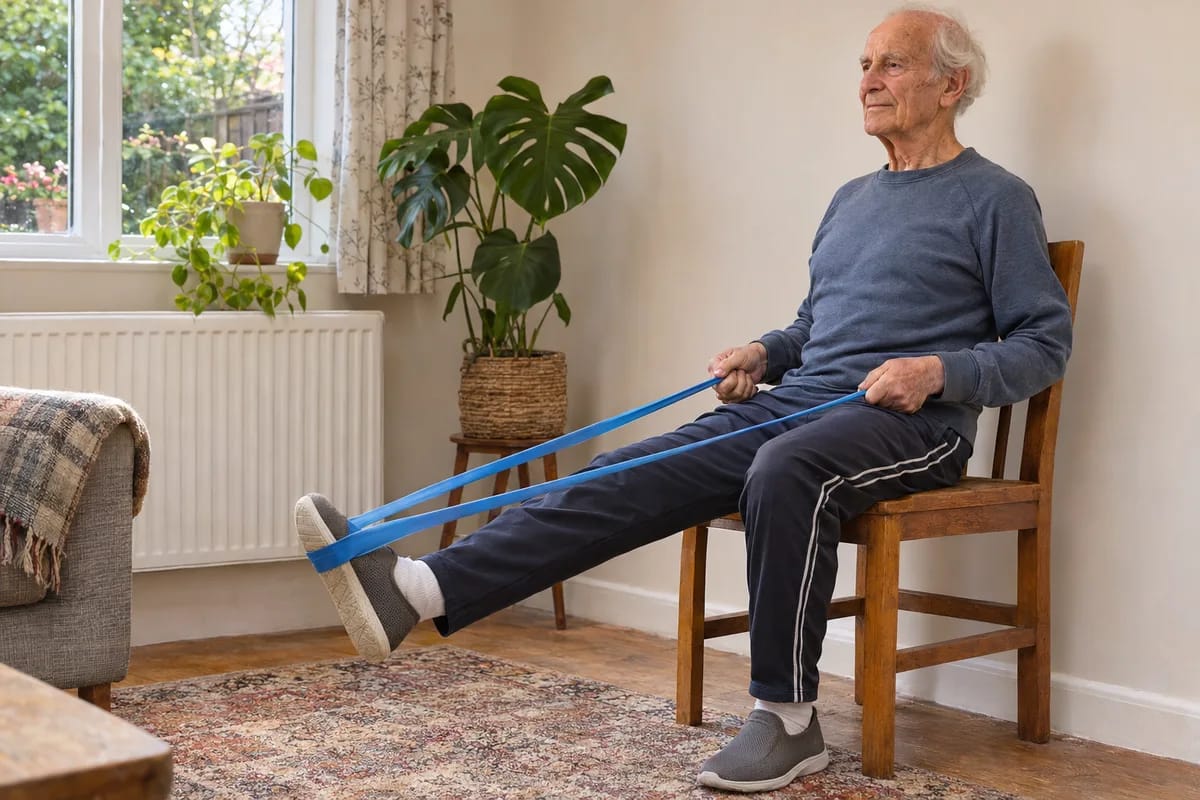
- Sit near the front of the chair, legs out, band around the arches of both feet, one end in each hand.
- Sit tall, then pull your elbows back past your ribs, close to your sides.
- Pause a beat, then let your arms go forward slowly.
Easier: hold the band further from your feet so it starts looser. Harder: wrap it once more around each hand.
Chest press (pair 1). Works your chest, shoulders and the backs of your arms, the muscles you use to push up from a chair or out of bed.
- Run the band across your upper back, under your armpits, one end in each hand at chest height. If you're seated, sit forward so the band crosses your back, not the chair.
- Press both hands straight forward until your arms are long, with a slight bend left in the elbows.
- Bring your hands back to your chest slowly.
Easier: hold the band longer. Harder: hold the band shorter.
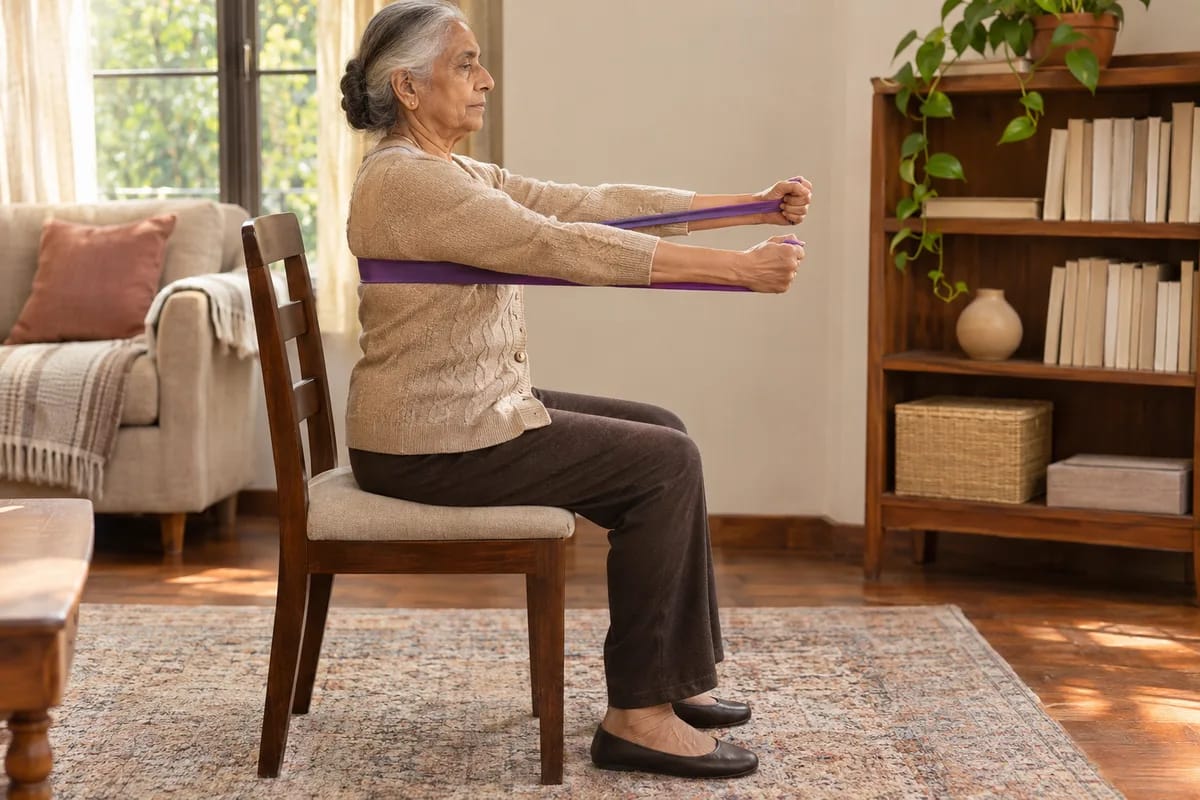
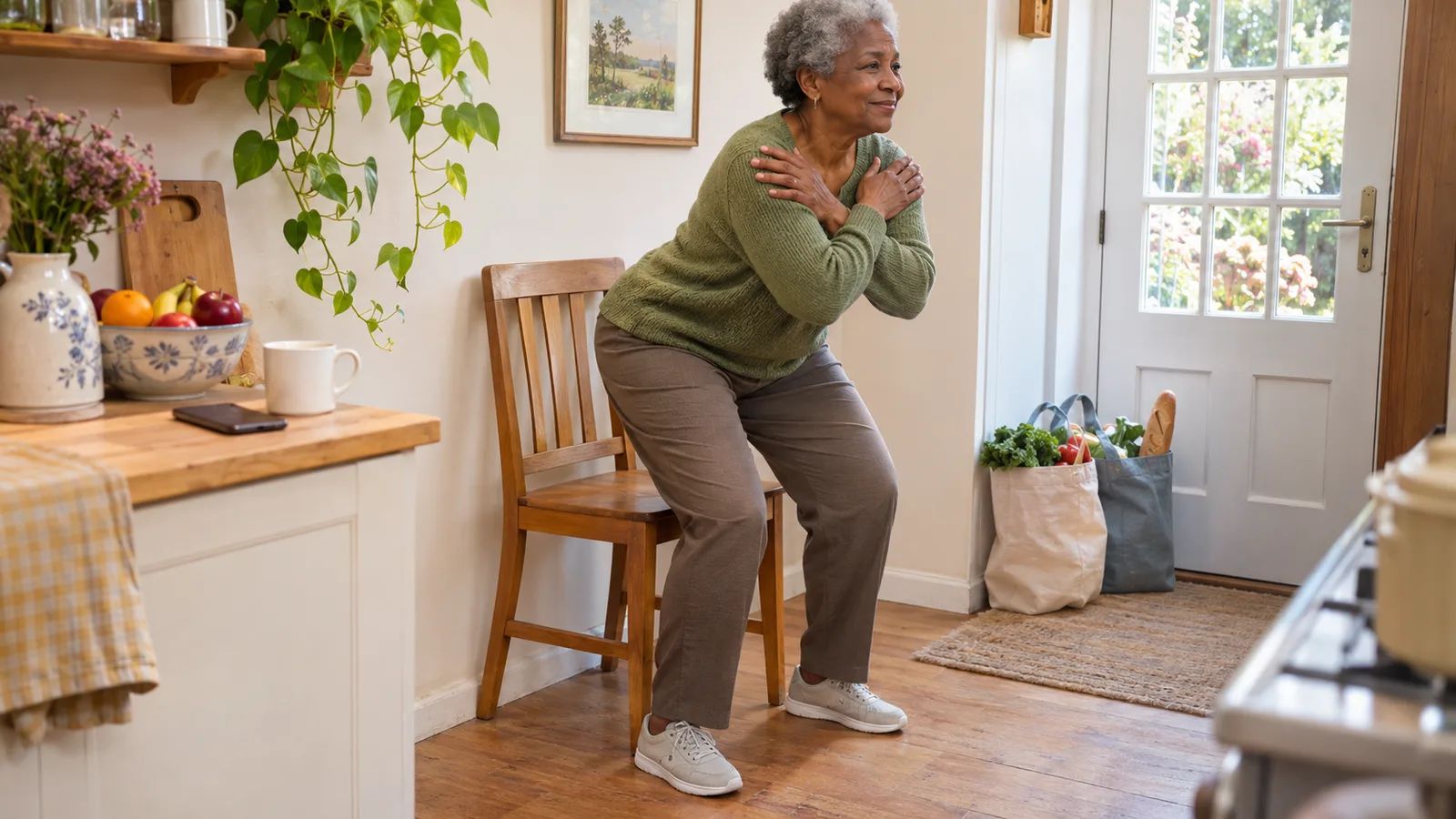
Sit-to-stand (pair 2). Our pick for the most useful leg exercise of all, because it's the move the rest of your day depends on. No band here on purpose: standing up is hardest as you leave the seat, exactly where a band is slack, so a dumbbell is the next step. Our sit-to-stand test guide explains the 30-second version and what your score means.
- Feet flat, a little behind your knees, hip-width apart.
- Lean forward until your nose is over your toes, then push through your heels to stand tall.
- Sit back down slowly, taking about three seconds. Don't drop.
Easier: a firm cushion on the seat, hands on your thighs. Harder: hold a 5 lb (2 kg) dumbbell or a bag of cans at your chest.
Pull-apart (pair 2). Works the muscles between your shoulder blades.
- Hold the band in front of you at shoulder height, hands about shoulder-width apart, arms nearly straight.
- Pull your hands apart until the band touches your chest, squeezing your shoulder blades together.
- Let your hands come back together slowly, keeping a little tension in the band.
Easier: hands wider apart to start. Harder: hands closer together to start.
Leg press (pair 3). Works the front of your thigh and your hips. Lighter than the sit-to-stand, but it lets you train one leg at a time.
- Sit back in the chair. Loop the band around the arch of one foot and hold both ends near your hips.
- Bring that knee up toward your chest, then push the foot forward and down until the leg is straight, without locking the knee.
- Bend the knee back slowly, keeping the band tight. Do all your reps, then switch legs.
Easier: hold the band longer. Harder: shorter, or pause for two seconds with the leg straight.
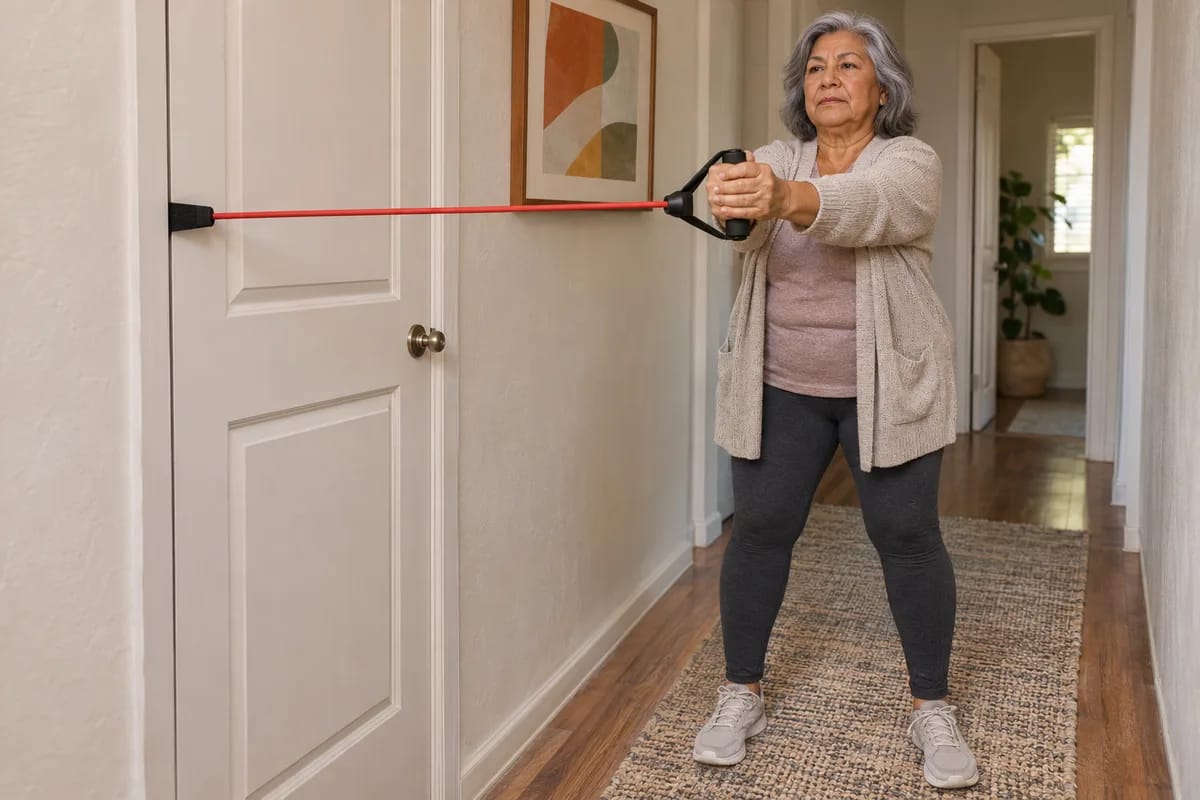
Anti-turn press (pair 3). Trainers call it a Pallof press. It trains your trunk to stay still while something pulls you sideways, which is much of what your core does when you carry a bag or reach for a shelf.
- Stand or sit side-on to the door, the band anchored at chest height. Hold the end with both hands at the middle of your chest. Step or scoot away until the band is taut.
- Press your hands straight out in front of your chest. The band will try to turn you toward the door. Don't let it.
- Hold for two seconds, bring your hands back to your chest, and repeat. Then turn around and do the other side.
Easier: stand closer to the door. Harder: step further away, or stand with your feet together. No door anchor yet? Skip this one and do a third round of the row.
Heel raises (finish). Works your calves, which push you forward with every step.
- Stand facing the counter, fingertips resting on it.
- Rise up onto the balls of your feet over two seconds.
- Lower over three seconds, all the way down.
Easier: do them sitting down. Harder: one foot at a time.
Pick your band by feel, not by color
If you're wondering whether a band is enough: in the studies that compared them, bands built about as much strength as dumbbells and machines.4 What matters is picking the right one, and the color won't tell you. Colors aren't a standard, so a green band from one brand can feel nothing like a green band from another. Even TheraBand labels its color chart "illustrative colors only" and says resistance depends on the product and how far the material is stretched.5 So test the band on the seated row:
| What happens on the row | What it means | What to do |
|---|---|---|
| 15 or more, and the last rep feels like the first | Too light | Next band up |
| 10 to 12 smooth reps, the last two noticeably slower | Right for this move | Keep it |
| You can't get to 8, or your back rounds and your shoulders creep up | Too heavy | Go down a band |
You'll often use one band for everything and change only where you hold it. The pull-apart usually needs the lightest setting, and the leg press the heaviest.
Which kind of band. This session is built for a long flat band (the kind physical therapists hand out) or a tube band with handles and a door anchor. A loop band, the short circle, is good for hip work but won't do most of the moves here. Buy a set of three or more, light to heavy, so the next band up is already in the drawer. If you're allergic to latex, buy a band marked latex-free; latex can cause allergic reactions.3 Our budget home gym guide prices a band kit with handles and a door anchor at about $25.
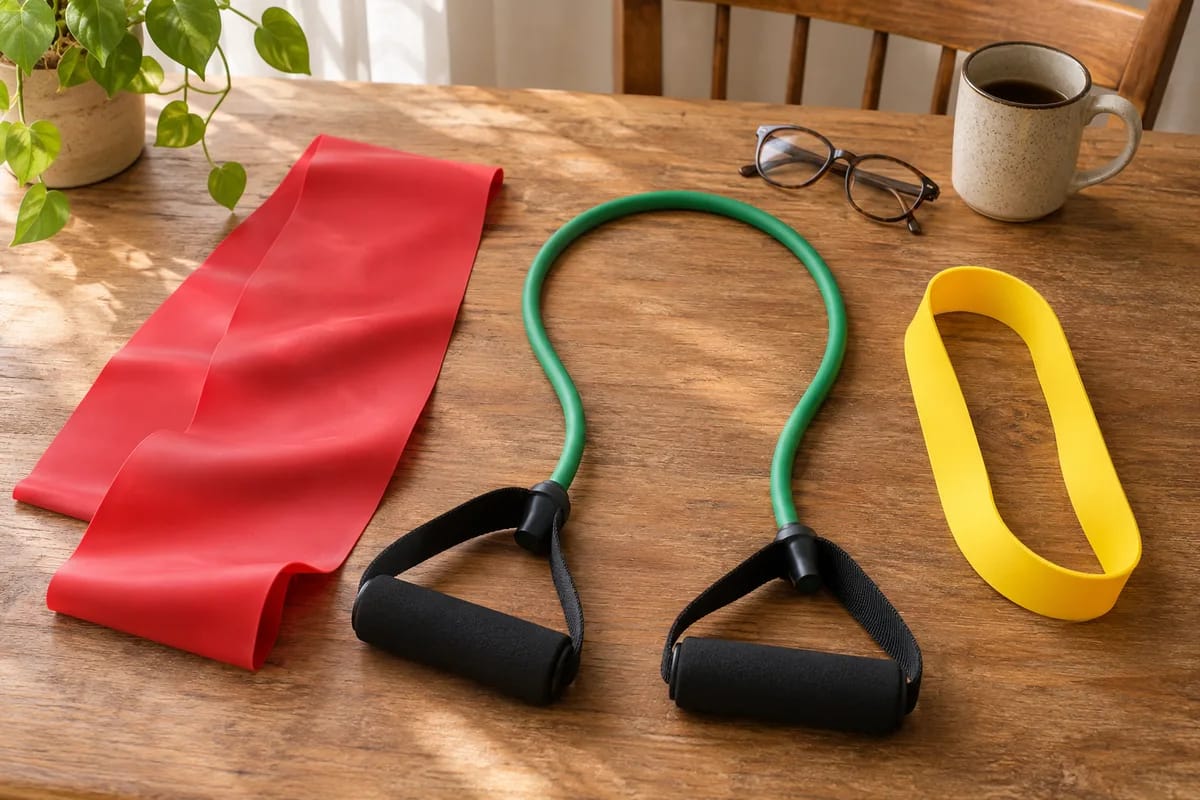
If your hands are stiff or arthritic, handles are easier to hold than a flat band. With a flat band, lay it across your palm and close your hand around it, rather than wrapping it tightly around your fingers. Or tie a loop in each end and slip your hands through.
Making it harder without buying another band
A band gets harder the further you stretch it,5 so the band you already own gives you a whole ladder. Start each band move at 10 to 12 reps and add a rep when you can, up to 15. When you get 15 clean reps on both rounds, two sessions in a row, take the next rung and drop back to 10 reps. Change one thing at a time.
Slow the way back to four seconds
A slower return keeps the muscle working for longer on every rep, and it costs nothing.
Shorten the band
Hold it closer to your feet, wrap it once more around your hands, or step about a foot (30 cm) further from the anchor. The band is tighter from the first inch of the move.
Double the band or go up a band
Fold a long band in half, or move to the next one in your set. Go back to your usual three-second return and climb the ladder again.
Two limits. Don't stretch a band past three times its resting length (if it looks close to that, go up a band instead), and never use one to lift or support your body weight.3 If you've climbed the whole ladder and want more ideas, progressive overload at home has ladders for body-weight moves too.
Three faults worth watching for
- Bent wrists on the press. If your knuckles fold back, line them up with your forearm, as if you're punching gently.
- Shoulders creeping up as you pull. Think "shoulders in your back pockets". If they still rise, hold the band longer.
- Your face in the band's path. Keep the band below chin height on the row and press, and check it's secure under your feet or in the anchor before each set. A band that slips snaps back hard.3
These are hard to spot in yourself. A phone propped on a shelf and recording one set will show you more than a mirror. A second pair of eyes is better still. At Bespoke Fit, a coach watches every session live on video, on your phone or computer. They can check your band and anchor with you before the first set, tell you to step back half a step while you're mid-set, and call a stop if something looks off. Each coach has 12 members at most, so yours remembers how last week went. It's 14 days free, then $299/mo. If you'd rather run this session on your own, it costs nothing and it works.
What to expect, and when
These weeks come from a 2025 review of 25 band-training trials in adults over 60. Most of the trials were small and the results varied a lot, so treat them as a rough guide.6
Weeks 1 to 2
Learning the moves
Everything feels fiddly: where to hold the band, how far to sit from the door. That's coordination, not weakness, and it settles fast.
From about week 4
Steadier on your feet
Balance and walking tests can start to improve this early.
From about week 8
Stronger
Clear strength gains showed up in programs of 8 weeks or more. Your sit-to-stand count is the place to look.
Week 12 and after
Gains that stick
The review's authors recommend 12 weeks or longer for stable results. Retest your sit-to-stand count and compare it with the one you wrote down.
If you've never done any of this, our guide to strength training for seniors covers where to start, and if you have arthritis, lifting with arthritis explains why moving the joint usually helps.
Sources
-
Centers for Disease Control and Prevention. What counts as physical activity for older adults. Muscle-strengthening activity at least 2 days a week, "to the point where it's hard to do another repetition without help", 8 to 12 repetitions as one set, with two or three sets for more benefit. Working with resistance bands is one of its listed examples. Read November 12, 2026. ↩ ↩2
-
Sherrington, C. and colleagues, 2019. Exercise for preventing falls in older people living in the community. Cochrane Database of Systematic Reviews. 108 trials, 23,407 people, average age 76. Balance and functional exercise cut the rate of falls by 24% (high certainty); programs mixing several types of exercise, most often balance plus strength, probably cut it by 34% (moderate certainty); the effect of programs that were mainly strength training was uncertain. ↩
-
THERABAND. Care and safety. Inspect for nicks, tears or punctures; never let the band snap back toward your face; don't stretch beyond three times its resting length or use it to support body weight; stop and contact your healthcare provider if you feel dizzy, short of breath or in pain. Its latex products carry a warning that natural rubber latex may cause allergic reactions. Read November 12, 2026. ↩ ↩2 ↩3 ↩4
-
Lopes, J.S.S., Machado, A.F., Micheletti, J.K., de Almeida, A.C., Cavina, A.P. & Pastre, C.M., 2019. Effects of training with elastic resistance versus conventional resistance on muscular strength: a systematic review and meta-analysis. SAGE Open Medicine. Eight studies in mixed populations, not only older adults; no clear difference between bands and weight machines or dumbbells for upper or lower limb strength. ↩
-
THERABAND. Why THERABAND works. "Resistance varies by product family and how far the material is stretched", colors are "illustrative", and "as the band stretches farther, resistance increases". Read November 12, 2026. ↩ ↩2
-
Meng, Y., Hu, Y., Yang, W., Xue, Y. & Yang, S., 2025. Effects of elastic band resistance training on lower limb strength and balance function in older adults: a systematic review and meta-analysis. Frontiers in Sports and Active Living. 25 randomized trials, 1,318 people with an average age over 60, training two to four times a week for 4 to 28 weeks. Band programs improved leg strength, chair-stand results, a timed get-up-and-walk test and how far people could reach without stepping. Strength gains were clearer in programs of at least 8 weeks, balance could improve from 4 weeks, and the authors recommend 12 weeks or longer. Heterogeneity was very high and publication bias was detected; there was little data on falls. ↩