Leg exercises for seniors: 8 moves for stairs and chairs
Eight leg exercises for seniors, each matched to a daily job like stairs or getting out of a chair, from seated to standing, with how to make each one harder.
In this article7
The three that matter most are standing up from a chair, stepping up onto a stair and rising onto your toes. Do those two or three times a week and the everyday jobs that have started to feel heavy (the stairs, the low sofa, the car) get easier. The other five moves below fill the gaps, and every one of them has a seated or holding-on version, so you can start today whatever your legs feel like.
Start with the job that's been bothering you:
| If this has gotten harder | Train these |
|---|---|
| Getting out of a chair, off the toilet or out of a low car | 1. Sit-to-stand, 2. Knee extension, 8. Bridge |
| Going up the stairs | 6. Step-up, 2. Knee extension |
| Going down the stairs | 7. Slow step-down |
| Walking without shuffling, or catching a toe on a rug | 3. Heel raise, 4. Toe raise |
| Getting in and out of the tub or the car, stepping sideways | 5. Side leg raise |
Set up the room first
You need nothing you don't already own. A good setup is what lets you work hard without worrying about a wobble.
Set up before you start
- Push a solid chair with no wheels and no arms back against a wall so it can't slide
- Clear a spot at the kitchen counter, or a heavy table, where you can rest your fingertips
- Check the bottom stair has a rail you can hold
- Put on shoes with a grip, not socks or loose slippers
- Keep a phone within reach for the first few sessions
Check with your doctor or physical therapist first if you've fallen in the past year, had a joint replaced or other surgery recently, get dizzy when you stand up, or are being treated for a heart condition. They can also tell you which level to start at. After a hip or knee replacement, read strength training after a joint replacement too.
Whoever you are, stop and get checked if you feel chest pain, unusual breathlessness or dizziness.
Aching knees? Usually you can do the same moves with less range: raise the seat for the sit-to-stand, use a lower step, and lower yourself slowly. A mild ache in the muscles is normal. Pain in the joint that's sharp, gets worse as you go or is still there the next day means stop that move and see a physical therapist.
The eight moves
Each move has three levels. Level 1 is seated or the most supported, level 2 is standing and holding on, level 3 is hands-free or with a little weight. You'll probably sit at different levels on different moves, and that's how it should be. The moves are in session order, so you work from the chair to the counter to the stairs and finish lying down.
For one-leg moves, the reps are for each leg. Go up in about a second, come down in about three.
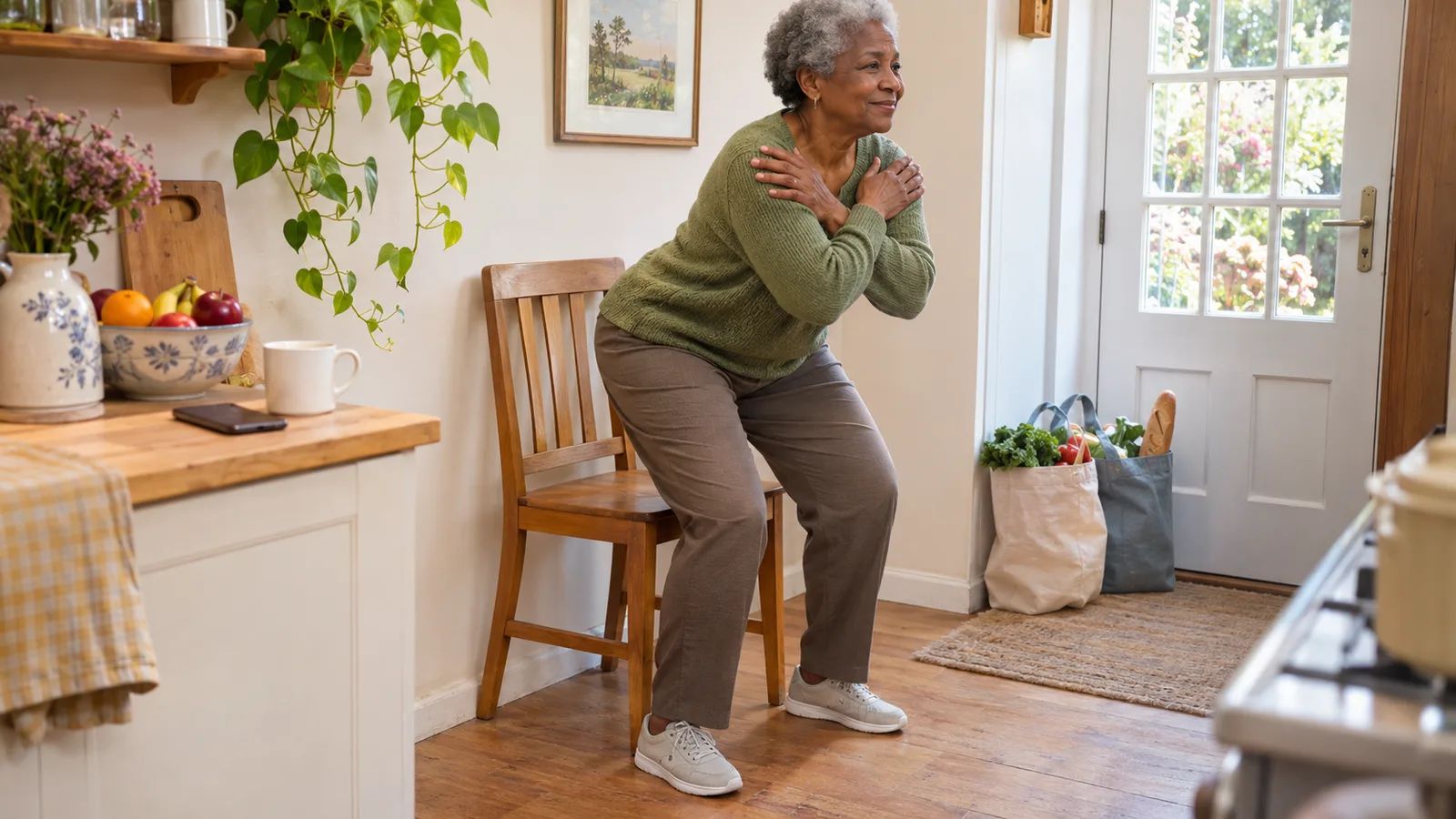
1. Sit-to-stand: for chairs, the toilet and the car
- Scoot to the front half of the seat, feet flat and a little behind your knees.
- Lean forward until your nose is over your toes, then push the floor away to stand up tall.
- Sit back down slowly. Don't drop into the seat.
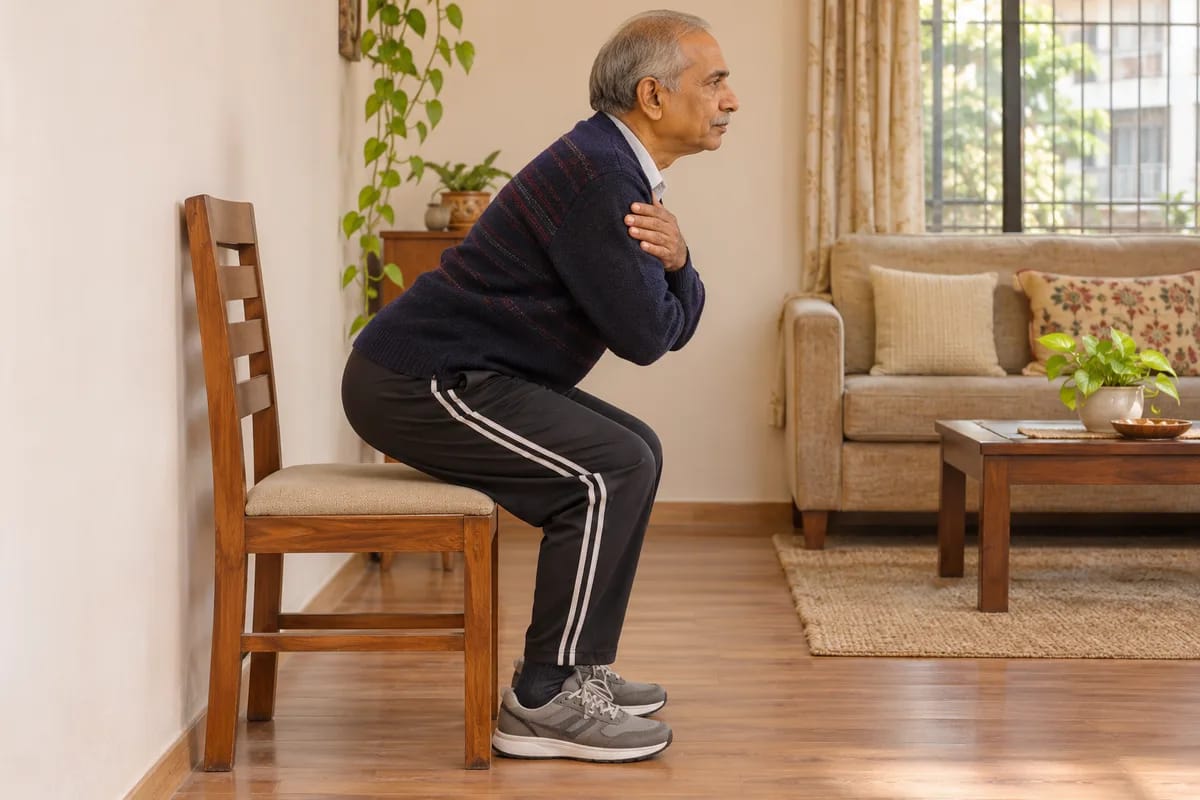
Level 1: a firm cushion on the seat to raise it, hands pushing on your thighs. Level 2: a normal chair, arms crossed over your chest. Level 3: hold a weight at your chest, like a full gallon jug of water, just over 8 lb (3.8 kg).
If you're stuck below level 1 or past level 3, our sit-to-stand guide has a longer ladder, including getting up off the floor.
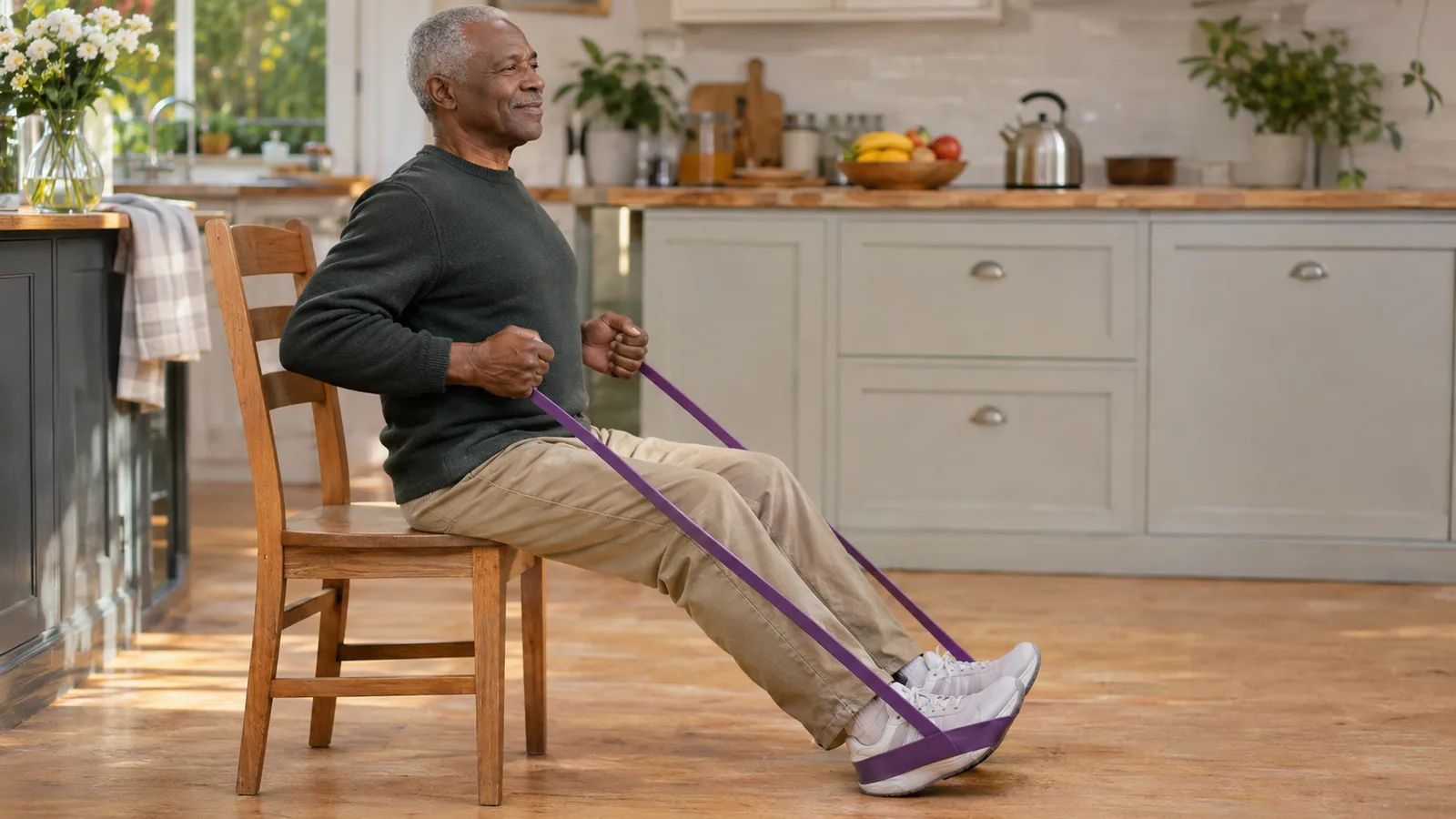
2. Seated knee extension: for stairs and standing up
- Sit tall with your back against the chair.
- Straighten one knee until your leg is level with the floor, toes pulled back toward you.
- Hold for a second, then lower it slowly.
Level 1: straighten partway, no weight. Level 2: straighten fully and hold for two seconds at the top. Level 3: add an ankle weight of 1 to 2 lb (0.5 to 1 kg).
This works the big muscle on the front of your thigh, the one doing most of the work when you stand up or climb. It's the way in if you can't stand for long yet.
3. Heel raise: for the push-off when you walk
- Stand facing the counter, fingertips resting on it, feet hip-width apart.
- Rise onto the balls of your feet, straight up rather than tipping forward.
- Lower your heels slowly.
Level 1: seated, with your hands pressing down on your knees for extra load. Level 2: standing, both feet. Level 3: one foot at a time, the other foot tucked behind your ankle.
Your calves push you forward with every step. When they're weak, steps get shorter, and reaching a high shelf on tiptoe feels shaky.
4. Toe raise: for clearing rugs and steps
- Sit or stand with your heels on the floor.
- Lift the front of both feet toward your shins as far as they'll go.
- Lower them slowly.
Level 1: seated. Level 2: standing with your back against a wall and your heels a few inches from it. Level 3: standing at the counter with your hands hovering just above it.
The muscles on the front of your shin lift your toes as your foot swings through each step, so they're what keeps your toes clear of the rug edge or the lip of a stair.
5. Side leg raise: for stepping sideways, the car and the tub
- Stand side-on to the counter, one hand on it, toes pointing forward.
- Lift your outside leg a few inches out to the side, keeping your body upright.
- Lower it slowly, then switch sides.
Level 1: both hands on the counter and a small lift. Level 2: one hand, a bigger lift. Level 3: an ankle weight of 1 to 2 lb (0.5 to 1 kg).
Your body shouldn't lean the other way. If it does, the lift is too high.
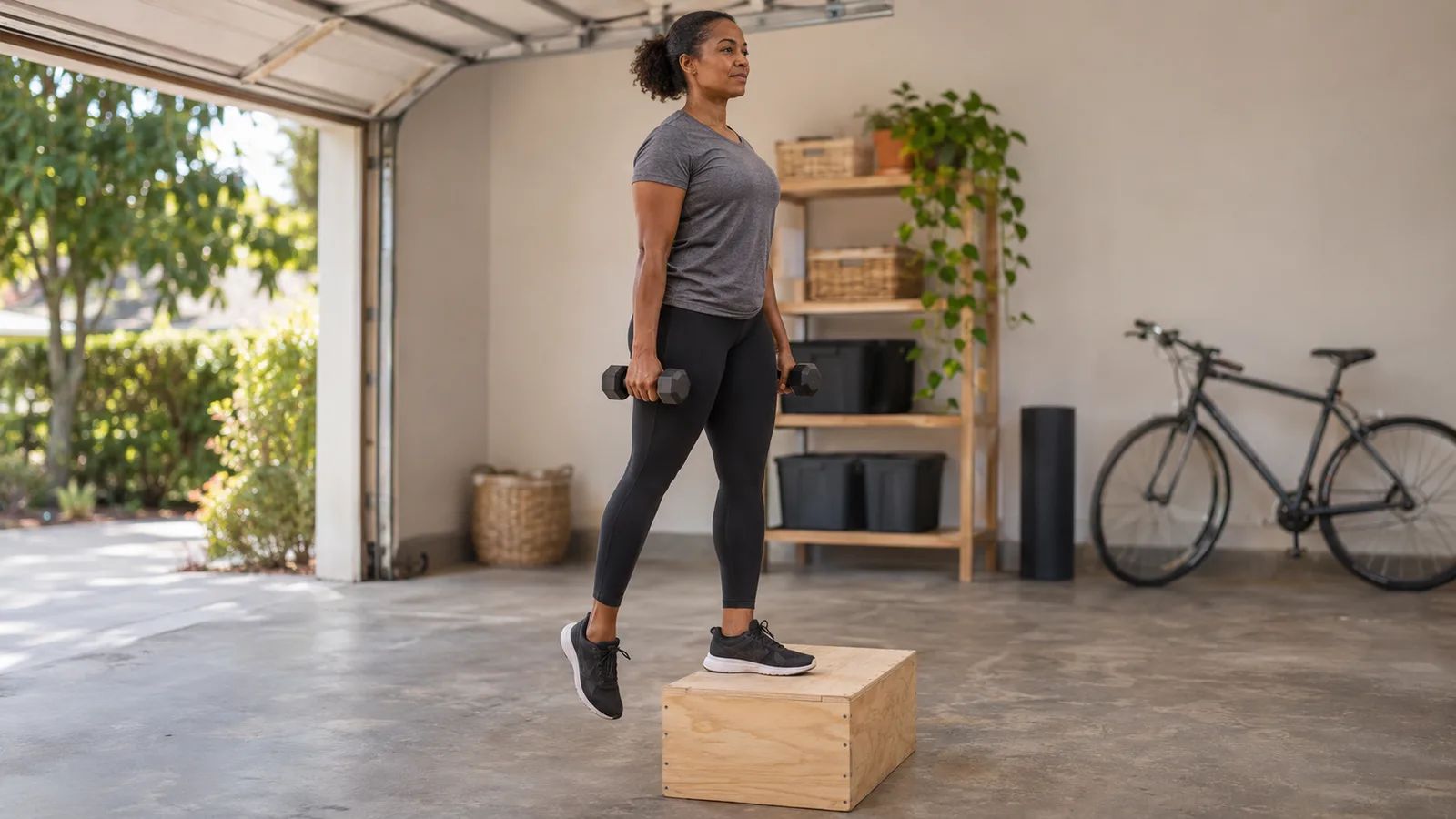
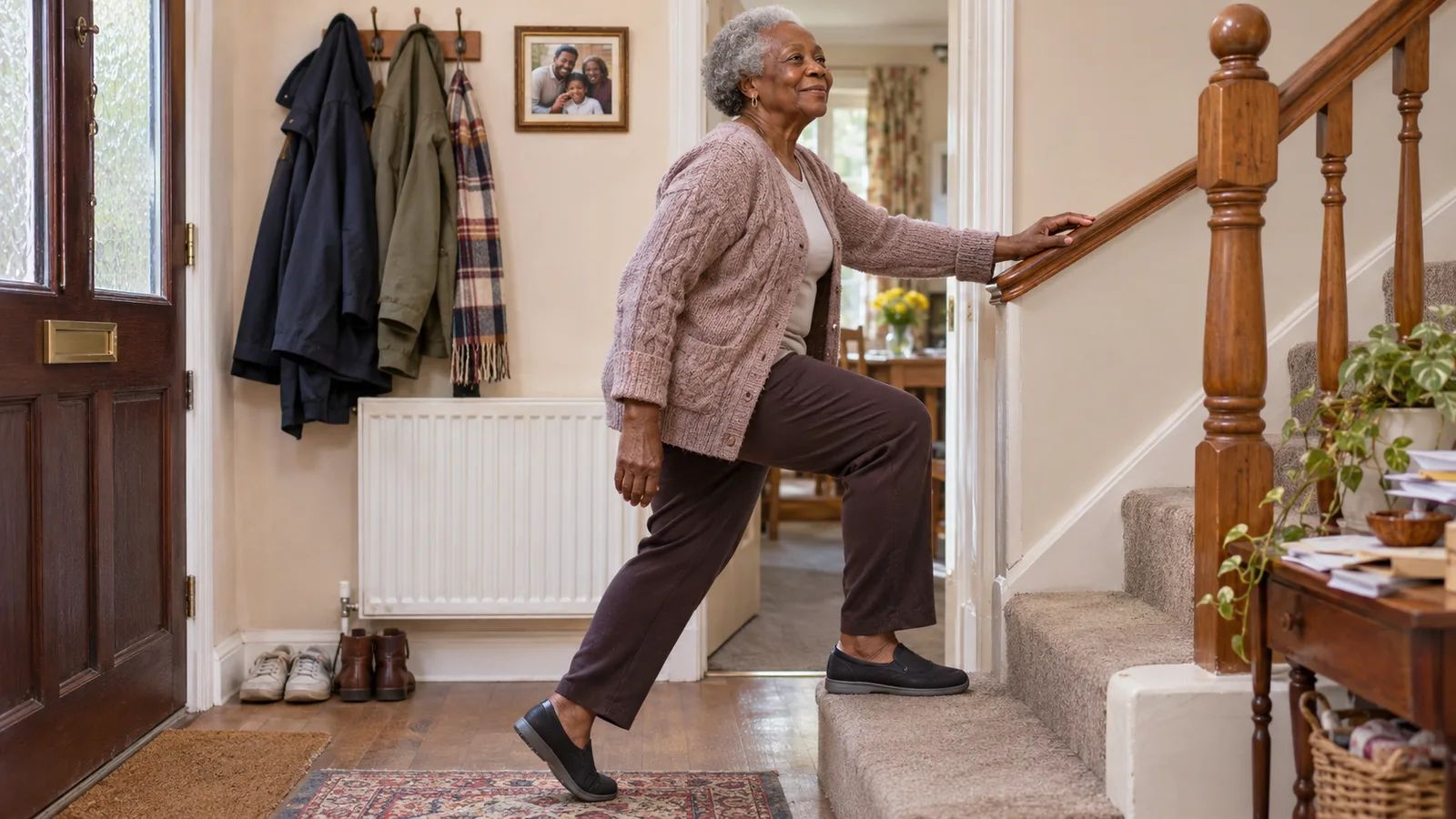
6. Step-up: for going upstairs
- Put your whole foot on the bottom stair, hand on the rail.
- Push through the heel of that top foot to stand up tall on the step. The bottom foot just comes along.
- Step down with that bottom foot first, so the working leg on the stair does the lowering. Do all your reps on one leg, then switch.
Level 1: a low, sturdy step about 4 inches (10 cm) high, with a firm hold on the rail. Level 2: the bottom stair, a light touch on the rail. Level 3: the bottom stair, holding a dumbbell or a bag of cans of 5 to 10 lb (2 to 4.5 kg) in the hand away from the rail.
7. Slow step-down: for going downstairs
For a lot of people, going down the stairs feels scarier than going up, so it's worth training on its own.
- Stand on the bottom stair facing down, holding the rail.
- Keep one foot on the stair and bend that knee to slowly lower the other heel toward the floor.
- Touch your heel down lightly, then straighten the leg on the stair to come back up.
The leg doing the work is the one that stays on the stair.
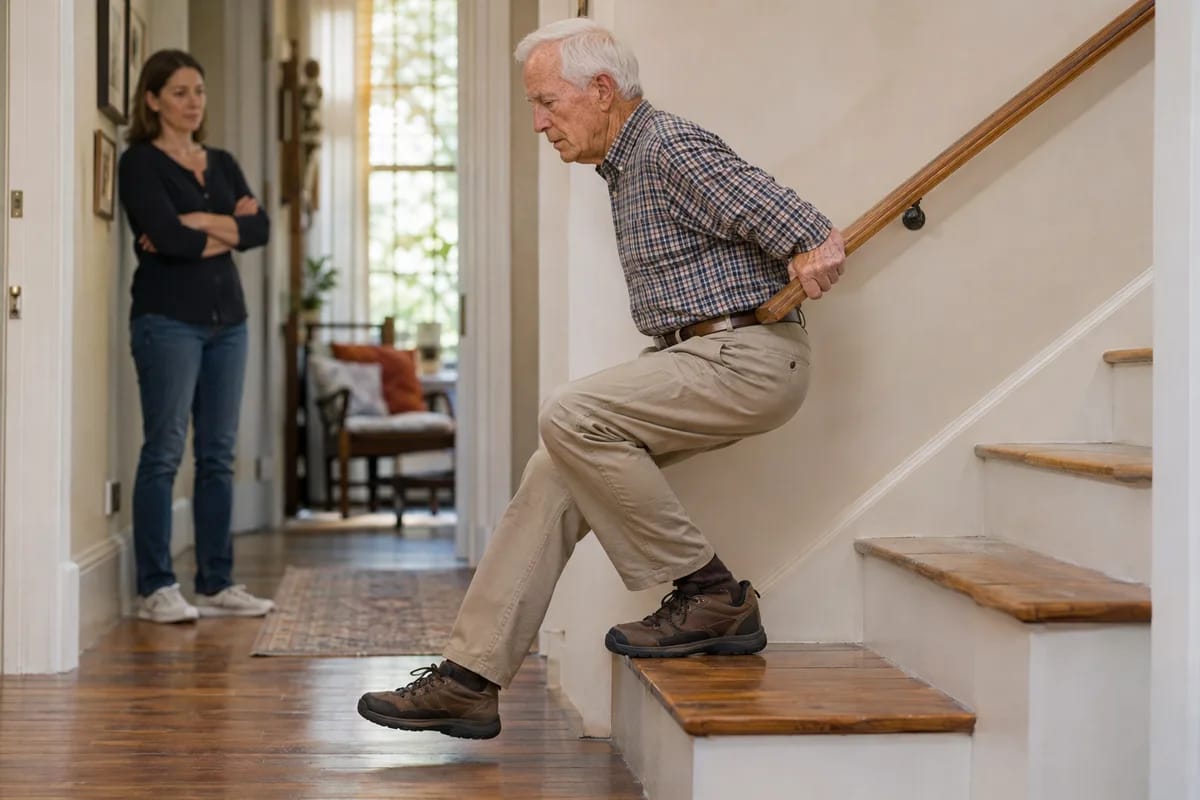
Level 1: a low step about 4 inches (10 cm) high, both hands holding on. Level 2: the bottom stair, one hand on the rail. Level 3: the bottom stair, a lighter touch and five seconds on the way down.
8. Bridge, on the bed: for hips that hold you upright
- Lie on your back on a firm bed, knees bent and feet flat, hip-width apart.
- Squeeze your glutes (your rear) and lift your hips until your knees, hips and shoulders make a straight line.
- Lower slowly.
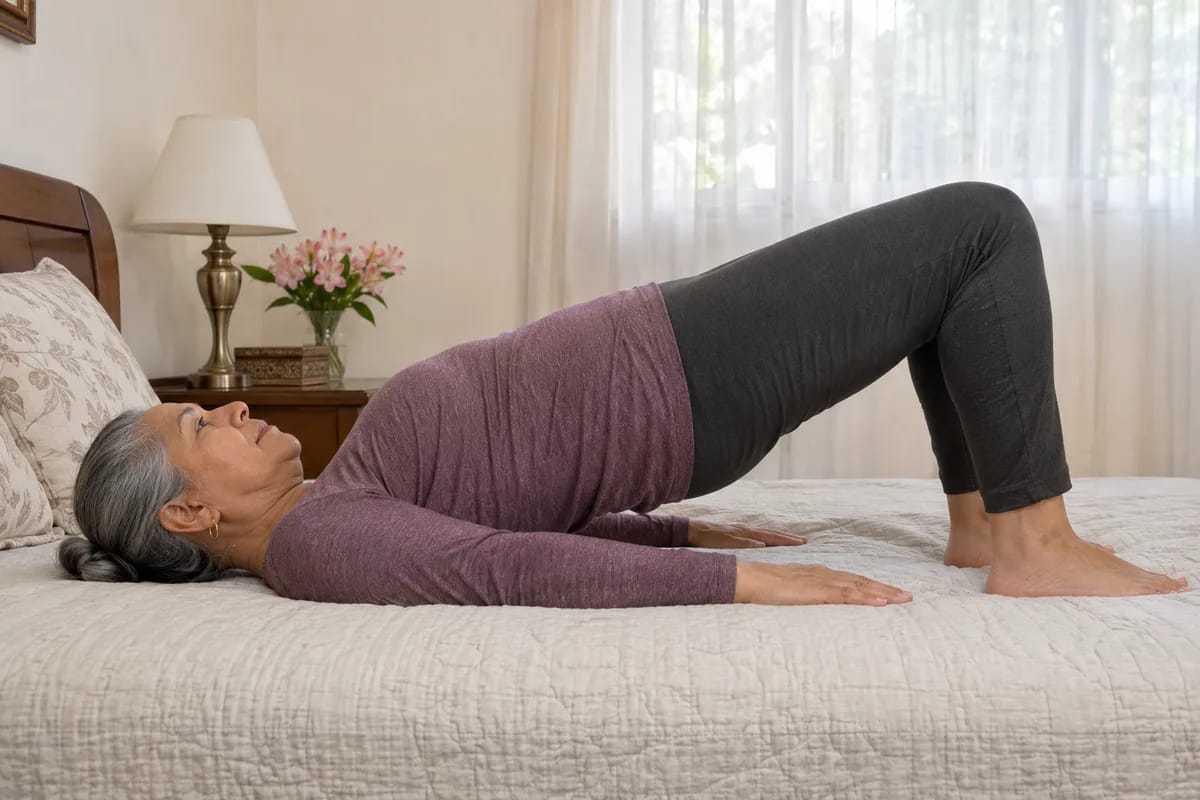
Level 1: a small lift. Level 2: a full lift, held for two seconds at the top, on the floor if getting down and up again is easy for you. Level 3: one leg at a time, the other foot lifted off the bed.
To get up afterwards, roll onto your side and push yourself up with your arms.
Your session on one card
Warm up first with three to five minutes of marching in place or walking around the house. Then go down the list once, resting about a minute between moves. That takes about 15 minutes plus the warm-up. Once that feels comfortable, after two or three weeks, do two sets of each, which takes 25 to 30.
| Move | Reps | Where |
|---|---|---|
| 1. Sit-to-stand | 8 to 12 | Chair |
| 2. Knee extension | 8 to 12 each leg | Chair |
| 3. Heel raise | 10 to 15 (each foot at level 3) | Counter |
| 4. Toe raise | 10 to 15 | Wall or counter |
| 5. Side leg raise | 8 to 12 each leg | Counter |
| 6. Step-up | 8 to 10 each leg | Bottom stair |
| 7. Slow step-down | 6 to 10 each leg | Bottom stair |
| 8. Bridge | 10 to 12 (6 to 10 each leg at level 3) | Bed |
Short on time? Do the big three plus the step-down (moves 1, 3, 6 and 7). That takes about 10 minutes and covers the chair, walking and both directions on the stairs.
Setting this up for a parent? Screenshot the card, do the first few sessions alongside them, and see the parent section of our strength training guide for seniors.
How often: two or three days a week, with a day off in between. The US guidelines ask older adults for at least two.1 If one is all you can manage, it still counts: in a trial where people aged 65 to 79 trained once, twice or three times a week, all three groups gained about the same strength over six months.2
How hard: the last few reps in a set should be "difficult, but not impossible", as the Arthritis Foundation puts it.3 If you could easily do ten more, you're on the wrong level. Breathe out as you stand, step or lift, and never hold your breath.
If you'd rather follow someone on screen, the National Institute on Aging has a free video of four lower-body strength exercises for older adults. To see one move at a time, the Arthritis Foundation's leg exercises page has a short video each for the sit-to-stand, step-up, calf raise (our heel raise) and side leg raise. Use the card to judge how hard to go.
What going wrong looks like
| You notice | What to do |
|---|---|
| Your knees fall in toward each other on the stand, step-up or step-down | Point them over your second toe. Use a higher seat or a lower step until they stay there |
| Your bottom foot pushes off the floor on the step-up | Lift its toes so it can't help. If you can't stand up without it, use a lower step |
| You drop into the chair, or land on the floor with a thud on the step-down | Raise the seat or use a lower step until you can lower slowly the whole way |
| You're gripping the counter hard | Fingertips only. If you need a full grip, stay at that level a little longer |
These are hard to catch on your own, because you can't see your own knees. Prop your phone at knee height off to your side and film a set, or ask someone to watch.
Or train with a coach on a live video call. With the phone in that same spot, they see the knee drift on the step-down on the rep it happens, hold you at a level on a wobbly day, and move you up when you're ready. That's what Bespoke Fit is, live 1‑on‑1 video personal training: your own coach, live on every session, with no more than 12 members, so they remember last week's wobble. As many sessions a week as you like, 14 days free, then $299/mo. Wanda, 70, one of our members, started with the usual doubt: "I was skeptical about doing training over video at my age, but it has been much easier than I expected. My trainer is patient and adjusts everything to what my body can handle."
If your film shows your knees staying over your toes and you're moving up levels on your own, the card is enough.
When to make it harder
When you reach the top of the card's range for two sets, on two sessions in a row, move that one exercise up a level and start again at the bottom of its range. Don't move everything at once.
Once you're at level 3 on a move and it's easy, there are two more ways to keep it working:
- Stand up briskly. Keep the slow way down, but come up as quickly as you safely can. The speed of getting up matters for daily life as much as the strength behind it, as our piece on fall-proofing with power explains.
- Add weight or harder versions. A heavier dumbbell on the step-up, or a split squat at the counter: one foot a long step ahead of the other, then bend both knees to lower straight down and come back up. Our dumbbell leg workout is the next step when the counter versions run out.
What to expect
Measure it rather than guess. Do the 30-second chair stand before you start and again every four to six weeks; the sit-to-stand guide shows how, and what scores mean for your age. Getting out of a chair is one of the things this kind of training reliably improves.4
Achy muscles for a day or two after the first few sessions are normal. In the trials, soreness was often reported and serious problems were rare.4
For falls, add a few minutes of balance exercises on the same days: programs built on balance and everyday movement cut falls by about a quarter, while the effect of strength training alone is still uncertain.5
Common questions
Can you build leg muscle after 70, or even 80? Yes. In one small, well-known trial, frail nursing-home residents with an average age of 90 more than doubled their leg strength in eight weeks of supervised training.6 You won't necessarily gain that much, but age on its own is no reason to think you can't get stronger.
Are seated leg exercises enough? They're a good start, especially if standing for long is hard right now. But getting up, climbing stairs and walking all happen on your feet, and standing versions train your balance at the same time. Move each exercise to its standing level as soon as the seated one feels easy.
Is walking enough to keep my legs strong? Keep walking, it's great for your heart, mood and stamina. But a walk you can do every day doesn't load your legs hard enough to rebuild much strength. Two short sessions a week of the moves on this page do that job, and walking does the rest.
Sources
-
Centers for Disease Control and Prevention, 2025. Physical activity guidelines for older adults. CDC. At least two days a week of activities that strengthen muscles. ↩
-
Taaffe DR, Duret C, Wheeler S, Marcus R, 1999. Once-weekly resistance exercise improves muscle strength and neuromuscular performance in older adults. Journal of the American Geriatrics Society. 46 healthy adults aged 65 to 79, 24 weeks of heavy training on gym machines. Strength rose by about 37% to 42% in all three groups, and timed chair rise improved. ↩
-
Arthritis Foundation. Leg exercises. Arthritis Foundation. ↩
-
Liu CJ, Latham NK, 2009. Progressive resistance strength training for improving physical function in older adults. Cochrane Database of Systematic Reviews. 121 trials, 6,700 people, mostly training two or three times a week at high intensity. A large effect on strength and a moderate to large effect on getting out of a chair (11 trials, 384 people). Serious adverse events were rare; muscle soreness and joint pain were common where they were tracked. ↩ ↩2
-
Sherrington C, Fairhall NJ, Wallbank GK, et al., 2019. Exercise for preventing falls in older people living in the community. Cochrane Database of Systematic Reviews. 108 trials, 23,407 people aged 60 and over. Balance and functional exercise cut the rate of falls by 24% (high certainty); programs mixing balance, functional and strength work probably cut it by 34%; the effect of programs that were mostly strength training was uncertain. ↩
-
Fiatarone MA, Marks EC, Ryan ND, et al., 1990. High-intensity strength training in nonagenarians: effects on skeletal muscle. JAMA. Ten frail nursing-home residents aged 90 on average, up to 96, on supervised machines for eight weeks. Strength rose 174% on average in the nine who finished. ↩
More on