Kettlebell workouts: a 20-minute plan with one bell
One kettlebell, five moves, about 20 minutes: a workout to do today, fixes for a bell that's too heavy or too light, which size to buy, and 8 weeks of progress.
In this article9
One kettlebell is enough for a full-body workout. Five moves cover the five things your body does all day: squat, hinge (bend at the hips), pull, push and carry. Do them as a circuit, two or three times a week with a day off between, and the whole thing takes about 20 minutes.
Here's the session. Do it today with the bell you have.
The 20-minute kettlebell workout
Warm up first with 5 halos each way, 5 slow goblet squats and 5 light deadlifts.
| Move | Reps |
|---|---|
| 1. Goblet squat | 8 to 10 |
| 2. Deadlift | 10 |
| 3. One-arm row | 8 each side |
| 4. Press | 5 to 8 each side |
| 5. Suitcase carry | 30 steps each hand |
- Go straight from one move to the next. Rest 60 to 90 seconds after the carry, then start the next round.
- Two rounds for the first two weeks, then three. A round takes about 5 minutes, so three rounds, two rests and the warm-up come to about 20 minutes. Two rounds is closer to 15.
- How hard: end every set with two or three good reps still in you. If you're unsure whether your bell is right, the three-set test settles it in one session.
- How often: two or three times a week, never two days running. Two days a week already meets the US guideline for muscle-strengthening exercise.1
Before your first round
Set up your space
- Clear a space you can reach your arms out in all round, with nothing breakable in front of or behind you
- Wear flat shoes or go barefoot (a soft running shoe tips you forward)
- Put a mat or rug where the bell sets down, for your floor and the people downstairs
- Have a sturdy chair or sofa arm nearby for the row
If you have a heart, blood pressure, bone or joint condition or a hernia, or you're pregnant, recently gave birth or recently had surgery, check with your doctor or physical therapist first. Stop for pain that's sharp or runs down a leg. Muscle soreness a day or two later is normal and clears within a few days.2
How to do the five moves
Halo (warm-up). Hold the bell upside down at your chest, hands on the two sides of the handle (the horns). Circle it slowly around your head, close to your hair, five times each way. It loosens your shoulders for the press.
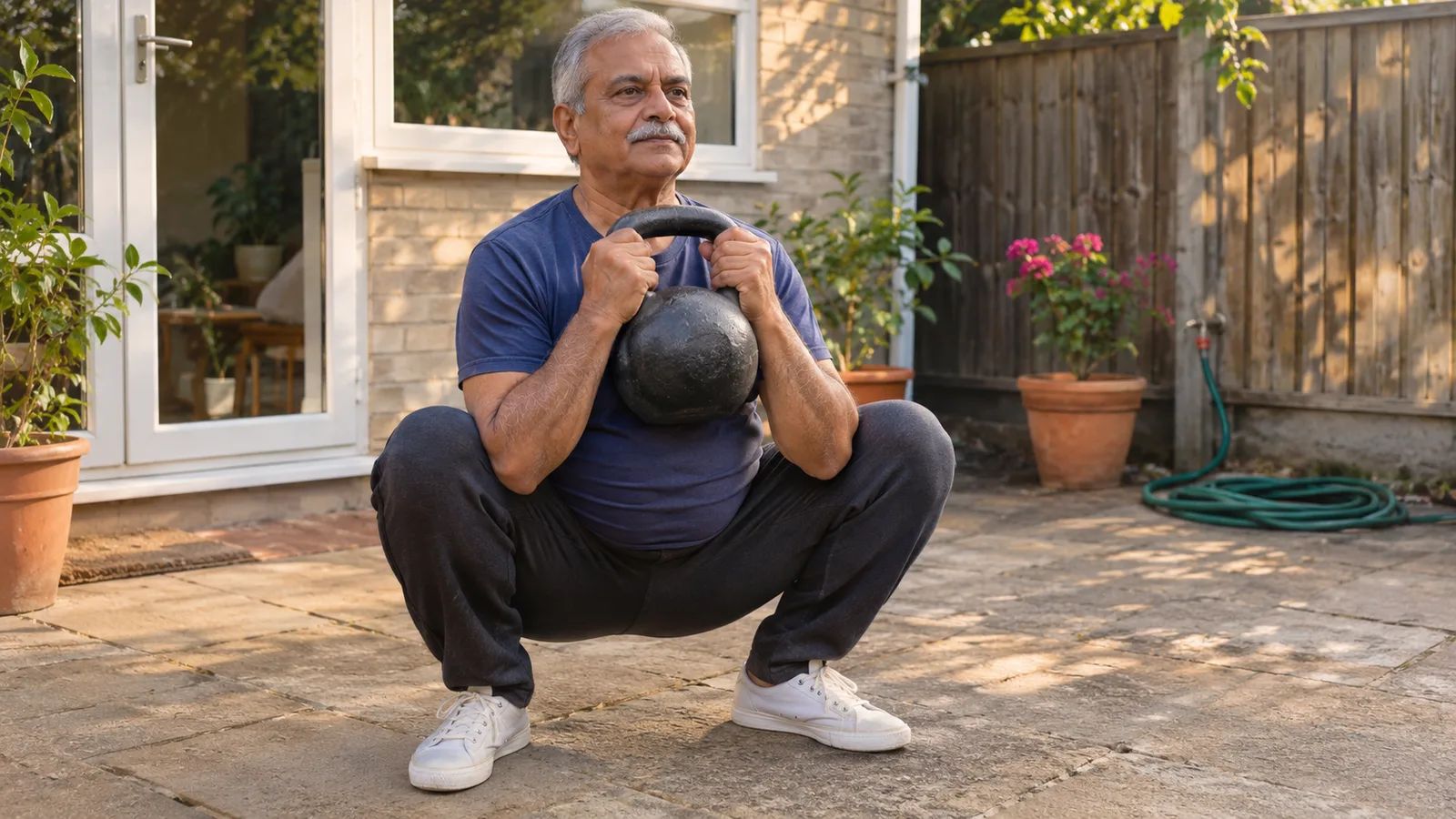
Goblet squat. Hold the bell by the horns against your chest, elbows pointing down. Feet a little wider than your hips. Sit down between your heels until your elbows brush the insides of your knees, keeping your chest up and your heels on the floor, then stand. Go only as low as you can keep your back flat. A chair behind you is a fine depth marker while you learn.
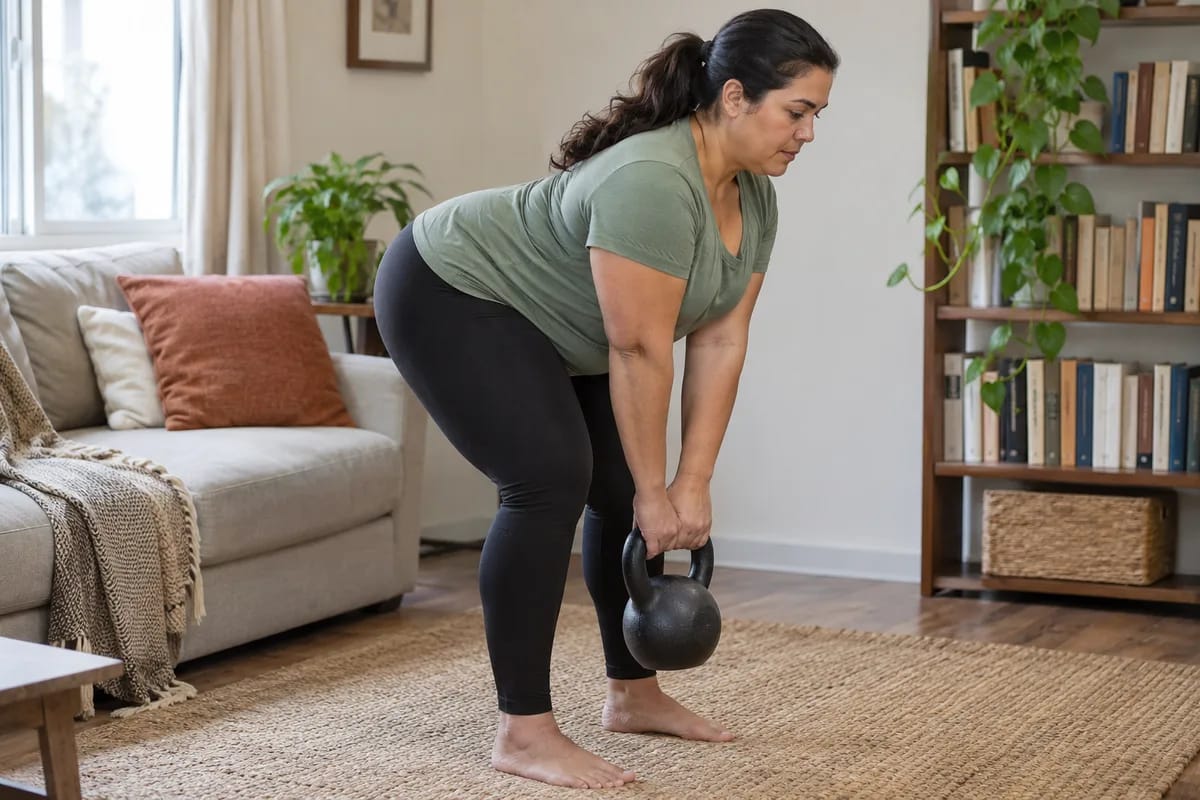
Deadlift. Bell on the floor between your feet, level with your ankles. Push your hips back, let your knees bend a little and take the handle in both hands with a flat back. Stand up by driving your hips forward and squeezing your glutes at the top. Lower it the same way. Your hips travel back, not down: that's a hinge, and it's the move the swing is built on.
One-arm row. Put one hand and the same-side knee on a chair seat or sofa arm, back flat like a tabletop. The bell hangs under your shoulder from the other hand. Pull it up to your hip, elbow brushing your side, then lower it slowly. If your body twists to get it up, the bell's too heavy for rows.
Press. Lift the bell to your shoulder with both hands for now, one on the handle and one cupping the bell. This is the rack: handle deep in your palm, the bell resting against the back of your forearm, wrist straight, elbow tucked in. Squeeze your glutes and stomach, then press straight up until your arm is beside your ear, and lower it back to your shoulder. Kneeling on one knee makes it easier to keep your ribs down and your back from arching.
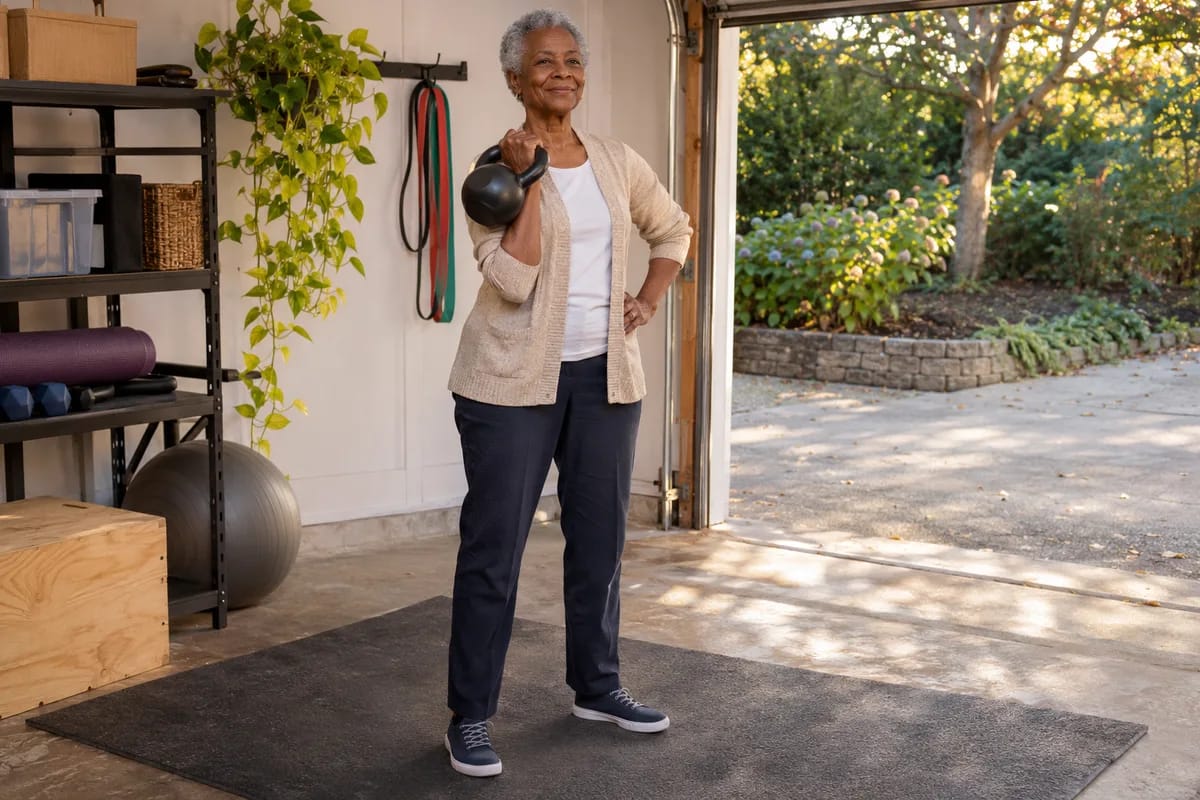
Suitcase carry. Pick the bell up in one hand and hold it at your side like a suitcase. Stand tall, shoulders level, and walk slowly. The bell wants to tip you sideways, so your trunk works the whole time and your grip gets a test. Switch hands and walk back.
When your bell is right for some moves and wrong for others
Almost everyone hits this. A bell that suits your squat is often too heavy to press overhead, because your shoulders are much smaller muscles than your hips and thighs. A bell you can press is often too light for your legs. Keep the bell for the moves it suits and change the rest. These are our coaching swaps, a rule of thumb rather than anything measured.
| If the bell is... | Keep it for | Change this |
|---|---|---|
| Too heavy to press | Squat, deadlift, row, carry | Floor press (lying on your back), or push-ups against a counter, going lower over the weeks |
| Too heavy to squat 8 good reps | Deadlift, row, carry | Sit to a chair and stand, with the bell or without. Press: counter push-ups |
| Too light for squats | Press, row | Lower over 3 seconds, pause at the bottom, up to 20 to 25 reps |
| Too light for deadlifts | Press, row, carry | Kickstand deadlift: back foot on its toes, weight on the front leg. Or start swings sooner |
| Too light for rows | Everything else | Pause 2 seconds at your hip, lower over 3 |
| Too light for carries | Everything else | Walk a minute each hand |
When a light bell runs out of road, you have more options than buying the next size. Slower reps, pauses and one-leg versions make the same weight harder for months.
Which size kettlebell to start with
If you can own only one, pick it for your squat and deadlift. Your legs and hips are the biggest muscles you have, and the press is the easiest move to swap. These are our coaching starting points, not research:
| Where you are | One bell to start with |
|---|---|
| Never lifted, or coming back after years off | 15 to 18 lb (7 to 8 kg) |
| Active, but new to weights | 18 to 26 lb (8 to 12 kg) |
| Already strength training | 26 to 35 lb (12 to 16 kg) |
Why the sizes are such odd numbers. Kettlebell training grew up in kilos, and much of the advice online still talks in them: "start with an 8", "move up to the 16". That's why so many US labels read 18, 26 or 35 lb: those bells are made to kilo weights. Rogue's 35 lb bell, for example, is built to weigh 16 kg, to within 1%.3 So the common sizes decode like this: 18 lb is an 8 kg bell, 26 lb is 12 kg, 35 lb is 16 kg, 44 lb is 20 kg and 53 lb is 24 kg.
The cheaper bells at big-box stores like Target are made in plain pounds instead, mostly in 5 lb steps (10, 15, 20, 25 lb and so on). For a beginner that's a small advantage: going from 15 to 20 lb is a gentler jump than 18 to 26 lb, which is about half as heavy again.
Starting from nothing, a pair of dumbbells is the better first buy, and a kettlebell a great third. If one is already in your hall cupboard, it's plenty for this plan. When you buy a second, go heavier, for your legs and swings, not lighter.
Learn the deadlift before the swing
The swing is the famous kettlebell move, and plenty of beginner videos put it in week one. We'd wait. A swing is a deadlift done fast, with the bell flung forward on the snap of your hips. If the hinge isn't solid at slow speed, it won't be at fast speed, and the usual result is a sore lower back.
Switch the deadlift for 10 to 15 swings when two things are true: your deadlift feels smooth with a flat back through every round, and you can hike the bell back between your thighs like a football center. Our kettlebell swing guide has the steps, the faults you'll feel and the fix for each.
This is the part of kettlebell training that goes best with someone watching. A common fault is squatting the bell up with your knees instead of snapping it up with your hips, and from the inside it feels like a good swing. On a live 1‑on‑1 video session with a Bespoke Fit coach, your coach watches every rep through your camera and corrects the swing while the bell's still moving. They write your program around the bell you actually own, and because each coach trains at most 12 people, they remember that the press was a struggle last week.
Cleans, snatches and Turkish get-ups are good skills for later. This plan doesn't need them.
Your first eight weeks
Weeks 1 to 2
Learn the moves
Two rounds. Keep the effort easy to somewhat hard. You're practising positions, not testing yourself.
Weeks 3 to 4
Add a round
Three rounds. Swap in the swing when you pass the two checks above.
Weeks 5 to 6
Fill the rep ranges
Work up to the top of each range: 10 squats, 8 presses each side. If you're swinging by now, add a short finish: 10 swings at the start of each minute for 5 minutes.
Weeks 7 to 8
Make it harder
Use the harder versions from the table for any move that feels easy, or bring in a heavier second bell for squats and swings.
Each step adds one thing. If a week goes badly, repeat it rather than pushing on.
What a kettlebell will do for you
In a 12-week trial, 32 inactive adults aged 59 to 79 got 14 to 16 lb (6 to 7 kg) stronger in grip, walked about 137 feet (42 m) farther in six minutes and stood up from a chair three more times in 30 seconds.2 They trained more than this plan asks: three 45-minute classes a week, in person and then by video, plus home practice.
The limits: in young men, barbell lifting built squat strength faster than kettlebells,4 and kettlebell research overall is thin, with few long trials and small effects.5 A kettlebell is a very good all-round tool for getting stronger at home, not the fastest route to a big squat.
If you also own dumbbells, our plan for beginners works with them, and your kettlebell fits its carries.
A few more kettlebell questions
Can I lose belly fat with kettlebell workouts? Not from your belly in particular. No exercise picks where fat comes off. Kettlebell workouts help with fat loss by adding to everything you move in a week, and what you eat matters more. What the bell does reliably is make you stronger, which is worth having at any size.
What will doing 100 kettlebell swings a day do? Built up to over a few weeks, it makes your hips, grip and breathing fitter. Started on day one, it's how a tired lower back ends up doing the work your hips should. It also leaves out squats, presses and rows, so it works best alongside a session like the one on this page.
Do I need to do cardio as well? Some, yes. This session gets you breathing hard, but a short circuit isn't the same as steady walking, cycling or swimming. Keep some easy movement on the days in between, even a 20-minute walk.
Sources
-
US Department of Health and Human Services. Top 10 things to know about the second edition of the Physical Activity Guidelines for Americans. "Adults also need muscle-strengthening activity, like lifting weights or doing push-ups, at least 2 days each week." ↩
-
Meigh, N.J., Keogh, J.W.L., Schram, B., Hing, W. & Rathbone, E.N., 2022. Effects of supervised high-intensity hardstyle kettlebell training on grip strength and health-related physical fitness in insufficiently active older adults: the BELL pragmatic controlled trial. BMC Geriatrics. 32 adults aged 59 to 79, 12 weeks of usual activity then 12 weeks of kettlebell training in three 45-minute group classes a week (supervised in person for weeks 1 to 6, then delivered by video because of COVID restrictions) plus twice-weekly home practice. Grip strength rose 7.1 kg (right) and 6.3 kg (left), six-minute walk 41.7 m, 30-second sit-to-stand 3.3 reps, appendicular lean mass 0.65 kg; four non-serious adverse events; 20 of the 28 who finished reported muscle soreness at least once (3 rated it severe), all resolved within three days. The authors call that rate high and link it to the program's volume and intensity. No randomised control group; the lead author is a kettlebell instructor (declared). ↩ ↩2
-
Rogue Fitness. Rogue kettlebells, checked 12 November 2026. "The 35LB Rogue Kettlebell is actually spec'd to weigh exactly 16KG with a +1% / -1% tolerance"; the size chart pairs 8, 12, 16, 20 and 24 kg with 18, 26, 35, 44 and 53 lb. ↩
-
Otto, W.H. 3rd, Coburn, J.W., Brown, L.E. & Spiering, B.A., 2012. Effects of weightlifting vs. kettlebell training on vertical jump, strength, and body composition. Journal of Strength and Conditioning Research. 30 healthy men aged about 23, twice a week for six weeks; both groups gained strength and power, but "the gain in strength using weightlifting movements was greater than that during kettlebell training". ↩
-
Meigh, N.J., Keogh, J.W.L., Schram, B. & Hing, W.A., 2019. Kettlebell training in clinical practice: a scoping review. BMC Sports Science, Medicine and Rehabilitation. 99 publications, including reviews, expert opinion and case reports; effect sizes "typically trivial to small"; the small number of longitudinal studies were "largely underpowered and of low methodological quality". ↩