Full body dumbbell workout: 7 moves and how heavy to go
A full body dumbbell workout in 7 moves and about 45 minutes: the weight to start with on each, what to do with one pair, and a 30-minute version.
In this article5
This is one full body dumbbell workout: seven moves, about 45 minutes, two or three times a week with a day off between. You need one or two pairs of dumbbells, a sturdy chair and a patch of floor. No bench. The table gives a weight to try for every move, because your squats will soon want a heavier dumbbell than your shoulders do.
The workout
Do the moves in pairs. One set of 1a, rest about a minute, one set of 1b, rest a minute, and repeat until you've done three rounds. Then move on to pair 2.
| Move | Sets × reps | New to weights | Already active |
|---|---|---|---|
| 1a. Goblet squat, one dumbbell | 3 × 8 to 12 | Body weight, then 8 to 12 lb (4 to 5 kg) | 12 to 20 lb (5 to 9 kg) |
| 1b. One-arm row | 3 × 8 to 12 each arm | 8 to 12 lb (4 to 5 kg) | 15 to 20 lb (7 to 9 kg) |
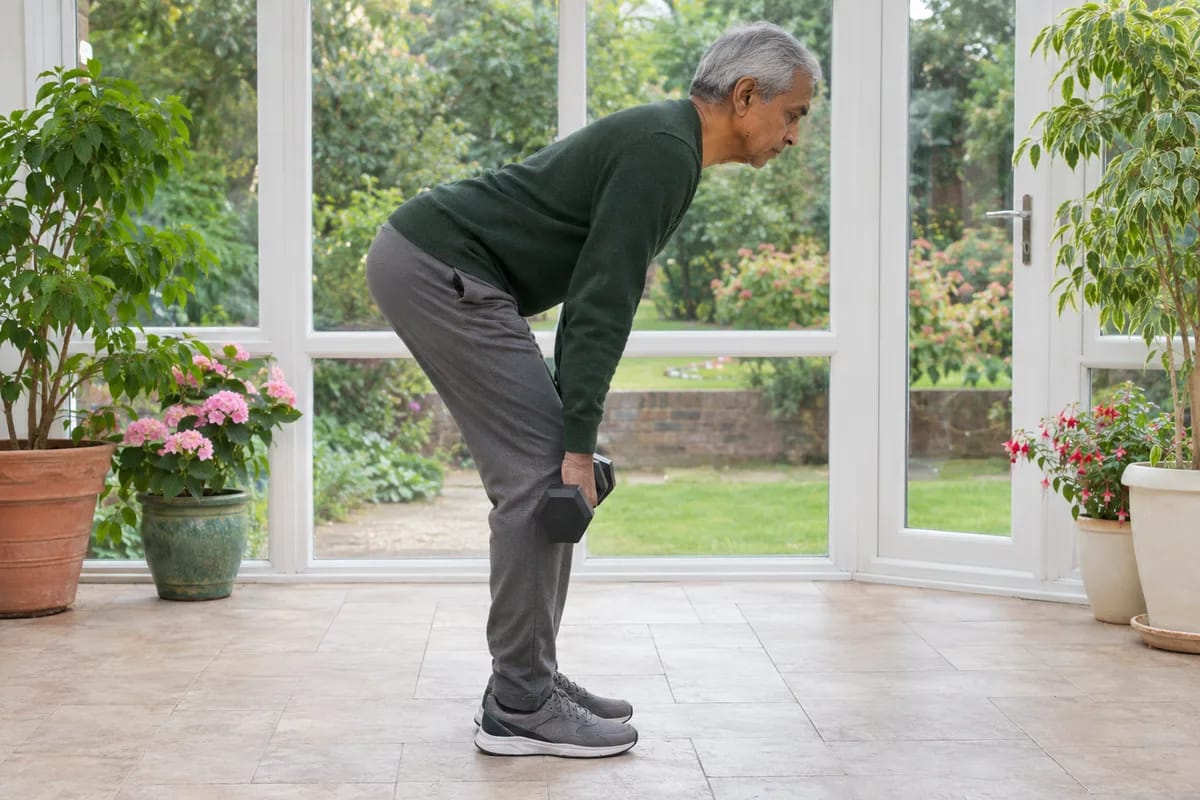
| 2a. Romanian deadlift | 3 × 8 to 12 | 8 to 12 lb (4 to 5 kg) each hand | 15 to 20 lb (7 to 9 kg) each hand |
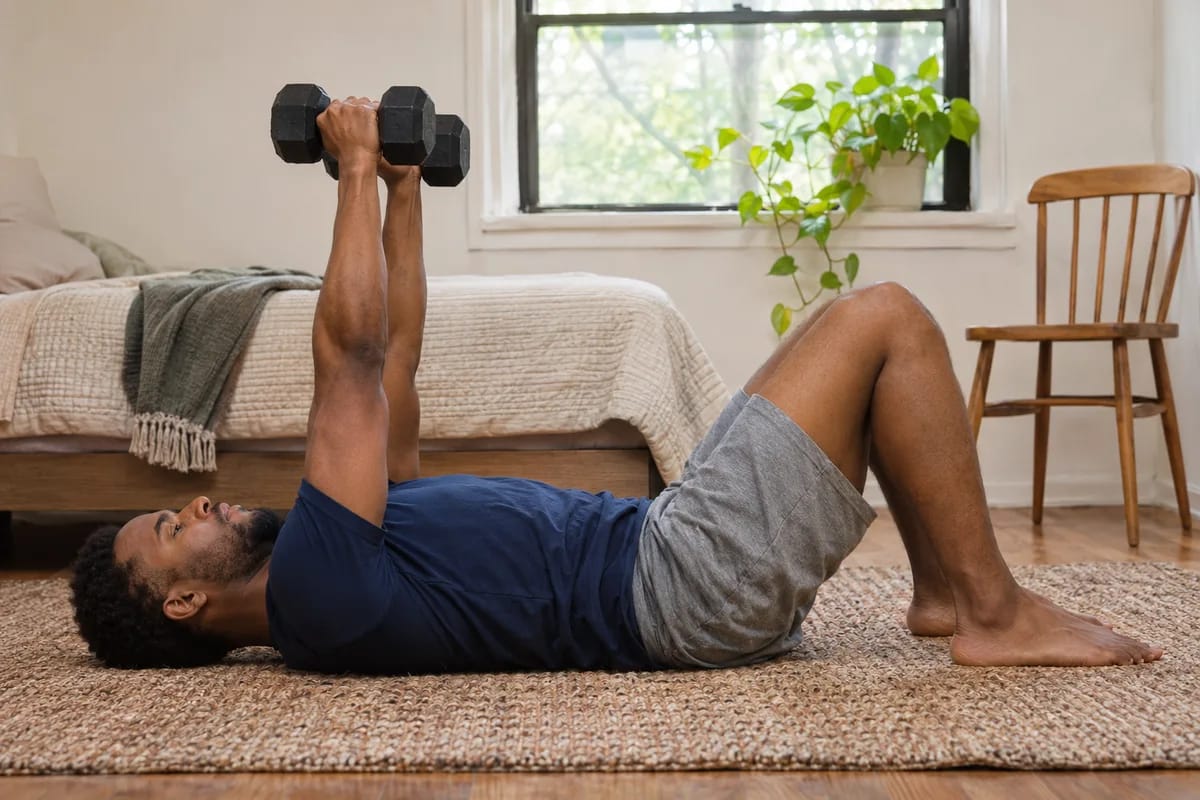
| 2b. Floor press | 3 × 8 to 12 | 5 to 10 lb (2 to 5 kg) each hand | 10 to 15 lb (5 to 7 kg) each hand |
| 3a. Split squat | 3 × 8 to 12 each leg | Body weight | Body weight, then 5 to 10 lb (2 to 5 kg) each hand |
| 3b. Overhead press | 3 × 8 to 12 | 5 to 8 lb (2 to 4 kg) each hand | 8 to 15 lb (4 to 7 kg) each hand |
| 4. Suitcase carry, one dumbbell | 2 walks of about 40 sec each hand | The heaviest you can walk tall with | The heaviest you can walk tall with |
"New to weights" means you've never lifted, or not in years. "Already active" means you move regularly but dumbbells are new. These are our coaching starting points, not research. They're a weight to try, not a weight you ought to manage.
Three things make the numbers yours:
- Finish each set with two or three good reps left. The last reps should slow down, but you never grind to failure. The American College of Sports Medicine's 2026 review found that going all the way to failure doesn't add to your gains, and suggests stopping about two or three reps short.1 If 12 reps come easily, go up next set. If you can't reach 8, go down. Reps in reserve explains how to judge it.
- Warm up for five minutes. March in place, do 10 slow squats to a chair and 10 hip hinges, circle your arms, then do one light set of goblet squats.
- Rest about a minute between the two moves in a pair. Each muscle still gets two minutes or more before its next set.
Short on time, or brand new? Do two rounds of each pair and one carry each hand. That's about 30 minutes with the warm-up. If you've never lifted, use this version for your first two weeks, then go to three rounds.
Two or three sessions a week meets the US guideline of strength work on two or more days. The seven moves work every muscle group it lists (legs, hips, back, abdomen, chest, shoulders and arms), the abdomen and arms mostly as helpers in the carry, rows and presses.2
If you have a heart or blood pressure condition, are pregnant, have had recent surgery or a joint replacement, or have a joint that hurts when you put weight through it, ask your doctor or physical therapist which moves and loads suit you before you start.
Which dumbbell for which move
Your legs and back usually handle a good deal more than your shoulders and chest. That's a coaching rule of thumb, not a law, but it's why a dumbbell that feels right in a goblet squat feels like a lot in an overhead press. How much weight to start lifting with has a three-set test if you want to check your numbers.
The order follows from it. The goblet squat and row, which take your heaviest single dumbbell, come first while you're fresh, and moves done early in a session tend to gain the most strength.1 The presses, which need the lightest weights, come later. The carry goes last because it's short, and a tired grip just means a shorter walk.
Two pairs? Use the heavier pair for the goblet squat, row, Romanian deadlift and carry, and the lighter pair for the floor press, split squat and overhead press. With one adjustable pair, change the setting between the moves in pair 2. The minute of rest covers it.
One pair? On day one it can cover everything: about 8 lb (4 kg) if you're new, or about 15 lb (7 kg) if you're active, with just one dumbbell held at your chest for the split squat. Your legs and back outgrow it long before your shoulders do. Then:
- Light pair, 5 to 10 lb (2 to 5 kg): hold both dumbbells at your shoulders for the goblet squat, and do the Romanian deadlift with one foot back on its toes, like a kickstand. Lower each row for a slow count of three.
- Middle pair, 12 to 20 lb (5 to 9 kg): fine for the squat, row, Romanian deadlift and carry. If you can't reach 8 presses, hold one dumbbell by its ends in both hands, and use one at your chest for the split squat.
- Heavy pair, 25 lb (11 kg) and up: do push-ups instead of the floor press, hands on a counter or the floor, and press overhead one arm at a time with a full gallon jug of water, about 8 lb (4 kg). If you're new, do the goblet squat and Romanian deadlift without weight for a week or two, until 12 reps feel easy.
About to buy? Two pairs, or one adjustable pair, beat a single fixed pair. Choose the light pair by your overhead press and the heavy pair by your row. A home gym on a budget covers what to get first.
How to do each move
For each one: how to get the weight into place, the cue that matters most, and what it looks like when it slips. Film one set from the side now and then. Most slips are obvious side-on and invisible from the front.
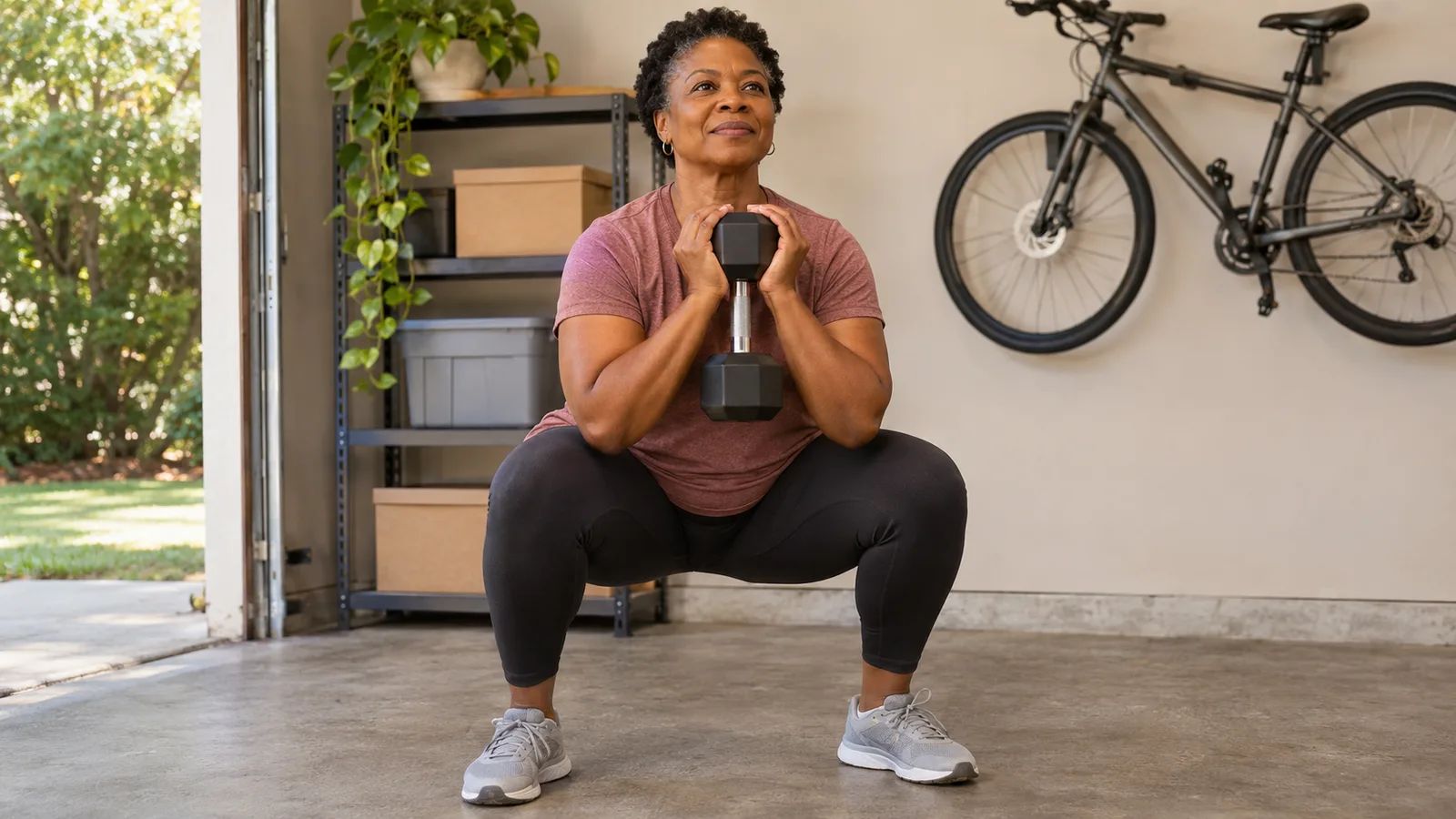
1a. Goblet squat
- Into place: stand the dumbbell on end on the chair seat, cup the top end in both hands, and lift it to your chest.
- Cue: feet a little wider than your hips, sit down between your heels, elbows inside your knees at the bottom.
- Slipping: heels lift or knees fall in. Hold the dumbbell higher, widen your stance a touch, and only go as low as your heels stay down.
1b. One-arm row
- Into place: set the dumbbell on the floor beside your working-side foot first. Then put your free hand on the chair seat and reach down for it with a flat back.
- Cue: pull your elbow toward your back pocket, pause for a second, lower slowly.
- Slipping: your chest twists open to heave it up, or your shoulder creeps to your ear. Go lighter and keep your chest facing the floor.
2a. Romanian deadlift
- Into place: squat down to pick the dumbbells up, then stand tall with them in front of your thighs.
- Cue: soft knees, push your hips back as if closing a car door with your backside, and let the weights slide down your thighs. Stop when your hips stop moving back, usually around your knees or just below. Stand up by driving your hips forward.
- Slipping: it turns into a squat as your knees bend more each rep, your back rounds, or the weights drift away from your legs. Keep them brushing your thighs. The floor isn't the target.
2b. Floor press
- Into place: sit on the floor, knees bent, with a dumbbell standing on end on each thigh. Hug them to your chest and lie back together.
- Cue: elbows at about 45 degrees from your sides. Press straight up, then lower until your upper arms touch the floor softly.
- Getting out: bring them back to your chest and rock up to sitting with them on your thighs, or roll onto your side and set them down. Never let go from arm's length. Lifting in an apartment has more on quiet set-downs.
- Slipping: elbows flare out into a T, or your wrists bend back. Tuck the elbows and keep your knuckles pointing at the ceiling.
3a. Split squat
- Into place: take one long step, back heel up, with your feet hip-width apart like railroad tracks, not a tightrope. Hold the dumbbells at your sides or one at your chest, or keep a hand on a counter for balance.
- Cue: drop straight down until your back knee is just above the floor, then stand up. Do all the reps on one leg, then switch.
- Slipping: the front heel lifts (step longer) or you wobble (widen your feet).
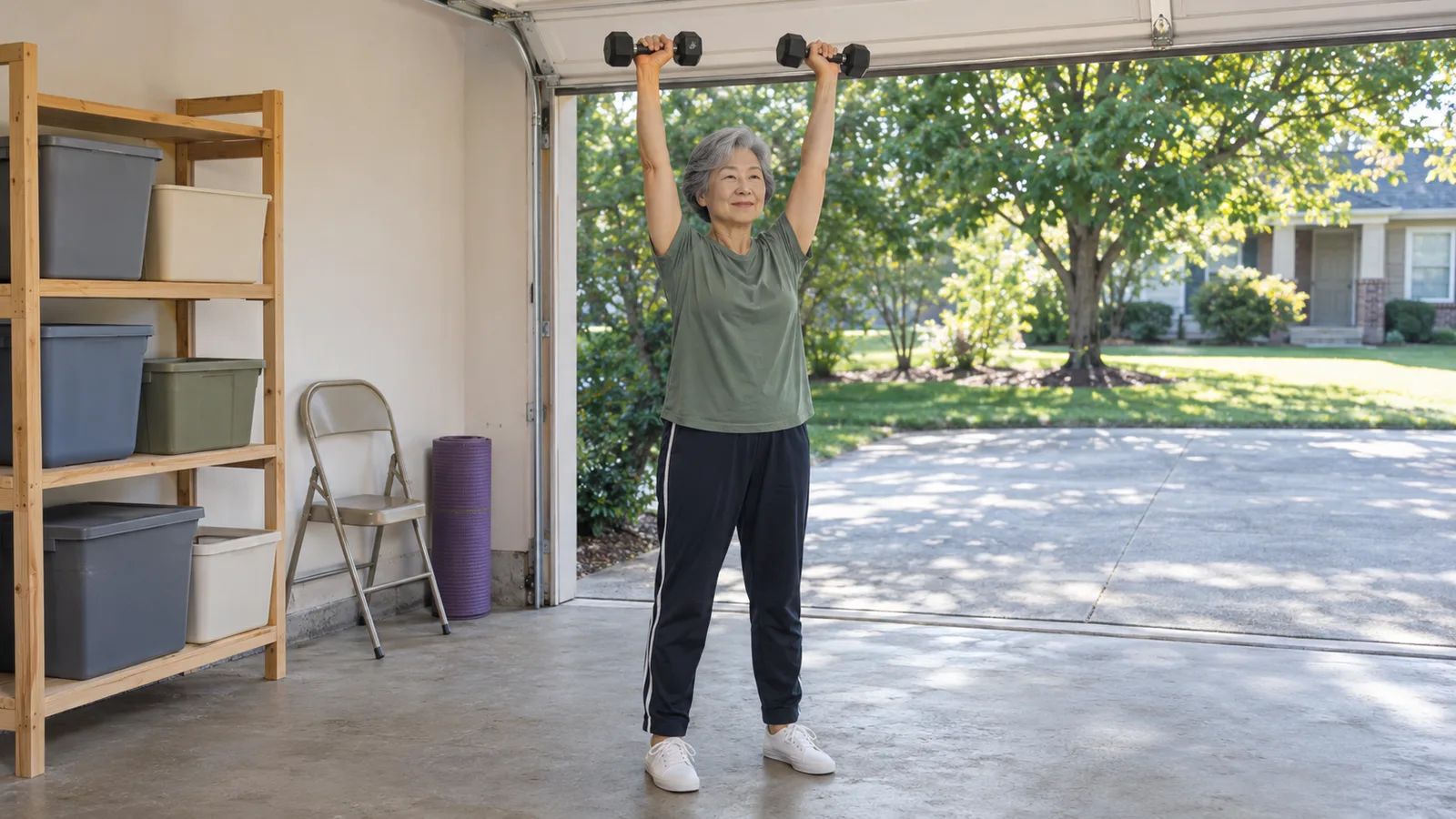
3b. Overhead press
- Into place: curl the dumbbells up to your shoulders, one at a time if they're heavy.
- Cue: squeeze your glutes, keep your ribs down and press until your arms are straight beside your ears.
- Slipping: leaning back to finish the rep. That means it's too heavy. Go lighter, or sit on the chair to press.
4. Suitcase carry
- Into place: squat down beside the dumbbell and pick it up like a suitcase.
- Cue: walk tall and slowly, shoulders level. A hallway works, and so do laps of a room.
- Slipping: leaning toward the weight. Take shorter steps, or use a lighter dumbbell.
A muscle working hard is fine, and stiff legs a day or two later are normal in the first weeks. A sharp or pinching pain in a joint is different. Stop that move for today and use the easier version next time. If it keeps happening, see a physical therapist. Joint-friendly programming covers working around a grumpy knee or shoulder.
The two hardest things on this page to do alone are choosing the right dumbbell for each move and catching your Romanian deadlift as it turns into a squat. On a live 1‑on‑1 video session with Bespoke Fit, your coach does both while you're mid-set ("hips back, let the weights slide down your thighs"), instead of reviewing a video you sent them a day and a half later. The workout above costs nothing and works fine on your own. A coach is for people who want someone choosing the weights, watching the reps and waiting for them on Thursday.
Next week, and the month after
Stay with the same weight until every set reaches 12 reps at the same effort. Then pick up the next dumbbell and start back at 8: reps first, then weight. For a row, that might look like 10, 9 and 9 reps with 15 lb (7 kg) in week one, 12, 12 and 12 by week three, then 8, 8 and 7 with 20 lb (9 kg).
You drop back to 8 because the next dumbbell is a big step. Beginner guidelines suggest adding 2 to 10% at a time,3 and 15 to 20 lb is a third heavier. The weights guide has two tricks for when the jump feels too big.
Your moves won't climb at the same speed. Legs and back go first, which is when the one-pair lines above earn their keep. If a set runs past about 20 to 25 reps before it gets hard, switch to a harder version instead of doing more reps. Progressive overload at home has full ladders of them.
When you want more than one session:
- Two different workouts to alternate, plus a four-week timeline for true beginners: workout plans for beginners.
- Plans for two, three or four days a week with your pairs: dumbbell workouts at home.
Coached members get the next step written for them: your coach puts each workout on your training calendar, you log every set in the app, and the coach adjusts next week from what they saw. Each coach has 12 members at most, so yours remembers last Tuesday's rows.
Common questions
Can you get a good body with just dumbbells? Yes. Muscle responds to hard sets, not to a particular kind of equipment. A review of 21 studies found lighter and heavier loads built similar muscle when every set was taken to failure, though the heavier loads built more top-end strength.4 What usually runs out first is weight for your legs, and that's when a heavier pair or the harder versions above take over.
Is strength training good for weight loss? It helps, mostly by changing what you're made of rather than what the scale says. In a review of 114 trials in people with overweight or obesity, lifting on its own cut about 2 lb (1 kg) of fat and added close to 2 lb (0.8 kg) of lean mass compared with not training. The bigger losses came when eating changed too: lifting plus a lower-calorie diet cut about 12 lb (5 kg) of fat while lean mass held steady.5 If the scale is your goal, pair this workout with changes to how you eat.
What are the only 5 exercises you'll ever need? There's no standard five. The useful version is five movements: a squat, a hip hinge, a push, a pull and a carry. This workout covers them with the goblet squat, Romanian deadlift, floor press, row and suitcase carry. It adds a split squat and an overhead press because daily life asks for one leg at a time and for lifting things above your head.
Sources
-
Currier BS, D'Souza AC, Singh MAF and colleagues (Phillips SM, senior author), 2026. American College of Sports Medicine position stand. Resistance training prescription for muscle function, hypertrophy, and physical performance in healthy adults: an overview of reviews. Medicine and Science in Sports and Exercise. Covers 137 systematic reviews; training to failure did not enhance gains, and near-failure or 2 to 3 reps in reserve is suggested; strength gains were greater for exercises done at the beginning of a session; home-based training improved strength. ↩ ↩2
-
Centers for Disease Control and Prevention. Adult activity: an overview. Muscle-strengthening activities on 2 or more days a week that work all major muscle groups (legs, hips, back, abdomen, chest, shoulders and arms). ↩
-
American College of Sports Medicine, 2009. Progression models in resistance training for healthy adults. Medicine and Science in Sports and Exercise. For novices: loads of an 8 to 12 repetition maximum, 2 to 3 days a week, and a 2 to 10% increase once the current load can be lifted for one or two reps over the target. ↩
-
Schoenfeld BJ, Grgic J, Ogborn D, Krieger JW, 2017. Strength and hypertrophy adaptations between low- vs. high-load resistance training: a systematic review and meta-analysis. Journal of Strength and Conditioning Research. 21 studies of adults without known medical conditions, all sets to momentary failure, 6 weeks or longer; muscle growth was similar with low (60% of one-rep max or less) and high loads, while one-rep max strength gains were greater with high loads. ↩
-
Lopez P, Taaffe DR, Galvão DA, Newton RU and colleagues, 2022. Resistance training effectiveness on body composition and body weight outcomes in individuals with overweight and obesity across the lifespan: a systematic review and meta-analysis. Obesity Reviews. 114 trials, 4,184 people with overweight or obesity. Against no training, resistance training alone reduced fat mass by 1.0 kg and raised lean mass by 0.8 kg; combined with calorie restriction, fat mass fell 5.3 kg and lean mass was maintained. ↩