How many days a week should you lift weights? 2 or 3
Two days a week gets you most of the benefit, and three suits most people. What a fourth or fifth day adds, if lifting every day is OK, and how to pick yours.
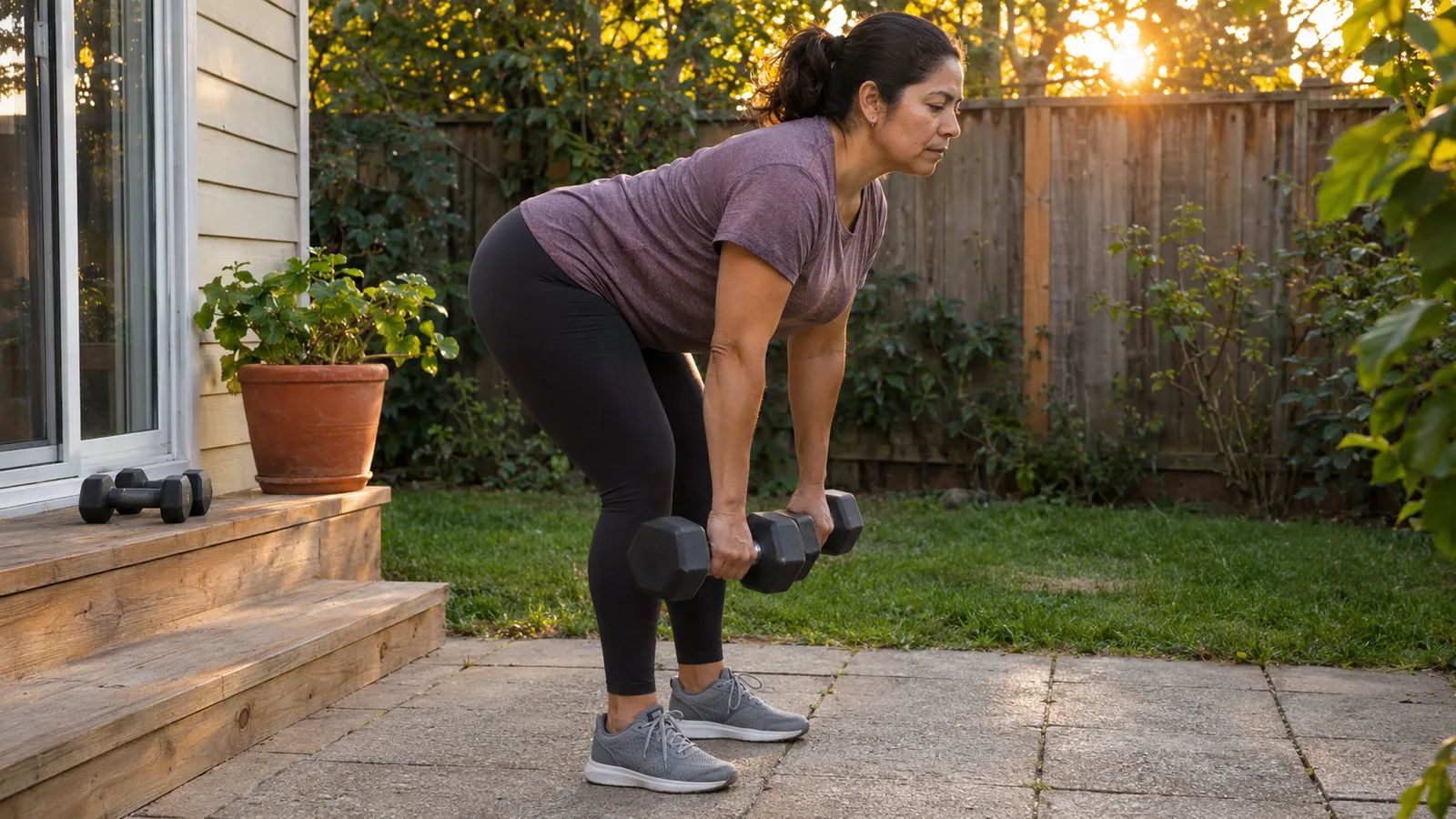
In this article8
The short answer
Two days a week counts and gets you most of the benefit. Three suits most people who want to get stronger. Four or more is fine if you recover well, but extra days mostly give you room for more sets.
Maybe you just bought a pair of dumbbells, or your doctor said "do some strength work". Then someone online showed off a six-day week, and now two days feels like a rounding error. It isn't.
What makes you stronger is the hard sets you do in a week. A hard set is one you finish with only two or three good reps left in you. Days are just the places you put those sets.
Pick your number
Find your main goal. The first number is the least that counts, the second is where we'd start most people, and the last column is what extra days add.
| Your main goal | Least that counts | Where most people do well | What more days add |
|---|---|---|---|
| Health, and staying strong enough to do things on your own | 2 days | 2 days | Little that anyone has measured |
| Getting stronger | 2 days | 3 days | A little more strength |
| Building muscle | 2 days | 2 or 3 days | Nothing extra once your weekly sets match |
| Losing fat | 2 days, plus walking most days | 2 or 3 days, plus walking most days | Unknown |
| Building as much muscle as you can, after years of lifting | 3 days | 3 or 4 days | Room for the extra sets you now need |
| Getting through a busy patch | 1 day | 1 or 2 days | Not the point: this is about keeping what you have |
The table is our coaching judgment, built on the research further down. A few things it can't show:
- If you're new, two or three full-body days are plenty. Your first months are as much about learning the moves as loading them, and every session is practice.
- If you're over 50, you don't need extra days to make up for age. In the strength research, adding days (and the sets that came with them) helped young adults, but made no clear difference for middle-aged and older adults.1 Healthy older lifters also tend to recover about as fast as younger ones from work they're used to.
- If fat loss is the goal, we haven't found research comparing lifting days for it, so don't expect the number of days to decide it. Two or three lifting days plus the guideline's 150 minutes a week of brisk walking or similar covers what the guideline asks.2
Here's what each number looks like in a real week:
| Days | A week that works | Each session |
|---|---|---|
| 2 | Monday and Thursday | Whole body: a squat, a hinge (bending at the hips, like picking a box off the floor), a push and a pull |
| 3 | Monday, Wednesday and Friday | Whole body, the same four kinds of move |
| 4 | Upper body Monday and Thursday, legs and hips Tuesday and Friday | Half the body, so each half still gets two turns a week |
Four or five exercises at two or three sets each, with a warm-up, takes roughly 40 to 60 minutes. Fewer days means each one runs a little longer. Any days with the same gaps work just as well. The best workout split lays out weeks of five and six days too.
Choose the number you'd still hit in a month with a cold and a deadline in it. Planning four and doing one and a half feels worse, and builds less, than planning two and doing two.
If you have a heart or blood pressure condition, are pregnant, have had recent surgery or have pain that doesn't settle, check how many days and how hard with your doctor or physical therapist before you start.
What each extra day buys
In a large review of lifting days and strength, more days looked better at first: one day a week worked, and each extra day added a little. But the people training more days were often doing more sets too, and the researchers concluded that the extra sets did most of the work. When they kept only the studies where weekly sets matched, the number of days made no meaningful difference.1 Muscle growth works the same way: with the sets matched, people grew as much on one day a week as on more than five.34
What does matter is the total. Aim for 10 or more hard sets per muscle a week if muscle is the goal, and two or more sessions a week if strength is, spread over whatever days suit you.4 Two or three sets of one move per muscle, two or three days a week, comes to 4 to 9 sets. If muscle is your goal, add a second exercise for the parts you care about most.
So a fourth day isn't magic. It's room. If your sessions already run long, or you want more sets than three sessions hold, another day spreads the work out so you do each set fresh. If your three sessions are done in 40 minutes, a fourth mostly adds another warm-up. How many sets per week your muscles need shows how to count your own.
Two days is a real plan
Two days is the US guideline for every adult: muscle-strengthening work on 2 or more days a week, covering your legs, hips, back, belly, chest, shoulders and arms.2
It's also roughly where the health payoff seems to bunch up. In studies that followed people for years, those who did about 40 minutes of muscle-strengthening a week had the lowest risk of dying early, about 17% lower than people who did none.5 That's two 20-minute sessions, so short ones count. Past about 40 minutes the risk didn't drop any further, so the longer sessions above are for strength, muscle and how you feel. The studies relied on people describing their own habits, so they show a link, not proof.
To make two days pay off:
- Leave two or three days between them so you come back fresh.
- Make every set a hard one. Comfortable sets twice a week are where people stall.
- Do two or three sets of each move, with a weight you can lift 8 to 12 times.6
The full sessions, and what to add over 12 weeks, are in the 2-day full body workout.
Can you lift every day?
Yes, if the days don't hit the same muscles. People who lift five or six days usually split the body up, upper body one day and legs the next, so each muscle still gets time off. Lifting most days is a choice about how to spread the work, not an upgrade.
Back-to-back days follow the same logic. Two full-body sessions in a row means the same tired legs twice, so leave a day between those.
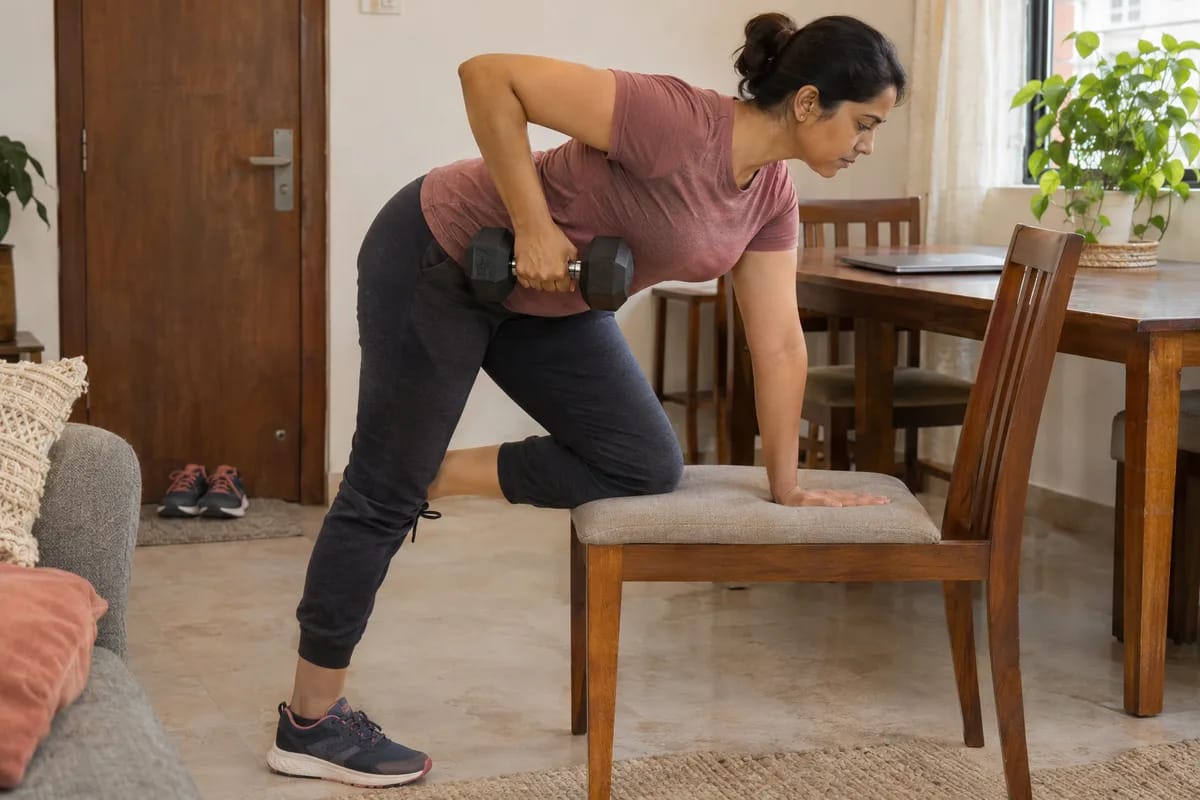
Rest days don't have to be spent on the sofa. A brisk walk, a bike ride or a swim fits on any of them.
Is once a week worth it?
As a plan, it's below the guideline, and one session can only hold so many hard sets. As a floor, it's very useful. A review of the smallest dose that keeps fitness found that strength and muscle size, at least in younger people, held for up to 32 weeks on one session a week and one set per exercise, as long as the weights stayed heavy. Older adults may need two sessions a week to keep their muscle size.7
So in a month that's eaten by work, a move or a new baby, one solid session a week keeps what you built until there's room again. How fast you lose strength when you stop lifting covers what happens if even that stops.
When to add a day, and when to drop one
Add a day when
- You've made nearly every session for about two months
- Your sessions keep running past the time you have
- You feel recovered well before the next session and want more
Hold or drop one when
- You miss one session most weeks
- Soreness, or a joint, is still complaining when the next session comes round
- You've been short on sleep for a while
- A new day would push out your walks, your sleep or something you enjoy
These are our coaching rules of thumb, not study findings. When you add a day, start it small, two or three exercises in about 30 minutes, and let it grow over a few weeks.
Where a coach changes the number
Everything above works on your own. The weak spots are the gap between the number you pick and the number that happens, and knowing whether your sets were really hard.
At Bespoke Fit every session is a live 1‑on‑1 video call with your own coach, in our app on iPhone, Android or a browser. You train at home, phone propped up where your coach can see you. A pair of dumbbells is plenty to start, or nothing at all: your coach writes the sessions around what you have.
- Booked days are hard to skip. Each session is a set time with a person waiting on the call, so skipping means telling someone. That's the appointment effect.
- Every set is seen. You don't have to judge mid-set whether you had two reps left or six. If your last set of goblet squats with a 20 lb (9 kg) dumbbell looks easy, your coach tells you to pick up the 25 lb (11 kg) one for the next. If your knees start caving in, they say so before the next rep.
- The price doesn't ration your days. One flat price covers unlimited sessions. Averaged over the year, $299 a month is about $35 a session at two a week, $23 at three and $17 at four. Here is how that compares with paying a trainer by the hour.
"I've always wanted to be consistent with training, but I'd get demotivated and just stop showing up. Knowing Tris is waiting for me at every session means I actually go. Zero planning on my end, he's got it all figured out. Simplest and best thing I've ever done for my health."
Henrik, 36, a Bespoke Fit member
Your coach has 12 members at most and is on every call, so after three months of twice a week they know whether you made them all, and the app shows whether your top lifts are still climbing. That's what a third day gets decided on. When a week goes sideways, you message them and move the session instead of losing it.
Sessions run 45 to 90 minutes at the same price, and most people settle at around an hour. You start with a call with a head coach, who matches you to your coach. It's 14 days free, then $299/mo, and the 14 days start at your first session, not at signup. Cancel anytime.
It isn't for everyone. If you already lift steadily on your own and like it, keep going. If $299 a month would strain your budget, the 2-day plan above and the 3-day full body workout cost nothing. And if you want someone in the room to spot you, or meal plans, we're not it: we coach on video and we don't do nutrition.
Common questions
Is 3 days a week enough to build muscle? Yes. Three days holds all the weekly sets most people need for muscle. If growth stalls, add a set or a second exercise to the sessions you have before you add a day.
Does yoga, gardening or a class count as a lifting day? It can. The CDC counts weights, resistance bands, body-weight moves like push-ups, digging in the garden and some yoga poses, as long as the work gets hard enough that another rep would be tough without help. That is close to the hard set described above. A gentle stretch class doesn't count. A class with weights where the last reps are hard does.
Sources
-
Grgic, J., Schoenfeld, B.J., Davies, T.B., Lazinica, B., Krieger, J.W. & Pedisic, Z., 2018. Effect of resistance training frequency on gains in muscular strength: a systematic review and meta-analysis. Sports Medicine. 22 studies, most in people new to lifting. Effect sizes of 0.74, 0.82, 0.93 and 1.08 for 1, 2, 3 and 4 or more sessions a week; no significant effect of frequency when volume was equated (p = 0.421). Significant in young adults (p = 0.024), not in middle-aged and older adults (p = 0.093); significant in women (p = 0.030), not men (p = 0.190). The authors write that these effects "seem to be primarily driven by training volume". ↩ ↩2
-
Centers for Disease Control and Prevention. Adult activity: an overview. Adults need 150 minutes a week of moderate-intensity activity such as brisk walking, and muscle-strengthening activity on 2 or more days a week that works all major muscle groups. ↩ ↩2
-
Schoenfeld, B.J., Grgic, J. & Krieger, J., 2019. How many times per week should a muscle be trained to maximize muscle hypertrophy? A systematic review and meta-analysis of studies examining the effects of resistance training frequency. Journal of Sports Sciences. 25 studies; frequency did not significantly or meaningfully affect muscle growth when volume was equated, and the authors suggest choosing a weekly frequency by personal preference. ↩
-
Currier, B.S., D'Souza, A.C., Fiatarone Singh, M.A., and colleagues, 2026 (Phillips, S.M., corresponding author). American College of Sports Medicine position stand. Resistance training prescription for muscle function, hypertrophy, and physical performance in healthy adults: an overview of reviews. Medicine and Science in Sports and Exercise. An overview of 137 systematic reviews; strength enhanced by 2 or more sessions a week, no difference in muscle growth between 1 and more than 5 days a week with total volume equated, growth enhanced by 10 or more sets per muscle a week. ↩ ↩2
-
Momma, H., Kawakami, R., Honda, T. & Sawada, S.S., 2022. Muscle-strengthening activities are associated with lower risk and mortality in major non-communicable diseases: a systematic review and meta-analysis of cohort studies. British Journal of Sports Medicine. 16 cohort studies, all using self-reported activity (13 by questionnaire, 3 by interview), with mostly very low certainty of evidence. Lowest all-cause mortality risk at about 40 minutes a week (17% lower). The curve was J-shaped: risk stayed below that of doing none up to about 140 minutes a week, and the authors say higher amounts may require caution. ↩
-
Centers for Disease Control and Prevention. What counts as physical activity for adults. Muscle-strengthening includes lifting weights, resistance bands, body-weight exercises like push-ups, digging in a garden and some yoga postures, done until it's hard to do another repetition without help; 8 to 12 repetitions make a set, and two or three sets bring more benefit. ↩
-
Spiering, B.A., Mujika, I., Sharp, M.A. & Foulis, S.A., 2021. Maintaining physical performance: the minimal dose of exercise needed to preserve endurance and strength over time. Journal of Strength and Conditioning Research. A narrative review; strength and muscle size (at least in younger people) kept for up to 32 weeks with 1 session a week and 1 set per exercise at a heavy load; older adults may need up to 2 sessions a week and 2 to 3 sets. ↩
More on