Gym anxiety: a five-visit plan to make the gym feel normal
Gym anxiety is common, and it's mostly fear of the unknown. A five-visit plan, the gym's unwritten rules with words to use, and when it's more than nerves.
In this article9
The short version
Gym anxiety is common, and it fades. It's mostly the unknown plus the feeling of being watched. Go five times with a small written plan, quiet hours first, and keep going.
If the gym feels like a room where everyone else got the instructions, you're far from alone. In a 2025 UK survey of people without a gym membership, a third said they'd expect to be judged if they joined.1
Most of what makes the gym scary is not knowing: where things are, how the machines work, what the rules are. Every visit answers some of that, so the feeling runs out. (Rather learn the moves before you go near a gym? Skip to that.)
What's actually worrying you?
| If you're thinking | Try this |
|---|---|
| "Everyone will look at my body" | Wear something you've already worn on a long walk, and pick a spot facing a wall or window, not the mirror. |
| "I don't know how anything works" | True for now, and true for everyone once. Ask at the front desk whether an intro session comes with your membership; some gyms include one. Learn four machines, not forty. |
| "The free weights corner" | It's the loudest, busiest part of the gym, with the most unwritten rules. Skip it for now. Visit 3 below covers it. |
| "Someone will want my machine" | Nobody owns a machine. Go at a quiet hour for the first visits, and borrow the two sentences in the rules table. |
| "The locker room" | You don't have to change or shower there. Arrive dressed, keep your bag by you if the gym allows it, and shower at home. |
| "I'll be the only one like me" | Ask whether the gym runs beginner or older-adult classes; the people at those are often the ones you hoped to see. On the tour, notice who's there at the hour you'd go. |
| "I don't feel safe" | That isn't nerves. In the same UK survey, 17% said the threat of sexual harassment or intimidation would make them feel unsafe in a gym.1 Choose a gym with staff on the floor and a posted conduct policy, use women-only areas or hours if offered, and report anyone who bothers you. That's the gym's job to fix, not yours. |
Five visits to a normal session
This is our coaching judgement, not a study protocol. Each visit has one job, and if one goes badly, you repeat it instead of moving on. At two visits a week you're through it in under three weeks.
Before visit 1
Take the tour
Call or drop by and ask two things: when is it quietest, and can someone show you around. Not a member yet? Take the tour before you sign anything, and ask about a day pass. Find the locker room, the water, the bikes, the row of weight machines and the cleaning spray. The night before, pack water, a towel, headphones and this page saved on your phone.
Visit 1
In, one thing, out
At a quiet hour: 10 minutes on a bike, then one machine from the session below for 2 sets of 10, light. Then go home. About 20 minutes, and the only goal is a visit that went fine.
Visit 2
The four machines
Still at a quiet hour, the whole session below. It takes about 35 to 40 minutes.
Visit 3
One dumbbell
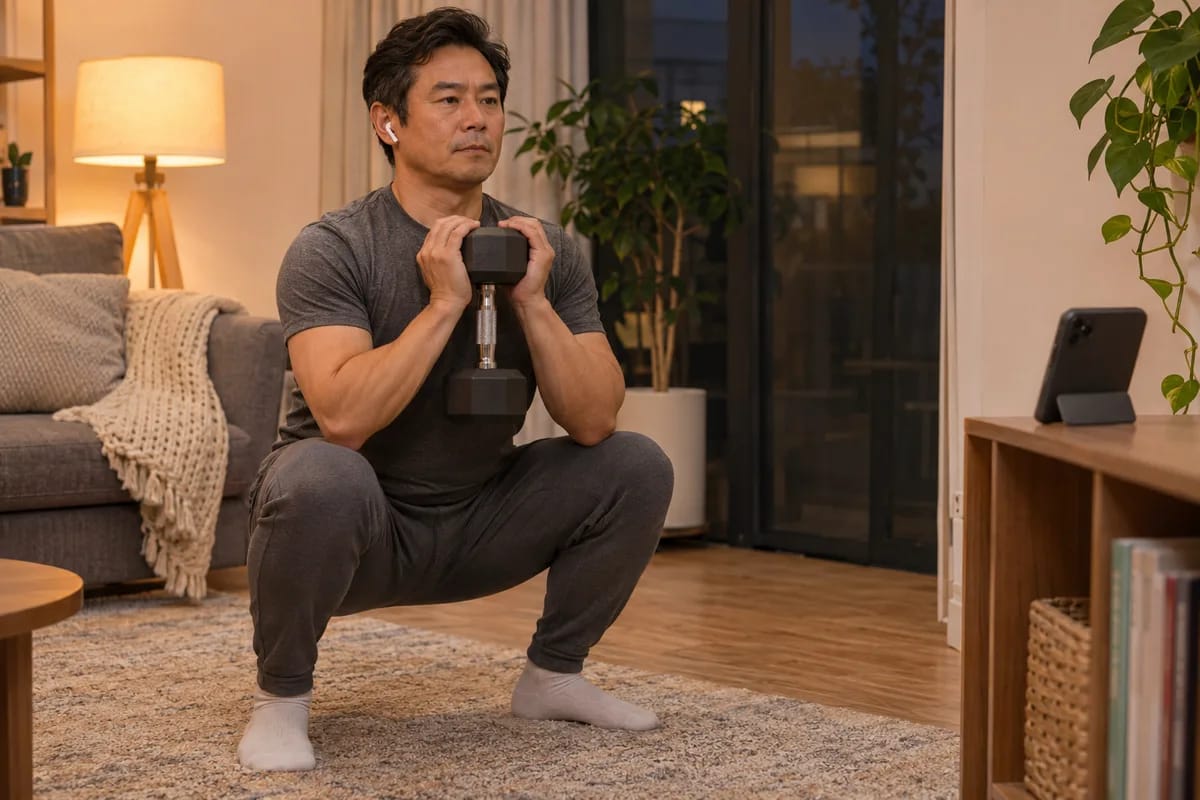
The same session, plus a goblet squat: hold one dumbbell upright against your chest and squat. Do it on a mat or in a quiet corner, and put the dumbbell back on the rack after. Start with no weight; when that's easy, 8 to 12 lb (4 to 5 kg) is a common first dumbbell.
Visit 4
A busier hour
The same session at a time with more people. If a machine is taken, do the next one first.
Visit 5
An ordinary session
The same session at whatever time suits your life, after work or on a Saturday morning. Success is that it felt like a workout, not an event.
Your first session, written down
Four machines that cover your legs, back, chest, shoulders and arms. They're guided, so the machine holds the path and there's nothing to drop, and they're often in the same part of the gym, so you don't have to cross the whole floor.
| Order | Move | Sets × reps | Setting it up |
|---|---|---|---|
| 1 | Bike or treadmill | 5 to 8 minutes | Easy enough to chat |
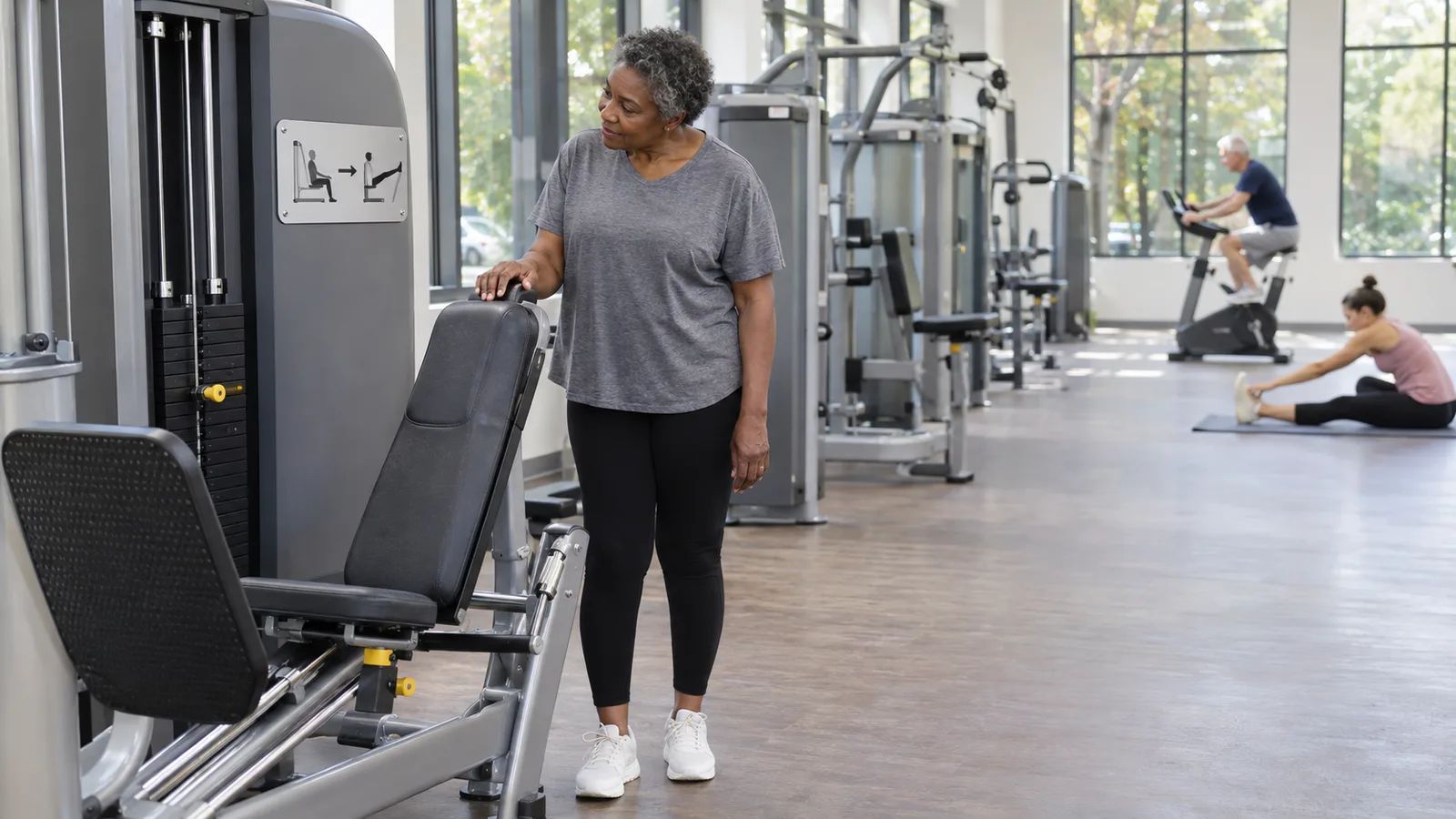
| 2 | Leg press | 3 × 10 | Feet hip-width in the middle of the plate. Lower until your knees are bent to about a right angle, back flat on the pad |
| 3 | Chest press | 3 × 10 | Seat height so the handles line up with the middle of your chest |
| 4 | Seated row | 3 × 10 | Chest against the pad if there is one; otherwise sit tall. Pull the handles toward your lower ribs |
| 5 | Lat pulldown | 3 × 10 | Thigh pad snug, pull the bar to the top of your chest |
How heavy: a weight where the last two or three reps of each set feel hard but still look like the first. Rest a minute or two between sets. On a weight stack, start with the pin near the top, where the plates are lightest. If the leg press takes plates instead of a pin, start with the empty sled; it already weighs something. Note each machine's seat setting and pin number on your phone, so the next visit starts with no fiddling.
For starting weights move by move, see how much weight to start lifting with. Once the five visits are done, a beginner workout plan for your first four weeks takes it from there, and if you're starting later in life, starting to lift at 50 was written for you.
The unwritten rules, and what to say
Etiquette worries people who already go, too. In a survey of men who use gyms, a third rated someone hovering for their equipment as anxiety-provoking, and a quarter said the same about a trainer correcting their form.2 Most of it fits in one table.
| Situation | What to do | What to say |
|---|---|---|
| Someone's on the machine you want | Ask how long they'll be, or do the next machine first | "Are you nearly done with this one?" |
| They've got a while to go | Ask to "work in": you take turns, each resetting the weight | "Mind if I work in?" |
| Someone hovers while you rest | You're allowed to finish. Resting is part of the set | "Two more sets, about four minutes." |
| You can't work out a machine | Look for the drawing on the frame (many machines have one), or ask staff | "Could you show me how to set this up?" |
| Advice you didn't ask for | Thank them. You don't have to take it | "Thanks, I'll keep that in mind." |
The rest needs no words. Wipe the seat and handles when you're done (spray and paper towels are usually nearby), put dumbbells and plates back, take the plates off a leg press, and keep other people out of any video you film. And headphones in is the gym's universal "not chatting right now" sign, which works for you too.
If it spikes mid-visit
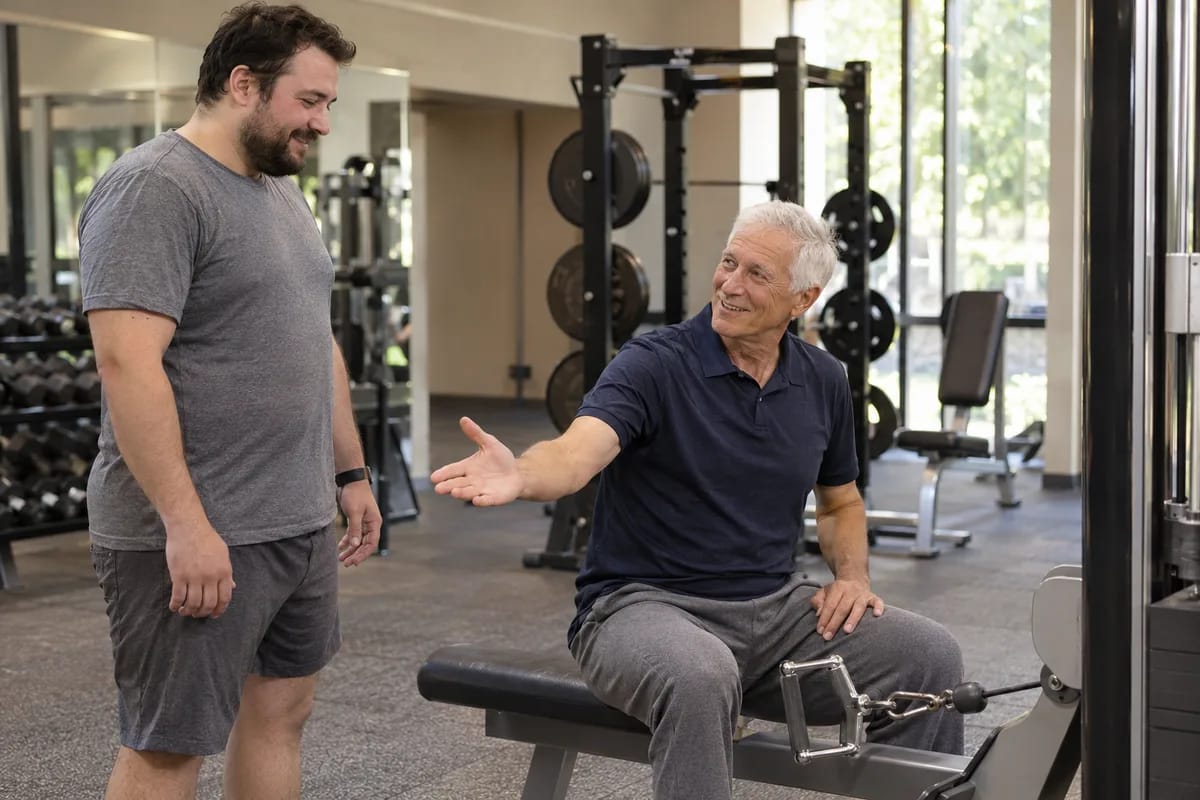
You're standing by the leg press, heart going, sure everyone is looking. Telling yourself they aren't rarely helps in the moment. This does:
- Step away somewhere ordinary. The water fountain, the restroom, the locker room. Nobody looks twice at someone getting a drink.
- Breathe slowly for a minute: in for a count of 4, out for a count of 6.
- Then pick one: a machine you already know, for one easy set, or the door. Either counts as the visit. Go back within a few days and repeat that step, so a bad moment isn't your last memory of the place.
Why it gets easier each time
Nerves about a place tend to ease if you stay in it, and each visit that goes fine makes the next one a little more comfortable.3 Therapists use the same idea on purpose. It's called exposure, and it's part of cognitive behavioral therapy (CBT), the best-studied talk therapy for social anxiety.4
An illustration, not measured data
Skipping works the other way. Turning around in the parking lot feels great for an hour, but avoiding what you fear can make the fear worse over time,3 so the next attempt starts higher, not lower. Going only at quiet hours does the same thing slowly: if you only ever go at 6 am, the 6 pm gym stays scary. That's why visit 4 adds people.
The room is also watching less than it feels. In a well-known experiment, students sent into a room in an embarrassing T-shirt overestimated how many people would remember it.5 Everyone at the gym is the main character of their own workout, and you're an extra.
When it's more than gym nerves
Gym nerves shrink with visits. If the fear feels out of your control, also shows up in shops, meetings or parties, has lasted six months or more, or comes with blushing, sweating, trembling or a fast heartbeat, talk to your doctor or a therapist. That can be social anxiety, which is common and treatable, and CBT is the best-established therapy for it.4
Or learn the moves first, at home
For a lot of people the hard part isn't the lifting. It's learning to lift in public, hunting for the seat lever with strangers nearby. You can split those two jobs: learn the moves somewhere private, then decide about the room.
If the room is your only problem, the five visits cost nothing extra, so try them first. A coach is the shorter road if you've tried before and turned back in the parking lot, if you'd rather nobody watched you learn, or if you want more than four machines and don't trust a drawing on a frame to teach you a squat.
Bespoke Fit is built for that split. Every session is a live 1‑on‑1 video call with your own coach, in our app on iPhone, Android or a browser. You train at home in whatever you've got on, and your coach watches through your camera.
If "watches" just made your stomach drop, that's fair. One person isn't a room of strangers, though. It's the same coach every session, picked for you by a head coach on a 30-minute call, and they're watching your knees and hips, not your body. The camera feels oddest the first time (more on that).
- Nothing to figure out on the spot. It's the written plan this page told you to bring, except a person writes it: your coach puts each workout on your training calendar, and you log it set by set.
- Corrections with no audience. Your coach says "sit back, weight in your heels" while you're still in the rep, and nobody from the gym is there to see it. That's how you learn the squat, the hip hinge, a push and a pull.
- A set time with your coach. Your coach books each session with you, and it lands in your calendar with reminders. Skipping means telling someone, which is why the sessions get done.
- A coach who knows you. Each coach has 12 members at most, and we hold to that when we assign coaches.
"From day one, Coach Angela believed in me even when I didn't always believe in myself. She celebrates every small win and pushes me to become stronger every session. I've grown not only in strength but also in confidence."
April, a member who trains with Angela
Then it's your call: keep training at home, which is real training and not the consolation prize, or walk into a gym later already knowing how a squat should feel. Not sure what you'd need at home? The FAQ covers equipment.
It's 14 days free, then $299 a month, cancel anytime, and the 14 days start at your first session. Sessions run 45 to 90 minutes, and most people settle at around an hour. The price covers as many as you want, so at an hour a session, twice a week works out at about $35 a coached hour and three times at about $23. Set that against what a personal trainer costs by the hour.
We're not the right fit if you want a gym floor or someone in the room to spot a heavy barbell, because we're not in person. And if $299 a month would be a stretch, or you want meal plans (we don't do nutrition coaching), personal training for people who hate gyms compares cheaper ways to get help at home.
Common questions
How long does gym anxiety last?
No study times it, and it varies. Each visit that goes fine takes a little off the next one, which is why the plan here runs over two to three weeks. If the dread hasn't eased after a month or so of regular visits, or it's growing, read the section on when it's more than gym nerves.
What is gymtimidation?
Another name for gym anxiety: feeling nervous or intimidated about going to a gym, or about working out in front of the people there. The word itself is a trademark of the gym chain Planet Fitness.
Should I bring a friend?
If a friend gets you through the door, bring one, especially one who already knows the machines. Just do at least one of the five visits on your own, so the gym doesn't end up feeling safe only when they're with you.
Sources
-
Quinn, 2026. Understanding social gym intimidation and anxiety using the power-threat-meaning framework. Frontiers in Sports and Active Living. A framework paper with no new data. The survey figures (47% uncomfortable at the thought of joining a gym, 32% expecting to be negatively judged, 17% feeling unsafe because of the threat of sexual harassment or intimidation) come from ukactive's 2025 survey of non-gym members representative of the UK population, as reported in this paper. We couldn't find a US survey that asked the same questions. The paper also notes the gymtimidation trademark and reviews who reports gym anxiety. ↩ ↩2
-
Cyr, Munroe-Chandler and Gammage, 2019. Might plight: the social anxiety felt by men in the weightlifting environment. ACSM's Health and Fitness Journal (doi). A sample of male gym users. Figures as reported in Quinn, 2026 (above): 33% rated someone hovering to use their equipment as anxiety-provoking, 24% their form being corrected by a trainer. ↩
-
Cleveland Clinic, 2023. Exposure therapy. Medically reviewed patient guide: you stay with a feared situation "until your anxiety gradually goes away", repeated over several sessions, and avoidance "can help manage panic in the short term" but "over time, it can make our fears worse." ↩ ↩2
-
National Institute of Mental Health, 2025. Social anxiety disorder: What you need to know. Covers symptoms, the six-month duration, and CBT (including exposure therapy) as the well-studied "gold standard" psychotherapy. ↩ ↩2
-
Gilovich, Medvec and Savitsky, 2000. The spotlight effect in social judgment. Journal of Personality and Social Psychology. People overestimate how much others notice how they look and what they do. ↩