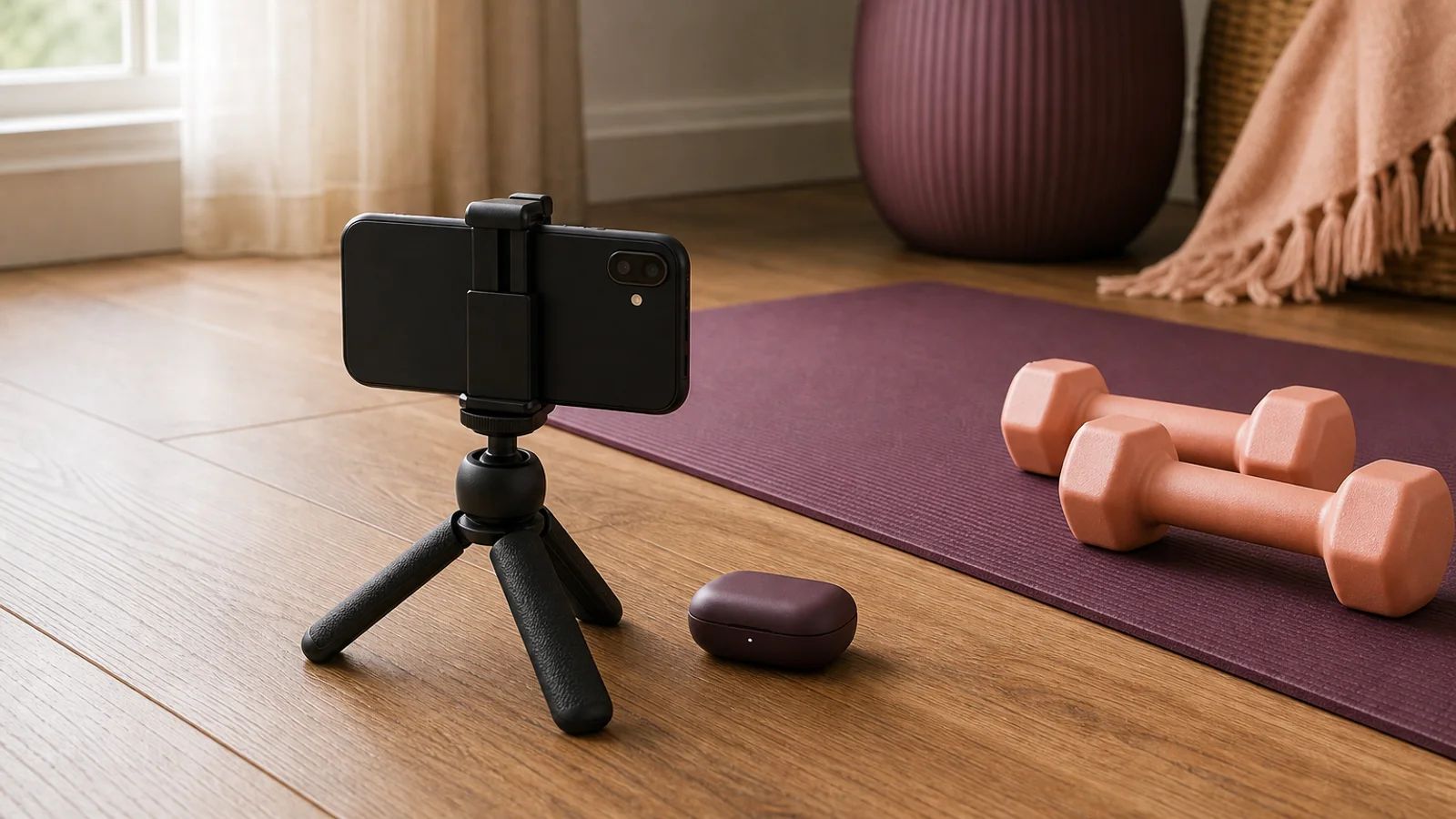
Online personal training for people who hate gyms
Half of Americans say gyms intimidate them. Here's the research on training from home, what dumbbells can and can't do, and when you'd still need a gym.
Updated

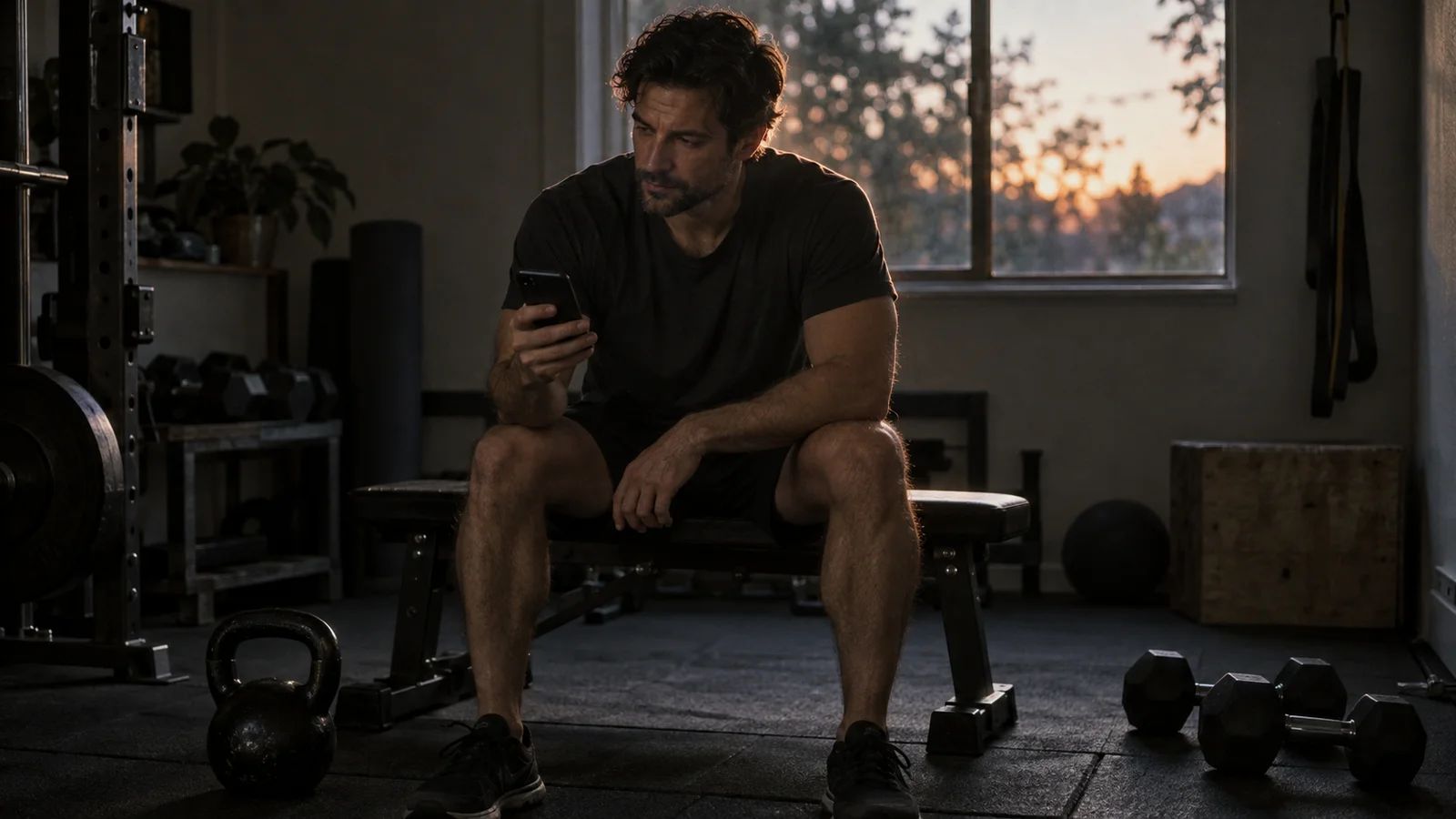
Ask people why they stopped going to the gym and you rarely hear that the squats were too hard. You hear about the drive. The wait for a rack. The mirrors. The feeling of being watched while you learn something new in public. The industry mostly treats that as a mindset problem to push through.
You don't have to push through it. Your muscles can't see the room. They respond to tension and to effort, and you can produce both in a living room with a pair of dumbbells. What you give up by staying home is narrow and specific, and it's worth knowing before you spend a dollar on equipment.
Gym dread is a majority position
Half of the 2,000 Americans in one 2019 poll said the thought of working out in a gym intimidated them, and 32% dreaded exercising near someone in great shape.1 A protein brand paid for that poll, so hold the exact percentage loosely.
It doesn't stand alone, though. In 2025 the UK fitness industry's own trade body asked non-members what stopped them: 47% said they'd feel uncomfortable joining a gym, and 32% expected to be judged if they did. Those numbers reach us through a 2026 research review, and that's the industry counting its own lost customers.2
That review also pushed back on the idea that gym anxiety is a personal defect. It reads more like a reasonable response to a real place: equipment nobody taught you to use, rules nobody wrote down, and a roomful of people who already look like they belong. If you had one bad early experience, or crowds and noise wear you out, you're not making it up.
So if the weight room makes your skin crawl, you're in the mainstream. Roughly one in two people feels some version of the same thing.
Why light weights still build muscle
Muscle doesn't read the number printed on the dumbbell. It responds to tension and to how close a set gets to failure. Recruit the fibers, work them near their limit, recover, do a little more next time. Load is only one way of making that happen.
A 2017 meta-analysis of 21 studies in the Journal of Strength and Conditioning Research found light loads grew about as much muscle as heavy ones when sets were taken close to failure.3 Heavy loads won at exactly one thing: a one-rep max, which is partly the skill of expressing force rather than proof of more muscle. Across eight trials, even elastic bands held up against machines and free weights for building strength.4
There's a catch in that word "close." Light weights only work when the set gets genuinely hard, so the last set of each exercise should land within 2 or 3 reps of failure. Stopping at comfortable is where home training quietly stops working.
Progressive overload just pulls different levers here. When 20-pound goblet squats stop being hard, add reps. Then slow the lowering to three seconds. Then pause at the bottom, cut the rest short, or do the whole thing on one leg. Then add weight and start the cycle again. Adjustable dumbbells plus that list covers years for most people.
What do you have to buy?
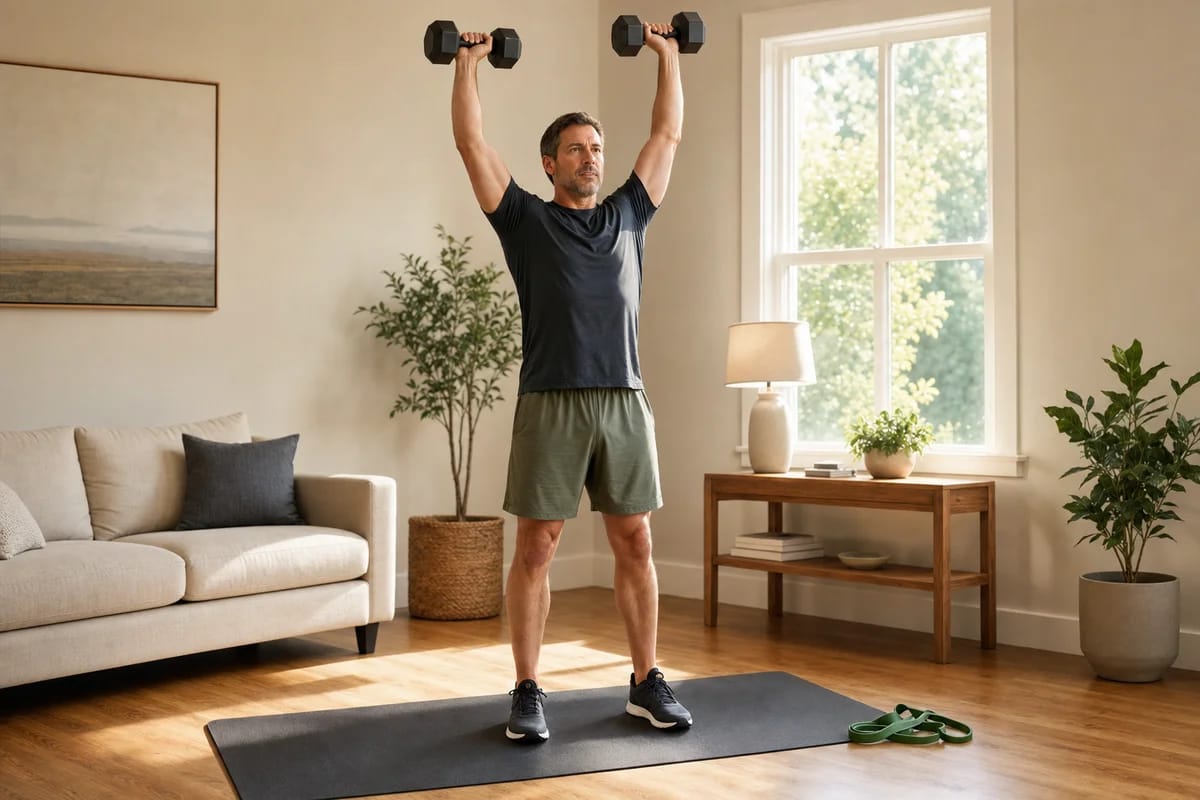
Nothing, for the first 2 to 4 weeks. Squats, push-up progressions, hip hinges, split squats, planks. That's a real month of training. Then bodyweight squats pass 20 easy reps, progress slows, and every set starts to drag.
Adjustable dumbbells and one heavy resistance band is where most people should land, and it's where we'd point you first. Every pattern that matters becomes loadable: squats, Romanian deadlifts, presses, rows, carries, lunges. The pair usually costs less than a few months of a mid-range gym membership.
A bench and a doorway pull-up bar are nice rather than necessary. A sturdy step or the arm of a sofa stands in for a bench more often than you'd think.
Nothing on that list is a barbell, a rack, or a cable stack. Which raises the fair question of what you're missing.
What you give up by staying home
Three things, and they're real.
Heavy barbell work is the first. Dumbbells top out, usually somewhere between 50 and 90 pounds a hand. Once your squat or deadlift outgrows what you can hold, you're in barbell-and-plates territory. A powerlifting meet, a double-bodyweight deadlift, or strongman work means a gym eventually.
Machines are the second. A fixed path makes it easy to isolate a muscle and push a set to failure safely, which matters for advanced physique work and for some rehab. Free weights and bands cover most of that, with more skill asked of you.
Spotters are the third. Nobody should test a true one-rep max alone in a living room. Home programming works around that by living in rep ranges where a missed rep is a non-event.
Whether any of it matters depends on what you're training for. If you're after health, energy, body composition, and still being strong at 70, the ceiling is beside the point, because the useful dose sits nowhere near it. Pooling 16 cohort studies, researchers found 30 to 60 minutes of strength work a week was associated with a 10-17% lower risk of dying from any cause, along with lower rates of heart disease, diabetes, and several cancers.5 The curve is J-shaped, not a plateau: risk reduction peaks in that 30-to-60-minute window, and pushing well past it stops adding the same benefit. That dose asks for effort and consistency, not a leg press.
Where home training goes wrong
Take away the intimidation and a gym was still doing two useful jobs. It gave you a container: a place, a time, and a plan. And it put you among people who noticed whether you turned up.
That second job is where home training breaks, and it's almost never injury. It's drift. You skip Tuesday, the mat stays rolled up in the corner, and three weeks pass before anyone, you included, says out loud that training has stopped.
The adherence research is kinder than you'd guess. In a Cochrane review, older adults stuck with home-based programs better than center-based ones, 68% versus 36% at two years in one trial.6 Home wins on friction. What it's short of is a witness.
That's the gap live coaching fills. A booked 7:15 with a coach who's expecting you rebuilds the structure without the audience, and a coach watching your reps rebuilds the noticing; the supervision research sits in our piece on whether online personal training works for beginners. The only person watching is one whose whole job is being on your side. If the camera is the part that bothers you, we wrote about that too: is it awkward to work out on camera.
Coach or training partner, the fix is the same shape. The session goes in a calendar and somebody else knows it's there. The workout that dies at home is the one nobody booked.
When a gym is still the right answer
Competitive powerlifting or weightlifting, because meets happen on barbells. Heavy barbell strength as the goal itself, once dumbbells run out. Advanced bodybuilding, where machine variety earns its keep.
And one case worth naming, because it happens: people who start at home sometimes find, six months in, that gyms have stopped being frightening. Most gym anxiety is really not knowing what to do. Once you know, the building becomes a choice instead of a gauntlet, and a coach who programs around whatever you own moves with you either way.
Where this evidence gets thin
The gymtimidation numbers come from a sponsored online poll and an industry survey, not probability samples. They show that gym dread is common; they don't pin down how common. The load research mostly ran 6 to 12 weeks in young adults with sets taken to failure, and getting genuinely near failure is harder on your own than it sounds. The mortality figures are observational, so they show association, not proof. And the adherence trials followed older adults doing mostly moderate activity, not strength programs.
Common questions
Can I build real muscle with just dumbbells and bodyweight? Yes. Growth comes from taking sets close to failure, not from heavy loads, and adjustable dumbbells give you years of progression through added reps, slower tempo, pauses, and single-leg work. The ceiling only matters if you're chasing maximal barbell numbers.
Do I need a personal trainer if I don't go to a gym? Not strictly. What you need is what the gym used to supply: a plan that progresses, and someone who notices whether you're doing it. A coach is the shortest route to both. A good free program plus a training partner who reliably turns up is a legitimate substitute.
Is working out at home as effective as the gym for losing weight? Weight loss is mostly a diet job. Exercise's role is protecting muscle while the fat comes off, and that works anywhere you can train hard. The best venue is the one you'll actually show up to.
The room was the optional part
The building was one way to deliver structure and attention, and it's a delivery method roughly half the population finds hostile. The training itself never needed it.
Bespoke Fit is built for this reader. Unlimited live 1-on-1 video sessions with a real coach who programs for whatever you own, every session a booked appointment with someone expecting you, nobody watching but that one person. It's $49 your first month, then $299 a month as a founding member, locked for life, 25 spots, with a 30-day money-back guarantee, no questions asked. Our FAQ covers the practical questions, camera setup included.
One question sorts out whether you'd get your money's worth: when a week goes sideways and you skip Tuesday, does anything happen? Plenty of people can answer that themselves with a free program, a pair of dumbbells, and a calendar slot they defend. If nothing happens when you skip, that's the part you'd be paying for. Either way, you never have to walk into that building again.
Sources
-
OnePoll, commissioned by Isopure, 2019. Half of Americans battle 'gymtimidation,' afraid of working out in front of others. StudyFinds. ↩
-
Quinn, 2026. Understanding social gym intimidation and anxiety using the power-threat-meaning framework. Frontiers in Sports and Active Living. ↩
-
Schoenfeld and colleagues, 2017. Strength and Hypertrophy Adaptations Between Low- vs. High-Load Resistance Training: A Systematic Review and Meta-analysis. Journal of Strength and Conditioning Research. ↩
-
Lopes and colleagues, 2019. Effects of training with elastic resistance versus conventional resistance on muscular strength: A systematic review and meta-analysis. SAGE Open Medicine. ↩
-
Momma and colleagues, 2022. Muscle-strengthening activities are associated with lower risk and mortality in major non-communicable diseases: a systematic review and meta-analysis of cohort studies. British Journal of Sports Medicine. ↩
-
Ashworth and colleagues, 2005. Home versus center based physical activity programs in older adults. Cochrane Database of Systematic Reviews. ↩
More on