Weighted vest for walking: how heavy and how to start
How heavy a weighted vest to get for walking, in pounds for your body weight, how long to wear it, a six-week start, and what it really does for bone.
In this article7
The short answer
Start at 5% of your body weight, or about 8% if you already walk briskly most days: 6 to 16 lb (3 to 7 kg) for most adults. Wear it 15 to 20 minutes, two or three times a week. Add time before weight.
Maybe the vest is still in your cart. Maybe it arrived yesterday and is sitting on a chair in the hallway, looking heavier than it did online. Either way, it's a reasonable buy. It makes an ordinary walk a little more work, and for some people it's the nudge out the door.
The easy mistake is going too heavy and too long on day one. So here's your number first, then the vest that fits it, then a first six weeks you can follow.
How heavy your vest should be
Find your weight and read across. Use the first column if you're new to exercise or to carrying weight. Already walk briskly most days? You can start in the middle column. The plan below takes you from the first column to the second in about two to three months, and the last column is room to grow if you want it. You don't have to.
| Your weight | Start: 5% | Next step: about 8% | Later, if you want: 10 to 15% |
|---|---|---|---|
| 120 lb (54 kg) | 6 lb (3 kg) | 10 lb (4.5 kg) | 12 to 18 lb (5 to 8 kg) |
| 140 lb (64 kg) | 7 lb (3 kg) | 11 lb (5 kg) | 14 to 21 lb (6 to 10 kg) |
| 160 lb (73 kg) | 8 lb (4 kg) | 13 lb (6 kg) | 16 to 24 lb (7 to 11 kg) |
| 180 lb (82 kg) | 9 lb (4 kg) | 14 lb (6 kg) | 18 to 27 lb (8 to 12 kg) |
| 200 lb (91 kg) | 10 lb (4.5 kg) | 16 lb (7 kg) | 20 to 30 lb (9 to 14 kg) |
| 220 lb (100 kg) | 11 lb (5 kg) | 18 lb (8 kg) | 22 to 30 lb (10 to 14 kg) |
| 250 lb (113 kg) | 13 lb (6 kg) | 20 lb (9 kg) | 25 to 30 lb (11 to 14 kg) |
The percentages are our arithmetic, rounded to the nearest pound. They match the practical guides: start around 5%, build toward 10 to 15%.1
If you weigh 220 lb (100 kg) or more, the last column stops at 30 lb (14 kg) on purpose. Every step already moves a lot of you, so a heavier vest adds strain faster than it adds benefit. That's our rule of thumb. Past that point, add time instead.
Is an 11 lb (5 kg) vest enough? For most people, yes. Eleven pounds is between 5 and 10% of your body weight if you weigh anywhere from 110 to 220 lb. That's a full starting range and then some.
Fixed or adjustable: let your number decide
There are three kinds of vest. Fixed vests have the weight sewn in. Pocket vests take small weights you add or remove. Plate vests hold a flat plate front and back, and the plates are often sold separately.2
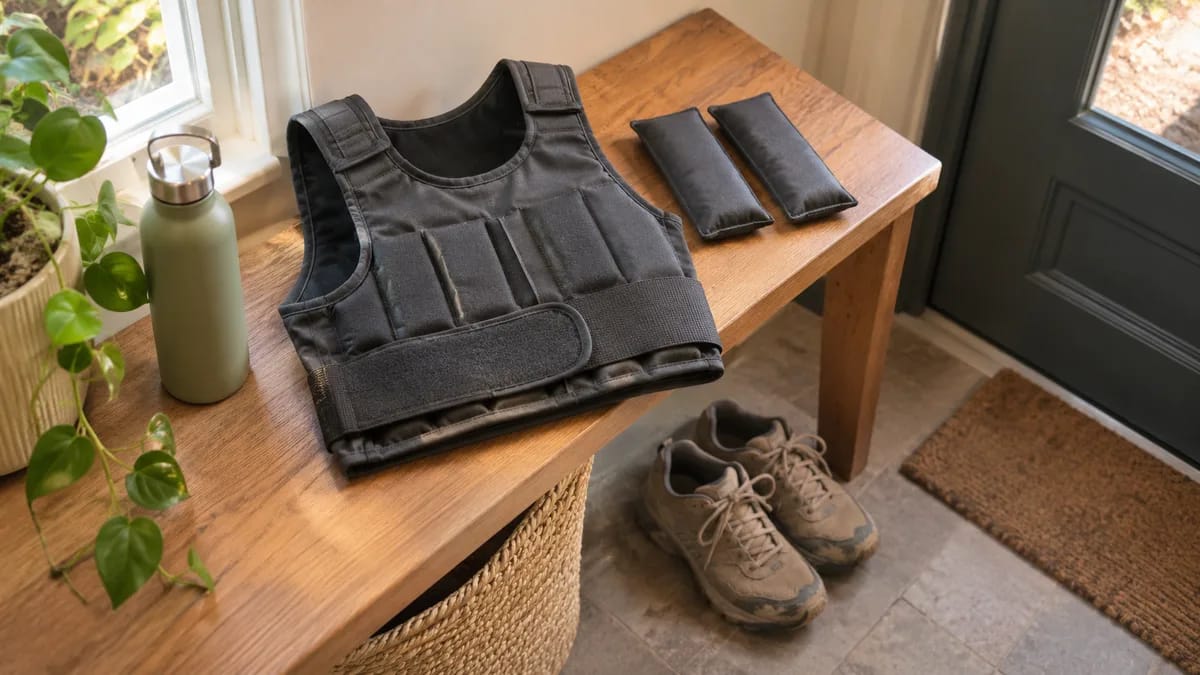
Look at your middle column.
- If your middle column is 10 to 12 lb (about 5 kg) and you're happy to stay there, a fixed vest at that weight is simple and cheap. It may be all you ever need. Since it's above your 5% figure, start it with less time in the vest (weeks 1 and 2 below say how).
- If it's higher, you plan to keep building, or someone else in the house will share it, buy adjustable. A pocket vest lets you go up in small steps, which is exactly what the six weeks below ask for. A fixed vest locks you at one weight and usually can't be tightened much.2
- Plate vests can be the least comfortable: rigid plates don't bend with your body the way flexible weights do, and the plates usually cost extra.2
What they cost: when OutdoorGearLab tested 15 vests, the two cheapest were fixed sand vests listed at $35 and $50, and the adjustable pocket vests ran from $60 to $270, more for heavier versions.2 Those were list prices in December 2025, so check today's.
Then there's fit, which matters more than the label. Testers at OutdoorGearLab found some vests bounce more as the weight goes up,2 so do your own test.
When the vest arrives
- Put it on over the top you'll walk in and tighten every strap until it's snug
- Walk up and down the stairs swinging your arms and turning your head; nothing should bounce, rub under the arms or press on your neck
- Check the weight sits high on your chest and upper back, not around your belly
- If you have a bust, check the front lies flat without pressing; vests that carry the weight at the sides and back are worth a look if it doesn't
- If you have a short torso, lift each knee high; the bottom edge shouldn't dig into your hips
- Keep the box until you've done one real 15-minute walk in it

Your first six weeks
Your shoulders, back and feet need a few weeks to get used to carrying something, so keep the vest light and the walks short.
Weeks 1 and 2
Your starting vest, 15 to 20 minutes, flat ground
Wear your starting weight (or your middle column, if you started there) for the first 15 to 20 minutes of a walk you already know. Already own a vest heavier than that? Wear it for 10 minutes instead and add 5 minutes a week. Plan a loop that passes your front door, so you can drop the vest and keep walking without it. Two or three vest walks a week, with ordinary walks on the other days.
Weeks 3 and 4
Same vest, a bit longer
Add 5 to 10 minutes. If the next morning your neck, shoulders and back feel the same as after a normal walk, you're on track.
Weeks 5 and 6
The first step up in weight
If the whole walk felt easy, add 2 to 3 lb (about 1 kg) and keep the time the same that week. Repeat every week or two until you reach your middle column. With a fixed vest, skip this and add time instead.
After that
Longer, then a hill
Build toward 30 to 45 minutes, then add a gentle hill. Go heavier only if the walk has stopped feeling like work, and no further than your last column.
A good walk feels brisk: you can still talk in full sentences, a little out of breath. If you can't, slow down or take some weight out.
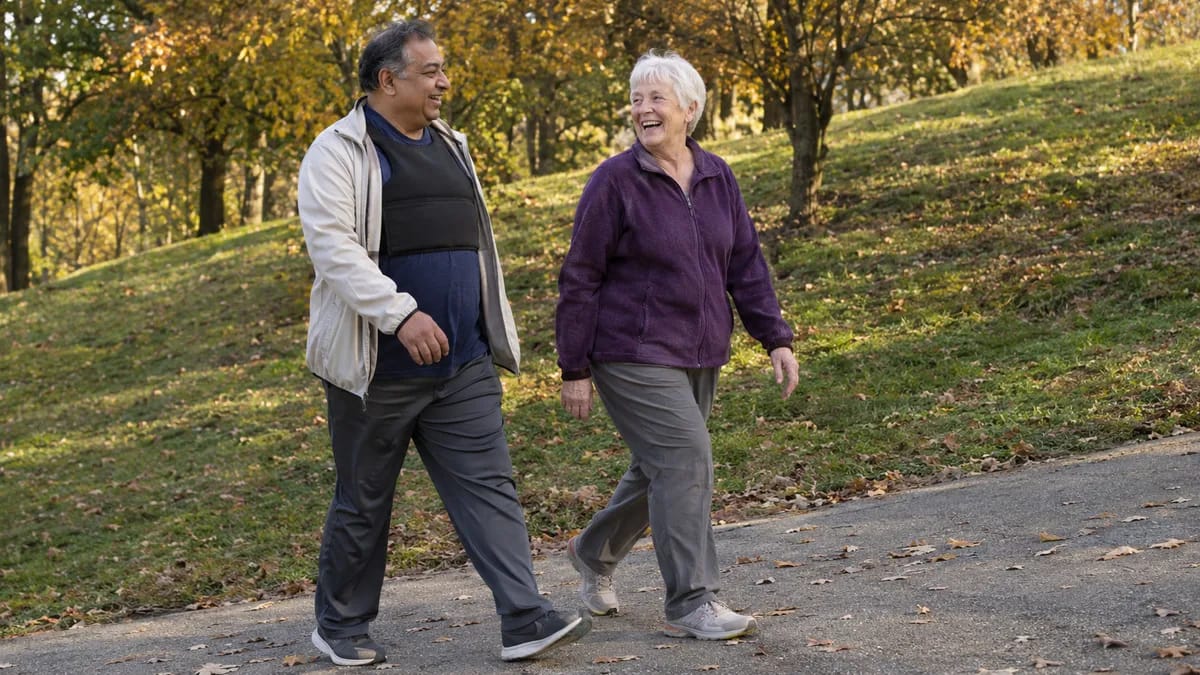
How to walk in it
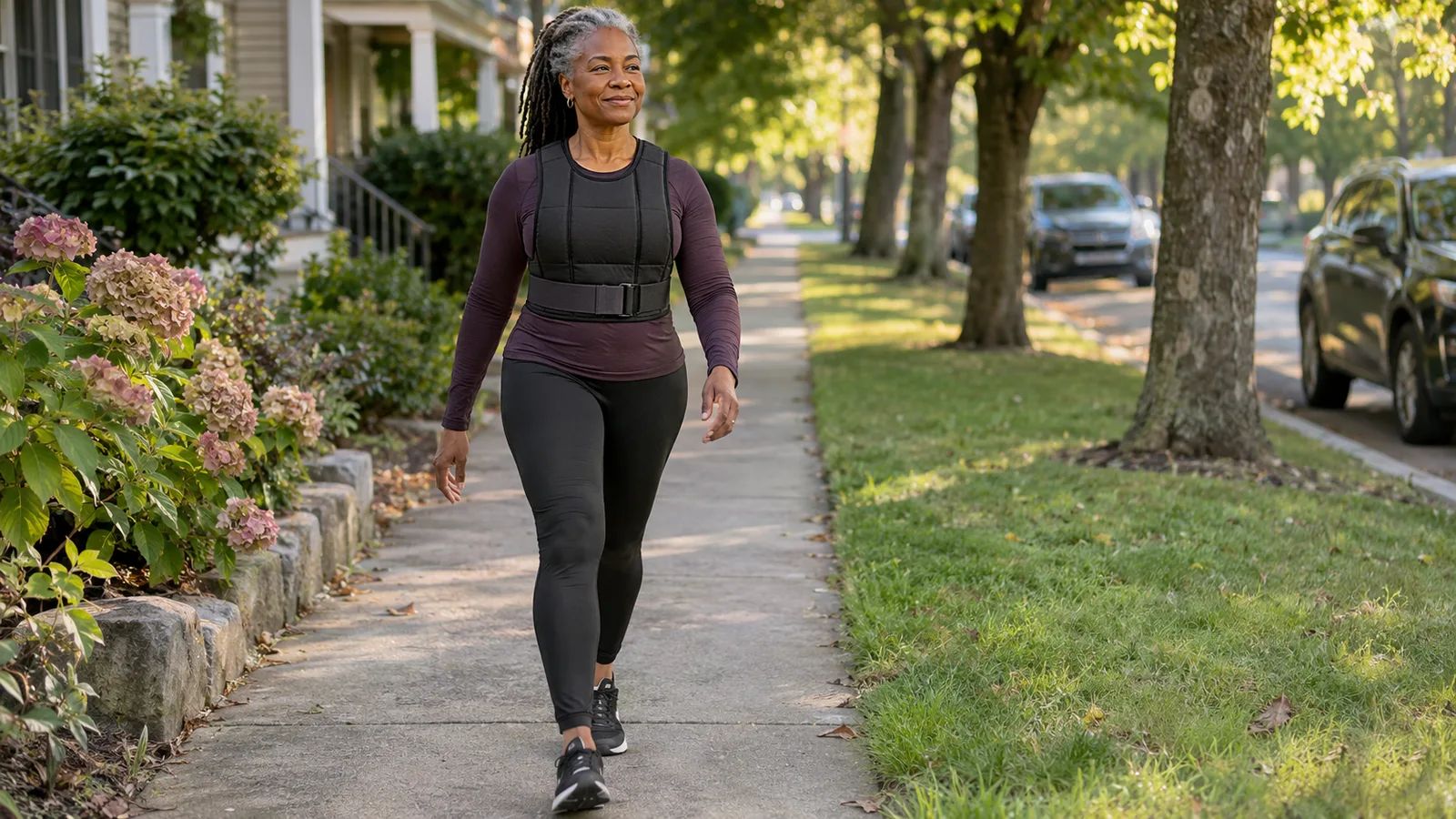
Your stride shouldn't change much.3 What to watch is posture: the weight on your chest can tempt you to tip forward to balance it.
Do this
- Stand tall, ribs over hips, chin level
- Let your arms swing the way they normally do
- Take shorter, slower steps going downhill
Skip this
- Folding forward from the hips to balance the front
- Hand or ankle weights on top of the vest
- Running in it before walking feels easy
- Lots of bending, twisting or racket sports with it on
Hand weights strain your wrists, elbows and shoulders, and ankle weights change your gait.1 In racket sports, as one trainer puts it, "you turn and torque too often".4
Two signals mean stop for the day. If your arms or hands tingle or go numb, loosen the vest or take some weight out. If a pain in one spot lingers into the next day or keeps getting worse, rest it.
Check with your doctor or a physical therapist before you start if you have back, neck, shoulder or knee pain now, osteoporosis (especially if you've had a spine fracture), a heart condition or a medicine that changes your heart rate, trouble with balance, or you're pregnant.
What a vest does, and what it doesn't
It makes the same walk harder, mostly uphill. In a lab test, 14 and 20 lb (6 and 9 kg) vests made a steep 10% slope harder work, but not flat ground or a 5% slope.3 On a level sidewalk you'll feel it in your shoulders more than your lungs. For cardio, hills do more than pounds; on a treadmill, our incline walking guide has settings to start with.
The extra calories are small. A 30-minute walk at 3 mph (about 5 km/h) burns about 120 to 168 calories, and a vest might add 15 to 22.1 That's less than a teaspoon of peanut butter, and ten more minutes of walking adds more. Even a heavy vest, 15% of your body weight, adds only about 12% by the figures Texas A&M cites,1 so be wary of far bigger numbers.
It doesn't make you fitter than the same walk at the same effort. When women walked at the same heart rate for 12 weeks, the group in vests got no fitter or stronger than the group without.5 The effort did the work; the vest is one handy way to get it.
It hasn't been shown to build bone on its own. The largest trial we found followed older adults through a year-long diet, which costs some bone. Those who wore a vest about seven hours a day lost as much hip bone as those who only dieted, and supervised lifting didn't stop the loss either.6 In the vest studies that did help bone, people jumped, climbed stairs or did leg strength work in the vest, not only walked.7
None of that makes the vest a waste of money. If it turns a stroll into a walk that leaves you a little winded, or makes you want to go out at all, it's doing its job. And if you'd rather carry the weight in a backpack, our rucking guide covers load and pace.
If bones or strength are why you bought it
Keep the vest walks, and add lifting that gets properly heavy for you, plus some impact work such as small jumps and landings (with your doctor's OK first if you have osteoporosis). The clearest evidence is the LIFTMOR trial: women past menopause with low bone mass did exactly that twice a week for eight months, with a trainer at every session. Their spine bone density rose 2.9% while a gentle home group's fell 1.2%.8 Our explainer on how lifting builds bone walks through why.
Lifting is the half that's harder to start on your own: which exercises, how heavy, whether the form is right. Our guide for women over 50 shows what "heavy enough" means in practice. If you'd like someone to teach it to you, a Bespoke Fit coach trains you at home over live 1‑on‑1 video, watching every rep and fixing your form mid-set. You can train as often as you like for one flat price, and your coach books each session with you: 14 days free, then $299/mo.
Common questions
Is a 20-minute walk with a weighted vest good?
Yes, as a start it's about right. Twenty minutes is the end of week two in the plan above. Most of the good comes from the walk itself, so if 20 minutes in the vest is too much, walk the rest without it.
How long should I wear a weighted vest each day?
For walking, the time in the plan: 15 to 20 minutes at first, building toward 30 to 45. You don't need to wear it for hours. In the dieting trial above, people wore one about seven hours a day and it didn't protect their hip bone.
Can you run in a weighted vest?
You can, but it's not the place to start. Running lands much harder than walking, and Texas A&M's extension service advises against vests for long runs. If you want to try, wait until vest walks feel easy, keep the vest at the low end of your range, and run short stretches only.
Can I wear my weighted vest for housework or other workouts?
Short spells around the house are a good way to get used to the fit. Once your walks feel comfortable, it can come along for stair climbing and leg strength work.
Sources
-
Texas A&M AgriLife Extension, Howdy Health. Walking with weights. Advises starting with a vest of 5% of body weight for 10 to 15 minutes and progressing to 10 to 15%; gives the 120 to 168 calories for a 30-minute walk at 3 mph and "only 15–22 extra" with a vest; cites studies in which a vest of 15% of body weight raised calorie burn by 12%, and one of 10% on a 5 or 10% treadmill grade by 13%; recommends against hand, ankle and wrist weights for walking because they change your gait and strain the wrist, elbow, shoulder and neck; says vests can be unsafe for people with back or neck problems and aren't advised for long-distance running. ↩ ↩2 ↩3 ↩4
-
OutdoorGearLab, updated 19 December 2025. The best weight vests of 2026. Describes fixed, pocket and plate styles; notes fixed vests can't be cinched or adjusted, plates are usually bought separately, rigid plates are less comfortable than flexible weights, and some vests bounce more as weight rises. List prices in its comparison table: the two cheapest of the 15 vests, Henkelion ($35) and Zelus ($50), are fixed sand vests; the eight pocket vests run from $60 (CAP Barbell) to $270 (TRX HexGrip), and the page notes pocket-vest prices rise with heavier options. ↩ ↩2 ↩3 ↩4 ↩5
-
Gaffney, Cunnington, Rattley and colleagues, 2022. Weighted vests in CrossFit increase physiological stress during walking and running without changes in spatiotemporal gait parameters. Ergonomics. 20 adults (10 men, 10 women) wore 20 lb (9 kg) and 14 lb (6 kg) vests. Walking demand rose with the vest at a 10% gradient but not at 5% or 0%; stride length and frequency didn't change. ↩ ↩2
-
AARP, updated 4 December 2025. Weighted vests are in: what to know about the latest fitness trend if you're 50+. Wake Forest researcher Kristen Beavers on taking the vest off for activities with a lot of bending and on skipping it with chronic back, shoulder or knee pain; trainer Denise Austin on skipping pickleball and tennis in a vest because "you turn and torque too often". ↩
-
Tantiwiboonchai, Kritpet and Yuktanandana, 2011. A comparison between the effects of the walking exercise with and without weighted vests on bone resorption and health-related physical fitness in the working women. Journal of the Medical Association of Thailand. 48 women aged 30 to 60 walked 30 minutes on a flat treadmill three times a week for 12 weeks at 65 to 75% of maximum heart rate. The vest group walked without load for two weeks, then added 2% of body weight a week until reaching 8% in week six. Both groups improved leg and arm strength and endurance and peak oxygen uptake, with no difference between them, and no difference in bone markers. ↩
-
Beavers and colleagues, 2025. Weighted vest use or resistance exercise to offset weight loss-associated bone loss in older adults: a randomized clinical trial. JAMA Network Open. 150 adults with obesity, average age 66, all on a 12-month diet, split into diet alone, diet plus vest (worn an average of 7.1 hours a day) and diet plus supervised lifting three times a week, 50 in each. Hip bone fell in every group, with no difference between vest and diet alone; the authors conclude that neither the vest nor lifting offset weight-loss bone loss at the hip and that exercise "may be insufficient on its own". ↩
-
Snow, Shaw, Winters and Witzke, 2000. Long-term exercise using weighted vests prevents hip bone loss in postmenopausal women. The Journals of Gerontology, Series A. Nine women did weighted-vest jumping exercise three times a week for 32 weeks a year over five years and kept their hip bone, while nine active controls lost 3.4 to 4.4%. Also: Jessup and colleagues, 2003, Effects of exercise on bone density, balance, and self-efficacy in older women, Biological Research for Nursing (strength training, walking, stair climbing and balance work in vests for 32 weeks improved bone density at the top of the thigh bone and balance against sedentary controls); and Shaw and Snow, 1998, Weighted vest exercise improves indices of fall risk in older women, The Journals of Gerontology, Series A (nine months of lower-body strength and power exercises in a vest raised strength 16 to 33% and power 13%, with no change in hip bone). ↩
-
Watson, Weeks, Weis, Harding, Horan and Beck, 2018. High-intensity resistance and impact training improves bone mineral density and physical function in postmenopausal women with osteopenia and osteoporosis: the LIFTMOR randomized controlled trial. Journal of Bone and Mineral Research. 101 women, average age 65, with low bone mass; twice-weekly 30-minute supervised sessions of 5 sets of 5 at over 85% of their one-rep max, plus impact training, for eight months, against a low-intensity home program. Lower spine bone density rose 2.9% versus a 1.2% fall, and the lifters did better on all functional tests. ↩