Desk workouts: a 3-minute routine and what it can't do
A 3-minute desk workout in work clothes, a 2-minute move for a stiff neck, what desk exercise really does, and the 20-8-2 rule checked.

In this article8
The short version
Every 30 minutes if you can, and at least once an hour, stand up for 3 minutes: 10 sit-to-stands, 10 desk push-ups, 20 calf raises, 10 shoulder-blade squeezes. In lab trials with adults who had overweight, some with type 2 diabetes, short breaks every 20 to 30 minutes blunted the rise in blood sugar after meals. They won't replace two real strength sessions a week.
You don't need to change clothes, find a mat or get sweaty. You need a chair that stays put and a desk that doesn't slide. The routine comes first, then a straight answer on what it does, because most desk exercise lists promise far more than three minutes can deliver.
The 3-minute desk break
First, the chair. If it has wheels, push it back against the desk or a wall so it can't roll, or use one with fixed legs. Before the push-ups, lean your weight on the desk edge. If it shifts or wobbles, use a wall instead.
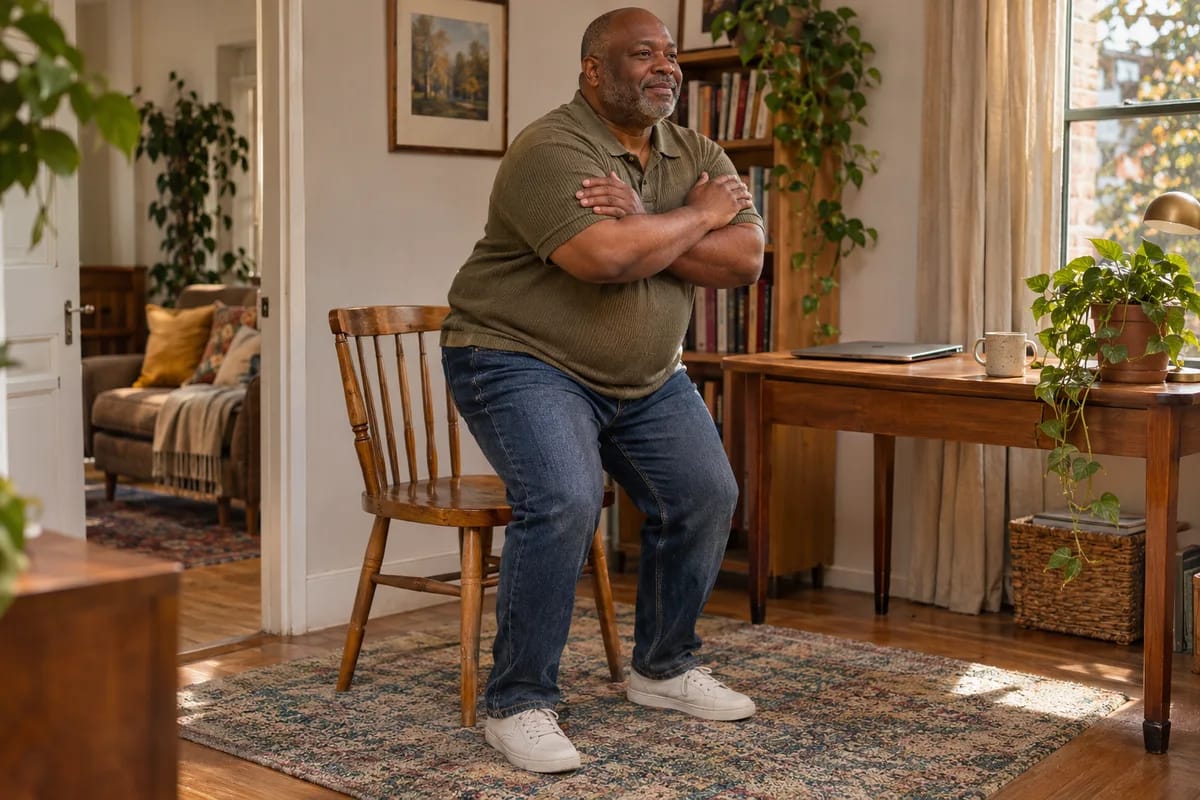
10 sit-to-stands from your chair
Sit near the front edge, feet flat and under your knees, arms crossed or hands on your thighs. Stand all the way up, then sit back down slowly instead of dropping. Too easy? Take three seconds to sit. Too hard? Push off the armrests.
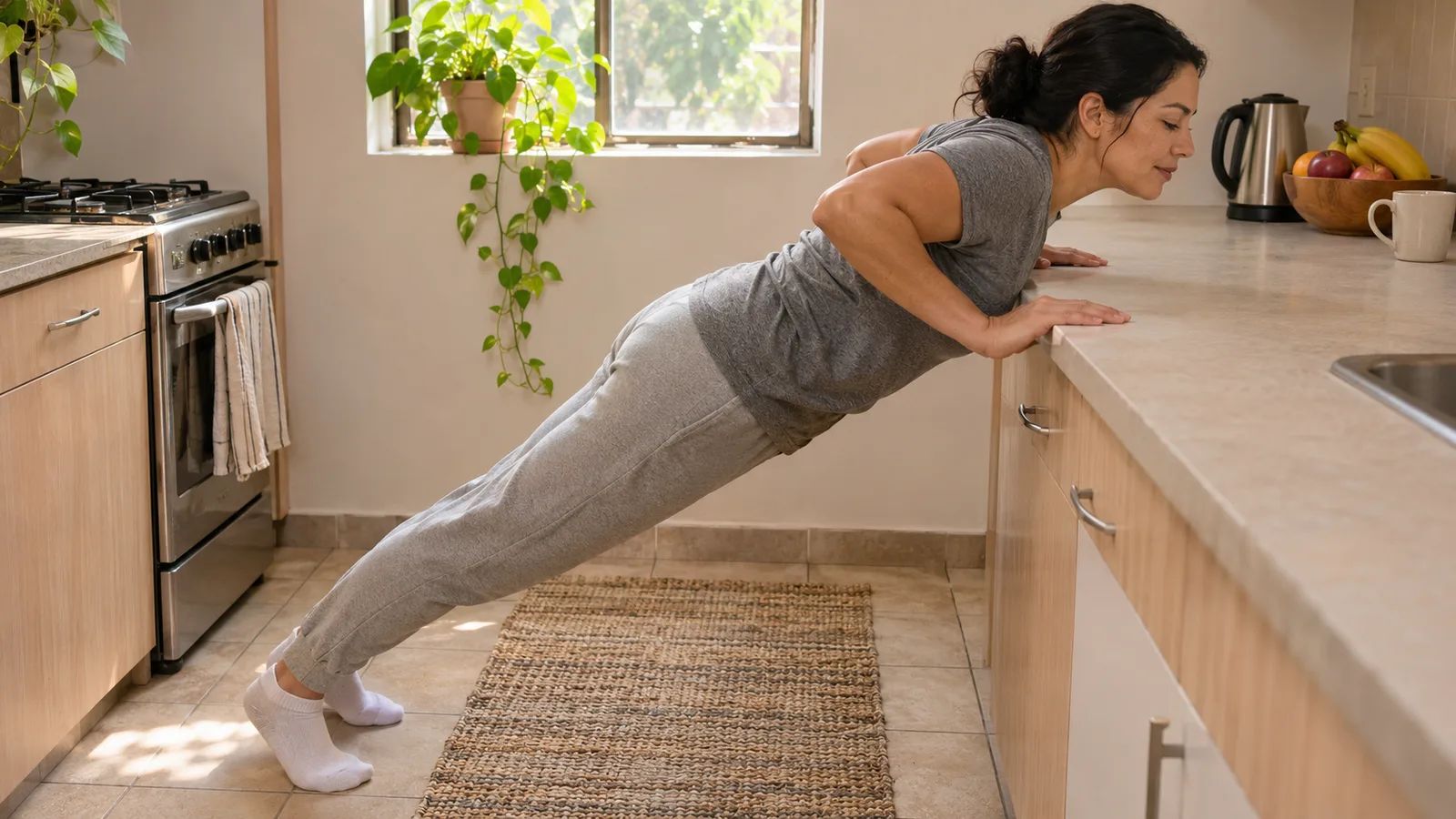
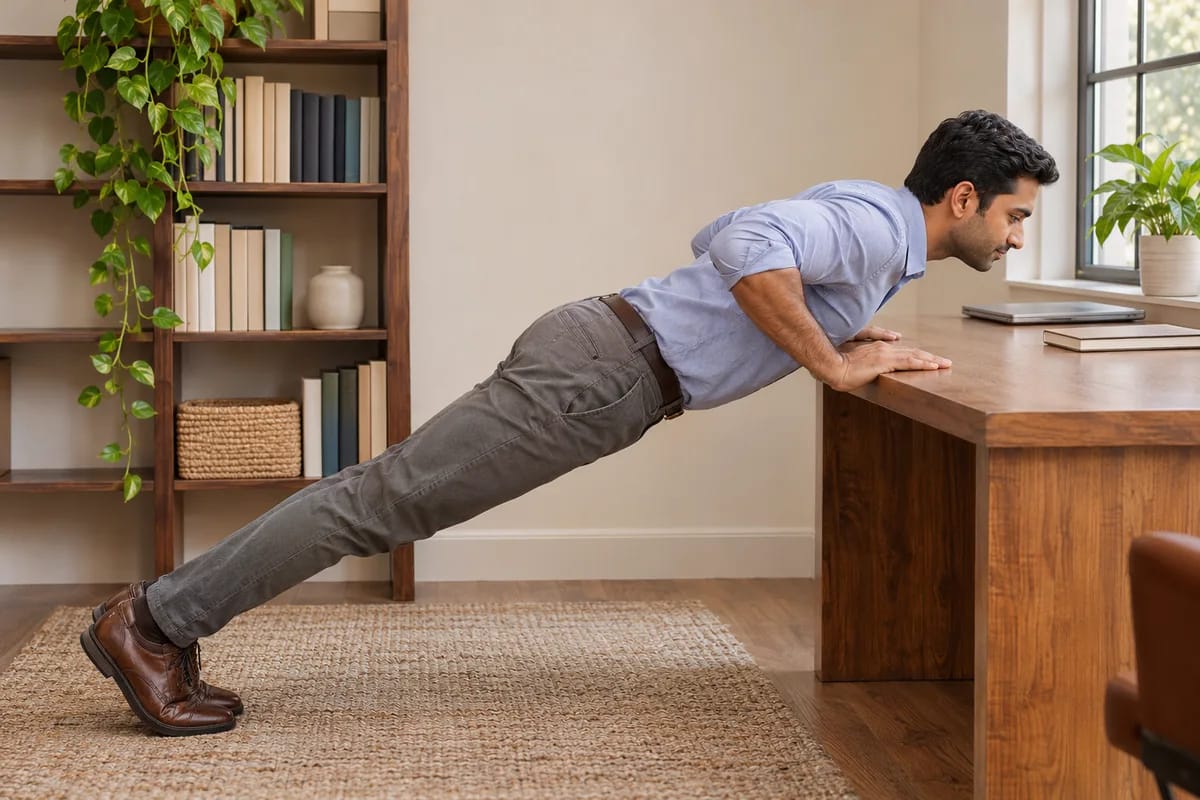
10 push-ups against the desk
Hands on the edge, a little wider than your shoulders. Walk your feet back until your body is one straight line, lower your chest toward the desk, then push away. Further back is harder.
20 calf raises
Stand tall with your fingertips on the desk. Rise onto the balls of your feet, pause at the top, and take two seconds to lower. The desk is there for balance, not to lift you.
10 shoulder-blade squeezes
Elbows bent at your sides, palms facing forward. Draw your elbows back and squeeze your shoulder blades together, hold for two seconds, let go. Keep your shoulders down, away from your ears. Got a light band in your drawer? Hold it at chest height and pull it apart toward your chest instead. It's harder.
Ask a doctor or physio first if you have pain that spreads down an arm or leg, numbness or tingling, a recent injury or operation, a heart condition or uncontrolled blood pressure, or you're pregnant. On medication that lowers blood sugar? The blood sugar findings below are general information, not a reason to change it.
Stiff neck and shoulders? Add one band raise a day
This is the move from a trial with people working full time who had frequent neck and shoulder pain.1 Stand on the middle of a light resistance band, an end in each hand. Raise your arms out to the sides and a little forward, up to shoulder height, two seconds up and two seconds down. Keep going until you can't do another clean rep, which takes about two minutes. Do it once a day, five days a week. When 12 reps feel easy, move to a stronger band.
People who did this for 10 weeks ended with noticeably less neck and shoulder pain than a group that got weekly health tips instead. No band yet? Two full water bottles will do for now, though that version wasn't part of the trial.
What a desk workout can and can't do
What it can do
- Blunt the rise in blood sugar after meals. In a lab trial with adults who had type 2 diabetes, 3-minute breaks of simple moves every half hour cut it by about 40%. A slow walk did as well, so a trip to the kitchen counts23
- Ease neck and shoulder pain, with the band raise above1
- Improve strength and chair-stand scores in adults 50 and over, done as a regular program4
What it can't do
- Count as your strength training. The World Health Organization asks for muscle strengthening on 2 or more days a week,5 and in our view ten desk push-ups aren't hard enough to count for most people
- Cancel out a whole day of sitting. In data on over a million people, the extra risk that came with sitting 8 hours or more only seemed to disappear with about 60 to 75 minutes a day of moderate activity, like brisk walking6
Those data had a twist: people who sat little but barely moved fared worse than people who sat all day but were very active.6 The chair isn't the villain. Moving too little is, and desk breaks are one easy way to move more. If you wonder why a few squats shift your blood sugar at all, is muscle really a glucose sink explains it.
Moves for where you are
The real limit on desk exercise isn't fitness. It's who's sitting next to you.
Seated in an open-plan office. Nobody will notice. Twenty calf raises under the desk (toes down, heels up), five glute squeezes held for 10 seconds each, ten slow knee lifts a side, then press your palms together hard for 10 seconds. About two minutes. It's the least you can do here, but your legs are working instead of idling.
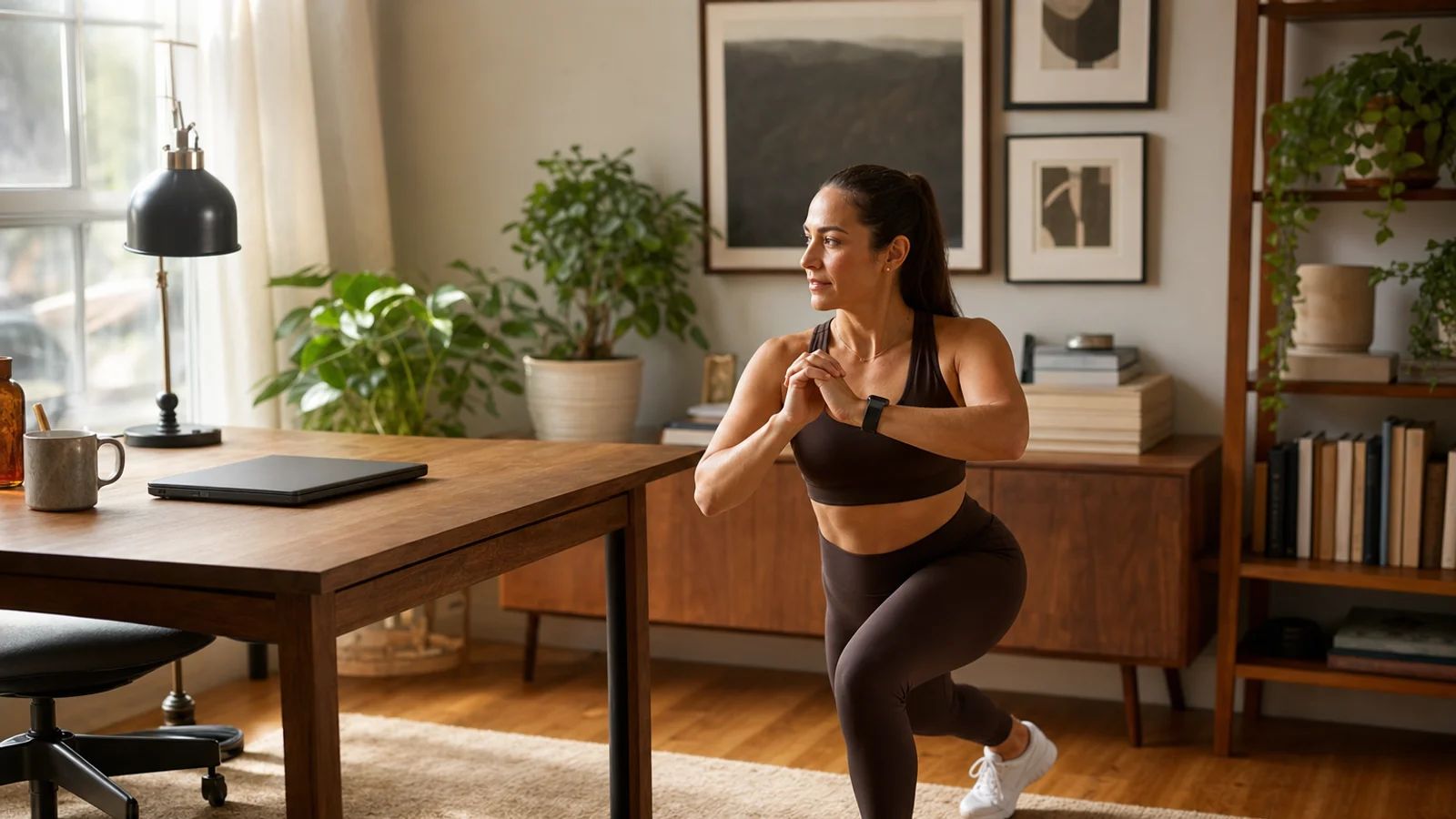
Standing at your desk. The person opposite will, for about a minute. The 3-minute break above. To make it harder, add split squats holding the desk: one foot well in front, lower your back knee toward the floor, 8 a side.
Door closed, or working from home. Nobody. Floor push-ups, a wall sit for 20 to 40 seconds, and band pull-aparts. Take them close to your limit and that's a short strength set.
On a camera-off call. Check it really is off. Walk around, do calf raises, or slow squats on mute.
Wall sits are a sneaky good one. Done as a regular program over weeks, wall squats were among the best exercises for lowering resting blood pressure in a large review of trials.7 Blood pressure rises while you hold one, though, which is why it's on the doctor list above. And skip the desk-edge tricep dips you'll see on other lists. Office chairs roll and desks tip, and falling backward onto a desk edge is a bad way to end a Tuesday.
The rules you've seen, checked
Search for desk exercise and you'll meet a lot of number rules. Here's where each one comes from.
| Rule | What it says | Holds up? |
|---|---|---|
| 20-8-2 | Each half hour: sit 20 minutes, stand 8, move 2 | Cornell's advice, and "the absolute time isn't critical".8 We found no study of it |
| 3-3-3 | TRX: 3 hours of deep work, 3 important tasks, 3 chores | A workday plan, not a workout.9 Searched as one, with no agreed meaning |
| 5-5-5-30 | Every 30 minutes: stand 5 minutes, 5 reps of a strength move, 5 paces | TRX: "not a strict prescription".9 We found no study, but it's close to the trials |
| 5 to 10 minutes an hour | Short, frequent screen breaks | A UK safety regulator's example, not a legal minimum10 |
| Soleus push-up | Seated heel raises, toes down | Up to 52% less blood sugar rise, done nonstop for 3 hours in a small study.11 A few raises aren't that |
| 28-day chair workout | A month of seated moves, from app ads | We found no trial of 28 days. Chair trials measured strength and function, not weight4 |
Does a standing desk count?
As a position change, yes. As a workout, no.
Sit-stand desks cut sitting at work by about an hour a day once the first few months have passed, though the evidence is low quality.12 They haven't been shown to ease back pain.13 And six hours of standing burns only about 54 calories more than sitting.14 The point is to change position often, and to use the standing time for the break above.
Making it stick
The routine is easy. Remembering it at 3:40 on a Wednesday is the hard part.
Set it up once
- Tie the break to something that already happens: every call ends, every water refill, every time you hit send on something big
- Set a 30 or 60 minute nudge, from a watch stand reminder or a phone timer
- Tell the person opposite once, so your calf raises stop being a talking point
- Do the first break now, before you go back to your inbox
What it adds up to
Hourly breaks come to about 25 minutes of light movement in an 8-hour day, and half-hourly ones to about 45 to 50 (our arithmetic). On a day stuck at the desk, that's worth having. The guideline it sits beside is 150 to 300 minutes a week of moderate activity, plus those two strength days.5 Here's where the strength days can fit around a desk job:
- A 15 to 30 minute gap at home holds a real strength session. Working out at home between meetings shows what fits each gap.
- A lunch hour holds a proper workout once you count travel and changing. Lunch break workouts does the sums for 30, 45 and 60 minutes.
- No weights at all? Bodyweight moves get harder without adding a pound: see progressive overload at home.
When the desk eats the real sessions
Desk breaks are free, and nobody needs a coach for them. A coach is for the two or three real sessions a week that a desk day keeps eating.
That's the part Bespoke Fit does. Each session is a live 1‑on‑1 video session with your own coach, in our app or a browser: at home before work, at lunch on a work-from-home day, in a hotel room on a trip. You need a phone or laptop with a camera and a bit of floor. Your coach programs around whatever kit you have, including none.
It's an appointment, not train-whenever, and that's the point. On a desk day, "whenever" tends to become never. A set time with someone waiting on the call is harder to skip, because skipping means telling a person.
| On a desk day | With a coach on the call |
|---|---|
| The session never gets booked | Your coach books it with you. It arrives as a calendar invite, like your meetings, with reminders the day before and shortly before |
| A meeting lands on it | Message your coach and find another time. Cancelling 12 hours or more ahead is always free; closer than that, three a month are free, then $20 each (fair use) |
| You've got 45 minutes and no plan | Your coach has written today's session on your training calendar. You open it and start |
| Your back is stiff and your shoulders round forward | Your coach writes your program around that and watches every rep. If your shoulders creep up toward your ears on a row, you hear about it mid-set |
Each coach has 12 members at most, and we hold to it when we assign coaches. Twelve people training two or three times a week for about an hour is already 24 to 36 hours of calls a week. That's a caseload small enough for your coach to remember what your back did last Tuesday.
2 months in and I haven't skipped a single workout, which has literally never happened before. I don't have to plan anything. I just put on my clothes and fill my water bottle, and my coach does the rest.
Deqa, 27, a member who trains with Angela
It costs $299 a month after 14 days free, for as many sessions as you book: about $35 a session at two a week, $23 at three. Sessions run 45 to 90 minutes, and most people settle at around an hour.
It's the wrong fit if you already get two real sessions done most weeks (keep going), if $299 would strain your budget (cheap online personal trainer options covers cheaper help), or if you can't yet protect 45 minutes twice a week at a set time (start with the shorter workouts in the guides above).
If it fits, you start with a 30-minute call with a head coach, who matches you to your coach. You add a card, your 14 days free begin at your first session, and a reminder comes 3 days before the first charge. How it works has the rest.
Sources
-
Andersen and colleagues, 2011. Effectiveness of small daily amounts of progressive resistance training for frequent neck/shoulder pain: randomised controlled trial. Pain. 198 adults working at least 30 hours a week; elastic tubing, 2 or 12 minutes a day, 5 days a week for 10 weeks, against a control group sent weekly health information. Pain fell about 1.4 points out of 10 in the 2-minute group compared with the control group. The exercise was the lateral raise in the scapular plane, two seconds up and two down, taken to failure in the 2-minute group, with thicker tubing once 12 reps came easily, as described in a follow-up paper on the same trial. ↩ ↩2
-
Dempsey and colleagues, 2016. Benefits for type 2 diabetes of interrupting prolonged sitting with brief bouts of light walking or simple resistance activities. Diabetes Care. 24 inactive adults with type 2 diabetes and overweight, three 8-hour days, 3-minute breaks every 30 minutes of slow walking or half-squats, calf raises, glute squeezes and knee raises; glucose response 24.2 sitting vs 14.8 walking and 14.7 resistance moves. Only the resistance moves also lowered blood fats. ↩
-
Dunstan and colleagues, 2012. Breaking up prolonged sitting reduces postprandial glucose and insulin responses. Diabetes Care. 19 adults aged 45 to 65 with overweight; 2-minute walks every 20 minutes. ↩
-
Klempel and colleagues, 2021. The effect of chair-based exercise on physical function in older adults: a systematic review and meta-analysis. International Journal of Environmental Research and Public Health. 25 studies, 1,388 adults aged 50 and over; handgrip, arm curl and 30-second chair stand improved. ↩ ↩2
-
Bull and colleagues, 2020. World Health Organization 2020 guidelines on physical activity and sedentary behaviour. British Journal of Sports Medicine. ↩ ↩2
-
Ekelund and colleagues, 2016. Does physical activity attenuate, or even eliminate, the detrimental association of sitting time with mortality? A harmonised meta-analysis of data from more than 1 million men and women. The Lancet. Observational data from over a million people; the authors say 60 to 75 minutes a day "seem to eliminate" the extra risk. ↩ ↩2
-
Edwards and colleagues, 2023. Exercise training and resting blood pressure: a large-scale pairwise and network meta-analysis of randomised controlled trials. British Journal of Sports Medicine. ↩
-
Cornell University Ergonomics Web, Sitting and standing: "every 20 minutes stand for 8 minutes AND MOVE for 2 minutes". Read 12 Nov 2026. ↩
-
TRX, The 20 best exercises to do at the office and your desk, FAQ section, read 12 Nov 2026. It defines 3-3-3 as 3 hours of deep work, 3 important tasks and 3 maintenance tasks. ↩ ↩2
-
Health and Safety Executive, Work routine and breaks: "For example 5 to 10 minutes every hour is better than 20 minutes every 2 hours." ↩
-
Hamilton, Hamilton and Zderic, 2022. A potent physiological method to magnify and sustain soleus oxidative metabolism improves glucose and lipid regulation. iScience. A 3-hour glucose test with the movement done throughout. The 52% is at the higher intensity, which 10 of the 15 people did; the lower intensity, done by all 15, gave about 39%. The authors state they are developing technologies to teach the movement, and the University of Houston intends to patent it. ↩
-
Shrestha and colleagues, 2018. Workplace interventions for reducing sitting at work. Cochrane Database of Systematic Reviews. ↩
-
Parry and colleagues, 2019. Workplace interventions for increasing standing or walking for decreasing musculoskeletal symptoms in sedentary workers. Cochrane Database of Systematic Reviews. ↩
-
Saeidifard and colleagues, 2018. Differences of energy expenditure while sitting versus standing: a systematic review and meta-analysis. European Journal of Preventive Cardiology. The 54 calories is for a 65 kg (143 lb) person. ↩