Training at home between meetings: a realistic guide
The remote worker's real problem isn't finding time to train. It's defending a block everyone assumes is free because you're home. Here's how to hold it.
In this article8
If you work from home, you don't have a time problem. You have a defense problem.
The office worker's obstacle is obvious: the commute, the lunch-hour crowd, a gym that's a bus ride away. Working from home removes all of that. Your equipment sits 20 feet from your desk. No travel, no changing room, no queue. On paper, you're the best-positioned person in the building to train on a workday.
And yet the block you set aside keeps evaporating. Not because you ran out of time, but because a 3:30 moved to 4, someone "just grabbed 15 minutes," and the slot you were saving got quietly eaten. The real issue isn't time. It's that everyone, including you, treats a block on a home worker's calendar as free space. Stop treating it that way. Start treating it like a meeting nobody can move.
Why home blocks vanish and office ones don't
A calendar block behaves differently depending on where you are. At the office, "gym, 12:30" is protected by physics: you've left the building, you're not at your desk, nobody can grab you. At home, that same block sits on a calendar that says you're online, in the house, one message away.
So it gets treated as slack. A colleague sees a white space and books over it. Your manager pings "quick sync?" and you say yes, because saying no to protect a workout feels indulgent when you're clearly right here. Then your own brain joins in: I'll just push it an hour, I'm home anyway.
A workout block at home isn't defended by distance or a closed office door, so the calendar has to do that job instead. If it says "free," the block is already lost. If it says "busy, booked," everyone, yourself included, has a reason to leave it alone. At the office, your absence protects the workout. At home, only the calendar can.
Make the block impossible to casually move
You already apply these rules to real meetings. You just haven't applied them to yourself. You wouldn't delete a client call because you felt a bit tired at 3pm. Give the workout the same standing.
- Put it on the calendar as an actual event, not a mental note. A recurring entry with a start time and a hard end time: "Training, 12:00 to 12:40." A note that lives only in your head is the first thing to get renegotiated.
- Set your status to busy. This alone does more than anything else on this list. Most scheduling tools show a block as free or busy to anyone trying to book your time. Free is an invitation. Busy is a wall.
- Name it so it reads as booked. "Personal appointment" or "Training, do not book" beats "workout." You're not hiding anything. You're just removing the one item on your calendar that looks negotiable.
- Anchor both ends. Stack a real meeting right after the block so it can't drift the way evening slots drift when the workday runs long. A session boxed in on both sides holds its shape.
- If something real collides with it, move the block. Don't delete it. A rescheduled session still happens. A deleted one doesn't. Pick the new slot in the same breath you decline the old one.
If your week is too chaotic for a fixed daily slot, that's a different problem. I cover it in a schedule that survives chaos.
Fifteen minutes between meetings still counts
Yes. And this matters more than almost anything else about training from home, because the gap between meetings is often all you've got.
There's an old instinct that a workout only counts if it's a full hour with a warm-up and a sense of occasion. That instinct is what makes people skip the 20-minute gap: if it can't be the full thing, why bother. Public health guidance has moved the other way. The World Health Organization says plainly that any amount of activity beats none, and that it all counts, whatever the duration. Its weekly target for adults, 150 to 300 minutes of moderate activity plus two strength sessions, says nothing about how you have to slice it up.1
Your muscles and heart respond to the load you actually put through them, not to how the calendar labels the block. Three tight 15-minute strength sessions in a day do real work. A 45-minute session you keep "saving for later" does none, because it never happens.
Staying presentable for the next call
This is the quiet blocker nobody talks about. You'll skip a between-meetings session not because you can't do it, but because you don't want to walk into a 1pm video call red-faced and dripping. So the session has to be built to leave you camera-ready.
Keep the intensity moderate when a call is stacked right after. Heavy, breathless intervals spike your core temperature, and you'll keep sweating for 10 to 15 minutes after you stop, long past the point you've sat back down. Strength work at a controlled pace, mobility, or an easy incline walk raises your heart rate without turning you into a puddle.
Finish with a real cooldown, even two or three minutes. Drop the intensity, let your breathing settle, and give your body a moment to stop generating heat before you close the laptop lid and open the call. A splash of cold water on the wrists and face helps you shed heat faster than you'd expect.
Leave a buffer, too. A session that ends at 12:58 for a 1:00 call is a recipe for showing up flushed. End at 12:50 and you've got margin to cool down, change your shirt, and arrive looking like someone who was working, not sprinting. If it helps, save the harder sessions for the end of the day when no call is watching, and keep the between-meetings slots for the presentable, recovery-friendly work.

The real edge: almost no transition cost
Equipment isn't the real advantage of training at home. The advantage is transition cost: the friction between deciding to train and actually starting.
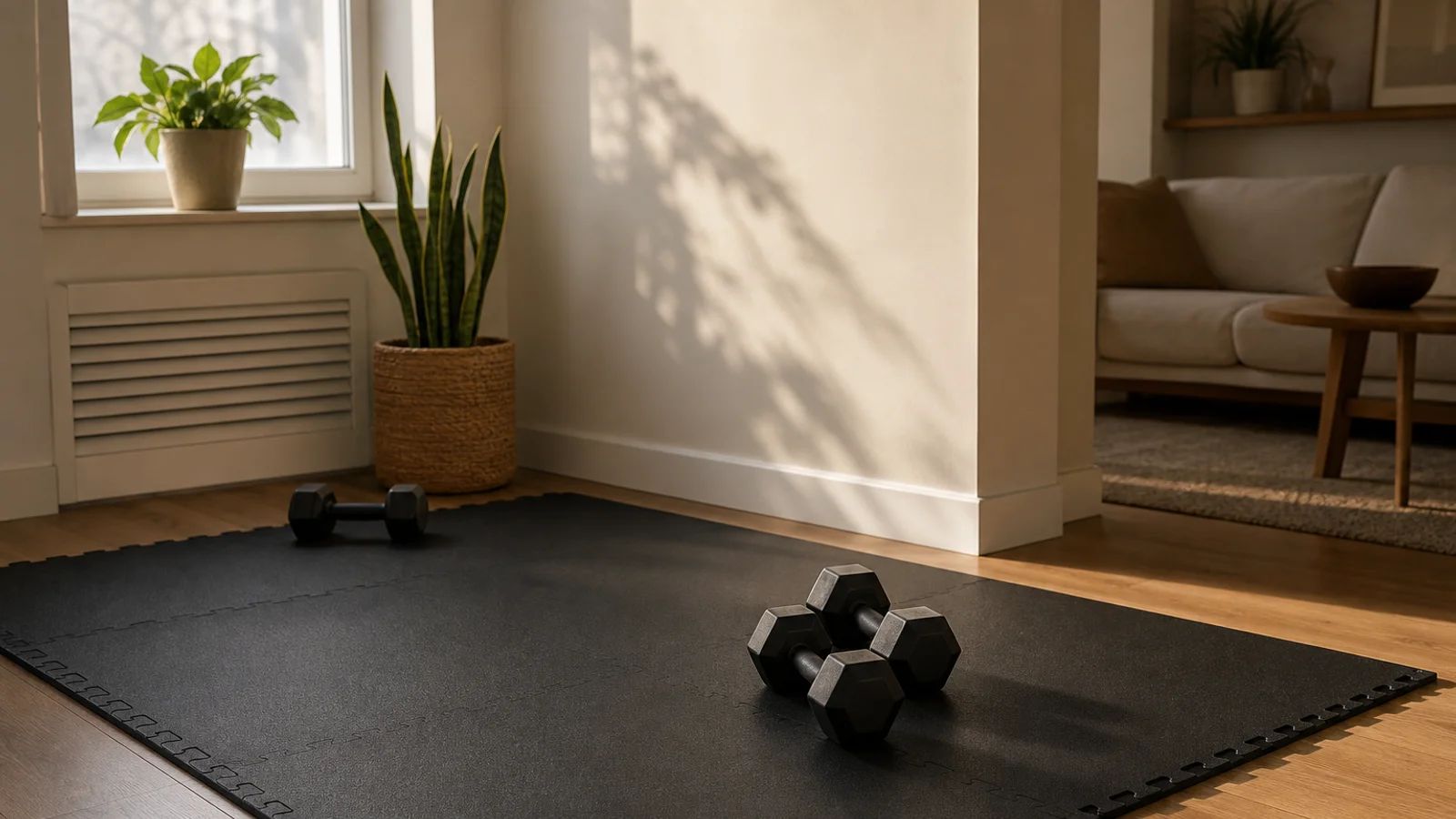
At a gym, that friction is real: change, drive, park, walk in, find a rack, warm up. Every step is a place to bail. At home it can be almost nothing. The mat's already down. The dumbbells are by the desk. You stand up and you've started. That's what makes short, frequent sessions realistic, the little-and-often pattern a between-meetings life is actually built for.
You can lower the friction further by staging your setup: leave the equipment out and visible, keep workout clothes within reach of the desk, decide the session the night before so 12:00 isn't a planning meeting with yourself. When the block arrives, there should be nothing between you and the first rep.
It's the same door-to-door logic behind training in a lunch hour, just with the commute deleted. Working from home hands you back the travel time, but only if you protect the block that time was supposed to fill.
What a calendar trick can't fix
Defending a calendar block is a scheduling fix. It's not a training program. Holding the slot gets you to the session. It doesn't tell you what to do once you're there, and a protected block spent scrolling your phone is still wasted time.
The WHO's "all activity counts" point is about total volume for general health. It's not a claim that four scattered five-minute bursts equal a structured strength session aimed at a specific goal. Frequent short sessions also demand more discipline about finishing: a 15-minute block is easy to cut to five once you're a few reps in.
And none of this survives a genuinely brutal week. Some stretches, the realistic move is a maintenance minimum, not pretending the calendar is fully under your control.
Common questions
Is 20 minutes between meetings actually enough to train? For maintaining strength and hitting your weekly activity, yes. A focused 20 minutes of resistance work, two or three exercises taken close to hard, does real work. It won't replace a long session if you're training for a specific performance goal, but it beats the 45-minute session you keep skipping because you're waiting for a clear hour that never comes.
How do I stop colleagues from booking over my workout block? Set the block's status to busy or private in your calendar so it doesn't show as available time, and give it a title that doesn't invite negotiation. Most double-bookings happen because the slot simply looked open. Close the opening and the problem mostly disappears on its own.
Should I work out before or after meetings when I'm home all day? Whichever slot has a hard edge you can defend. A block wedged between two fixed meetings is easier to protect than an open-ended one at the end of the day, because the workday expands into any soft evening slot. If you only trust yourself first thing, train before the calendar wakes up.
How do I avoid being sweaty on the next video call? Keep the intensity moderate before a call, finish with a short cooldown, and leave a real buffer so you're not walking from your last rep straight into "can everyone see my screen." Save the harder, sweatier sessions for the end of the day when nothing's watching.
Once the block holds
A calendar app, a status set to busy, and a title that says do not book get the entire job done on their own. Add a bit of stubbornness about protecting the block, and a self-motivated person can hold it indefinitely without paying anyone.
Where a coach changes the math is on the two failure points this piece is actually about: defending the block, and using it well once you're in it. A booked live session is an appointment with a real person waiting for you at the start time, on HD video, watching every rep. That's harder to steamroll than a block you set for yourself, because now there's someone on the other end at 12:00, not just a white rectangle you can talk yourself out of. Every session is 1‑on‑1 with a real coach, never AI, and because it's unlimited on a flat rate, you can book a short between-meetings session and a longer one later the same day without a per-session cost talking you out of it. The rate is $299 a month, and the first 14 days are free, a low-risk way to find out whether a standing appointment holds your block better than you do.
But start with the calendar tonight. The block doesn't care whether the person defending it is paid. It only cares that someone finally is.
Sources
-
Bull et al., 2020. World Health Organization 2020 guidelines on physical activity and sedentary behaviour. British Journal of Sports Medicine. ↩