Staying fit as a founder: a schedule that survives chaos
Fixed training plans break on your first crazy week and rarely restart. Here's how busy founders build a fitness floor that survives the chaos.

In this article8
Most founders build their training plan for the week that never comes. Six a.m. sessions, four days on the calendar, nothing on fire. Then a launch slips, a customer churns, an investor call moves twice, and the plan is dead by Wednesday.
The fix isn't more willpower. It's building the plan around your worst week instead of your best one.
A low floor you never miss beats an ambitious plan you eventually give up on. If your routine only works when your calendar behaves, it isn't a routine. It's a wish. Set a minimum you can hit even in the ugliest week of the quarter, stay loose about when, and let everything else be a bonus you add back in once things calm down.
Build a floor, not a ceiling
A floor is the smallest amount of training you commit to, no matter what. The dose you'd still hit during your worst week. For most people that's two sessions a week, 30 to 40 minutes each: some hard resistance work, plus something that gets your heart rate up.
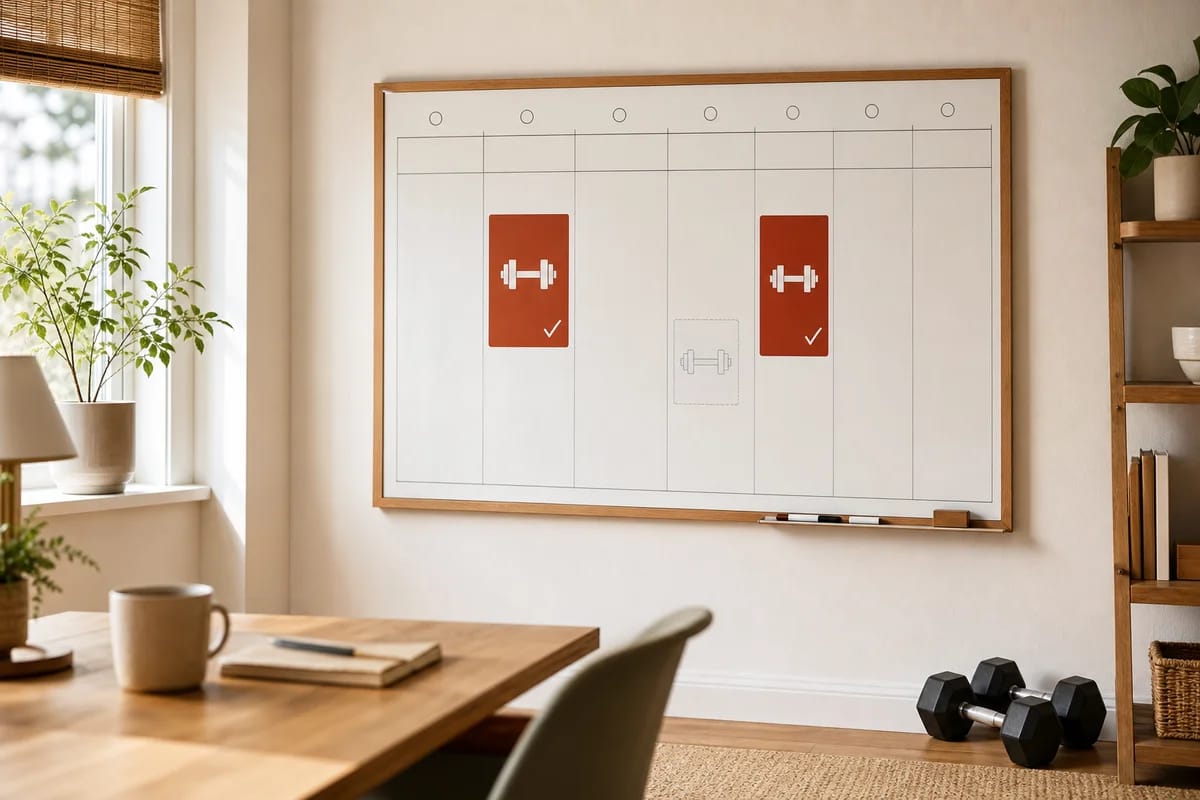
The floor only moves in one direction. You never drop below it, but you're free to add above it whenever life allows. On a calm week, stack on a third session, a longer walk, a real gym trip. On a brutal week, you do the two and stop, and that still counts as a full win.
This changes the scoring. An ambitious plan gets measured against a ceiling, so almost every real week feels like a shortfall. A floor gets measured against a minimum, so almost every week is a win, including the ugly ones. You end up with a record of showing up instead of a record of falling short.
The floor works because two sessions is genuinely enough to hold onto most of your strength and fitness. The research on how little it takes to maintain what you've built is stronger than most people expect, and I dug into the numbers in the minimum effective dose of exercise.

Why rigid plans die in week one
A typical plan says train five days a week, mornings, in this order. That works fine until the week it doesn't, and for a founder that week comes fast.
Here's the actual failure mode. You planned five days and hit one. Now the plan and your real week don't match, so the whole thing feels broken. A broken plan is easy to walk away from, because in your head it's already ruined. You weren't beaten by the missed session. You were beaten by the gap between the plan and your life.
Founders get hit by this harder than most, because the volatility is the job. A normal employee has a rough week now and then. A founder's calendar can invert overnight, and a five-day plan treats every one of those weeks as a failure, even the weeks you were doing everything right.
A rigid plan is a promise you can only keep when nothing goes wrong. Something always goes wrong.
Pick the dose, keep the time flexible
The instinct is to fix the time. Same slot every day, no decisions to make. For people with steady calendars, that works well. For founders, it can backfire, because a fixed slot has nowhere to go. The week it gets overrun, the session just disappears.
A 2021 field experiment in Management Science tested this directly. Economists John Beshears, Katherine Milkman, and colleagues paid a large group of gym members to exercise: some only if they trained at the same time every day, others any time they liked. The flexible group logged more gym visits, both while the payments were running and after they stopped. Locking people into one slot produced fewer visits, not more.1
That's a little counterintuitive, since we're usually told routine builds habits. It does, for people whose lives hold still. But when your calendar is the volatile part, a fixed time turns one missed slot into a missed day, and missed days compound. Flexibility gives the session somewhere else to go.
So the floor sets how much, and flexibility sets when. Two sessions this week, any two days, any two times. A blown Tuesday isn't a failure. It's just information that the session happens Thursday instead.
Four rules that make it hold
The mechanics matter, because a floor you don't defend is just a hope you're being nice to yourself about.
Pick two anchor sessions and protect them like investor meetings. Put them on the calendar as real blocks with a real name. You wouldn't ghost a term sheet call because you felt busy, so treat the floor the same way. A booked block you have to actively cancel survives a lot better than an intention you have to actively honor.
Keep each session short and self-contained. Thirty to forty minutes, no dependency on a specific gym, ideally doable at home so a canceled plan doesn't cancel the workout too. The more conditions a session needs, the more ways a bad week can kill it. I wrote a realistic guide to training at home between meetings that covers the logistics of this part.
Let sessions move inside the week, never disappear. If Tuesday dies, it lands on Thursday. If Thursday dies too, it lands on Saturday. The week is the unit you're scoring, not the day.
Name the bonus tier so you actually know what "extra" means. Write down what you add on a good week: a third session, a longer walk, some easy cardio. Naming it means a calm week doesn't get wasted deciding what to do, and a busy week has an obvious thing to drop first. Skipping the bonus tier costs you almost nothing. I covered the actual timeline in how fast you lose strength when you stop lifting, and it's slower than most people fear.
Key takeaways
- Set your floor at two sessions a week, 30 to 40 minutes each: the dose you could still hit on your worst week of the last quarter.
- Book both as named calendar blocks with the same status as an external meeting, not a mental to-do.
- Score the week, not the day. Two sessions in any two slots is a full win, even if both land on the weekend.
- Never subtract from the floor. Only add on top of it on calm weeks.
- If a session gets bumped, move it inside the same week. A session can travel. It can't vanish.
What the studies can't tell you
This is a framework, not a law, so a few honest limits are worth naming. The Beshears and Milkman study was about incentive design in gym members, not specifically about founders or about floor size, so treat it as support for flexibility, not proof that two sessions is the right number for you. How small your floor should be depends on your training age, your goals, and how well you recover. Two is a starting point, not a prescription.
A floor is a survival tool. If your goal is a real strength or physique change on a deadline, you'll need more than the minimum most weeks. And the real risk of a low floor is that it quietly becomes the ceiling on every week, including the calm ones. The floor keeps you in the game. It doesn't win it for you.
Common questions
What's a realistic minimum workout for a founder with no time?
Two sessions a week of 30 to 40 minutes is a defensible floor for holding most of your strength and general fitness. The trick isn't finding more time, it's making those two sessions unconditional and short enough that a bad week can't take them out. Do them at home if you can, so a canceled plan doesn't cancel the workout.
Won't training twice a week stop my progress?
For maintaining what you've built, two well-run sessions go a long way, especially if you push them reasonably hard. For actively building strength or size, two is a floor, not a target, and you'll want the bonus sessions most weeks. Two isn't optimal. It's what survives the weeks when four was never going to happen.
How do I restart after a chaotic stretch wipes out my routine?
Don't rebuild the ambitious plan. Rebuild the floor. Book one short session in the next 48 hours, then a second later in the week, and call that a full week done. The urge to make up for lost time with one huge week is exactly what makes a restart fragile. Small and unconditional beats big and heroic.
Should I train at a fixed time or stay flexible?
If your calendar is stable, a fixed time removes decisions and works well. If your calendar is volatile, which covers most founders, stay flexible about timing and fixed only about the weekly dose. The evidence leans toward flexibility for people whose schedules move, because a rigid slot has nowhere to go when the day blows up.
What a coach adds when you're the bottleneck
A coach mostly changes who defends the floor on the week you're the bottleneck, though a disciplined founder can hold the floor itself alone, with nothing but a calendar and an honest weekly count. When your week inverts, the easiest thing to drop is the session only you were holding yourself to. A booked appointment with a real person is a lot harder to quietly delete.
That's how Bespoke Fit works: your training runs on live one-on-one video sessions with a real coach, never AI, and when a launch eats your Tuesday, the coach moves the session inside your week instead of letting it evaporate. Sessions are unlimited and reschedulable rather than a use-it-or-lose-it package, so a heavy week and a calm week fit inside the same plan: floor on the bad ones, bonus on the good ones. It's 14 days free, then $299 a month. You can see how the sessions actually work if you want the mechanics.
Build the floor for the week you're actually going to get. Let the good weeks stack on top of it.
Sources
-
Beshears, Lee, Milkman, Mislavsky, and Wisdom, 2021. Creating Exercise Habits Using Incentives: The Trade-off Between Flexibility and Routinization. Management Science. ↩
More on