The Hawthorne effect: does being watched make you train harder?
The famous factory experiment is half myth, yet being watched really does change how hard you train. Here's what the research actually shows.
Every article about accountability and training eventually reaches for the same story: in the 1920s, researchers at Western Electric's Hawthorne Works near Chicago changed the factory lighting, and output went up no matter what they did, brighter or dimmer. The workers weren't reacting to the light, the story goes. They were reacting to being watched. That's where the "Hawthorne effect" comes from, the idea that people perform better simply because someone's paying attention.
Here's the short version: the factory story is mostly fiction, but the idea behind it isn't. Modern research keeps finding real effects from being observed, and in the gym they're bigger and more consistent than the debunked legend ever claimed. I run a coaching service built on someone watching every rep, so I have an obvious interest in this being true. Here's what holds up and what doesn't.
The lighting study that started it all
The illumination experiments ran at Western Electric's Hawthorne Works in the mid-1920s. For decades, everyone repeated the same clean version of what happened: output rose with every change to the lighting, then dropped once the study ended, proof that attention alone was doing the work. Almost nobody had checked the actual records. They were thought destroyed.
Then economists Steven Levitt and John List tracked down the surviving files and reran the numbers in 2011. Their conclusion: the commonly cited description of the results was, in their words, entirely fictional.1 Output did drift up over the course of the study, but most of that tracked ordinary things, like production simply running higher on Mondays regardless of what the lighting was doing. Buried in the noise, they still found faint traces of a real observation effect. Just nothing like the legend.
So is the whole idea junk? Not quite. A review that pooled 19 studies built specifically to test whether being observed changes behavior, published in 2014, found real effects in 12 of them.2 Small to moderate, and it swung a lot depending on the situation. That's the real shape of it: being watched nudges behavior. The nudge is real. It's just smaller and more selective than the legend claims.
Why watching changes what you do
Psychology got here before economists did. In 1898, a researcher named Norman Triplett noticed that cyclists rode faster racing another rider than racing a clock alone, one of the first recorded social psychology experiments.3
The explanation that's held up since: other people raise your arousal, and arousal makes you lean harder into whatever you already know how to do. On a task you've drilled a hundred times, that instinct is correct, so an audience helps. On something new and complicated, your instinct is usually the mistake, so an audience hurts. Psychologist Robert Zajonc worked this out in 1965, and it's held up well enough that the same split keeps showing up whenever researchers pool the studies together: simple tasks get faster with company around, complex ones get worse.4
This is the part that matters for training, and I'd rather say it plainly than let the good news carry the whole article.
Does an audience make you lift more?
The exercise-specific research is smaller than the psychology lab studies, but it answers what you clicked for.
A 2003 study in the Journal of Strength and Conditioning Research had 32 recreationally trained men and women max out their bench press under different social setups. Lifting with an audience watching, they hit about 105 kg (231 lb) on average. Lifting alongside people who weren't paying attention, they topped out around 93 kg (205 lb).5 That's a real jump, on a lift they already knew how to do, exactly what Zajonc's theory would predict.
Encouragement adds another layer on top of plain watching. In a small trial of 28 people running maximal treadmill tests, cheering someone on every 20 to 60 seconds got them measurably further and harder than staying quiet, or than cheering only every three minutes.6 Sparse encouragement barely helped. Frequent encouragement clearly did.
None of this changes what your muscles can physically do. It changes how much of that capacity you're willing to spend before you decide you're done.
New lifters, a different story
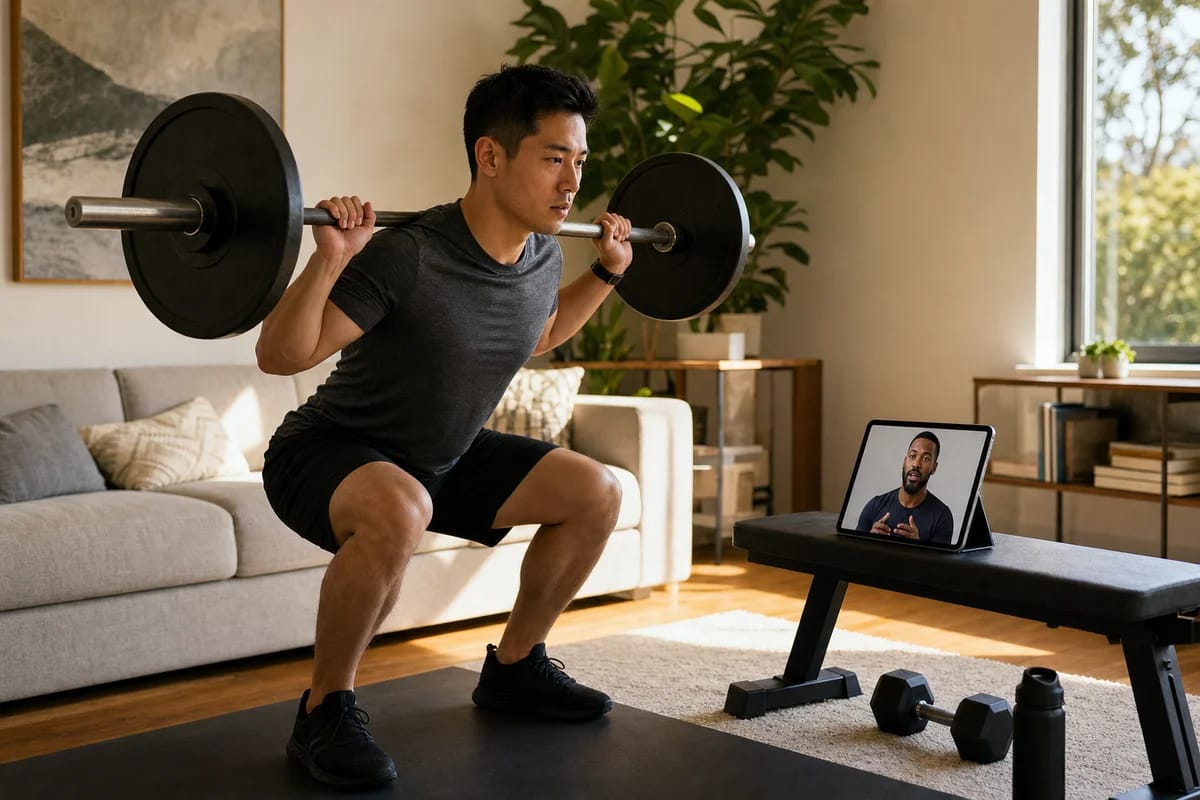
A set of squats you've done a hundred times is a simple, practiced task, exactly where an audience helps. Learning to hinge, or cleaning up a new squat pattern, is a complex, unpracticed one. Being watched during that stage can make the first sessions feel worse, not better. Anyone who's tightened up the moment a trainer walked over already knows the feeling.
It fades once the movement becomes automatic. At that point the audience effect flips from working against you to working for you. So keep the load light while a lift is still new, and give the pattern time to feel boring before you expect the boost.
What a coach adds that an audience can't
Everything above is passive observation: somebody watching, maybe cheering. A coach does more than watch, and that's the part the Hawthorne framing doesn't capture.
The two mechanisms run on different timescales. An audience effect lives inside a single set: you push a little harder today because someone's there. Feedback compounds across weeks: a coach sees your depth fade at rep six, corrects it in the moment, notices you had two reps left in the tank, and writes next week's program a little heavier because of it. I went deeper on why that timing matters in why a coach watches every rep.
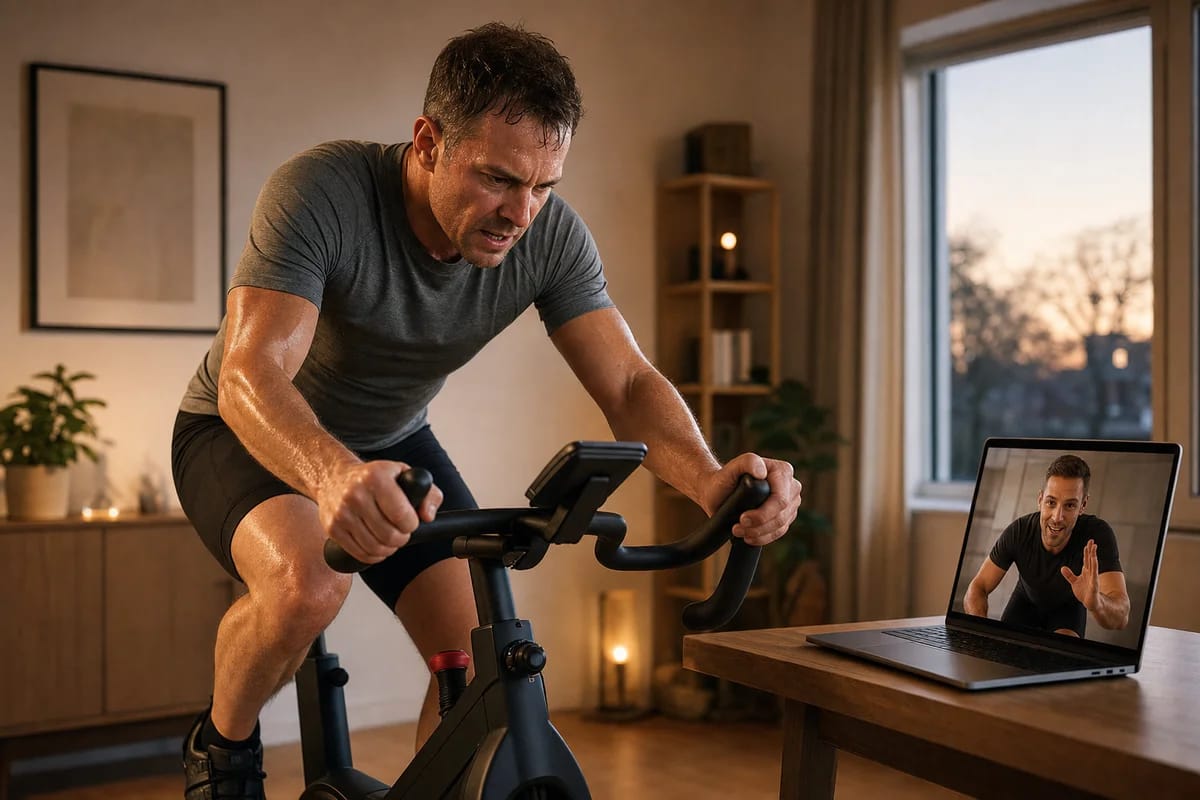
Zoom out to months instead of a single session, and supervision keeps winning, mostly through harder training and fewer skipped sessions rather than any per-rep magic. I covered those longer trials, including the adherence gap between supervised, app-guided, and self-guided training, in does online personal training actually work. The durable part was never just being watched. It's being watched by someone who acts on what they see, and who you'd feel bad canceling on.
Where the evidence runs thin
The same skepticism that took down the factory story belongs here too. The broad meta-analyses report small effects. The flashier gym numbers, the bench press jump especially, come from small studies measuring one session, not months of progress. Novelty is doing some of the work, and novelty fades. Nobody has shown the pure audience boost survives a year of the same audience.
Observation anxiety is real too, not imagined. For some people, especially on a skill that's still new, the same arousal that helps a practiced lifter tips into interference instead. If the camera itself is what worries you, I wrote separately about whether it's awkward to work out on camera and why that discomfort usually fades within a few sessions.
Most of this research also comes from young, healthy volunteers doing lab tasks, not someone in their 40s doing goblet squats in a living room. Treat the specific numbers as a direction, not a promise.
Common questions
Why do you lift more at the gym than at home?
Partly it's equipment and habit, but social facilitation is probably doing real work too. Trained lifters test higher one-rep maxes with people around, and the effect is strongest on movements they've already mastered, pushed hard. A live coach watching you train at home recovers a good chunk of that gap, because the mechanism is attention, not the building you're standing in.
Does being watched help or hurt beginners?
For raw effort, it helps at any level. That's just arousal amplifying what you already know how to do. For learning a brand-new movement, it can work against you at first, since arousal amplifies mistakes just as readily as instinct. Light loads and patient feedback while the pattern is new fix this. Once the pattern is grooved, being watched stops costing you and starts helping again.
Does filming yourself count as being watched?
To some degree, yes. The mechanism is knowing someone, even future you, will see the set. It's not about a body physically standing in the room. It's a weaker version of the effect than a live person cueing you mid-set, but it beats training with zero accountability, and it costs nothing to try.
Test it for free, then decide
Ask a training partner to watch your top set and talk you through it for one session, then compare how it felt, and how much you moved, to training alone. That single data point will tell you more about your own response than any meta-analysis will.
Bespoke Fit leans on the part of this a friend can't fully replace: every session is a live, unlimited 1-on-1 video call where a real coach watches every rep and calls out cues mid-set, for $49 your first month and $299 a month locked for life if you're one of the 25 founding spots, though a training partner watching your top set for free will still get you a real share of the same effect. You can see how a session runs before deciding anything.
Sources
-
Levitt, S. and List, J., 2011. Was there really a Hawthorne effect at the Hawthorne plant? An analysis of the original illumination experiments. American Economic Journal: Applied Economics. ↩
-
McCambridge, J., Witton, J. and Elbourne, D., 2014. Systematic review of the Hawthorne effect: new concepts are needed to study research participation effects. Journal of Clinical Epidemiology. ↩
-
Triplett, N., 1898. The dynamogenic factors in pacemaking and competition. American Journal of Psychology. ↩
-
Zajonc, R., 1965. Social facilitation. Science. ↩
-
Rhea, M., Landers, D., Alvar, B. and Arent, S., 2003. The effects of competition and the presence of an audience on weight lifting performance. Journal of Strength and Conditioning Research. ↩
-
Andreacci, J., LeMura, L., Cohen, S., Urbansky, E., Chelland, S. and Von Duvillard, S., 2002. The effects of frequency of encouragement on performance during maximal exercise testing. Journal of Sports Sciences. ↩
More on