Five longevity training myths that will not die
Cardio isn't enough, lifting isn't dangerous at 90, and your metabolism doesn't crash at 40. Five longevity training myths and the studies that end them.

Fitness advice doesn't stick around because it's true. It sticks around because it sounds true. Five lines about training for a long life keep getting repeated, and none of them survive contact with the actual research.
I'll take each one in turn: the part that's real, and the evidence that ends the argument. The numbers below are stated plainly enough that you can check them yourself.
Myth 1: cardio alone is enough
The claim: build a strong aerobic engine, zone 2 plus intervals, and the rest of your longevity takes care of itself.
There's a lot of truth packed into that. Fitness is the single best exercise-based predictor of how long you live. The biggest study on this, more than 122,007 patients tracked in JAMA Network Open, found that being unfit carried a higher risk of death than smoking or having diabetes.1 I made the full case for that in why VO2 max predicts how long you will live, so cardio clearly matters more than almost anything else you do.
It just isn't the whole bet. The largest pooled look at muscle-strengthening activity, 16 cohort studies, ties regular strength work to a 10 to 17 percent lower risk of dying from any cause, plus lower rates of heart disease, cancer, and diabetes, on top of whatever your aerobic fitness already buys you. The benefit shows up at just 30 to 60 minutes a week, and it held even in people who already trained hard aerobically.2
The reason is mechanical. A strong heart and lungs won't stop you falling, won't carry you through a hospital stay, and won't keep you off the floor if your legs give out. Muscle does that work, and I unpack why it acts like an organ rather than scaffolding in muscle is an organ.
Cardio and strength are separate bets on a long life. The research says place both.
Myth 2: lifting gets dangerous once you're older
The claim: past a certain age, heavy resistance training is how you tear a shoulder or blow out your back. Better to stick with light and gentle.
There's a real risk buried in this one. Bad technique and ego loading are dangerous at any age, and older joints don't forgive a sloppy rep the way 25-year-old joints do. That's an argument for coaching and sane progression. It's not an argument for avoiding load.
The clearest answer comes from a 1990 trial in JAMA, where Fiatarone and colleagues put 10 frail, institutionalized volunteers with a mean age of 90 through 8 weeks of high-intensity resistance training. The nine who finished it gained an average of 174 percent in strength. Their mid-thigh muscle area grew about 9 percent, and their walking speed improved 48 percent. These were nursing-home residents as old as 96, and the training was genuinely hard, not chair exercises.3
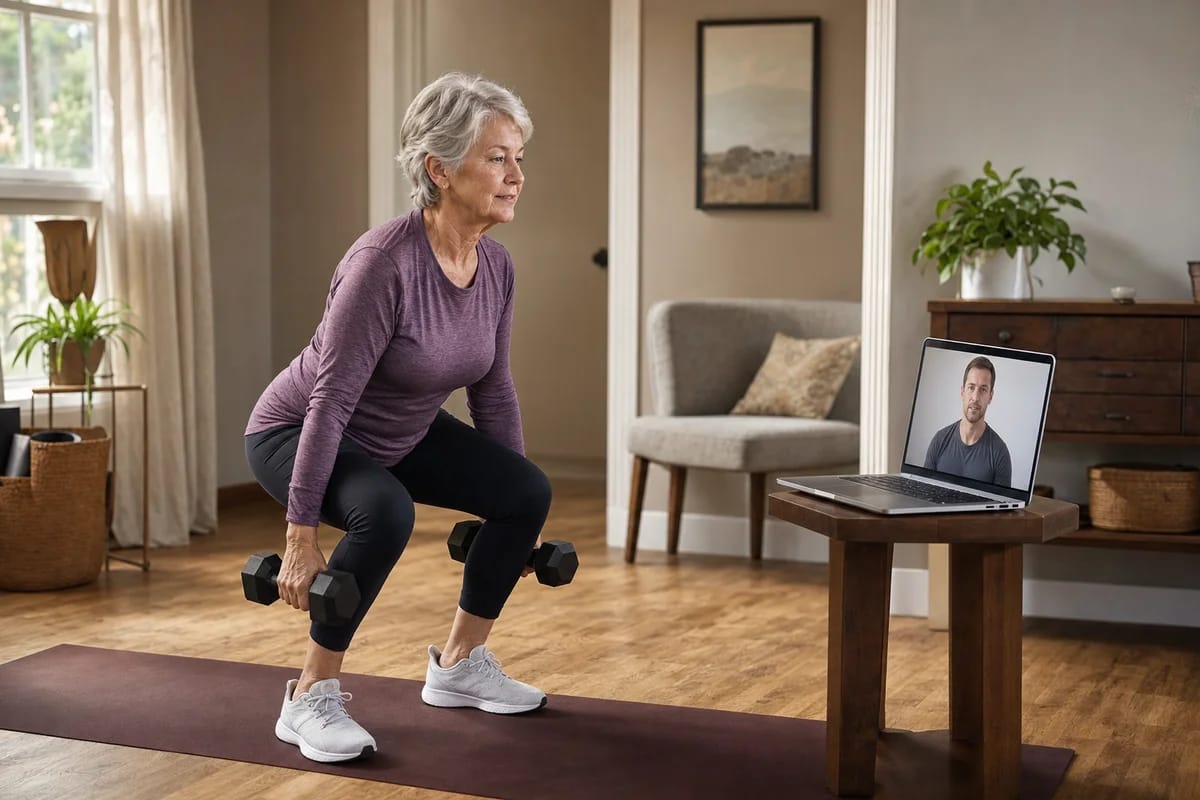
Muscle stays responsive to load for your entire life. Progressive resistance still triggers the same repair-and-grow signal in a 90-year-old that it does in a 20-year-old, just off a lower baseline. The actual risk in older lifters is almost never the weight on the bar. It's lifting unsupervised, with poor positions and nobody adjusting the load.
Heavy isn't the danger. Unsupervised and sloppy is, and that's fixable.
Myth 3: your metabolism crashes at 40
The claim: somewhere around your 40th birthday, your metabolism slams into a wall, and that's why the weight starts creeping on.
This is the myth that surprises people most, because it feels true. It isn't, and we finally have good data to check it against.
Researchers publishing in Science tracked energy expenditure with the doubly labeled water method, the gold-standard way to measure it, in more than 6,000 people across 29 countries, from 8 days old to age 95. Once they adjusted for how much lean tissue someone was carrying, energy burn stayed flat right through adulthood, from about 20 to 60 years old. It didn't start dropping until after 60, and even then only by about 0.7 percent a year. By your 90s you need roughly 26 percent fewer calories than you did in midlife.4 There's no cliff at 40, just a long, slow decline that starts two decades later than the myth claims.
Some of this is genuinely true, though. The number on the scale does creep up for a lot of people in midlife, and metabolism does eventually slow. Both of those are real. What's wrong is the explanation. Your engine, measured per pound of lean tissue, isn't slowing down in your 40s. What's changing is how much you move and how much muscle you're holding onto, and muscle burns calories all day just existing, so losing it drags your total burn down with it.
Midlife weight gain is mostly lost muscle and lost movement, not a broken metabolism. Both of those you can train back.
Myth 4: it's too late to start
The claim: if you didn't build the habit young, the window's closed. All that's left is managing the decline.
The window doesn't close. Go back to that Fiatarone group, the frail 90-year-olds who'd never trained a day in their lives and still gained 174 percent in strength in 8 weeks. If a room full of frail nonagenarians can add real muscle and walk faster in two months, the idea that 50 or 60 is too late doesn't survive contact with the data.
The machinery for building muscle, the satellite cells and the protein-synthesis response to a loaded muscle, keeps working into old age. It gets slower and wants a bigger nudge, more protein, more consistent training, but it never switches off. Untrained older adults often make the fastest early gains of anyone, because they're starting from so far back there's nowhere to go but up.
You don't get a smaller response because you're old. You get it because you haven't started yet.
Myth 5: 10,000 steps covers your bases
The claim: hit your 10,000 steps and your training box is checked.
Give this one its due, because the real part is strong. The largest look at step counts and mortality, pooling 15 cohorts and 47,471 adults, found that more steps meant a steadily lower risk of dying, right up to a point. That point arrived around 6,000 to 8,000 steps a day for people over 60, and 8,000 to 10,000 for younger adults. The researchers behind it said plainly that the famous 10,000 figure was a marketing number with barely any evidence behind it.5 Walking really is one of the best things you can do for how long you live.
But steps and strength are different currencies. Walking is aerobic, and it barely loads your muscles past what a normal day already does. It won't build or hold onto the strength that predicts how long you live independent of your cardio, the same muscle-strengthening effect from myth one. You can rack up 12,000 steps a day and still lose the leg strength that keeps you off the floor at 80.
Steps are a genuinely great mortality bet and a lousy strength plan. Do both.
Where the evidence is weaker than it sounds
Most of this comes from watching large groups of people over years, not from randomly assigning people to a training life for three decades and comparing outcomes. That's an important gap. The Momma, Pontzer, and Paluch numbers all show association, not proof of cause, and fitter, stronger people differ from everyone else in dozens of ways a statistical model can only partly account for.
The usual worry is reverse causality: some people are weak or inactive because an illness is already dragging them down, and it's the illness doing the damage, not the inactivity. Good studies try to strip this out by excluding people who die early in the follow-up period, and the link between strength and survival holds up when they do. It never fully disappears, though.
The Fiatarone trial is the most dramatic number in this whole piece and also the smallest study, just 10 people. Treat 174 percent as proof of what's possible in a 90-year-old body, not a number to expect for yourself. And the metabolism finding is an average per pound of lean tissue. Lose muscle as you age and your total daily burn drops anyway, which is one more reason to hang onto it.
Key takeaways
- Train both systems weekly. Whatever aerobic work you already do, add at least 2 strength sessions, since lifting's mortality benefit shows up in just 30 to 60 minutes a week.
- If you're over 60, lift real weight, not soup cans. Get supervised for the first few weeks so your positions are right, then keep adding load.
- Stop blaming your metabolism. Track your protein (about 1.6 grams per kilogram of body weight, roughly 0.7 grams per pound) and your weekly training instead. Those are the two levers that actually moved the numbers.
- Never trained? Start now, at any age. Expect fast early gains, and give it 8 to 12 weeks to show up.
- Keep your steps around 7,000 to 8,000 a day. That's cardio, not strength, so don't let it replace lifting.
Common questions
If I can only do one, should I pick cardio or strength? You shouldn't have to choose, and the research doesn't force it. If you're genuinely short on time, strength training delivers its mortality benefit in as little as 30 to 60 minutes a week and protects your independence in a way cardio can't. Most people already walk more than they lift, so strength is usually the missing half.
Will lifting hurt my joints as I get older? Done with good technique and sensible loading, resistance training tends to help your joints by strengthening the muscles around them. The real risk for older lifters is unsupervised ego lifting and bad positions, not the weight itself. That's a case for coaching, not for avoiding weights.
Does this mean my slow metabolism isn't real? If you're under 60, your metabolism per pound of lean tissue is almost certainly normal for your age. What usually changes in midlife is your muscle mass and how much you move, and both of those lower your total burn. The fix is training and protein, not a metabolism reset.
Is walking pointless then? Not even close. Walking is one of the best-supported things you can do for your lifespan, and the step-count data shows a clear dose-response. It just doesn't load your muscles, so it complements lifting instead of replacing it.
The facts were never the hard part
Every myth above breaks apart the same way: the research settled this years ago. What's actually hard is doing it consistently and safely, especially once real weight and older joints are both in the room.
That's where a coach earns their keep. At Bespoke Fit, your coach builds your strength and cardio program around your age and training history and runs every session live over video, fixing your position and adjusting the load in real time, though every fact in this piece is yours to use with or without a coach. Your first month is $49. After that, founding members pay $299 a month, locked for life, with unlimited live 1-on-1 sessions, 25 founding spots, and a 30-day money-back guarantee. See how it works.
Sources
-
Mandsager K, et al., 2018. Association of Cardiorespiratory Fitness With Long-term Mortality Among Adults Undergoing Exercise Treadmill Testing. JAMA Network Open. ↩
-
Momma H, et al., 2022. Muscle-strengthening activities are associated with lower risk and mortality in major non-communicable diseases: a systematic review and meta-analysis of cohort studies. British Journal of Sports Medicine. ↩
-
Fiatarone MA, et al., 1990. High-intensity strength training in nonagenarians: effects on skeletal muscle. JAMA. ↩
-
Pontzer H, et al., 2021. Daily energy expenditure through the human life course. Science. ↩
-
Paluch AE, et al., 2022. Daily steps and all-cause mortality: a meta-analysis of 15 international cohorts. Lancet Public Health. ↩