Swimming for zone 2 when your joints need a break
Your heart runs about 10 beats slower in the pool at the same effort, so land zone 2 numbers read too easy. Here's how to gauge zone 2 while swimming.
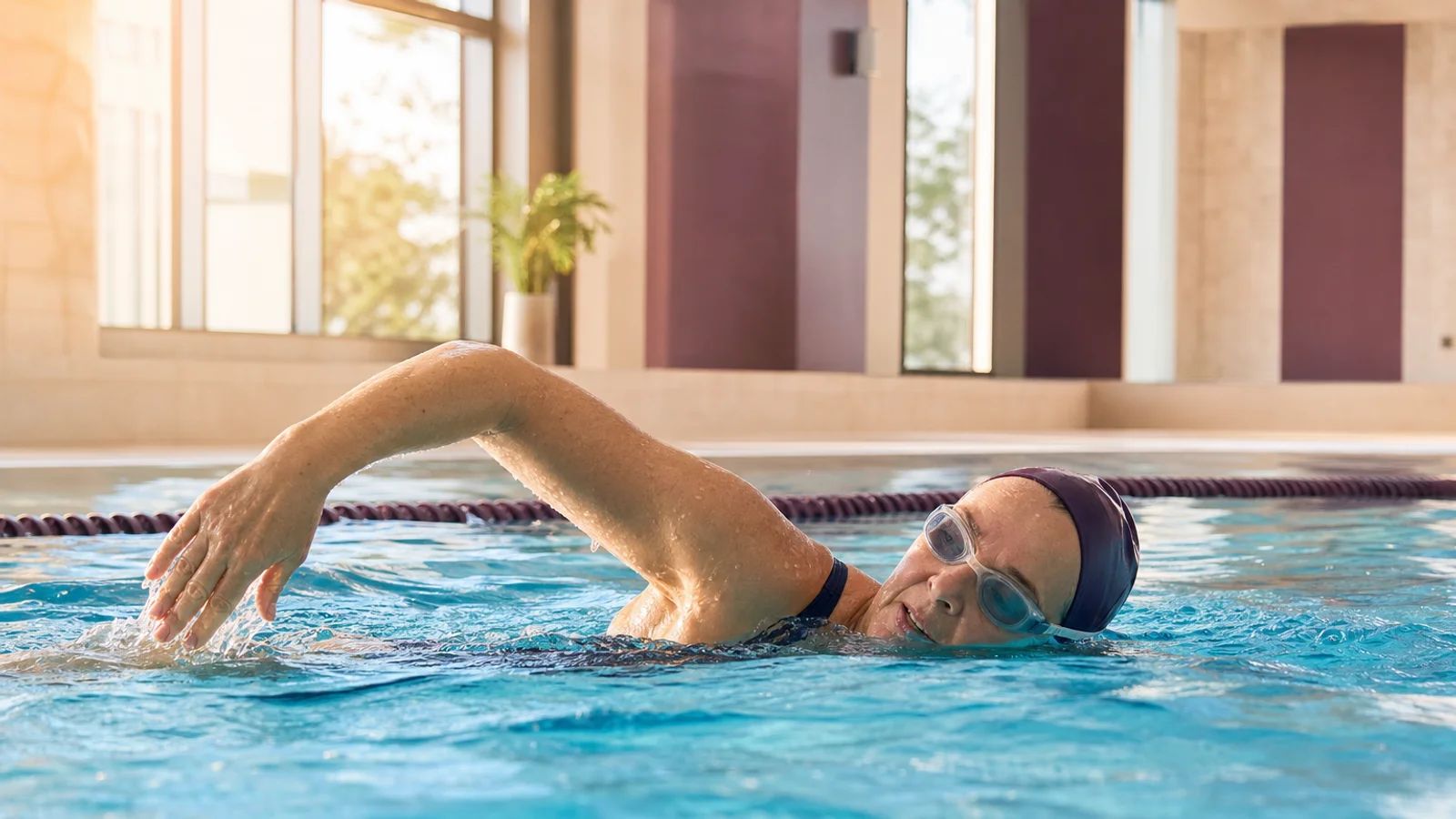
Get in the pool and swim at the same effort you'd run or bike, and your heart rate drops, often by 10 beats a minute or more. That's not fitness improving overnight. Water presses on your blood vessels, cools your skin faster than air, and lays you horizontal instead of upright. All three let your heart do the same job with fewer beats. The zone 2 number your watch learned on land is quietly wrong the second you push off the wall.
That's also why swimming is worth a look if running has started hurting. Water holds most of your body weight, so the pounding that grinds on arthritic knees, a sore hip, or a cranky lower back mostly disappears. You get real aerobic training without asking your joints to absorb it, once you know how to read your effort without trusting the number on your wrist.
Why the water fakes out your heart rate
Stand chest-deep in a pool and the water squeezes you. That's hydrostatic pressure, the same force that makes your ears hurt at the bottom of the deep end, and it pushes on the veins in your legs and gut hard enough to shift blood up toward your chest. A heart with more blood arriving fills fuller and pumps more with each beat, so it needs fewer beats to move the same amount. Researchers saw this directly back in 1987: 19 middle-aged men cycled both on land and neck-deep in water, and their hearts pumped more per beat at every stage in the water, beating slower for the same work once the effort got hard.1
Three smaller effects stack on top. Cool water pulls heat off your skin faster than air, so your body doesn't need to send as much blood to the surface to cool you down, which is work your heart skips. Swimming horizontal makes it easier for blood to return to the heart than standing does. And cold water on your face, combined with the breath-holding rhythm of swimming, triggers a mild reflex that slows the heart on its own.
None of this means your effort isn't real. It means the number on your wrist reads low for the same work.
How many beats should you actually subtract?
At an easy, steady pace, the gap is often around 10 beats a minute. A 2016 study in the European Journal of Applied Physiology followed 31 women averaging 59 years old and found their heart rate at a given oxygen use ran about 10 beats a minute lower walking in water than walking on land at the same intensity.2
Push the pace and the gap grows. A small trial of 20 young women doing matched interval efforts on land and in water saw heart rates run 17 to 19 beats lower in the pool once the work got hard.
So there's no single number to memorize. A land-based zone 2 ceiling reads somewhere around 10 beats too high in the water, more once you're working harder, and the exact offset shifts with water temperature (cold water pulls it down further, a warm therapy pool narrows the gap) and with the person. If your land zone 2 tops out at 130, don't chase 130 in the water. Knock at least 10 off the top, and treat even that as a starting guess rather than a measurement.
Trust your breathing over the watch
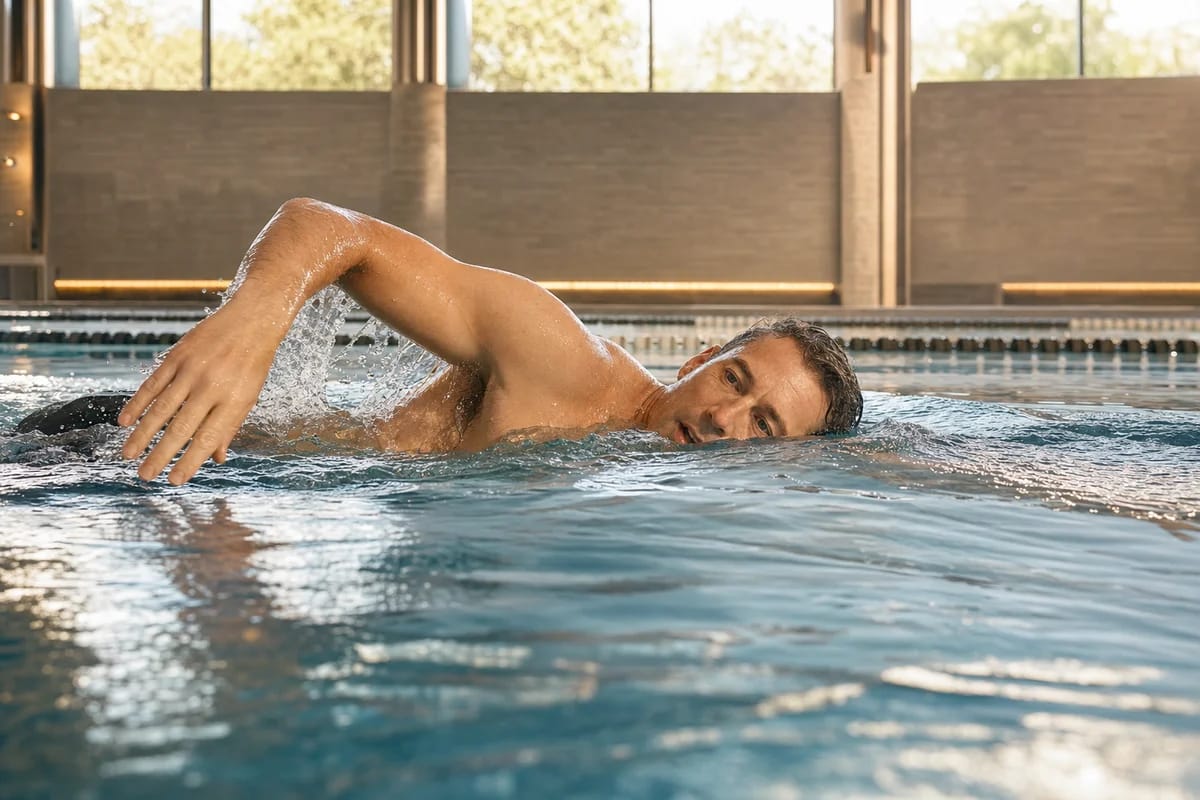
Stop treating the watch as gospel and read your body instead. Zone 2 is an easy, continuous aerobic effort, and the pool doesn't change what the zone is, only how you spot it. (Zone 2 training explained covers the full definition and why easy aerobic work pays off, if you want the background. This post is just about doing it in water.)
Three things work better than a heart rate number here:
- Breathing. In zone 2 your breathing is steady, not ragged. Settle into a pattern, say every third or fourth stroke, and hold it lap after lap without gasping at the wall.
- The talk test, done at the wall. Pause at the end of a length and try a short sentence. You should get it out but not want to linger. Chatting easily means you're going too slow. A couple of words between heaving breaths means you overshot.
- Perceived effort. Zone 2 should feel like something you could hold for 30 to 45 minutes, a 3 or 4 out of 10. If your stroke count per length starts climbing as you tire, you went out too fast.
Pick a pace that's boringly repeatable and a breathing rhythm you could hold for the whole session. That's your pool zone 2, whatever the watch says.
Joints win, bones don't keep score
Buoyancy offsets most of your body weight, so the pounding that a run sends through arthritic knees or a strained lower back mostly disappears in the water. You still get the aerobic stimulus, just without the joint bill, which is the real appeal if pain, extra weight, or a healing injury has priced you out of running.
There's real evidence behind that. A Cochrane review pooling trials of aquatic exercise for knee and hip osteoarthritis found moderate-quality evidence of small but clinically relevant short-term improvements in pain, disability, and quality of life.3 Small and short-term, sure, but for a joint that hurts on land, a form of cardio that doesn't provoke it is a real option, not a compromise.
The trade is that swimming isn't weight-bearing, so it does almost nothing for your bones. The same unloading that spares your joints means your skeleton gets no signal to get stronger. If bone density matters to you, and it should past your forties, swimming can't stand in for resistance training. It has to sit next to it. How lifting builds bone walks through why bone needs load that water won't give it.
Technique comes before zones for new swimmers
You can have a strong aerobic engine from years of cycling and still be gassed after two lengths of freestyle. Usually that's not your fitness. It's your technique.
Water is hundreds of times denser than air, so wasted movement, a dropped elbow, sinking legs, a head lifted too high, costs energy out of proportion to what it should. A smooth swimmer and a thrashing one can cover the same distance at the same speed while the thrasher burns far more to do it. Your heart rate and breathing spike because you're fighting the water, not because you're unfit.
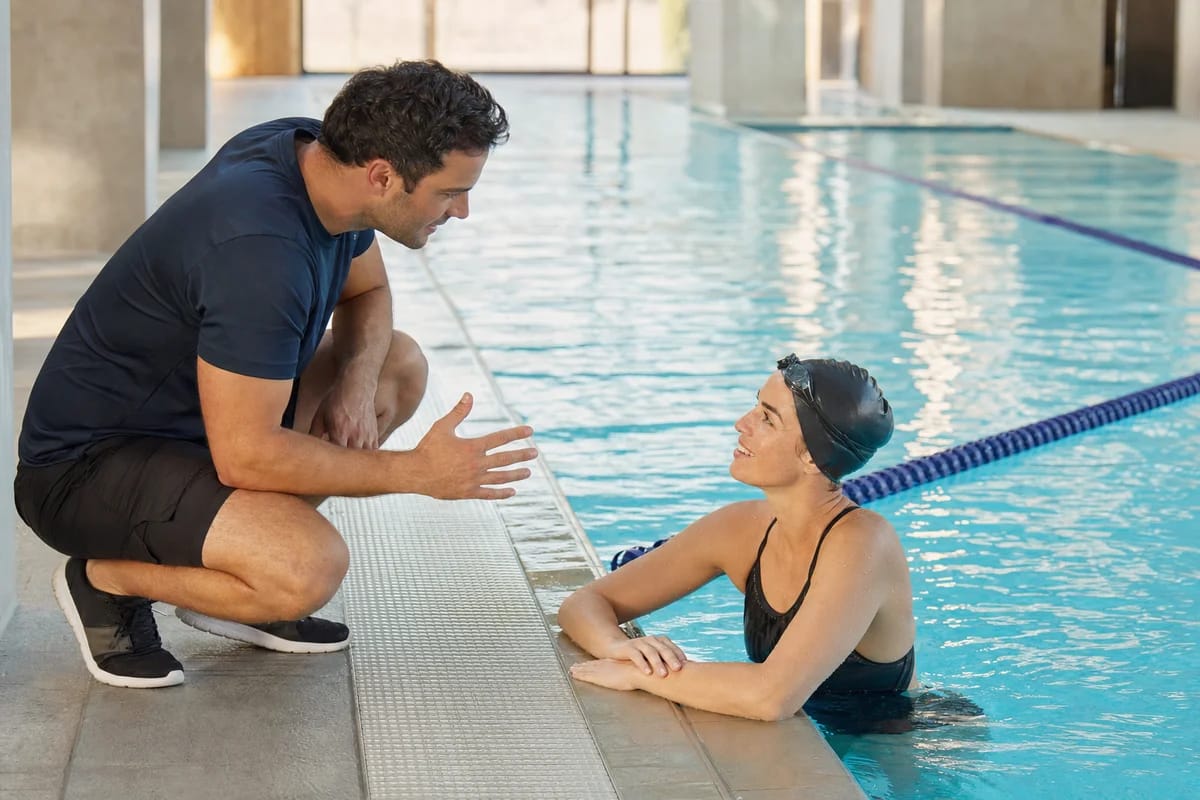
For a new swimmer, effort will jump around until your stroke smooths out, and holding a clean zone 2 pace is genuinely hard before that happens. That's a case for a few technique lessons, not a case against swimming. If freestyle isn't clicking yet, water walking or aqua jogging gets you the same buoyancy without the technique demand, a more repeatable way to log easy minutes while your stroke catches up.
Start simple, then build the rest of the week around it
Pick a lap pool you can get to two or three times a week. Swim continuous and easy, not intervals. Hold a breathing rhythm you could keep for the whole set. Subtract at least 10 beats from your land zone 2 ceiling and stop watching the number once your breathing settles in. Do 30 to 45 minutes, two or three sessions a week. That's the whole plan, and it works on its own.
What's harder to work out alone is everything around the swim: whether the pool is really the right call for your joints, how much land strength work to keep pairing with it so your bones don't fall behind, and when to push the pace versus hold it steady as you improve. At Bespoke Fit your coach builds the week around what your joints will tolerate, watches your strength sessions live over video, and adjusts as you get fitter. Your first month is $49. After that, founding members pay $299 a month locked for life, with unlimited live 1-on-1 sessions, 25 founding spots, and a 30-day money-back guarantee. How it works has the details if you want a coach building this around you.
Sources
-
Sheldahl and colleagues, 1987. Effect of head-out water immersion on cardiorespiratory response to dynamic exercise. Journal of the American College of Cardiology. ↩
-
Handa and colleagues, 2016. Target intensity and interval walking training in water to enhance physical fitness in middle-aged and older women: a randomised controlled study. European Journal of Applied Physiology. ↩
-
Bartels and colleagues, 2016. Aquatic exercise for the treatment of knee and hip osteoarthritis. Cochrane Database of Systematic Reviews. ↩