How often should you train with an online personal trainer?
Research points to 2 to 4 training days a week, each muscle twice, yet most people book one. Here's the frequency evidence by goal, training age, and budget.
Updated

2 to 4 training days a week, with every muscle worked at least twice. That's the dose the frequency research supports for almost any strength or size goal. Most people who hire a trainer see them once a week.
That gap has nothing to do with physiology. It's a budget. Once a week is what most people can afford at per-session rates, so once a week quietly became the default dose.
The question really has two halves, and they don't share an answer. How often you should train is a research question. How many of those sessions need a coach on the call comes down to whether the sessions you plan to do alone ever happen. I run a coaching service, so I have an obvious stake in telling you to train more, which is why what follows leans on published research and points at the thin spots.
The short answer, by where you are
- Brand new, or coming back after years off: three coached sessions a week for your first 12 weeks, full body each time.
- Six months to two years in: three or four training days a week, each muscle hit at least twice, with a coach on most of them if your attendance is patchy.
- Two years in and reliably self-driven: one coached session a week as a programming check-in, plus two or three solo sessions on the plan.
Whichever line you're on, give it 10 to 12 weeks before you judge it. That's the window nearly every trial used, and verdicts reached sooner are mostly noise.
Frequency research counts muscles, not appointments
The studies everyone quotes measure how often a muscle gets trained, not how many appointments you book. Related, not the same, and the numbers get much clearer once you split them.
Across ten pooled training studies, muscles worked twice a week grew more than muscles worked once.1 For strength, twenty-two studies pooled in 2018 showed gains climbing steadily as training went from one day a week to four or more, effect sizes rising from 0.74 to 1.08.2
Then those authors reran it using only the studies that matched total weekly volume, and the frequency advantage vanished.2
So why train more than once or twice a week at all? Because the work has to fit somewhere, and set quality drops as a session drags on. Cram 20 hard sets for one muscle into a single long workout and the last third gets done tired, with lighter weights and uglier reps. Spread those same sets over three shorter sessions and every one gets done fresh.
The days aren't magic. Enough good work per muscle barely fits into one or two sessions, and sits comfortably in three or four.
Why does almost everyone book one session a week?
Money, nearly all of it. Personal training in the US runs $40 to $100 a session, averaging around $55. Three of those a week is roughly $520 to $1,300 a month, which prices out anyone who isn't treating training as their main hobby.
So people ration. They buy one coached session and plan to train alone the rest of the week. Sensible on paper, with a predictable failure mode: the coached session happens, because a human is waiting on the call. The solo ones are the ones that quietly disappear. In a 2025 randomized trial, lifters training under supervision completed 88% of their sessions and lifters left to themselves completed 52%, which is a fair estimate of how fast.3 I went through that evidence in does online personal training actually work.
Rationing has a second cost, and it shows up on the coaching floor. Give someone one session a week and that session stops being training. It turns into a weekly review meeting with some exercise attached, because the coach has to spend it piecing together what happened on the other days. The per-session math across different services is in how much does online personal training cost.
None of that makes once a week useless. It just means once a week is a budget decision, and it's worth knowing whether you chose it or drifted into it.
Beginners need a coach on nearly every session
Two reasons, and they're independent of each other.
The first is physiology. A 2003 meta-analysis in Medicine & Science in Sports & Exercise, pooling 140 studies and over 1,400 effect sizes, found untrained people gained strength fastest training each muscle 3 days a week, while trained lifters peaked at 2.4
The second is behavior. Researchers who followed 111 new gym members for 12 weeks found that exercising at least four times a week for six weeks was the minimum pattern that predicted a stable exercise habit.5 Fewer, more scattered sessions never went automatic.
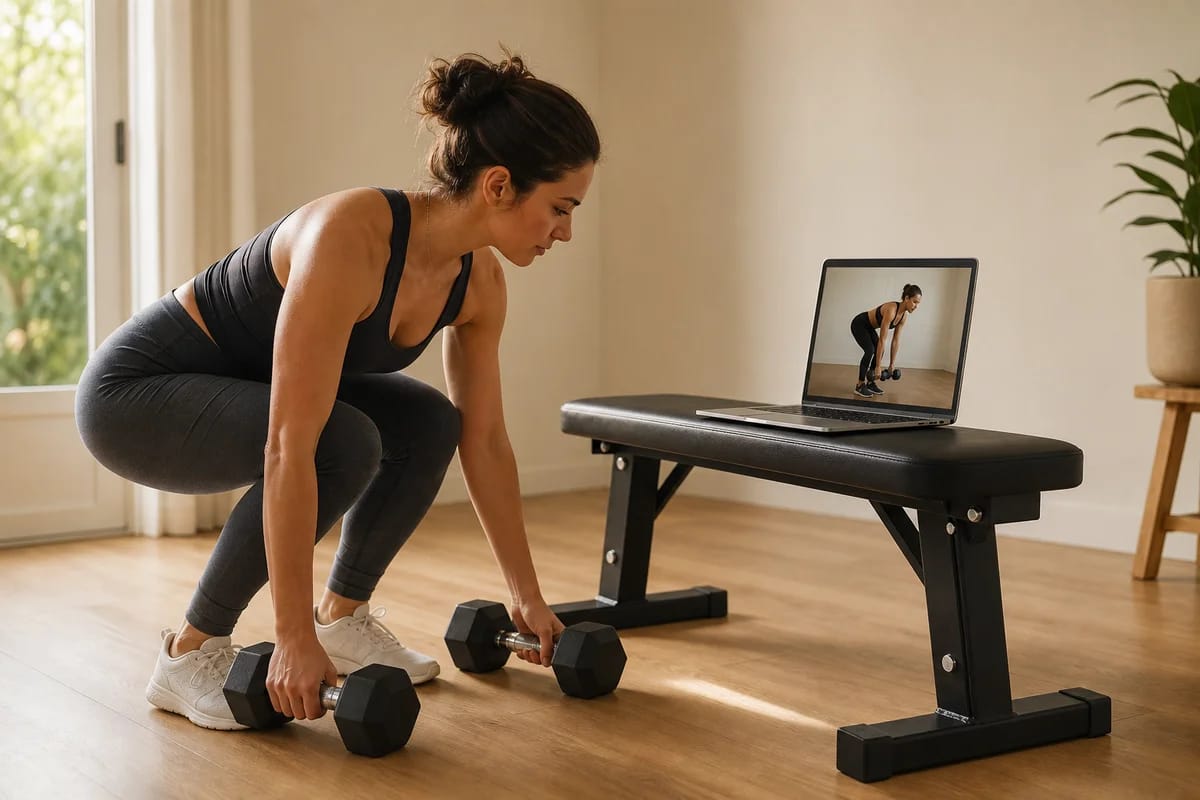
On top of both, every session in your first months is a technique session, and technique is the part someone has to watch while it's happening.
So the beginner number lands at about three coached sessions a week for the first three months. That's the dose that builds strength, technique, and the habit at the same time.
Who does fine on one coached session a week?
There's a lifter for whom one session a week is the right call rather than a compromise. Two or more years of consistent training. Doesn't skip solo sessions. Can tell how many reps were left in the tank. Lifts still moving.
For that person the coach's job shifts from supervision to programming. The weekly session becomes a check-in: review the week's numbers, watch the main lifts under real load, catch the technique drift you can't see from inside a set, then adjust the next block. The other two or three sessions run on the program alone, and they happen, because showing up was never this person's problem.
The 2003 pooling backs the logic. Trained lifters peaked at 2 days per muscle per week, so an experienced lifter on a sane three or four day program has no physiological need for a coach at every session. What they need is someone keeping the program honest.
Your log settles this better than your self-image does. Pull up the last eight weeks. If every solo session happened and the loads moved, once a week is enough. If the log has holes in it, you don't have a programming problem, you have an attendance problem, and more coached sessions is the fix the adherence numbers point to. Completing under about 85% of what you planned is the line I'd use.
Where the frequency evidence runs out
Most of these trials run 8 to 12 weeks on young, mostly male participants, so the long-term and older-adult picture is thinner than the confident numbers make it sound. They count per-muscle frequency, not appointments with a trainer, so mapping them onto coached sessions takes judgment. And the volume-equated result cuts both ways: a lot of weekly layouts work, which also means nobody can tell you your exact schedule is the correct one.
The biggest hole is the question this article is about. I couldn't find a trial comparing one coached session plus two solo ones against three coached sessions, head to head. That part is triangulated from adherence data rather than tested.
Common questions
Is one personal training session a week enough to see results?
It can be, as long as the other sessions still happen. One weekly session on its own sits below the twice-per-muscle threshold the growth research supports, so results depend on you training one to three more times alone. Experienced, consistent lifters do fine that way. Beginners usually don't, because the solo sessions are the ones that get skipped.
Is training twice a week enough to build muscle?
Yes, especially in your first year. Two well-run full-body sessions hit each muscle twice a week, which is the frequency the pooled growth research supports. Gains come slower than at three or four sessions, simply because less total volume fits in the week. Twice a week done for a year still beats four times a week abandoned in March.
How many times a week should a beginner see a trainer?
For the first three months, as often as you train, ideally three times a week. Every early session is a technique session. The habit research points at roughly four workouts a week for six weeks as the pattern that makes training stick. Once that base is there, plenty of people taper coached frequency down without losing momentum.
Can you train with an online personal trainer every day?
Physically, yes, if the programming alternates intensity and muscle groups and includes lighter movement days. Practically it depends on the service model, since per-session pricing makes daily coaching absurd for most budgets while flat-rate models allow it. Daily blocks work best as short pushes, a few weeks before an event or to rebuild a habit, rather than a permanent setting.
How you pay decides how often you train
Bespoke Fit sits on one side of this argument by design. Membership is a flat rate with unlimited live 1-on-1 HD video sessions and no per-session cap, so your cadence gets set by your coach, based on your goal and training age, instead of by session math. Most members land at three or four sessions a week, some run daily blocks for a few weeks at a time, and at four a week the founding rate of $299 a month, locked for life, works out to about $18.69 a session. The first month is $49, there's a 30-day money-back guarantee with no questions asked, and sessions can be rescheduled up to 12 hours ahead. Pricing and how it works cover the rest, and the fine print on what "unlimited" means is on the fair use page.
Before you pay anyone, though, ask yourself the log question one more time. Over the last eight weeks, how many sessions did you plan and then skip? If it's close to none, buy a single good session a week from a per-session coach and keep the difference, because unlimited coaching only pays for itself through frequency. If it's most of them, frequency is the thing you're short of, and that's what a flat rate buys.
Sources
-
Schoenfeld, Ogborn, Krieger, 2016. Effects of Resistance Training Frequency on Measures of Muscle Hypertrophy: A Systematic Review and Meta-Analysis. Sports Medicine. ↩
-
Grgic, Schoenfeld, Davies, Lazinica, Krieger, Pedisic, 2018. Effect of Resistance Training Frequency on Gains in Muscular Strength: A Systematic Review and Meta-Analysis. Sports Medicine. ↩ ↩2
-
Gavanda, Held, Schrey, Oberwetter, Lazzaro, Pergelt, Geisler, 2025. Optimizing Resistance Training Outcomes: Comparing In-Person Supervision, Online Coaching, and Self-Guided Approaches: A Randomized Controlled Trial. Journal of Strength and Conditioning Research. ↩
-
Rhea, Alvar, Burkett, Ball, 2003. A Meta-Analysis to Determine the Dose Response for Strength Development. Medicine & Science in Sports & Exercise. ↩
-
Kaushal, Rhodes, 2015. Exercise Habit Formation in New Gym Members: A Longitudinal Study. Journal of Behavioral Medicine. ↩
More on