7 best online personal trainers who train you live in 2026
7 online personal trainers who are on video with you while you train, ranked on what you pay at your pace, who coaches you and the app around the call.
Updated
In this article10
The short answer
Best overall: Bespoke Fit (ours). A coach is live on every session and watches your heart rate as you train, each coach has at most 12 members, and $299 a month covers as many sessions as you book. Cheapest: HipTrain, at one or two sessions a week. Future and trainwell don't put a trainer on your workouts.
If you've been looking for an online personal trainer, you've probably met Future, trainwell and Caliber. They're good services at $149 to about $200 a month, but they're built around an app: a trainer writes your plan, you train on your own, and feedback comes later by message.
This page is about the other kind: a trainer on a video call with you, watching your reps and changing the next set from what they just saw, the way a trainer at a gym would. We found seven that sell it at a price you can read before you sign up. At an hour twice a week they cost $220 to about $700 a month (one boutique studio charges $1,000), against $433 to $780 for a trainer in person.
We run one of the seven, Bespoke Fit, and we've put it first. Every reason is set against the other services' own published terms below, so you can check us. The short version on price: from three sessions a week ours is the cheapest live hour on this list, and below that it isn't, so we'll say who should pick something cheaper.
Live or app-based: check this first
A trainer on the call
- Watches your reps while you do them
- Fixes your form mid set, then changes the next set
- You book a time, like any appointment
- Costs more, because you're booking a person's time
A trainer in the app
- Writes your plan and checks in by message
- Reviews a clip you film, often hours later
- You train whenever you like, on your own
- Usually about $100 to $200 a month
If you already know your way around a squat and mostly want a smarter plan, the app kind costs less and works. If you're new, coming back after years off, or you know you skip workouts nobody's waiting for, the trainer on the call is the thing you were picturing when you searched. There's a longer side-by-side in live vs app-based coaching, and if a service's website is vague about which it is, five questions will tell you.
The seven, ranked
| # | Service | Pick it if | An hour, 2× a week | To try it |
|---|---|---|---|---|
| 1 | Bespoke Fit | You'll train 2 or more times a week | $299, any number | 14 days free, card needed |
| 2 | HipTrain | Price matters most | $220 | First session free, no card |
| 3 | Papayya | You want 30 or 45 minutes | $343 on promo | 14 days free, no card |
| 4 | Echelon Coach | You want specialists, yoga to physical therapy | $484 to $693 | First session about $5 |
| 5 | Mywowfit | You want a cheap first taste | 30 min: from $217 | $10 for 30 min |
| 6 | The Perfect Workout | 20 minutes twice a week is enough | 30 min: $235 to $465 | Free intro |
| 7 | Holly Roser Fitness | You want a boutique studio | $1,000 | Free 15-min consult |
Where one flat price wins
Six of the seven charge more the more you train: per session at Echelon Coach and Mywowfit, by sessions a week at HipTrain, Papayya and The Perfect Workout, by membership at Holly Roser. We charge $299 a month for as many sessions as you and your coach book. Here's an hour at the paces people actually train.
Hour-long sessions, per month
| Service | 2× a week | 3× | 4× | 5× |
|---|---|---|---|---|
| Bespoke Fit | $299 | $299 | $299 | $299 |
| HipTrain | $220 | $320 | not sold | not sold |
| Papayya, promo | $343 | $486 | $609 | not sold |
| Echelon Coach | $484 to $693 | $725 to $1,040 | $967 to $1,387 | $1,209 to $1,733 |
| Holly Roser Fitness | $1,000 | $1,500 | not sold | not sold |
| In-person trainer | $433 to $780 | $650 to $1,170 | $867 to $1,560 | $1,083 to $1,950 |
Our maths: price per session × sessions a week × 52 ÷ 12, rounded (our pricing page counts a month as four weeks, so it shows $18.69 a session at four a week). Echelon Coach runs from its biggest bundle to a single session. Mywowfit prices hours only in euros and The Perfect Workout sells only half hours, so neither is in the grid. In person is Bark's US average of $50 to $90 a session.2
What the grid says, straight:
- Once a week, don't buy a flat price. An hour a week is $110 at HipTrain and $181 at Papayya on promo. Ours works out to $69 a session.
- Twice a week, HipTrain costs $79 a month less for hours, and $179 less for half hours. Papayya is cheaper too if 30 or 45 minutes is enough ($226 or $291 on promo), and so are Mywowfit's half hours, from about $217. What that $79 buys with us is under HipTrain below.
- Three a week, we're the cheapest hour on the list: about $23 a session. HipTrain is $320, and stops there.
- Four a week, nobody comes close. Papayya's promo is $609, Echelon Coach $967 or more, and HipTrain doesn't sell it. Ours is $17.25 a session.
- Five a week is where a flat price runs away with it. On this grid, only Echelon Coach and a trainer in person still sell that many hours, at $1,083 a month or more. Ours is still $299, about $13.80 a session. Train six times a week and it's about $11.50, because our fair-use policy puts no cap on how many sessions you book.
The price model also changes what your coach plans. When every session costs extra, a coach who thinks you'd do well with a third session a week is asking you for more money. When it doesn't, they plan what you need. It changes your week too: you're not deciding whether today's workout is worth $40, because it's already paid for and someone's waiting on the call.
Every option here except Holly Roser and the top of Echelon Coach's range costs about the same as or less than a trainer in person at the same pace. If you want the whole market, apps and AI included, what online personal training costs covers it.
What you get besides the hour
Price is the easy part to compare. These are the things that decide whether you're still training in month six. The two studios are left out of this table; their profiles are further down.
| Service | Your coach | The call and the app | Coach watches your heart rate live |
|---|---|---|---|
| Bespoke Fit | Matched to you, with at most 12 members | Our own app on iPhone, Android and the web: call, program, progress and messages | Yes |
| HipTrain | The same coach every session | Its own app, with chat; iPhone app last updated July 2024 | Couldn't find |
| Papayya | No right to a specific trainer, per its terms | A video link; no app | Couldn't find |
| Echelon Coach | Whichever trainer you book | Its app or website; Android app last updated October 2023 | Couldn't find |
| Mywowfit | Not guaranteed, per its terms | Zoom or Google Meet; tracking in a third-party app, per its privacy policy | Couldn't find |
"Couldn't find" means we looked on its site and app listings on November 11, 2026 and found nothing.
A coach with time for you. Live training works because the person on the call remembers last week: the knee that grumbled, the set that moved fast. That takes room in their week. A coach who's on every session live can't look after hundreds of people, so ours don't: each coach has at most 12 members, a cap we hold when we assign them. For contrast, trainwell's CEO has said that, thanks to software it built, its trainers, who aren't on your workouts, "can train hundreds of clients at once".3 You don't pick from a catalogue, either. A head coach meets you on a 30-minute call and matches you, every coach does 90 days of onboarding with our founder before taking a member, and a head coach reviews recorded sessions for quality. You can meet them on our coaches page.
HipTrain keeps you with one coach too, and its coaches are well reviewed. Echelon Coach is a marketplace: you rebook a trainer "whenever they are free", and its own FAQ recommends sticking with one.4 Papayya's terms say there's "no entitlement to a specific trainer", and that plans "provide 1:N Sessions by default", meaning "a trainer may coach more than one Client at the same time". Its site calls sessions 1‑on‑1, and nothing says how often the shared kind happens.5
An app built around the call. Our sessions run inside the Bespoke Fit app on iPhone, Android or a browser, not a Zoom link, and the same app holds the program your coach writes, your log, your lifts over time and your messages. We shipped 13 versions of it between August 20 and November 3, 2026. Elsewhere, we couldn't find progress tracking described on HipTrain's site or app listings,6 the App Store link on Echelon Coach's site returns a 404, Papayya says it needs "no downloads and no app", and Mywowfit's privacy policy says workout and progress tracking runs through Trainerize, a coaching app made by another company.7
A coach watching your heart rate. Wear an Apple Watch or a Bluetooth heart rate strap and your coach sees your heart rate on their screen during the session, and trains you by it. Say you've just done a set of step-ups. If your heart rate is still high a minute later, you get longer before the next set; if it has barely moved and you're chatting happily, the next set gets heavier. Sessions save to Apple Health (Health Connect on Android), and the app reads your other workouts and activity from it.
Sessions that can run long. Ours run 45 to 90 minutes, and most people settle at about an hour. A 90-minute session costs the same as a 45. Every other service here trains you for an hour at most; Holly Roser's one 90-minute call is an assessment and program session, at $219.8
Who each one suits
Bespoke Fit, if you'll train two or more times a week
That's us: 14 days free, then $299/mo, the same price for everyone. Other lists sometimes show our older prices; this is the current one. We've quoted star ratings for the others and show none for ourselves, so don't take this page's word for it. That's what the 14 days are for: they start at your first session, not at signup, so you judge the coaching before you pay anything. You add a card when you join, a reminder goes out 3 days before the first charge, and cancelling in the trial costs nothing. After the matching call, your coach writes your program and books sessions with you at times you both have, as many a week as you agree on. If your coach isn't the right fit, ask and we move you and your booked sessions to another. How it works walks through a session.
Who shouldn't buy it: anyone training once a week, anyone who wants 30-minute sessions, anyone who wants meal plans or macro targets, which we don't do, and anyone already training well on their own who only wants a plan, which an app-based service does for less. Sessions are appointments with a person, with three free late cancellations a month and $20 each after that, under our fair-use policy. And it's not in person: your coach sees you through your camera and can't spot a heavy lift.
HipTrain, if price matters most
HipTrain is the closest thing to us: live 1‑on‑1 video every session, the same coach, its own app with chat between sessions. Its coaches are certified trainers based in Latin America, and its reviews praise them. Plans are monthly and priced by sessions a week: $59.49 to $179.99 for half hours, $109.99 to $319.99 for hours, about $14 and $25 a session. Your first session is free with no card, and it's HSA and FSA eligible.6
Pick it over us at once a week, or at twice a week if an hour or less is all you want and the lower bill matters most. Pick us at twice a week if about $9 a session more is worth this: a coach who sees your heart rate and sets your rest and weights by it, sessions up to 90 minutes, your program and progress in the same app as the call (HipTrain's iPhone app was last updated in July 2024), and a third or fourth session at no extra cost, where HipTrain adds $100 a month for a third hour and sells no fourth. At three or more a week, pick us on price alone.
Papayya, if you want to pick your session length
Papayya has its own team rather than a marketplace, and says every trainer holds a certification plus a college degree in a field like kinesiology or sports science. You pick 30, 45 or 60 minutes and one to four sessions a week, and the more you train, the less each one costs. At its 2026 promotional rates a session runs $23.20 to $41.74, against crossed-out prices of $42.24 to $76. Plans renew every four weeks. The 14-day free trial needs no card.5
Worth knowing: besides the shared-session and trainer terms above, the terms ask for 24 hours' notice to reschedule while the homepage says 8, and the homepage says "Join today to lock in" the promo rate without saying for how long. Pick it for two sessions a week of 30 or 45 minutes on a budget.
Echelon Coach, if you want a specialist
Echelon Coach used to be FlexIt; Echelon bought it in March 2025 and rebranded it. You book trainers from partner gyms across strength, yoga, nutrition and physical therapy, and pay by the session: $40 for 30 minutes, $60 for 45, $80 for an hour, down to about $29, $42 and $56 in its biggest monthly bundle, which bills the whole pack every 30 days. A first session costs about $5.4
Worth knowing: monthly plans carry a two-month minimum, and after a 72-hour refund window on your first session, sessions you've bought are non-refundable. Pick it to see a yoga teacher one week and a physical therapist the next, or to train less than once a week.
Mywowfit, if you want a cheap first taste
Mywowfit runs every session live, with trainers who hold NASM, ISSA or ACE certificates, three of the main US personal trainer qualifications. A first 30-minute session is $10, sessions start at $25 for half an hour, and longer ones are priced only in euros on its site. It's HSA and FSA eligible through Truemed, after a health questionnaire, and Trustpilot shows 4.9 from 250 reviews.7
Worth knowing: packs of 8 or 12 sessions expire after three months, and the terms say it "cannot guarantee a particular trainer, time slot or schedule". Pick it to find out what live training feels like for $10.
The Perfect Workout, if 20 minutes twice a week is all you want
The Perfect Workout is a chain of strength studios built around one method: lifting slowly and under control until the muscles can't do more. Its virtual sessions are "always live", booked for 30 minutes with about 20 of work, once or twice a week, for $235 to $465 a month depending on frequency, commitment and studio. You need no equipment. The intro is free, and if you show up, follow the plan and aren't measurably stronger in 90 days, you get a full refund.9
Pick it if time is what you're shortest of. It isn't built for training more often, or for running, mobility or anything outside that one method.
Holly Roser Fitness, if you want a boutique studio trainer
Holly Roser runs a personal training studio in San Mateo, California, and trains clients live over Zoom. Each hour is a 5-minute check-in, a 45-minute workout and a 10-minute cool-down. A single session is $136; a membership is $125 a session at $500, $1,000 or $1,500 a month for 4, 8 or 12 sessions, with 30 days' notice to cancel. It shows 4.9 stars from 134 reviews.8
Pick it if you want a high-end studio trainer on a screen and price isn't the question. It's the most expensive option here, more than most in-person trainers at the same pace.
The famous names that aren't live
These five turn up in most lists of the best online personal trainers. Each gives you a real person behind your plan. None has that person on the call for your regular workouts, though Caliber and Kickoff offer some live calls.
| Service | Price | How the coaching works |
|---|---|---|
| trainwell | $149/mo, billed every 3 months | Trainer writes the plan, the app runs the workout. Its own site suggests an in-person trainer if you need "real-time correction on every rep".10 |
| Peloton Personal Trainer | $99.99/mo on top of a Peloton membership, in an iPhone-only beta | Run by trainwell. Peloton's FAQ says video calls are "not for live workout sessions".11 |
| Future | $50 first month, then $199/mo | Coach plans your week and messages you; you train alone to their recorded cues12 |
| Caliber | 1‑on‑1 starts "around $200 per month", per its signup page | Coach reviews clips you film and messages you; you train on your own13 |
| Kickoff | $95/mo, or $0 through insurance for most Americans, by its own account | Weekday texts from a coach; live video workouts are "optional"14 |
None of these is a bad buy. trainwell's trainers are full-time employees and its app is good and updated often. Kickoff's insurance-tier coaches are registered dietitians as well as trainers. Three of the five cost half what we do or less. trainwell and Future both record your heart rate from a watch or strap, but neither has a coach on the call, so nobody is changing your session by it as you train. TechCrunch's 2023 write-up of trainwell, then called Copilot, put it plainly: the coach "isn't watching your workouts".15 If you train well on your own and want a human behind the plan, they're a good fit. If what you wanted was someone watching, they aren't.
Does trainwell have live sessions? goes into that one in detail, and our comparison pages take the others one at a time. If you're a Peloton member who'd like a live coach for strength and the bike for cardio, this page covers that setup.
What a live session at home is like
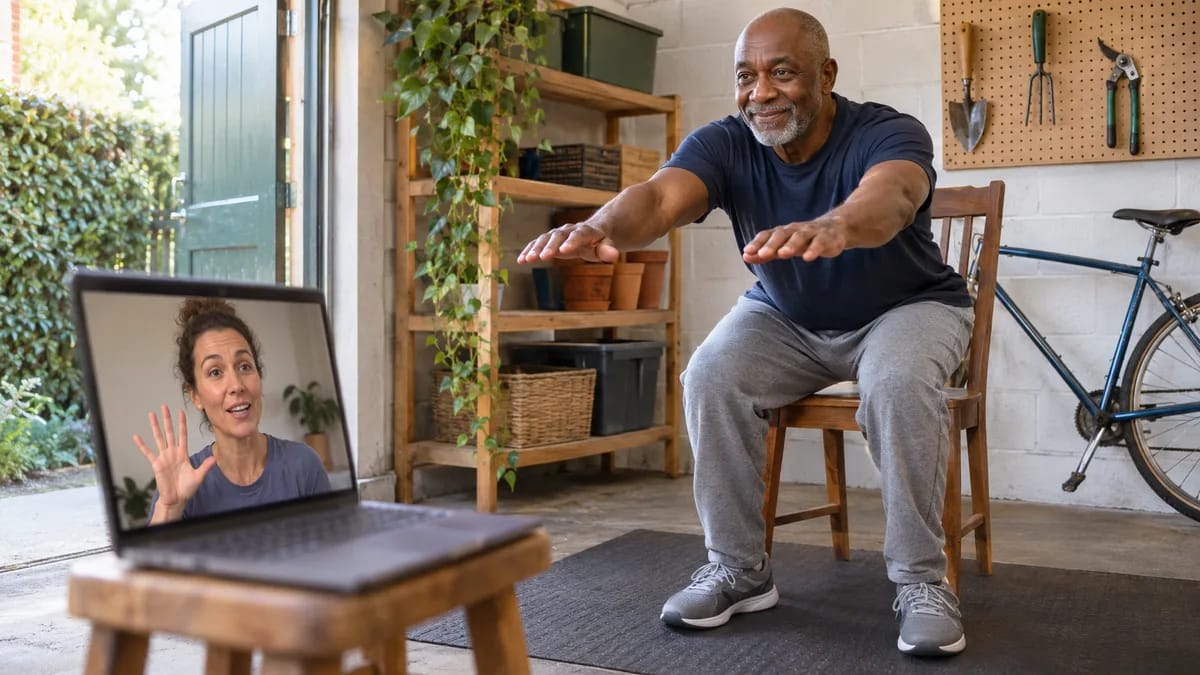
Here's how an hour goes with us; most live services run much the same way. A reminder comes the day before and again shortly before, at the lead time you choose. When you're set, you tap "Ready to work out" in the app, which tells your coach, and open the call. Your coach says hello and asks how you slept, whether anything aches, how last time felt. You lean the phone against something at about hip height, step back two or three big paces so all of you is in the frame, and start warming up while they watch.
From there it's a normal training session through a screen. They count. They cue ("sit back a little more", "slower on the way down"). They ask you to turn side-on when they want to see your back or your knees, and they change the next set based on what they just saw. Dumbbell too light? They'll slow the reps down. Knee grumbling? They'll swap the move. You don't need to know the name of anything. When you finish, the app shows a recap: what you lifted, your sets and any records.
A trainer on video sees almost everything a trainer in the room sees: your joint angles, how fast the weight moves, when you hold your breath, the face you make on rep nine. What they can't do is touch. There's no hand on your back to show you where to brace and no spot on a heavy bench press. At home that usually matters less than you'd think, because most home sessions don't use weights heavy enough to need a spotter. Filming your own lifts vs being watched live covers what each one catches.
After two or three sessions you'll know whether your trainer is any good. Here's what to watch for.
Good signs
- They say what they saw after each set
- The next set changes because of it
- They ask about pain and swap moves that hurt
- They ask you to move the camera when they can't see
- Most of the talk is about you
Time to switch
- They look away or seem to be on another screen
- The workout's the same whatever you tell them
- "Push through it" when something hurts
- Long pauses while you wait for the next move
- They can't say why today's exercises are in your plan
What you need for a first session
- Set up a phone, tablet or laptop with a camera, and something to lean it against
- Clear a patch of floor about 6.5 ft (2 m) square
- Wear clothes you can move in; ordinary ones are fine
- Keep water and a sturdy chair nearby
- Bring whatever weights you already have, or none at all
- Tell your trainer, in a sentence, about any old injury, pain or health condition
If you have a heart condition, are recovering from surgery, are pregnant, or have pain that's new or getting worse, check with your doctor before you start, and tell your trainer in the first session. Camera angles, sound and the rest of the set-up are in the logistics of live video training.
Does it work as well over video?
Close, as far as the small studies go. In a 16-week trial in healthy older adults, people trained by video did as well as people trained in the room on body weight, body fat, aerobic fitness and leg power; on muscle mass and grip strength the video group couldn't be shown to match.16 Having someone guide you seems to matter more than how: in a 2025 trial in adults who already trained, people coached in person or through an app stuck to the program far more often than people handed a PDF plan.17 Nobody has tested the long run yet. These studies last months, not years.
Before you pay
Questions to ask before you pay
- Ask whether the trainer is on the video for the whole workout, not just a check-in
- Ask what a third or fourth session a week would add to the bill
- Ask whether you'll have the same trainer every time, and how many people they coach
- Read the late-cancellation rule and any minimum term
- Find out what the price becomes after the trial or promo ends
Common questions
Is $299 a month a lot for an online personal trainer? It depends how often you train. At three hour-long sessions a week it works out to about $23 a session, and at four about $17, against $50 to $90 a session for a trainer in person in the US. At one session a week it's about $69 a session, and a cheaper live service makes more sense.
Do I need to be fit already to start with an online trainer? No. A good trainer starts from wherever you are, and for some people that's standing up from a chair ten times. Tell them your starting point honestly in the first session, and don't worry if the first few sessions feel easy. That's the trainer doing their job.
What happens if my internet drops mid-session? Rejoin the call and carry on. To make it rarer, test the call in the spot you'll train before your first session, stay close to your router, close other video apps and keep the phone plugged in. If the service charges for missed sessions, ask whether a dropped connection counts.
Sources
-
Fitness Together, 2026. Live 1‑on‑1 virtual training, read November 11, 2026: "Rates, services, and promotional offers vary; see individual studio for details." ↩
-
Bark, updated January 16, 2026. How much does a personal trainer cost?. Bark marketplace data, read November 11, 2026. ↩
-
Matt Spettel, trainwell CEO, talk at Carnegie Mellon's Swartz Center, September 2025 (video, at 48:05). He was describing capacity, not an average caseload; trainwell publishes no clients-per-trainer number. ↩
-
Echelon Coach, 2026. Training plans, plan terms, FAQ and Google Play listing, read November 11, 2026; Athletech News, March 17, 2025, Echelon acquires FlexIt to expand personalized training. ↩ ↩2
-
Papayya, 2026. papayya.com and Terms and conditions (effective November 1, 2025), read November 11, 2026. ↩ ↩2
-
HipTrain, 2026. hiptrain.com, Pricing and App Store listing, read November 11, 2026. ↩ ↩2
-
Mywowfit, 2026. mywowfit.com, Prices, Terms and Privacy policy; Trustpilot. Read November 11, 2026. ↩ ↩2
-
Holly Roser Fitness, 2026. Train online. hollyroser.com, read November 11, 2026. ↩ ↩2
-
The Perfect Workout, 2026. FAQs and Virtual personal training. Read November 11, 2026. ↩
-
trainwell, 2026. trainwell.net, How it works and FAQ, read November 11, 2026. ↩
-
Peloton, 2026. Peloton Personal Trainer, powered by trainwell. onepeloton.com, read November 11, 2026. ↩
-
Future, 2026. future.co and What should I expect from a Future Pro workout?, read November 11, 2026. ↩
-
Caliber, 2026. Welcome and FAQ, read November 11, 2026. Caliber publishes no 1‑on‑1 price list. ↩
-
Kickoff, 2026. trainwithkickoff.com and Personal training for $3 a day, read November 11, 2026. ↩
-
TechCrunch, October 4, 2023. Copilot app pairs users with one-on-one remote fitness coaches. trainwell was called Copilot at the time, and the line quoted is the reporter's description. trainwell's heart rate monitor help article says a strap can share your heart rate with your trainer during a workout; we found nothing saying a trainer watches it as you train. ↩
-
Langeard A, Bigot L, Maffiuletti N, Moussay S, Gauthier A, Quarck G, 2022. Home-based videoconference vs. face to face physical training in healthy older adults. European Journal of Public Health (conference abstract). 41 adults; 28 trained an hour twice a week, by video or face to face, and the rest were controls. The video group was non-inferior on body weight, fat mass, aerobic power, knee extension and leg power, but not shown to be on muscle mass, handgrip, trunk extension and knee flexion; the authors suggest the motivation of a trainer in the room as one possible reason. ↩
-
Gavanda S, Held S, Schrey S, Oberwetter K, Lazzaro P-GM, Pergelt M, Geisler S, 2025. Optimizing Resistance Training Outcomes: Comparing In-Person Supervision, Online Coaching, and Self-Guided Approaches: A Randomized Controlled Trial. Journal of Strength and Conditioning Research. 79 trained adults; adherence was 88% supervised in person, 81% coached through an app and 52% with a PDF plan, and the supervised group gained the most squat strength. There was no video arm. ↩